Has Hesai Technology, Which Turned Laser into a Profitable Business, Been Underestimated?
 08/03 2026
 474
474

Text by Ning Chengque
Source: Bowang Finance
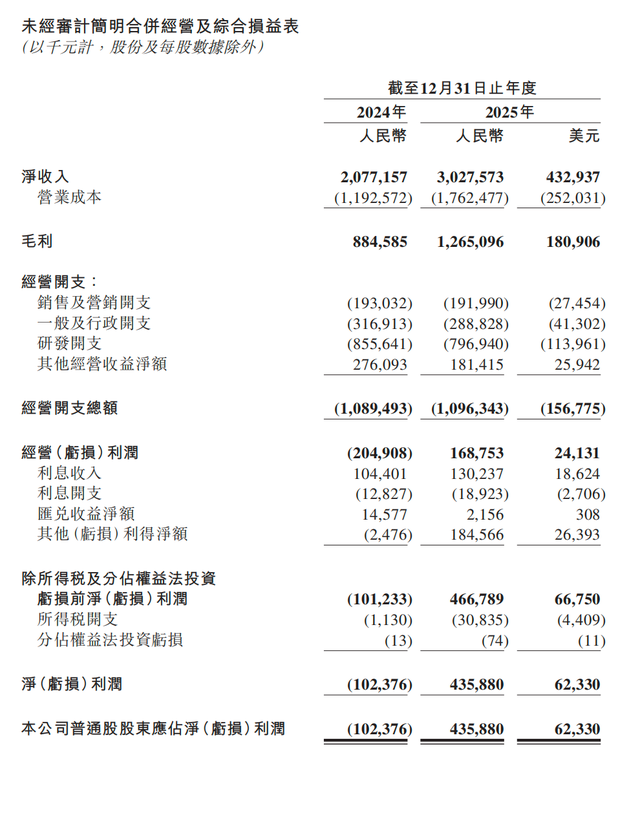
In July 2026, Hesai Technology delivered a standout performance that turned heads across the industry: full-year net revenue of RMB 3.028 billion in 2025, up 45.8% year-on-year, with a net profit of RMB 436 million, making it the first company in the global LiDAR industry to achieve full-year profitability under GAAP standards.
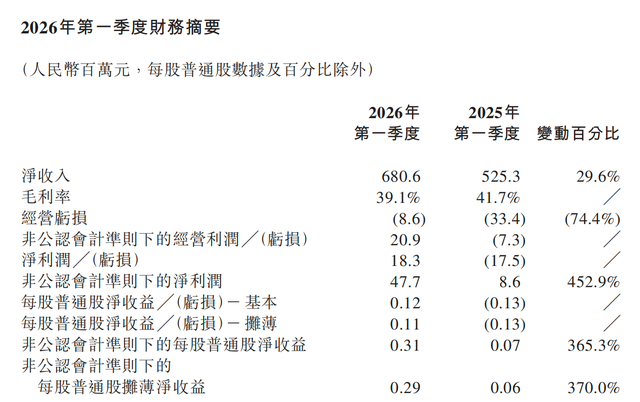
The growth momentum continued in the first quarter of 2026, with revenue of RMB 681 million, up 29.6% year-on-year, marking eight consecutive quarters of positive year-on-year growth, and a net profit of RMB 18.3 million, achieving GAAP profitability for four consecutive quarters.
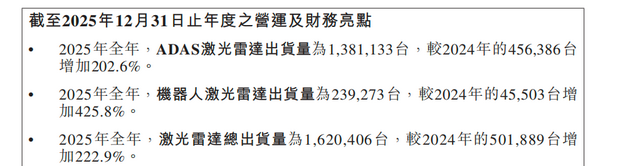
In terms of shipments, total shipments reached 1.62 million units in 2025, up 222.9% year-on-year, with 1.381 million ADAS products delivered. In market share, Hesai ranked first in global long-range ADAS LiDAR shipments in 2025, capturing a 43% share.
However, in stark contrast to these impressive financials, the capital market remains indifferent.
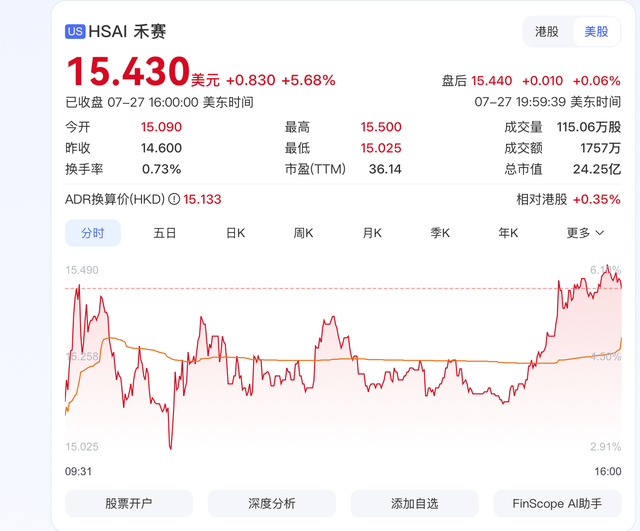
As of July 27, 2026, Hesai's U.S. stock (HSAI) had a market cap of approximately $2.4 billion, while its Hong Kong stock (02525.HK) had a market cap of around HK$18.8 billion, with the stock price hovering near its 52-week low of $14.29, still more than 50% below its 52-week high of $30.85.
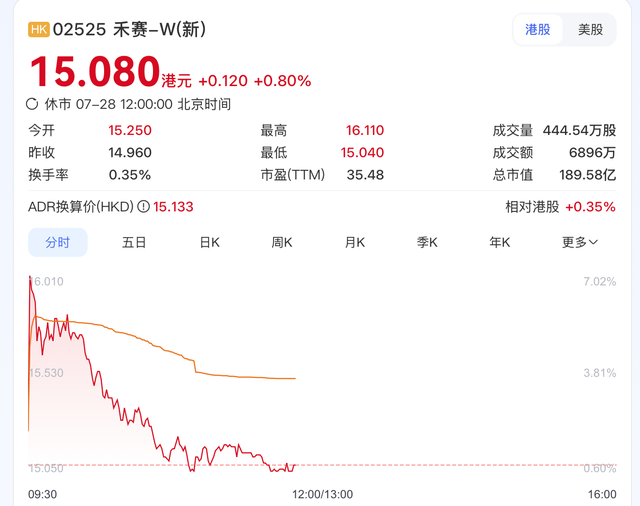
Why is a LiDAR leader with a 43% global market share, consistent profitability, and orders from top automakers like Mercedes-Benz experiencing such a stark contrast between "hot performance" and "cold stock price" in the capital market?
01
The 'Gold Content' of Profitability: From Burning Money to Generating Cash, What Did Hesai Do Right?
Hesai's profitability story, if judged solely by surface-level numbers, is easily underestimated.
For years, the LiDAR industry has been synonymous with "burning money." From Velodyne to Luminar, from RoboSense to Innovusion, the vast majority of players are still struggling in the quagmire of losses. Hesai is the first to cross the breakeven line.
The quality of profitability is equally noteworthy. The full-year gross margin in 2025 remained at a high 41.8%; in the first quarter of 2026, the consolidated gross margin reached 39.1%, while RoboSense's gross margin was only 21.7% in the same period, creating a gap of nearly 18 percentage points. The margin gap is essentially a product mix gap—Hesai's revenue is largely driven by high-margin premium automotive products, with technological premiums translating directly into profits.
Performance on the expense side is equally noteworthy. In the first quarter, R&D spending was RMB 205 million, up 11.7% year-on-year, far below revenue growth; combined sales and administrative expenses totaled RMB 94.3 million, still declining year-on-year.
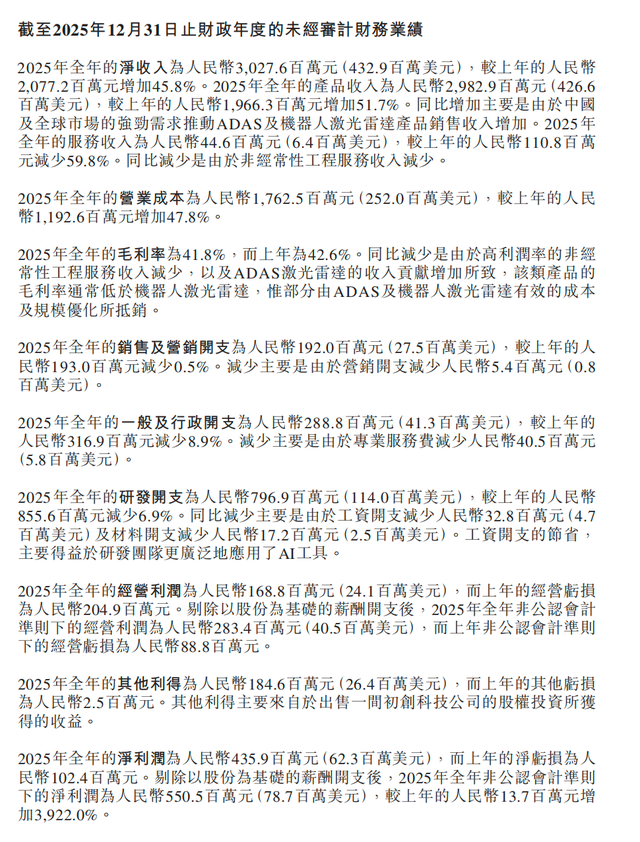
Maintaining R&D intensity while keeping expenses in check—this "flexible" rhythm indicates that the company's operations have entered a virtuous cycle. Three consecutive quarters of positive operating cash flow also prove that the core business has self-sustaining capabilities. As of the end of the first quarter, the company's cash reserves reached RMB 7.232 billion, providing solid financial support for R&D, capacity expansion, and new business layout (deployment).
02
From 'Burning Money' to 'Generating Cash': LiDAR Can Be a Good Business.
Just as financials sent positive signals, the first-instance ruling in a patent lawsuit cast a shadow over Hesai's technological moat.
On July 14, 2026, Innovusion disclosed that four patent infringement lawsuits filed by Hesai in the Ningbo Intermediate People's Court had all concluded in the first instance: one case was dismissed after the patented technology was declared invalid; two cases were voluntarily withdrawn by Hesai; only the last case resulted in a substantive judgment, with Innovusion ordered to pay RMB 400,000 and cease infringement.
In terms of damages, Hesai did not secure a major win. It had originally claimed RMB 5 million in compensation but was awarded less than 10% of that. Of the four patent "shots" fired at its rival, only one hit, with damages less than 10% of the claimed amount.
The key issue here is not the RMB 400,000 but the timing. Innovusion went public on the Hong Kong Stock Exchange via De-SPAC on December 10, 2025, becoming the third LiDAR firm to list in Hong Kong after Hesai and RoboSense. Just before and after the listing, Hesai initiated multiple patent lawsuits against Innovusion—in addition to the four Ningbo cases, it had also sued Innovusion in the Hangzhou Intermediate People's Court over two patents, seeking a total of RMB 20 million in damages. Outsiders interpreted this as a "sniper attack" at a critical time for its rival.
However, the results show that this "sniper attack" had limited effect. The court found Innovusion guilty of infringement only on claim 18, a dependent claim. With three wins and one loss in the four cases, Innovusion was able to declare that "overall litigation risks are controllable." Innovusion also stated that the first-instance judgment has not taken effect and that it is evaluating appeal strategies, meaning no damages need to be paid nor infringement ceased until the appeal is concluded.
For Hesai, the deeper lesson from this lawsuit is that the breadth of patent layout (deployment) does not equal the depth of the moat. The court found that except for claim 18, the technical solutions corresponding to Innovusion's other 11 claims showed no substantive differences from existing technologies. This means competitors can design around most claims, requiring a reassessment of the true thickness of the technological barrier. In the second half of the LiDAR industry's shift from price wars to patent wars, Hesai needs not just more patents but core technological barriers that are "unavoidable."
More notably, this lawsuit exposed the escalating competitive dimensions in the LiDAR industry. Patent litigation in the industry is not just about damages—especially during a rival's IPO window or core product ramp-up, litigation itself becomes a form of pressure: it affects information disclosure, client perceptions, and forces the rival to further explain its technological barriers and patent boundaries. While Hesai's "sniper attack" did not fully succeed, it sent a clear signal to the market: the technological moat battle has just begun.
From a market competition standpoint, Hesai still has a sufficiently strong foundation. Data from Gasgoo Automotive Research shows that in the first five months of 2026, Hesai ranked first in China's passenger car LiDAR installation market with 595,400 units and a 34.2% share, followed by Huawei at 30.6%, while Innovusion and RoboSense had 14.9% and 14.2%, respectively. But precisely in this landscape, Hesai needs to be more vigilant—as competitors gradually narrow the share gap, the thickness of technological barriers will become the key variable determining long-term success.
03
The 'Three Mountains' Pressuring Valuation: Why Won't the Market Pay a Premium?
While performance is growing and the moat is deepening, Hesai's valuation remains pegged at the level of traditional Tier 1 auto parts suppliers—10 to 15 times P/E, rather than the 30+ times premium typically enjoyed by high-growth tech stocks. Behind this "valuation anchoring" lies the market's pricing of three core risks.
The First Mountain: Declining Unit Prices and Margin Pressure.
Price war pressures are rippling up the supply chain. To push LiDAR into mainstream models priced between RMB 150,000 and RMB 200,000, unit prices continue to decline. While Hesai has achieved revenue growth through doubled shipments, the "volume up, price down" trend is eroding long-term gross margin potential, leaving profit-focused investors cautious.
In the first quarter of 2026, Hesai's gross margin fell to 39.1% from 41.7% year-on-year, breaking below the 40% threshold. The company attributed this to a rising share of lower-margin product revenue. While the product mix "shift downward" is a strategic choice to embrace the mass market, it also dilutes overall profit quality—a reality investors must confront.

The Second Mountain: Diversion Expectations from 'Pure Vision' Routes.
The "end-to-end pure vision" approach, represented by Tesla's FSD, continues to spark debate. Some investors worry that entry-level models below RMB 150,000 may abandon LiDAR for extreme cost-cutting. This discounted expectation of LiDAR's long-term "must-have ceiling" directly suppresses its premium as a high-valuation tech stock.
However, a noteworthy counter-signal is that by March 2026, Hesai's market share in China's passenger car primary LiDAR installations had reached 55%, surpassing the combined share of all other suppliers and maintaining industry leadership for 14 consecutive months. This indicates that LiDAR penetration is still rising rapidly in actual vehicle configuration decisions, and the "pure vision replacement theory" has yet to be validated at the industrial level. But capital market expectations often outpace industry realities—this "expectation gap" is one source of valuation pressure.
The Third Mountain: Geopolitics and Systematic Discounts for Chinese Concept Stocks.
As a leading Chinese concept stock involved in sensor hardware and spatial data, regulatory geopolitical uncertainties remain a looming shadow. This requires overseas long-term institutional funds to demand an extremely high "margin of safety" in allocations, directly leading to systematic valuation discounts.
Together, these three mountains explain why a tech company with a 43% global market share and consistent profitability sees its stock price linger near 52-week lows. However, 19 institutions have given a consensus target price of HK$226.08, far above the current price—indicating a significant cognitive gap between professional institutions and market sentiment.
04
From 'Selling Sensors' to 'Building an Ecosystem': Hesai's Next Move
If Hesai is viewed merely as a "sensor parts supplier," its current valuation may seem justified. But Hesai is trying to tell a bigger story.
Trump Card 1: Self-Developed ASIC Chip Integration. Unlike peers who rely heavily on purchased components, Hesai has successfully implemented a self-developed ASIC chip route for core transceiver and signal processing modules. By miniaturizing complex architectures onto silicon, Hesai has established a cost base that competitors cannot match, giving it the technological confidence to maintain high gross margins of 35–40% during price war cycles.
Trump Card 2: Robotics as the Second Growth Curve. While automotive-grade ADAS pressures unit prices, Hesai has achieved Exceeding expectations (better-than-expected) growth in the pan- (general) robotics sector. CFO Fan Peng expects strategic growth businesses to start contributing revenue in the second quarter of 2026, with full-year net revenue of around RMB 100 million in 2026 and RMB 500 million in 2027. In the first quarter of 2026, robotics LiDAR shipments reached 118,282 units, up 137.8% from 49,731 units in the same period of 2025.
In the embodied AI field, Hesai's JT128 LiDAR helped Honor Robotics' "Lightning" win the world's first humanoid robot half-marathon. In unmanned delivery, Hesai secured an exclusive 200,000-unit LiDAR order from 9Z Robot. In commercial scenarios like lawn-mowing robots, LiDAR has become "standard." These orders across multiple verticals are converging into a new growth curve. Some analysts point out that the long-term market size for LiDAR in robotics could reach 10 times that of the automotive industry—opening vast imagination space for Hesai's valuation.
In April 2026, Hesai announced a strategic upgrade from "spatial perception" to "spatial intelligence." That same month, Hesai's three founders launched a new robotics company, Sharpa, through cross-border entrepreneurship. These moves indicate that Hesai aspires to be more than a "sensor seller"—it aims to become a player in the infrastructure layer of the physical AI era.
Trump Card 3: Global Client Matrix. In the first quarter of 2026, Hesai announced a strategic partnership with Mercedes-Benz as its LiDAR supplier for L3 autonomous driving models, with production at the Thailand "Galileo" manufacturing center. This marks the first time a Chinese LiDAR firm has publicly entered the L3 front-fit supply chain of a global luxury brand. Combined with previous entries into the supply chains of leading automakers like Li Auto, Xiaomi, Changan, and BYD, Hesai's client list now covers the world's most core automotive brands. Just this May, Hesai secured a new order of over 1 million units from a top European automaker.
More notably, the "ceiling" for shipments is being continuously raised. In 2026, Hesai sharply raised its full-year shipment guidance to 3–3.5 million units, up 85–116% year-on-year, far exceeding market expectations of 2.66 million units. To meet surging demand, the company plans to double annual capacity from 2 million units in 2025 to 4 million units in 2026. This means Hesai is transitioning from "million-unit scale" to "multi-million-unit scale"—a leap that could partially offset the erosion of profits from declining unit prices.
From "automotive front-fit" to "robotics," from "domestic market" to "global top automakers," Hesai is attempting a transformation from hardware supplier to spatial intelligence platform. Whether this path succeeds depends on three factors: whether automotive LiDAR unit prices stabilize, whether robotics businesses scale as expected, and whether geopolitical black swans strike again.
05
Conclusion: Hesai's Real Test Lies Beyond the Financials
The Hesai story is essentially a case study of "how a technological leader navigates valuation fog."
Operationally, it has proven that LiDAR can be profitable, scalable, and global. A 43% global market share, four consecutive quarters of GAAP profitability, and orders from Mercedes-Benz—these hard metrics would support a high-valuation tech company in any industry.
However, from the perspective of the capital market, the challenges it faces are equally real: pressure from declining unit prices, diversification due to the pure vision approach, systemic discounts due to geopolitical factors, and questions about the depth of its technological moat exposed by patent litigation. Together, these factors constitute the 'fundamentals' behind the current valuation discount.
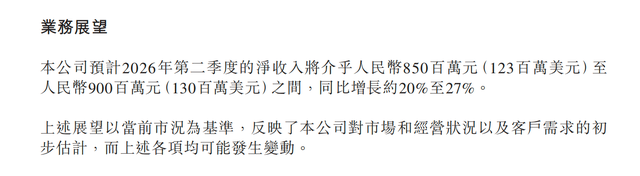
The next test for Hesai is not whether it can continue to expand shipment volumes, but whether it can find a profit equilibrium amid the trend of 'increasing volume but decreasing prices,' whether it can replicate its success in the automotive sector to new fields like robotics, and whether it can respond to competitors' patent challenges with stronger technological barriers.
As a company transitions from 'burning cash' to 'generating cash,' the market's valuation logic shifts from 'dream premium' to 'profit validation.' Hesai has completed the first step—proving that lidar can be profitable. But the second step—proving that it can sustainably generate high-margin profits—will be the key to determining whether its stock price can shift from 'hovering close to the ground' to 'soaring skyward.' The HK$226 target price set by institutions is less a recognition of the current state and more a bet on the future.
How far that lidar can see depends on technology; how far Hesai's valuation can go depends on whether it can persuade the capital market to reprice it through sustained profitability and stronger barriers.
-
Financing and IPO: Is Ant Group a Financial Giant or a Pioneer in Cutting-Edge Tech?
-
![]()
Revenue Soars Twofold in Three Years! Optical Firm Reignites Bid for Hong Kong Stock Exchange Listing
-
![]()
Jiangsu LEAD Microelectronics Successfully Hands Over Its Inaugural 12-Inch Wafer-Level Optical Magnetron Sputtering System!
-
![]()
Domestic Computing Power Hits Breakthrough: Super Nodes as the Pivotal Force
-
![]()
Tongze Kangwei Secures IPO Registration on GEM: Broadband Terminal Equipment Provider Set for Imminent Share Issuance
-
![]()
Transforming Car Manufacturing into a 'Smartphone Launch' Frenzy: 5 Tips to Avoid Pitfalls When Purchasing a New Car
-
![]()
The Three-Way Battle Among AI Office Software: A Decade of War Among BAT
-
![]()
The Three-Way Battle Among AI Office Software: A Decade-Long War Among BAT