Intelligent Driving at a Crossroads: The Divergence and Convergence of Underlying Architectures
 08/03 2026
 476
476
The intelligent driving industry in 2026 is permeated with a subtle sense of change.
Looking back over a two-year cycle, 2024 marked the disruptive year when 'end-to-end' systems replaced modular architectures. Back then, whoever could first integrate perception, planning, and control into a single neural network held the key to advanced intelligent driving. However, by mid-2026, a simple end-to-end approach was no longer sufficient. The industry's cutting-edge discussions had shifted from 'whether it's end-to-end' to 'how to understand the world beyond end-to-end.'
Against this backdrop, Physical AI and World Models emerged as the two most discussed technological routes.
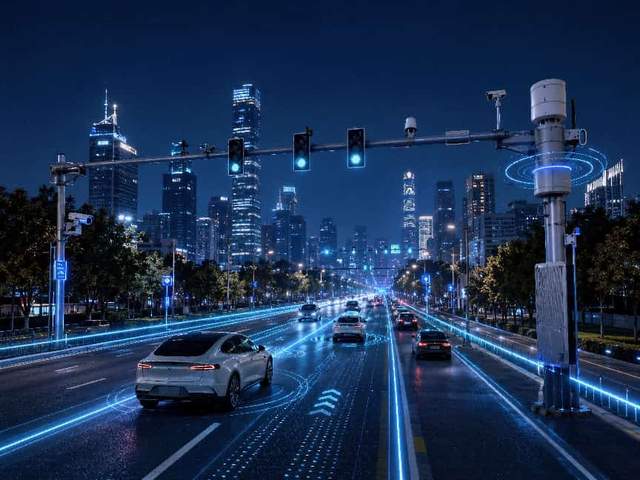
World Models do not directly output actions; instead, they first simulate how the world will evolve in the next few seconds internally and then select the optimal path. The concept of 'Physical AI' is broader, emphasizing enabling AI systems to understand physical laws such as gravity, inertia, and causality.
At the 2026 Beijing Auto Show, the topic of 'Physical AI' even surpassed the number of LiDAR sensors and chip computing power in popularity, becoming a common slogan among leading automakers and intelligent driving solution providers.
End-to-end large models, VLA, World Models, and Physical AI frequently alternate and sometimes overlap or diverge in industry discussions in 2026. What is the relationship between them? Are they competitive, complementary, or do they converge to the same goal? Could World Models and Physical AI become the new underlying architectures for intelligent driving?
The Triumph and Limitations of End-to-End Systems
First, let's look at end-to-end large models, which have long been considered the mainstream route for the underlying architecture of intelligent driving.
In early 2024, Tesla's FSD V12 reduced rule-based code from 300,000 lines to 3,000 lines, entrusting perception, decision-making, and control entirely to a single neural network. This marked the first deployment of end-to-end systems in mass-produced vehicles and a cognitive turning point for the entire industry.
Over the next two years, end-to-end architectures proliferated at an astonishing rate. Almost all leading players, including Li Auto, XPENG, NIO, Huawei, BYD, and Geely, adopted end-to-end as their foundational framework. By the 2026 Beijing Auto Show, claiming your intelligent driving system was not based on an end-to-end architecture was tantamount to admitting you were out of the game.
The core logic of end-to-end systems is extremely simple: camera pixel input, steering wheel angle output, with no artificially defined module boundaries in between. Through training on massive amounts of human driving data, the model autonomously learns the complete mapping from perception to control.
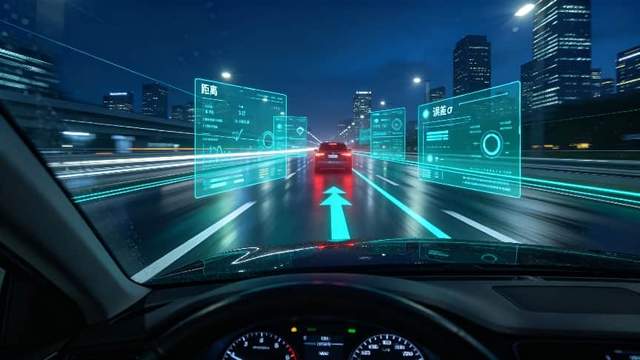
The advantages of this architecture are evident. It bypasses the cascading errors of perception-planning-control in traditional modular architectures, enabling end-to-end optimization of the entire system and achieving a qualitative leap in the smoothness of the intelligent driving experience, eliminating abrupt transitions at module boundaries and sudden brakes caused by rule conflicts.
However, the problems with end-to-end systems are equally clear.
First, it is essentially an imitation learning system. It learns how humans drive, not why they drive that way. When faced with long-tail scenarios never encountered in the training data, its performance degrades sharply. In industry terms: it can only do what it has seen, not what it understands.
Second, it lacks understanding of the physical world. The end-to-end model does not know that slippery road surfaces mean longer braking distances, that overhanging branches might fall, or that puddles might conceal deep potholes. While it can fit some surface patterns through large amounts of data, it cannot establish causal reasoning capabilities.
Third, its explainability is almost zero. When an end-to-end system makes a decision, it is difficult for engineers to explain why it did so, which is a fatal issue for L3/L4 compliance and safety certification.
Because of these limitations, the industry began exploring possibilities beyond end-to-end systems. World Models and Physical AI entered the mainstream spotlight in this context.
World Models: A New Underlying Architecture or a High-End Simulator?
World Models may represent the most technologically imaginative branch in the route towards underlying architectures for intelligent driving.
Their core idea is to construct a neural network capable of understanding the operational laws of the physical world, enabling it to predict the evolution of future states based on the current state. When given a scenario and a set of actions, it can generate what the world will look like in the next second, five seconds, or ten seconds.
This may sound like science fiction, but by 2026, it was already operational in mass-produced vehicles.
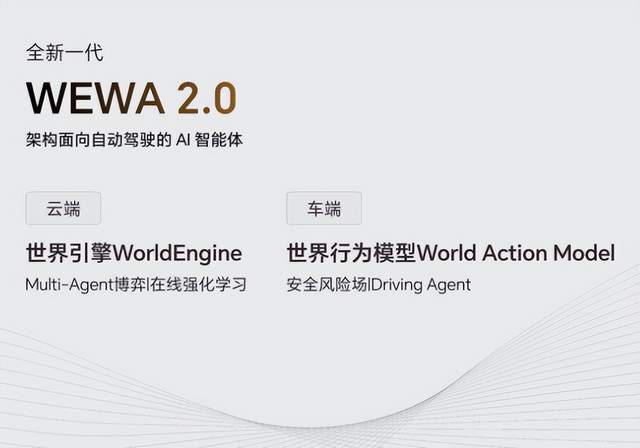
Huawei's WEWA 2.0 architecture is a prime example. The cloud deploys the World Engine, generating high-density extreme scenarios in virtual space through diffusion generative models, increasing the density of difficult cases by 1,000 times compared to the real world. The vehicle deploys the World Action Model, making real-time decisions based on multimodal perception inputs. This architecture is expected to be deployed in over 80 vehicle models in 2026.
Momenta's R7 World Model adopts a three-layer architecture of 'pre-training-simulation-reinforcement learning.' Based on over 12 billion kilometers of real driving mileage, it distills approximately 100 million segments of high-quality data, compressing physical laws, common sense, and causality into the model. This forms the basis for constructing a high-fidelity virtual training ground, allowing the system to repeatedly explore and learn from mistakes in an environment close to reality.
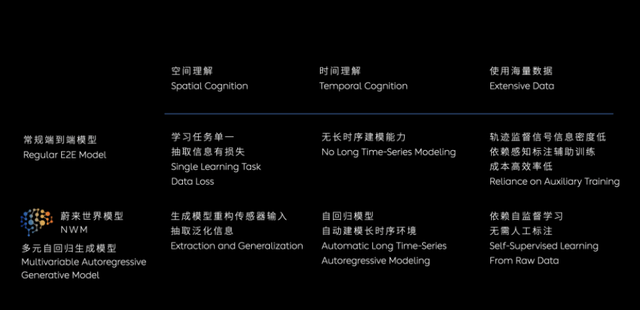
NIO's NWM (NIO World Model) takes an even more aggressive approach. It can deduce 216 potential scenario evolutions within 100 milliseconds and select the optimal path from them. In early 2026, NIO rolled out the World Model and closed-loop reinforcement learning architecture to hundreds of thousands of vehicles, resulting in a 92% and 116% increase in urban navigation-assisted driving mileage and duration, respectively, within three months.
Tesla unveiled its Neural World Simulator patent in January 2026, trained on its self-built massive dataset. It can generate future states based on the current state and next action, enabling AI to learn the equivalent of 500 years of human driving experience in a single day.
These real-world implementations demonstrate that World Models are no longer laboratory toys. They are real, operational, and data-driven.
But can World Models truly become the new underlying architecture for intelligent driving? Three key questions need to be answered.
First, are World Models an aid or a replacement? In all current mass-production solutions, World Models play a supporting role. They are responsible for cloud-based simulation, data augmentation, and safety assessment, not replacing the real-time reasoning architecture on the vehicle. In other words, World Models are more like an AI driving school. They provide more comprehensive training for end-to-end models before deployment, but the decision-making chain during actual driving remains fundamentally end-to-end or VLA architecture.
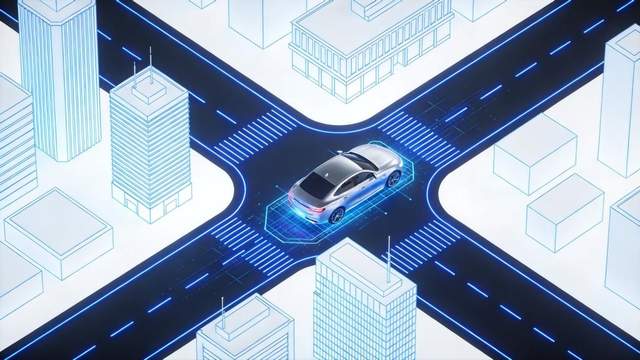
Second, is the deduction accuracy of World Models sufficient? Simulating the evolution of scenarios 5-10 seconds into the future in a virtual world sounds promising. However, the high complexity of the physical world means that any model's predictions of the future will decay over time. A 0.1% prediction error can be exponentially amplified through continuous deduction. Current solutions generally use 'multi-trajectory sampling + safety fallback' to address this issue, but this itself indicates that World Models' standalone reasoning is not yet sufficient as the sole basis for safe decision-making.
Third, what is the fundamental difference between World Models and Large Language Models (LLMs)? LLMs have become revolutionary infrastructure in the AI field because they found a unified, scalable pre-training paradigm, predicting the next word on trillion-token text data. World Models attempt to replicate this paradigm, predicting the next frame on trillion-frame video data. However, modeling the physical world is far more complex than modeling language: text is discrete and symbolic, while the physical world is continuous, high-dimensional, and full of uncertainties. Whether World Models can replicate the success path of LLMs remains unanswered.
Currently, World Models serve as a critical supplement and powerful booster for end-to-end architectures, but at least in 2026, they are not yet sufficient to independently become the underlying architecture for intelligent driving. They are more like equipping end-to-end systems with a physical common-sense engine, rather than replacing them.
Physical AI: The Rising Star of Intelligent Driving Technology
The term 'Physical AI' emerged as frequently in 2026 as 'large models' did in 2023, resembling a thriving new technological elite.
XPENG explicitly declared its transition to a Physical AI technology company. NIO reorganized its structure, establishing a Large Model Business Unit to focus on developing the NIO World Model. Li Auto, after reviewing three generations of technological routes, firmly anchored itself in the VLA direction. Momenta's CEO, Cao Xudong, directly positioned the company as a builder of foundational models for Physical AI.
But what exactly is Physical AI?
In one sentence: Physical AI enables machines to understand physical laws such as gravity, inertia, and causality, thereby truly participating in the operation of the real world. Its core distinction from Digital AI (such as LLMs) lies in the fact that Digital AI processes symbols and text, while Physical AI processes object motion and interactions in three-dimensional space.
Gartner has listed Physical AI as one of the top ten strategic technology trends for 2026. This judgment is based on a fundamental consensus: relying solely on perception and imitation, autonomous driving will never break through the L3/L4 ceiling.
Currently, Physical AI's specific implementation forms have diverged into two routes.
The first is the 'bolt-on fine-tuning' route. Using a general-purpose LLM as the base, driving data is stacked on top for post-training and fine-tuning. This approach is low-cost and quick to yield results, allowing for rapid market entry. However, its ceiling is also evident: the underlying model's innate understanding of the physical world is insufficient, lacking deep cognition of three-dimensional space, time series, and vehicle dynamics. An engineer put it this way: it's like asking a well-read liberal arts student to race a car. He can recite all traffic rules and driving manuals, but in the real physical world, he lacks muscle memory.
The second is the 'native foundation' route. During the pre-training phase of the foundational model, general-purpose corpora and intelligent driving data are deeply fused, enabling the model to understand the field from birth. The collaboration between Qianli Technology and Jieyue Xingchen is a typical example, creating a native intelligent driving foundational model with an innate understanding of the physical world. Li Auto's MindVLA-o1 also follows this path: adopting a native multimodal MoE Transformer architecture, it unifies perception, reasoning, and decision-making within the same model framework.
In April of this year, Geely officially released its cabin-driving fusion super intelligent agent—Super Eva—and achieved its global debut in mass production on the Zeekr 8X. By deeply integrating the understanding capabilities of the native large model with proprietary voice engineering and vehicle-end control, Super Eva's thoughts can be instantaneously transformed into safe physical vehicle control actions. This is a typical case of Physical AI's implementation.
Three Kingdoms Unified? The Convergence and Divergence of Routes
If you pay attention to the technical statements of various companies, you will notice an interesting phenomenon: no one truly chooses a pure end-to-end or pure World Model approach. The convergence of technological routes has become a new trend.
Li Auto's MindVLA-o1 introduces a predictive implicit World Model within the VLA framework. XPENG's second-generation VLA is officially defined as both an action generation model and a physical world model for understanding and deduction. Xiaomi's XLA Cognitive Large Model explicitly claims to integrate VLA and World Model architectures. Huawei's WEWA itself is a combination of a 'cloud-based World Engine + vehicle-end World Behavior Model.'
The industry is forming a new consensus: VLA is responsible for perceiving the current environment, understanding semantics, and deciding the next action; World Models are responsible for deducing how scenarios will evolve in the next 5-10 seconds. The two are not substitutes but complements.
This convergence trend actually points to a deeper judgment: the ultimate architecture for intelligent driving will not be a single model but a system of multi-model collaboration. Just as human driving relies simultaneously on intuition (cerebellum), reasoning (cerebral cortex), and physical intuition (bodily experience), future intelligent driving systems will also require a combination of multiple capabilities.
Therefore, choosing sides is meaningless. Whether it's end-to-end, VLA, or World Models, they will all ultimately integrate into the same technological system. What truly makes a difference is technological depth and engineering implementation capabilities. The outcome of the architectural debate depends on who can first achieve a complete closed loop (closed loop) from understanding to deduction to decision-making. End-to-end solves the 'how,' VLA adds the 'why,' and World Models supplement the 'what will happen next.'
Returning to the initial question: Are Physical AI and World Models truly the new underlying architectures for intelligent driving, or are they just riding the wave of AI foundational models?
They represent real, necessary technological upgrade directions but do not yet constitute independent underlying architectures. A more accurate description is that they are reshaping the upper limits of end-to-end architectures rather than replacing them.
End-to-end is the skeleton, providing end-to-end optimization capabilities from perception to control. Physical AI is the muscle, enabling the system to understand gravity, inertia, and causality. World Models are the rehearsal system, allowing the system to deduce consequences before acting.
-
Financing and IPO: Is Ant Group a Financial Giant or a Pioneer in Cutting-Edge Tech?
-
![]()
Revenue Soars Twofold in Three Years! Optical Firm Reignites Bid for Hong Kong Stock Exchange Listing
-
![]()
Jiangsu LEAD Microelectronics Successfully Hands Over Its Inaugural 12-Inch Wafer-Level Optical Magnetron Sputtering System!
-
![]()
Domestic Computing Power Hits Breakthrough: Super Nodes as the Pivotal Force
-
![]()
Tongze Kangwei Secures IPO Registration on GEM: Broadband Terminal Equipment Provider Set for Imminent Share Issuance
-
![]()
Transforming Car Manufacturing into a 'Smartphone Launch' Frenzy: 5 Tips to Avoid Pitfalls When Purchasing a New Car
-
![]()
The Three-Way Battle Among AI Office Software: A Decade of War Among BAT
-
![]()
The Three-Way Battle Among AI Office Software: A Decade-Long War Among BAT