Significant Investment in Optical Force Sensing: What's the Implication of Zizhi Force Control's Funding?
 04/09 2026
 628
628
Recently, Zizhi Force Control (Shanghai) Technology Co., Ltd. (hereinafter referred to as "Zizhi Force Control"), a company dedicated to developing full-body force self-sensing systems for robots, successfully completed a new round of financing, with Zhongxin Juyuan as the sole investor. Previously, the company had already secured investment from the Pudong AI Seed Fund, which is part of Pudong Venture Capital.

It is reported that the funds raised from these two successive rounds of financing will be mainly allocated to technological R&D iteration, the establishment of a small-scale production line, and the expansion of the engineering team. Notably, Zizhi Force Control has opted for optics as the technological foundation for its force perception, diverging from the industry's predominant use of resistive strain gauges.
How did this startup, which has been in operation for just about a year and a half, manage to secure such investment? What are its background and strengths? And why did it choose optics as the technological basis for force perception?
Dr. Song Geyang, the founder of Zizhi Force Control, holds a Bachelor's degree in Civil Engineering from the University of Sheffield, Master's and Ph.D. degrees from Imperial College London and the University of Nottingham, respectively, and conducted postdoctoral research at the University of Oxford. His primary research focus involves utilizing optical materials for mechanical monitoring of large-scale structures like bridges and buildings. This technical expertise, refined through monitoring structures weighing hundreds of tons, has been adapted to the kilogram-scale humanoid robot domain.
In less than two years since its inception, Zizhi Force Control has already established collaborations with several leading domestic embodied robot companies. Its products are also expanding into areas such as precision medical equipment and automotive battery collision monitoring. The company's technological core lies in "structure as sensing," which streamlines elastomer design, integrates optical components, and completes mechanical analysis through digital twin algorithms, thereby offering an alternative to traditional resistive strain gauge solutions.
In terms of system architecture, Zizhi Force Control employs centralized processing, where numerous optical sensor nodes are uniformly processed in the robot's "cerebellum," enabling batch processing without delay. Performance-wise, its crosstalk rate can be maintained within 0.3% at a 1000 Hz sampling frequency, and the optical medium is inherently resistant to electromagnetic interference, providing significant advantages in the complex electromagnetic environments inside robots.
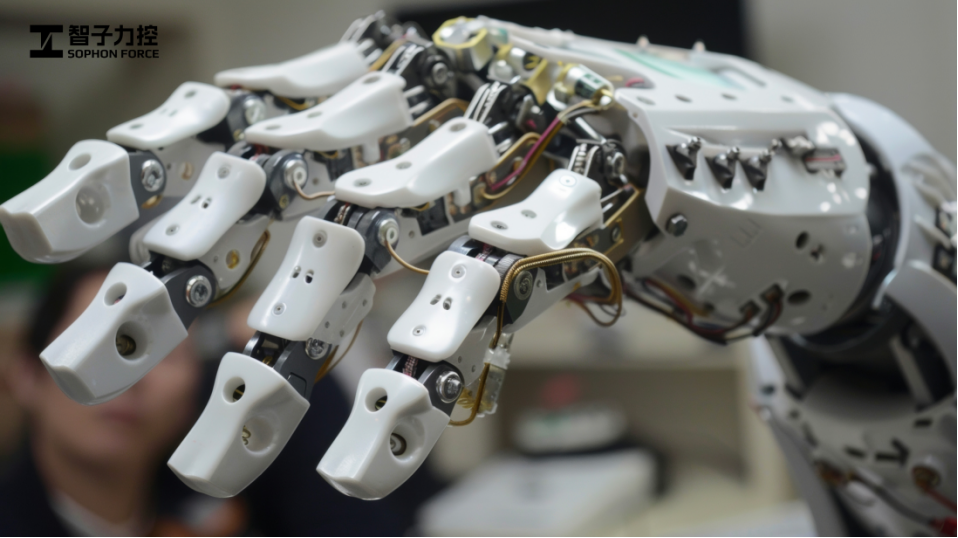
This technical approach precisely addresses the deep-seated challenges faced by the current robotics industry: mainstream six-axis force sensors based on resistive strain gauges rely on complex elastomer structures, with high-end products monopolized overseas, leading to high unit prices and long delivery times, hindering large-scale adoption. Moreover, merely installing force sensors at the end of robotic arms is no longer sufficient to meet the urgent needs of humanoid robots for "whole-body force control," with force perception emerging as a key differentiator in the next stage of competition.
According to forecasts by Fact.MR, the global robot sensor market is expected to grow from $2.8 billion in 2026 to $7.9 billion in 2036. Zizhi Force Control's optical approach demonstrates significant comprehensive cost advantages for large-scale deployment—when a robot requires numerous force sensing nodes, its centralized architecture and optical solution's wiring simplicity and integration efficiency will outperform traditional electrical solutions, which is the fundamental reason behind the continuous capital injections.
The exclusive investor in this round, Zhongxin Juyuan, is a leading institution in the semiconductor industry investment sector, managing assets exceeding 33 billion yuan. Its investment portfolio covers the entire integrated circuit industry chain, spanning all stages of equity investment, including angel, VC, PE, listed company investment, and M&A investment, with over 300 enterprises already invested in. Its rationale for investing in Zizhi Force Control clearly extends beyond mere financial returns.
Zhongxin Juyuan has previously invested in complete machine and component enterprises such as Linghou Robotics. This additional investment in Zizhi Force Control can be viewed as an extension of the industrial chain from "chips" to "perception"—Zhongxin Juyuan's strategic布局 (layout) is expanding from the chip level to the robot perception level, constructing a comprehensive map from underlying hardware to upper-layer applications.
An investor from Zhongxin Juyuan stated that their optimism towards Zizhi Force Control stems not only from its entry into the potential track of force perception but also from the team's clear systematic thinking in choosing technological routes. As the robotics industry transitions from "capable of movement" to "capable of perception, interaction, and fine operation," force control capabilities will become crucial in determining product limits in the next stage.
Zizhi Force Control's funding case sends three significant signals to the optical industry. Firstly, the application boundaries of optical sensing are significantly expanding. For a long time, the optical industry's application focus has been on traditional areas such as imaging, display, and communication. Zizhi Force Control demonstrates the potential of optical technology in the field of force perception—extending optics from the dimension of "seeing" to the dimension of "sensing." This suggests to optical enterprises that mechanical quantity perception fields such as force sensing and tactile sensing may be emerging as new value highlands for optical technology.
Secondly, the cross-disciplinary innovation capability of "optics+" is becoming a new competitive barrier. Zizhi Force Control's core competitiveness lies not solely in the manufacturing of optical components but in its ability to integrate optical perception, digital twin algorithms, and robot system architecture across disciplines. Song Geyang's team background itself is a microcosm: a civil engineering-trained optical mechanics monitoring expert venturing into the robotics field.
For optical enterprises, merely enhancing the performance of optical components is no longer sufficient to establish a competitive edge. How to deeply integrate optical technology with downstream systems and how to construct data processing capabilities at the algorithm level are becoming new dimensions for differentiated competition.
Thirdly, the comprehensive cost advantages of optical solutions in large-scale deployment are gaining recognition from the capital market. Song Geyang explicitly pointed out that traditional electrical solutions remain mature in low-node, local deployment scenarios. However, when a robot requires dozens or more force sensing nodes, the optical approach's advantages in comprehensive cost, wiring simplicity, and system integration efficiency become highly apparent.
Overall, tactile sensors are currently in the early stages of industrialization, and the optical path chosen by Zizhi Force Control represents a key node in the parallel development of multiple technological routes. Optical technology is transitioning from a supportive role to a core role, extending from visual imaging at the perception layer to force feedback at the execution layer. The optical industry may be on the verge of a redefinition of its industrial role.
-
On the Eve of Its IPO, Avatr Finds Itself Embroiled in a 'Farce of Controversy and Belittlement'
-
![]()
Yutong Optics' Japanese Subsidiary Unveiled in Tokyo, Shifting Strategic Focus to Technology-Driven Growth
-
![]()
Half-Year Revenue Outstrips Last Year’s Total! Zhongrun Optics Forecasts 80.2% H1 Revenue Growth
-
![]()
Why Does AI Competition Start with Computing Power?
-
![]()
Apple AI Finally Makes Its Debut in China, Yet iPhone's 'AI Autonomy' Faces Uncertainty
-
![]()
Apple AI and QianWen Make Up Lessons: Alibaba Has Its Own 'Doubao Phone'
-
![]()
QianWen Joins Apple, Signal for Large Models to ‘Fade into the Background’
-
![]()
The ‘Anchor’ Strategy of Google Hidden Behind the Bleeding Financial Report