Gecode Dongzhi APQP Agent Boosts Supplier Project Development Efficiency by 30%
 05/25 2026
 505
505
At an automotive chip manufacturer, a supplier quality manager once determined that, on average, a new project spans six months from APQP initiation to PPAP approval. Surprisingly, less than 20% of this duration is dedicated to technical reviews and problem-solving, with the remaining 80% consumed by three primary tasks.
Progress tracking hinges on constant reminders. Supplier Quality Engineers (SQEs) spend their weeks reaching out to numerous suppliers via calls and emails, inquiring, "Has the DFMEA been completed?" and "When will the control plan be submitted?" Delayed responses and ever-changing plans make project delays a common occurrence. An SQE managing 20 projects concurrently spends half their workweek merely chasing updates.
Documentation review is a manual and time-consuming process. A PPAP package comprises 18 deliverables, spanning from dozens to hundreds of pages. SQEs must meticulously examine each page for format adherence, data completeness, and valid signatures, while also cross-referencing with historical versions. More challenging are the subtle discrepancies, such as inconsistencies between control plan characteristics and FMEA, or non-compliant MSA sampling sizes, which are often only detectable by seasoned engineers.
Rectifications hinge on persistent follow-ups. Upon identifying discrepancies, SQEs email suppliers for corrections, await responses, and repeat the review cycle. A single PPAP package can entail a month of back-and-forth communication, effectively halting project progress in the interim.
The root issue lies not in the SQEs' lack of effort but in the complete reliance on manual processes in traditional APQP management. Progress tracking is reliant on Excel sheets, document circulation on emails, and audit standards on personal experience. When a company is juggling hundreds of suppliers and dozens of ongoing projects simultaneously, this manual approach becomes unsustainable.
Gecode APQP Agent: The Intelligent Hub for Streamlining Supplier Project Development
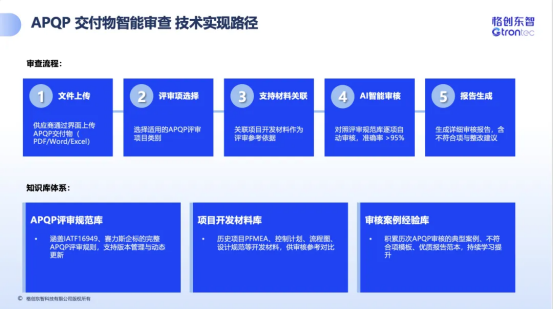
The APQP Agent, developed by Gecode Dongzhi, extends the intelligent agent architecture of the Octopus AI Brain into the realm of supply chain development. It transcends being a mere document management tool; it is a multi-agent collaborative system that proactively tracks progress, intelligently audits documents, and automatically closes the loop on rectifications. It encompasses all five stages of the APQP process, from planning to mass production approval. The core agent matrix comprises: APQP Progress Tracking Agent, PPAP Document Parsing Agent, Discrepancy Identification Agent, Rectification Follow-Up Agent, and Supplier Performance Evaluation Agent. Together, they automate the entire process, from project initiation and progress tracking to document review, discrepancy alerts, and rectification closure.
The APQP Progress Tracking Agent acts as the "commander" of the APQP Agent. It comes preloaded with standard task templates and timelines for the five APQP stages, with options for customization to meet client-specific needs. Upon project initiation, the agent automatically dispatches task lists and deliverable requirements to suppliers while monitoring completion status in real-time. When a milestone is overdue or a task stalls, the agent sends reminders to suppliers and escalates alerts to the SQE dashboard. SQEs no longer need to individually call each supplier; they can simply access the system to identify which supplier is stuck at which stage, the duration of the delay, and the underlying reason. After a Tier 1 client implemented the system, the time SQEs spent on progress tracking plummeted from 20 hours per week to 5 hours, and project delay rates decreased by 40%.
The PPAP Document Parsing and Discrepancy Identification Agents serve as the "auditors" of the APQP Agent. They can automatically parse 18 types of deliverables uploaded by suppliers, regardless of format (PDF, Excel, or scanned documents). Equipped with built-in quality standards like IATF 16949, they extract key data and pinpoint two types of discrepancies: explicit issues, such as missing table entries, out-of-spec data, or incorrect versions; and implicit issues, such as mismatched data between documents or non-compliant sampling methods. These implicit issues, often overlooked during manual reviews, are crucial for customer audits and zero-defect requirements. Working in tandem, these two agents can conduct an initial screen of a PPAP package in two hours, a stark contrast to the two weeks required for manual review, and automatically generate an audit report. SQEs transition from "page-by-page searching" to "confirming judgments," enhancing audit efficiency by over 80%.
The Rectification Follow-Up Agent functions as the "order tracker" of the APQP Agent. After discrepancy identification, it automatically generates a discrepancy report, dispatches it to the supplier, and creates a rectification task. Suppliers submit corrected documents online, and the agent automatically verifies compliance. If approved, it updates the status; if not, it returns the document with instructions for resubmission. This streamlined process eliminates the need for SQEs to manually send emails, maintain records, or chase progress. The rectification cycle is slashed from an average of three weeks to less than one week, with closure rates improving by over 50%.
Real-World Case: Accelerating the Full-Process for a Tier 1 Chip Supplier
A leading domestic automotive-grade chip design company faced the daunting task of managing new project development tasks across dozens of suppliers simultaneously. Under the traditional model, a three-person SQE team processed over 50 PPAP packages per month, with a project delay rate as high as 30%, leading to frequent customer complaints due to APQP progress lags. Gecode Dongzhi deployed a comprehensive APQP Agent solution for the company. Post-implementation data revealed:
Value and Benefits
1. The average project development cycle was reduced from six months to four months, a 33% improvement.
2. Time spent by SQEs on progress tracking was reduced from 20 hours per week to 5 hours.
3. The initial review time for a single PPAP package was reduced from 10 business days to 2 business days.
4. The rectification closure cycle was reduced from an average of three weeks to one week.
5. The project delay rate was reduced from 30% to below 10%.
More critically, the APQP Agent enabled the company to pass an annual supplier audit by a global leading Tier 1 company, with the audit report specifically highlighting "digitized and intelligent APQP management processes" as a key strength.
The essence of the APQP Agent lies in transforming the APQP process framework from "human-driven" to "system-driven." It does not alter the five APQP stages or deliverable requirements but leverages a cluster of intelligent agents to automate tasks previously performed manually by SQEs, such as tracking progress, auditing documents, identifying discrepancies, and following up on rectifications.
The role of SQEs undergoes a fundamental transformation: from a triple identity of "project manager + auditor + order tracker" to "rule setter + exception decision-maker." Freed from the tedium of chasing progress, reviewing documents, and following up on rectifications, they can now focus on high-value tasks such as supplier capability assessment, early design reviews, and risk mitigation planning.
In today's advanced manufacturing industry, where zero-defect and supply chain resilience requirements are becoming increasingly stringent, the APQP Agent is an indispensable tool for transitioning supplier quality management from human-dependent to autonomous.
-
Ofilm Teams Up with ADSensE to Propel Large-Scale Deployment of All-Solid-State LiDAR Powered by ADS6311 Chip!
-
![]()
Loss of 2.5 Billion Yet Facing Strong Demand for Shares? Another Battle for Control of Lianchuang Electronics
-
![]()
Huawei’s Enjoy Series Flies Off the Shelves, Prompting Xiaomi to Double Down on Budget Smartphones
-
![]()
Beijing Hyundai's Top Executive Criticizes Industry Disorder: Certain Brands Treat Customers as Beta Testers
-
![]()
The domestic mobile phone market has declined for five consecutive quarters! Huawei defies the trend with significant growth: maintains its top market share
-
Annual Revenue Surpasses 3 Billion: An Automotive Trim 'Little Giant' Makes Its Debut on the Beijing Stock Exchange
-
![]()
The Space Force Wants to Spend $30 Billion on Rocket Launches: Is Trump Doubling Down, and Is SpaceX the Big Winner?
-
![]()
Going Crazy! One out of Every Three Plug-in Hybrids Sold in Europe is a Chinese Vehicle