Self-Driving Vehicles: No More “Running Wild” in Zhangzhou! New Management Rules Set Regulatory Boundaries
 07/06 2026
 468
468
Introduction
On June 29, Zhangzhou City in Fujian Province unveiled two pivotal documents.
The “Implementation Rules for the Road Testing and Demonstration Applications of Intelligent Connected Vehicles in Zhangzhou City (Trial)” and the “Implementation Rules for the Road Testing and Demonstration Operations of Low-Speed Functional Autonomous Vehicles in Zhangzhou City (Trial)” were jointly issued by the Zhangzhou Municipal Transportation Bureau, the Municipal Industry and Information Technology Bureau, and the Municipal Public Security Bureau Traffic Management Department.
The release of these documents aims to tackle a pressing issue: in burgeoning sectors like smart logistics and autonomous driving, Zhangzhou faced a dilemma of “having the technology but lacking regulations, and having scenarios but no standards.”
In simpler terms: the technology was ready, the vehicles were here, and the roads were open, but there were no clear guidelines on how these vehicles should operate or who would be held accountable in the event of accidents.
Self-driving Vehicles Are Here (WeChat Official Account: Self-driving Vehicles Are Here) delves into this topic with everyone!
(For reference, please click: “Quanzhou City, Fujian Province: The First Police Autonomous Vehicle Officially Starts Work in Shishi City”)
I. National “Traffic Rules” Take Effect, Zhangzhou Provides an “Operation Manual”
First, let's set the stage.
On July 1, 2026, the “Safety Traffic Regulations for the Road Testing and Demonstration Applications of Intelligent Connected Vehicles” (GA/T 2388-2026), issued by the Ministry of Public Security, were officially implemented nationwide.
This marks the first national-level “traffic rule” covering all categories of unmanned delivery vehicles in China, providing unified standards from road rights allocation to accident liability determination for the first time. It ends the gray area where “technology could hit the road, but the law was unclear” for autonomous vehicles.
However, national standards serve as frameworks, and local implementation requires detailed rules.
Zhangzhou's two “Implementation Rules” were issued just before the national “traffic rules” took effect on July 1.
One set governs intelligent connected vehicles (passenger cars, commercial vehicles), and the other governs low-speed functional autonomous vehicles (delivery vehicles, patrol vehicles, etc.).
Both have a unified structure and complementary content, covering the entire chain from road testing to commercial demonstration operations.
Before issuing the documents, Zhangzhou made thorough preparations.
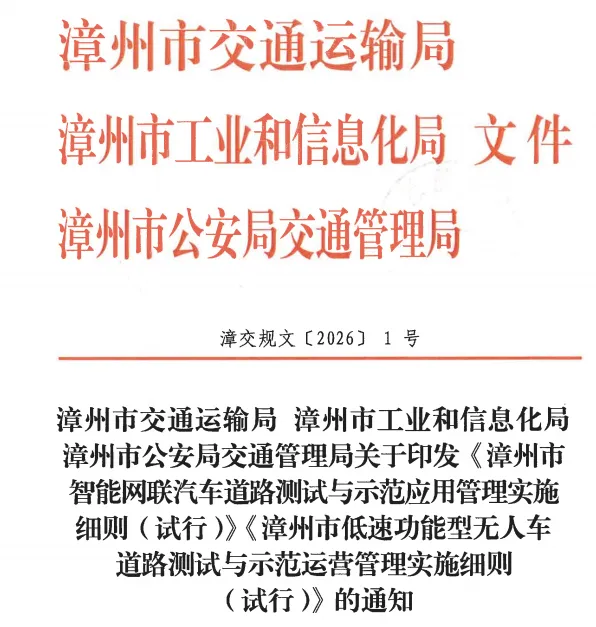 Source: Zhangzhou Municipal Industry and Information Technology Bureau WeChat Official Account
From January 26 to February 28, 2026, the two sets of rules were open for public comment.
The Municipal Industry and Information Technology Bureau conducted multiple rounds of themed discussions and exchanges with domestic autonomous vehicle R&D, manufacturing, and operation enterprises such as Neolix, Hadatu, HelloBike, and Baidu.
On May 19, the Municipal Industry and Information Technology Bureau explicitly stated in its response to a CPPCC proposal that the two sets of rules “effectively fill the policy gaps in the management of unmanned delivery vehicles in our city.”
From soliciting public opinions to the official issuance, it took less than five months.
II. “One Vehicle, One Code,” 5-Second Warning, 10-Second Stop—Key Provisions of the New Regulations
The core of the two sets of rules is to clarify “how to operate, who is in charge, and what to do in case of accidents.”
Progress in Stages, No Skipping: Intelligent connected vehicles conducting road testing, demonstration applications, demonstration operations, and remote driving activities must progress stage by stage and meet the requirements of the previous stage before applying for the next stage.
“One Vehicle, One Code” for Precise Management: Each vehicle has a unique code containing information such as regional code, county code, serial number, and activity type. It is clear whose vehicle it is, in which district it operates, and what tasks it performs.
Unified Prohibited Sections: Urban expressways, elevated roads, tunnels, school entrances and exits, pedestrian-dense sections of large commercial areas, and hospital emergency access channels are all prohibited for testing and demonstration. Low-speed autonomous vehicles are also prohibited from operating on urban roads at night. The prohibited areas are clearly defined.
Dual Mechanisms for Real-Time Data Supervision and Rapid Response: Vehicle operation data is uploaded in real-time and encrypted for storage. Alarm information triggers a warning within 5 seconds and automatically pulls over within 10 seconds. In case of an accident, the safety officer must arrive at the scene within 20 minutes. This standard is faster than the accident response for many manned vehicles.
Mutual Recognition of Out-of-Town Licenses: Vehicles that have obtained testing licenses in other provinces or cities can directly obtain testing qualifications in Zhangzhou after submitting materials by the local authority, third-party preliminary review, expert argumentation (expert demonstration), and special team confirmation. The compliant testing mileage in other regions is recognized. There is no need for repeated testing, significantly reducing the cost for enterprises to operate across regions.
Clear Responsibility Division: The rules establish a scenario-based liability determination mechanism, clearly defining the responsibility boundaries of safety officers, application entities, vehicle manufacturing enterprises, and other parties. It is no longer a confusing account when an accident occurs.
III. The New Rules Are Out, and the Vehicles Are Already on the Road
Documents are not meant to be written on paper; they are for the vehicles operating on the roads.
On June 25, 2026, the Xiangcheng District Government of Zhangzhou City organized a working meeting on the opening of road rights for autonomous vehicles.
Zhangzhou SF Express and Pupu Supermarket were included in the first batch of low-speed unmanned delivery vehicles for road testing in Xiangcheng District.
Earlier, in April 2026, Zhangzhou Post Branch, in collaboration with Minnan Normal University and Zhangzhou Unicom, successfully conducted a “drone + autonomous vehicle” smart logistics intermodal transportation scenario test on the Shishan Campus of Minnan Normal University.
The logistics drone took off with campus parcels from the collection and distribution center, flew several kilometers along a preset route, and landed precisely. The parcels were then transferred by the delivery person to an autonomous vehicle and delivered to the campus courier station. This was the first time Zhangzhou completed an “air-ground” unmanned collaborative delivery in a real university scenario.
On July 1, 2026, Zhangzhou City officially issued the “Key Tasks of the "Ten Major Actions" for Rural Revitalization in Zhangzhou City in 2026,” explicitly stating the need to “promote the intelligent and smart transformation of postal and express delivery terminal distribution and open a batch of autonomous vehicle or drone delivery routes.”
Policy implementation is forming a closed loop.
A bigger move is happening in the sanitation sector. In early June 2026, the results of the procurement project for unmanned sanitation equipment leasing services by Zhangzhou Environmental Group were announced, with COWAROBOT winning the bid with an average annual price of approximately 28.72 million yuan and a total of 86.17 million yuan over three years.
(For reference, please click: “The "King of Unmanned Sanitation" with a Contract Value of Nearly 90 Million Yuan Is Born! COWAROBOT: Secures the Largest Order in the History of Unmanned Sanitation Vehicle Leasing in Zhangzhou, Fujian Province”)
This is currently the highest-value publicly known unmanned sanitation vehicle leasing project. It is speculated that the scale of the leased fleet will reach the hundred-vehicle level.
Notably, on the same day COWAROBOT won the bid in Zhangzhou, the two “Implementation Rules” officially came into effect:
The close connection between the “king” project's implementation and the release of the new regulations reflects Zhangzhou's strategic intent of “policy guidance—project traction—scenario application—industrial agglomeration”;
The new regulations provide legal protection for the legal operation, compliant operation, and accident liability determination of autonomous vehicles.
IV. A National Game, with Localities Taking the Lead
Zhangzhou is not acting alone.
On July 1, 2026, the national “traffic rules” GA/T 2388-2026 were officially implemented. On the same day, Lanzhou New Area issued management measures for the road testing and demonstration operations of low-speed unmanned driving vehicles.
Earlier, Changsha, Weihai, Dongguan, Yinchuan, Ulanqab, and other places had also issued or were in the process of issuing similar regulations.
According to iResearch predictions, the annual sales of unmanned urban delivery vehicles in China will reach 89,000 units in 2026 and are expected to approach 1.5 million units by 2030.
Zhangzhou's two sets of rules, seemingly local documents, are actually early implementations under the national unified framework.
They answer a question that all autonomous vehicle enterprises are concerned about: You say you can operate, but can you operate in Zhangzhou? How?
Now there is an answer.
Conclusion
Self-driving Vehicles Are Here (WeChat Official Account: Self-driving Vehicles Are Here) believes:
Zhangzhou's new policies provide autonomous vehicles with a clear “guide to passing through the levels,” creating a compliant testing ground for enterprise innovation and enabling the industry to find a safe and effective landing point. This truly builds a bridge for innovative enterprises and the real economy, allowing autonomous vehicles to move from technology exhibition platforms to daily production lines and into the doorsteps of ordinary people. What do you think? References: Media reports from Haixia Metropolitan Daily, Zhangzhou Municipal Industry and Information Technology Bureau WeChat Official Account, TMTPost-Tech Potential Line, Zhangzhou Municipal Postal Administration Bureau official website, etc.
#SelfdrivingVehiclesAreHere #AutonomousDriving #SelfDriving #AutonomousVehicles
-
![]()
The Allure of 'Acquisition Spree': Li Shufu's Left Turn, Xu Jiayin's Right
-
![]()
Strategic Transformation Yields Results: Phoenix Optics Reports 10.9% YoY Rise in Core Net Profit for H1 2026
-
![]()
Three Key Growth Trajectories Synergize! Crystal-Optech Reports 3.478 Billion Yuan in Revenue for H1 2026
-
![]()
Semi-Annual Report Sparks XPENG Motors Buzz
-
![]()
1.6 Billion Big Order Secured! SeeYA Technology's Revenue Soars by 287.87% in the First Half of the Year
-
![]()
Baidu's Profits Plunge by 68%: Unraveling the Mystery Behind the Numbers
-
![]()
Baidu’s Profits Tumble by 68%! Where Has All the Money Gone?
-
![]()
Hynix’s Taobao Store Shuts Down Abruptly: What Should Customers Do About Warranty Services for Memory Modules?