OpenAI's Mysterious Ghost Model Briefly Appears, API Pulled Within Minutes
 11/04 2026
 365
Yesterday, OpenAI's core product lead Tibo posted a cryptic message in French on X: "Le GPT Fat."
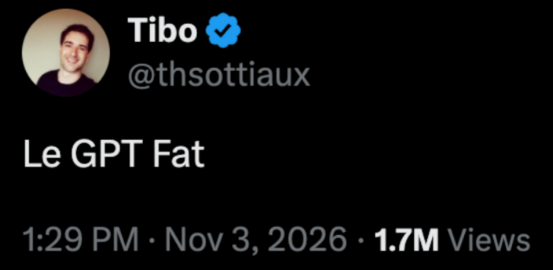
His full name is Thibault Sottiaux. He is Belgian and studied applied mathematics at KU Leuven in his early years. He now manages ChatGPT and the entire core product line.
Belgians speak French, after all, and the phrase "Le GPT Fat" immediately set the community to parsing it word by word. After all, the last time he posted something like this was on October 4 with "6.1 coming soon," and more than twenty days later GPT-6.1 Terra landed.
In the early hours of today, two never-before-announced model IDs suddenly appeared in the OpenAI API model list, named rc-ada-or-vm and rc-ada-sh-vm. Minutes later, they were taken down. Unlike last month's Aurora three-color models, which lingered for 26 hours before being discovered, this time only a few minutes passed between appearance and disappearance—it looked more like someone inside OpenAI immediately caught the slip-up. Quick-fingered developers rushed to make calls, but all hit 503, with the system indicating no available compute.
Tibo enjoys a rather peculiar popularity in developer circles. He often replies personally and helps people reset Codex quotas, earning him the nickname "cyber adoptive father." His hands-on style of fixing quotas and responding to feedback gives his updates their own interpretative heat. Every cryptic post he makes is read as a precursor to a release.
So when a cryptic French message is paired with today's two IDs, almost everyone concludes that OpenAI is about to do something big.
"Fat" is a byword for "big" in model circles, and this happens to match what people at OpenAI themselves have said. Company employee Ted Sanders explained the ordering of four models on Hacker News, starting from the smallest, Luna, and going upward through Terra and Sol to Astra as the largest. He stated clearly that the performance gap is broadly determined by a single variable—model size: the larger the model, the more expensive and the more capable.
Price says it best. Astra charges $10 per million tokens for input and $50 for output, while the smallest Luna costs only $0.1 and $0.5. A "Fat" version of Astra would mean it may be even heavier than the current flagship.
So what does the version number 6.2 mean? Again according to Sanders, version numbers today carry three things at once: release order, blood relationship with other models of the same generation, and the size of this jump.
6.1 means it comes after 5.6 and shares training data and personality with several other 6.1 models, but the progress is not big enough to merit the name 7. By this logic, 6.2 would be a smaller step than 6.1. Looking back at the cadence, Astra was released in September, 6.1 Sol and 6.1 Terra came out in succession in October, and another tier, 6.2, within two months would fit perfectly with this company's ever-faster release density.
Now look at the two IDs themselves. The prefix "rc" basically stands for release candidate. The trouble is the middle segment "ada," which was the name OpenAI gave its smallest models in its early years. On one side is the smallest old codename in history; on the other is "Fat," emphasizing bigness. Either engineers are playing a contrast meme, or two tiers of opposite size are being tested together in the same batch. The trailing "or," "sh," and "vm" look more like abbreviation fragments used internally to distinguish purposes.
What underpins the whole matter is that this kind of shadow model has played out repeatedly at OpenAI. Last month, on October 17, three models named Aurora quietly appeared in the API list—in red, green, and blue—and stayed for about 26 hours before being discovered by third-party tracking accounts, after which they were all deleted and calls likewise returned 503. At the time, some netizens joked that three models were enough for Tibo to post about for three days.
Further back, in April this year, the three "tape" codenames maskingtape, gaffertape, and packingtape appeared, and seventeen days later OpenAI launched GPT Image 2. In February, there was also an Aurora Alpha showing up on OpenRouter, and three days later GPT-5.3 Codex Spark was released.
Before major releases, mysterious models first appearing unexpectedly in the API has become almost a regular OpenAI program. Third-party accounts that watch models rely on polling the API list to catch changes, and no new ID escapes their eyes.
The codename Astra itself also carries a sensitive history. Earlier this year, because Astra reached a "critical" level in evaluations of autonomous cyberattack capability, OpenAI at one point slowed its release pace and put in place a whole set of safety controls.
That slowdown also brought isolated testing environments, weight encryption, and round-the-clock monitoring, showing just how cautious the company is about the Astra family of models. A 6.2 bearing the Astra name will naturally invite heavier scrutiny. A shadow model withdrawn within minutes also fits the company's habit of first testing capacity internally and only then signaling externally.
Of course, it is still too early to draw conclusions. OpenAI has given no official statement. These two IDs could be a configuration slip, a capacity canary, or indeed a pre-release trial balloon. I personally lean toward treating it as a capacity canary rather than a formal rehearsal before release.
A withdrawn API entry can turn into a global developer guessing puzzle within hours. OpenAI's "unreleased list" has now become a weather forecast watched by the entire industry. Whether or not GPT-6.2 Astra arrives this month, these shadow models have already told players on its behalf that there are still cards under the table.
-
![]()
Baidu AI Redraws Its Battle Lines
-
![]()
Memory Prices Are Soaring, and Better Days Are Coming for Longcheer Technology and Its Peers
-
![]()
Audi's North-South Split: Volkswagen Can't Afford to Wait
-
![]()
Doubao Phone Hits the Market: ByteDance's Bigger Game on the Phone Ecosystem
-
![]()
OpenAI's Mysterious Ghost Model Briefly Appears, API Pulled Within Minutes
-
![]()
Shenzhen Computing Power Chip Company Secures Nearly 2 Billion Yuan in Back-to-Back Financing
-
![]()
Najing Technology Secures Series A+ Funding in the Tens of Millions of Yuan!
-
![]()
Q3 Net Profit Plunges 30,154.65%: Lianchuang Electronics' Cracks Can No Longer Be Hidden