Another Computing Power Company IPOs: 70% of Revenue from ByteDance, with Oracle Close Behind
 11/11 2026
 384
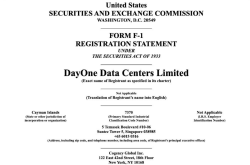
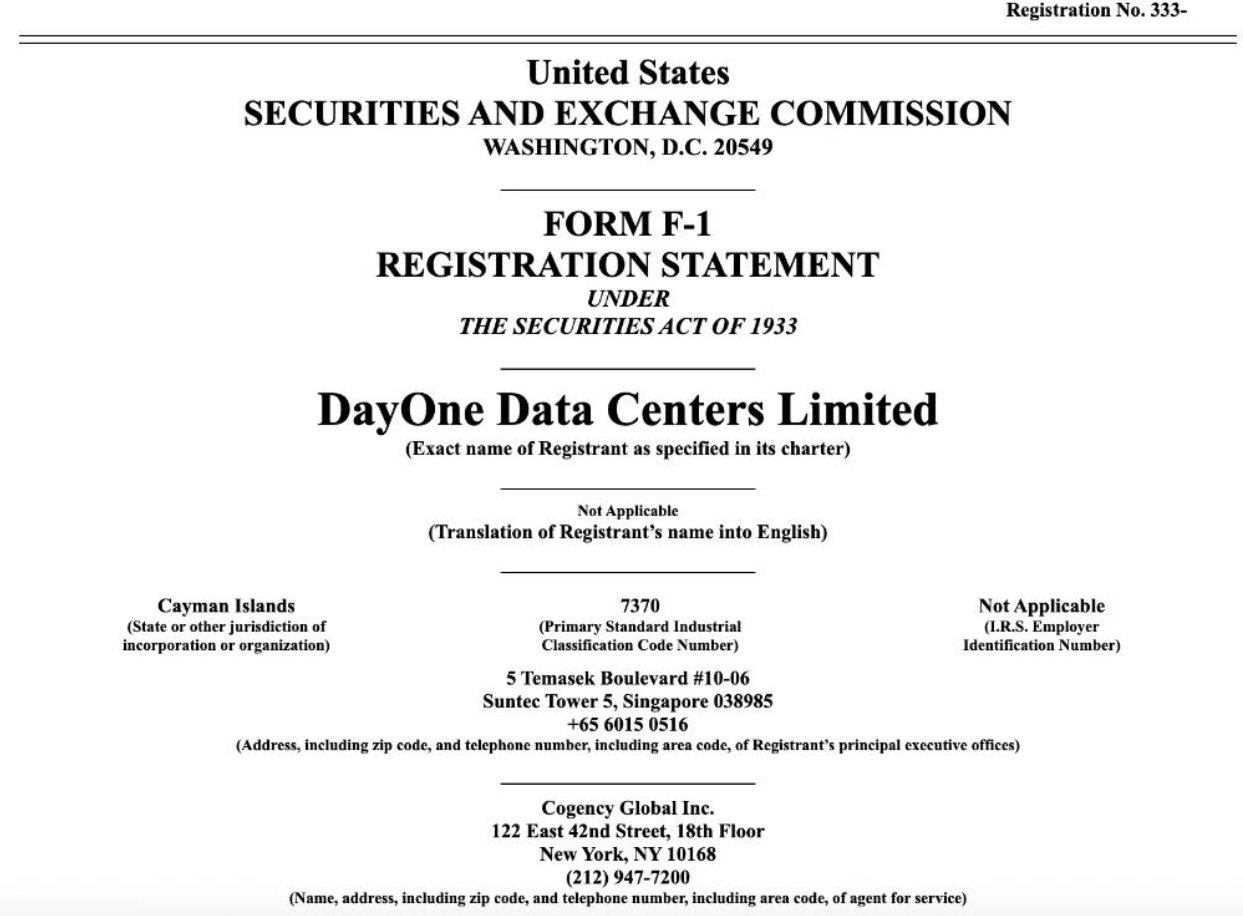
On October 5, Singapore-headquartered computing power provider DayOne submitted an F-1 registration statement to the U.S. SEC, planning to list on Nasdaq before the end of the year under the ticker DODC. The underwriting syndicate includes Morgan Stanley, JPMorgan, Bank of America, Citi and BNP Paribas. Initial market reports said the company sought to raise up to $5 billion at a valuation of $20 billion.
Less than two weeks later, on October 21, the company itself issued a statement saying it was considering cutting the fundraising size to between $2.5 billion and $3 billion and did not rule out postponing the listing. From $5 billion to $2.5 billion—expectations were halved at the first sign of trouble.
DayOne carries the genes of a Chinese company. In May 2022, GDS registered a company called DigitalLand Holdings in Singapore, packing all data center assets outside mainland China into it.
At the end of that year, ChatGPT was released, and generative AI ignited demand for computing power across the board. GDS had won ByteDance's order a year earlier and had also secured land parcels in Southeast Asia, so this new platform was almost tailor-made for the AI infrastructure boom.
On January 1, 2025, it officially changed its name to DayOne. From the day it became independent from its parent company, GDS's stake had been diluted to less than 20% and was no longer consolidated.
DayOne's smartest move was stitching together a computing power network. Singapore, Johor state in Malaysia, and Batam Island in Indonesia are separated on the map by national borders and a stretch of tropical sea, but in DayOne's sales map they are parts of the same machine. It named this layout SIJORI.
Singapore is responsible for dense international connectivity and a trusted commercial hub. Johor state is right next to it, with vast land and electricity cheap enough to be only a fraction of Singapore's. Batam Island further south reserves space for continued expansion within a special zone, and the three countries are connected by submarine optical cables, making distance negligible.
The prospectus says that by customer booked capacity, DayOne holds about a 33% data center market share in this region. Its powered capacity rose from 49 megawatts at the end of 2023 to 962 megawatts in September 2026, nearly twenty times in less than three years.
The prospectus shows that DayOne's full-year revenue was $178 million in 2024, jumping to $484 million in 2025, up 172%. In the first half of 2026 it reached $512 million, up another 238% year on year, surpassing the previous full year in just half a year. But it is still losing money. It had a net loss of $367 million in 2025 and another loss of about $77.2 million in the first half of 2026.
The prospectus explains that the widening losses were mainly due to share-based payment expenses and settlement fees related to ending customer support arrangements with its former parent company.
The other side of growth is its major customers. In the prospectus, the largest customer contributed nearly 70% of revenue in both 2025 and the first half of 2026 and was described as a technology company operating a globally leading short-video platform.
Bloomberg, industry institution SemiAnalysis, and The Information all point this anonymous customer to ByteDance. The second-largest customer was a U.S. hyperscale cloud provider that contributed about 15% of revenue in the same first half, which media pointed to as Oracle. Together, the two contributed nearly 85% of DayOne's revenue. As of September 2026, ByteDance had committed to leasing 838 megawatts of capacity from its sites in Malaysia, Thailand and Finland.
Such high customer concentration is actually not unusual in the asset-heavy, long-cycle data center industry. Most of DayOne's contracts with customers are 10- to 15-year take-or-pay contracts, meaning the agreed amount must be paid regardless of whether the capacity is fully used. The prospectus discloses that as of September 20, 2026, of the 962 megawatts in operation, 953 megawatts had already been billed, a utilization rate of 99.1%, meaning capacity is taken up as soon as it is built.
Of course, customer concentration risk is also significant. In public market pricing, betting 69% of revenue on a single customer is itself a structural constraint that requires a discount. Regulatory pressure TikTok continues to face overseas has already made some investors hesitant about DayOne's projects in Finland whose tenants include ByteDance. The good news is that, according to The Information, in DayOne's future contracts for 2027, ByteDance's share has already fallen below 50%.
The computing power business requires spending money first and collecting rent later, and the hard costs are clearly pressed onto the books.
In the first half of 2026, DayOne spent $3.11 billion on prepayments for purchasing fixed assets, land and construction, about six times its revenue for the same period, while net cash flow from operating activities was only $14.01 million. By the end of June, its total assets were $12.836 billion and total liabilities $6.497 billion, including $4.426 billion in interest-bearing borrowings.
An even heavier item is off the balance sheet. $6.364 billion in mezzanine equity mainly came from convertible preferred shares issued in Series A, B and C rounds. It carries a hard constraint: if the IPO is not completed by the end of 2030, a majority of qualifying shareholders can require the company to initiate an exit arrangement. This IPO is both a fundraising for expansion and a redemption point for preferred shareholders' liquidity expectations.
DayOne stepping on the brakes is not an isolated case. The IPO path for AI infrastructure had already suffered repeated setbacks before it. Australia's Firmus withdrew less than 48 hours after opening bookbuilding. Britain's Nscale was forced by investors to cut its valuation from $30 billion to $16-19 billion. Blackstone-owned AirTrunk postponed a REIT listing originally planned to raise about $1.5 billion in Singapore. Shares of emerging cloud service providers such as CoreWeave and Nebius fell 20% to 25% in the previous week.
Investors' focus has shifted from how strong demand for computing power is to whether capital expenditures can become sustainable free cash flow.
Beyond traditional server rooms, DayOne has also made a foray into the frontier. In March 2026, it partnered with Cortical Labs and the NUS Yong Loo Lin School of Medicine to create the first biological data center prototype in Singapore, which went live in July. This rack uses living neurons cultured from human stem cells to directly participate in computing, and the entire rack consumes only 850 to 1,000 watts.
One month after filing, on November 5, DayOne obtained another HK$1.86 billion bank loan, specifically for refinancing and expansion of its Hong Kong data center project.
The numbers in the prospectus point in two directions at the same time. Half-year revenue surpassed the previous full year, powered capacity rose nearly twentyfold in three years, and 2.3 gigawatts booked and 4.6 gigawatts of resources show that AI-driven demand is real and that DayOne's positioning in Southeast Asia is also real.
-
XFusion Set for Listing Review: A Bet on Computing Power in the Agent Era and a Growth Model for Domestic Computing Power Breakthroughs
-
![]()
StepFun Refuses to Be Just a Cloud-Side Water Seller
-
![]()
Another Computing Power Company IPOs: 70% of Revenue from ByteDance, with Oracle Close Behind
-
![]()
Who Is Squeezing Crystal Optech's Profits as Exclusive Supplier to a Major North American Customer?
-
![]()
Zhongrun Optics Finalizes New Management Team with Completed Board Reshuffle
-
![]()
Between the Pupil Function and the MTF Lies a Fourier Transform
-
Apple, Huawei, and Xiaomi Sales Over the Past 8 Years: Who Really Took Away Huawei's Users?
-
![]()
Huawei Starlight Phone Faces Uncertainty Even Before Launch: Stores Say No Notice Yet, and It Won't Come Cheap