StepFun Refuses to Be Just a Cloud-Side Water Seller
 11/11 2026
 430

StepFun has no intention of remaining merely a "cloud-side water seller" peddling models; it aims to push model capabilities all the way down to terminals.
On September 20, StepFun unveiled its next-generation flagship foundation model, Step 5 Preview.
Judging by the publicly available benchmarks and pricing data, Step 5 Preview cuts an impressive figure. On benchmark performance, Artificial Analysis data shows the model scored 44 on the comprehensive intelligence index, placing it in the first tier of global open-source models at launch. On cost and pricing, Step 5 Preview is plainly competitive as well: Artificial Analysis data puts its per-task inference cost at just one-eighth that of Claude Opus 5, with input pricing at $1 per million tokens—roughly 53% of the industry median—and output pricing at $2.7 per million tokens, about 27% of the industry median.
These public benchmarks and price points make one thing clear: StepFun already commands first-tier technical strength globally. Yet viewing this launch in isolation would miss the more notable strategic pivot behind StepFun's string of implementation moves this year.

Image source: Internet
An alternative path amid the parameter race
Placed in the industry context of 2026, Step 5 Preview's parameter count looks somewhat unorthodox.
Over the past year, the industry has swung back onto the parameter-race track, treating model scale as the core yardstick for technical strength. Public information shows Moonshot AI's Kimi K3 topping the global open-source parameter record with 2.8 trillion total parameters and 104 billion activated parameters; Alibaba's Qwen3.8-Max pushed total parameters to 2.4 trillion, with about 95 billion activated, and subsequently claimed first place globally on the Artificial Analysis agent capability leaderboard with 55.4 points, overtaking Claude Opus 5 and GPT-5.6; DeepSeek V4-Pro and Zhipu GLM-5.3 reached 49 billion and 40 billion activated parameters respectively. With both total and activated parameters climbing, "parameter count equals strength" has become the industry's near-default consensus.
StepFun, however, took the opposite road. Step 5 Preview adopts a sparse MoE architecture with 600B total parameters and only 27B activated during actual inference—an order of magnitude below mainstream industry levels on both counts.
Behind this unconventional choice lies StepFun's read on where the industry is heading. On September 20, the head of StepFun's R&D team said in an interview: "The logic of the scaling law for large models used to be trading more computation for stronger intelligence. But as model scale and task complexity grow in tandem, computing costs rise sharply. The next stage of the scaling law is not just more computation—it's more efficient computation."
Step 5 Preview's technical choices are precisely a concrete embodiment of that judgment.
The first is the sparse MoE architecture. MoE splits the model into multiple expert modules and activates only a small subset relevant to the current task during each inference, so Step 5 Preview needs to activate just 27B parameters per inference. This design delivers substantial cost improvements. According to Artificial Analysis data, completing an equivalent intelligence-index task costs $5.86 with Claude Opus 5, while Step 5 Preview costs only $0.71.
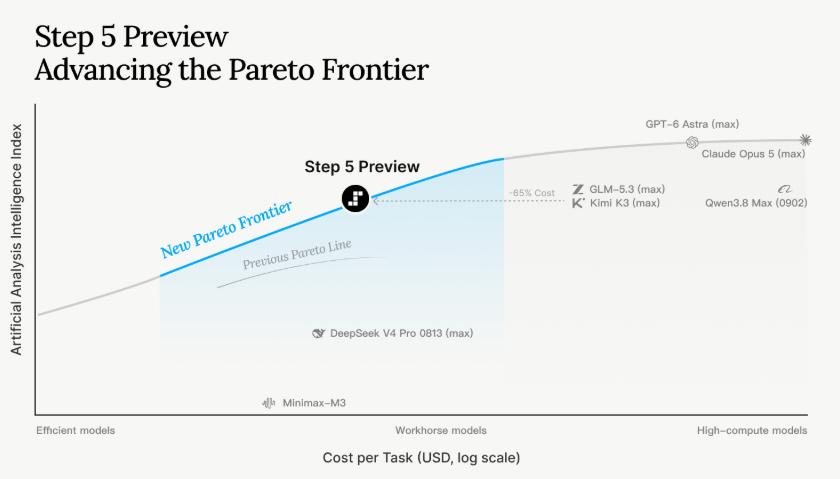
Image source: StepFun | Cost-intelligence index comparison between Step 5 Preview and mainstream models
The second is a narrow-and-deep network structure. StepFun's official disclosure states that Step 5 Preview contains 92 Transformer layers, following a route of increasing depth rather than width. The official explanation: in agent tasks, tool-returned information is concatenated into long inputs, and a deeper network can provide a more complete reasoning chain for multi-hop reasoning over long inputs. This maps precisely onto the realities of agent scenarios—continuous searching, code execution, and external tool invocation.
The third is a clear trade-off in capabilities. Multiple test results show that Step 5 Preview did not try to match top closed-source flagships across every dimension; instead it concentrated its capabilities where agent scenarios need them most. StepFun's official benchmark results show Step 5 Preview scoring 67.7 on DeepSWE v1.1 for software engineering, second only to GPT-6 Astra and Claude Opus 5 and ahead of Kimi K3 and GLM-5.3. On the FrontierFinance test for financial scenarios, Step 5 Preview scored 66.4, ranking second globally and ahead of GPT-6 Astra and other participating open-source models. On general tasks such as visual design, however, its performance is noticeably weaker—hands-on tests by outlets including QbitAI found the richness of materials the model produces to be limited, often requiring multiple rounds of adjustment to reach a usable state.
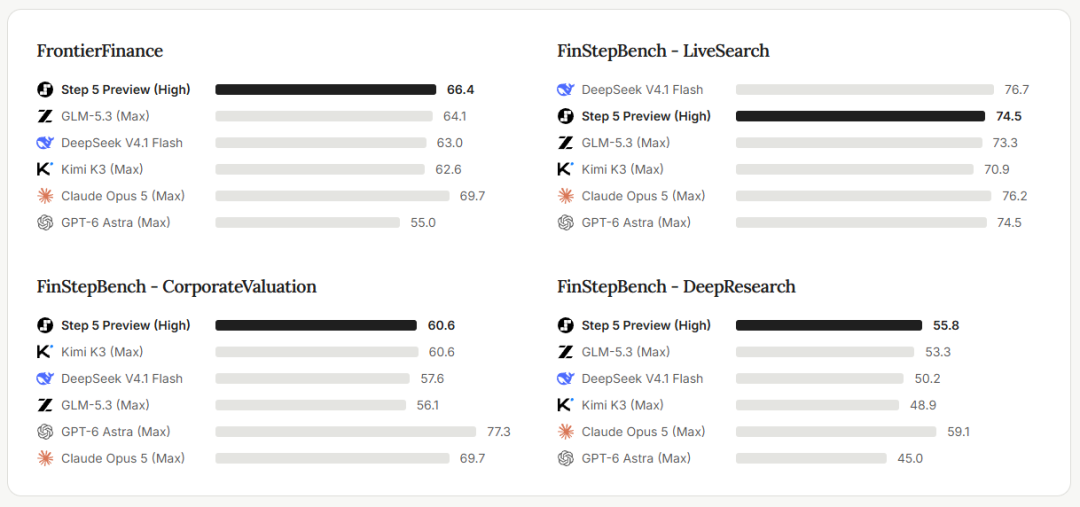
Image source: StepFun | Step 5 Preview's benchmark score in financial scenarios
From the sparse MoE architecture to the narrow-and-deep network structure to the clear capability trade-offs, Step 5 Preview's technical choices all point in the same direction: striking a balance among capability, cost, and efficiency suited to high-frequency agent invocation scenarios.
The same choice is visible in other models. Step 3.5 Flash, released in February this year, has 196B total parameters and about 11B activated; Step 3.7 Flash, launched in May, has roughly 196B total parameters and likewise only 11B activated, with a maximum generation speed of up to 400 tokens/s.
From Step 3.5 Flash to Step 5 Preview, three consecutive generations of StepFun models have all sought to push computational efficiency to the limit. Having done so, the next question to answer is: where should such capabilities ultimately land?
Unwilling to be a cloud-side water seller
The answer is not the cloud-side API market.
In 2026, domestic large-model capability iteration has visibly accelerated. DeepSeek launched V4.1 Flash, with the new version comprehensively outperforming the previous V4 Pro on metrics including performance, invocation cost, and overall latency. During off-peak hours, the cached-hit input price per million tokens drops to as low as 0.02 yuan, with output at 4 yuan. Stronger capabilities and lower costs have become the norm for this round of model iteration.
Yet behind the continuous improvement of model capabilities, the cloud-side API business model is under real pressure. On September 10, the day DeepSeek announced price cuts, Zhipu's stock closed down 10.34% and MiniMax's down 8.98%. Wall Street investment bank Jefferies subsequently lowered the valuation multiples for Zhipu's open platform and API business, shifting the valuation basis from 50x 2026 expected ARR to 30x—in other words, for the same one yuan of ARR revenue, the market's valuation shrank from 50 yuan to 30 yuan.
In terms of industry landscape, leading vendors have already built considerable scale barriers. Zhipu's 2026 interim results announcement shows that as of August 31, its MaaS platform's ARR calculated on a monthly revenue basis reached $1.6 billion, or $2 billion on a weekly basis; in the first half of the year, revenue from the MaaS open platform and API services reached 825 million yuan, up about 2,736% year-on-year and accounting for 86.5% of total revenue. Data from Securities Times shows MiniMax's models and products have served more than 2 million enterprise customers and developers globally, roughly 10 times the number in December 2025; in the first half of the year, B-end revenue rose 703.1% year-on-year to $73.9 million, with its share climbing to 63.4% to become the company's largest revenue source. The competitive landscape of the cloud-side market has essentially taken shape.
StepFun's answer is to step off this path: rather than competing on price on the cloud side, it would rather extend model capabilities to terminals. Revenue would no longer come solely from tokens, but also from terminal devices and the services themselves.
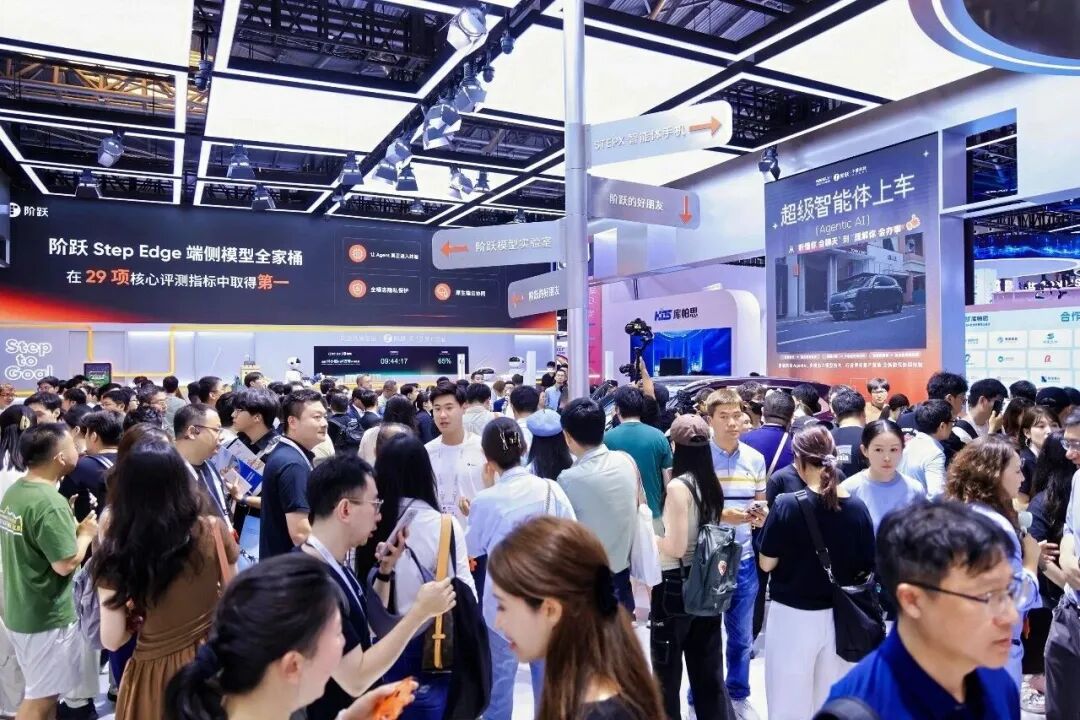
Image source: StepFun
On July 13, 2026, StepFun held a launch event in Shanghai, officially unveiling the large-model-native AI terminal brand STEPX, the agent-native operating system Step AOS, and the large-model-native agent phone STEPX Neo. According to Xinhua Net, StepFun Chairman Yin Qi said at the event that the launch "took the lead in connecting the complete chain from model foundation, native system, and terminal brand through to security governance."
This layout was no impromptu decision. According to 21st Century Business Herald, as early as January 2026 StepFun made clear externally that "foundation large models" and "AI + terminals" are the company's two long-term strategic directions. A Huxiu report likewise noted that StepFun has internally split two independent business lines, one focused on foundation large models and the other on agent terminals.
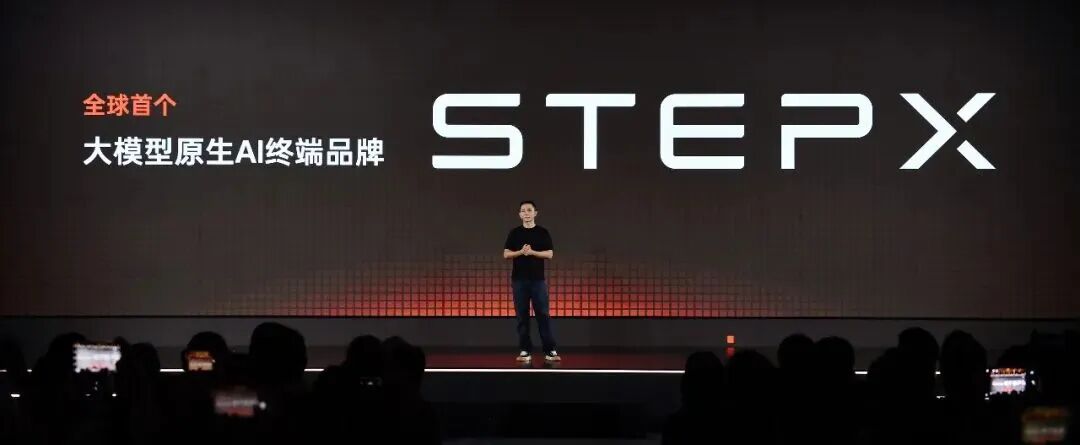
Image source: Huxiu APP
The core of this strategy is rebuilding the operating system around agents. Step AOS reconstructs the underlying layers of the traditional operating system, encapsulating hardware capabilities and system resources into interfaces callable by agents; users need only express natural-language intent, and the agent can autonomously plan and complete the entire set of operations. Yin Qi has a vivid way of putting it: the traditional operating system merely leaves a small door open for AI, and AI remains forever a "visitor" in the system; Step AOS, by contrast, builds the underlying environment from scratch, and AI is a "native" of the system.
Hands-on data supports this judgment. Within a traditional human-centered operating system, an agent's single-step operation success rate can reach 95%, but once 20 steps are chained continuously, the success rate drops straight to 30%. The value of agents lies in autonomously executing tasks across applications, yet existing phone systems were designed for human-computer interaction; large models can only run as applications or background services, cannot obtain underlying scheduling permissions, and cannot read user data across apps.
What Step AOS aims to solve is precisely this lack of permissions. The STEPX Neo equipped with the system has a built-in personal agent, Amoo, with system-level permissions. When a user issues an instruction such as "help me plan a weekend short trip, book train tickets and a hotel, and arrange a local specialty meal along the way," Amoo can coordinate with Ctrip, Didi, Meituan, and Alipay to complete route planning, ticket booking, and payment in one stop.
The key change at the product level is that it alters how large models are charged. The traditional cloud-side API model bills by token usage—the more calls, the higher the cost. Once agent capabilities are embedded in terminal hardware, model invocation is encapsulated within the device itself; users never perceive token consumption, only the full set of intelligent services the hardware delivers.
From selling APIs externally to laying out terminal hardware, StepFun is no longer positioning itself merely as a model supplier but transforming into a company integrating software and hardware. By relying on terminal hardware to carry agent capabilities, it can escape the single token billing model and build a differentiated growth narrative.
But making this path work is far more difficult than continuing to compete on price on the cloud side.
Three real constraints on the road to breakthrough
The strategic direction is clear. But turning the blueprint into reality requires StepFun to overcome three real constraints at once.
The first constraint comes from hardware. There is a structural mismatch between the existing capabilities of on-device chips and the product definition of an "agent phone."
After the STEPX Neo launch event in July 2026, Yin Qi said in an interview: "Our current on-device chips simply cannot support the needs of a large number of future users for the entire agent." He further explained that on-device chips "may not even be able to run a 10B model, or cannot run it quickly."
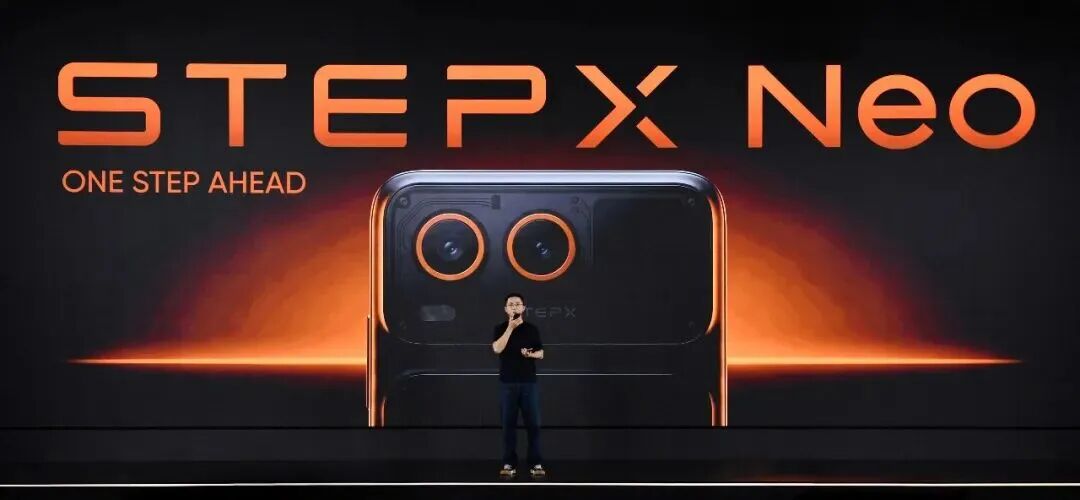
Image source: StepFun
The problem is that Step 5 Preview's activated parameters stand at 27B, while current on-device chips, at acceptable efficiency, have carrying capacity far below this order of magnitude. According to National Business Daily, Step AOS's device-cloud collaboration mechanism follows the principle of "use the device when possible, use the cloud when needed": simple tasks such as setting alarms and checking photos are handled locally by the on-device model, while complex needs such as planning trips and writing reports invoke the cloud model. This means the Amoo agent running on STEPX Neo still needs to send computing requests back to the cloud for a large share of tasks. The so-called "on-device agent" at this stage is closer to a hybrid form of "device-cloud collaboration."
Yin Qi also acknowledges that agent terminals are still at a very early stage. By his judgment, it will take another two to three years for hardware capabilities to mature. But the window left for StepFun to conduct commercial validation may not be so ample.
The second constraint comes from the ecosystem. The core value of agents depends on cross-app scheduling capability, and this is precisely limited by the absence of super apps.
The initial roster of ecosystem partners announced for STEPX Neo features platforms including Meituan, WPS, Jianying, Ctrip, Amap, Alipay, Baidu, Didi, JD.com, and Weibo. Noticeably absent from this list, however, is WeChat—the "national app." In a media interview, Yin Qi revealed that StepFun has engaged in extensive, in-depth discussions with Tencent and looks forward to collaborating with the company on this front in the future.
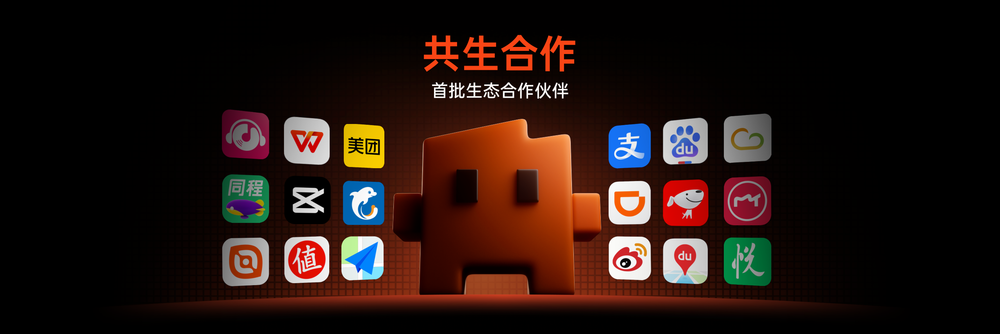
Image source: Huxiu APP
These super apps map precisely onto the core scenarios of cross-application agent operations: social communication, e-commerce, and content consumption. Yin Qi himself once described the "memory wall" that agents face: "User data is locked inside each app. WeChat doesn't know what you viewed on Taobao, and Taobao doesn't know what's on your calendar." Without this critical entry point, the real-world scenarios agents can cover would be drastically narrowed.
The business logic behind this is not hard to grasp. An agent's core value rests on autonomous cross-app scheduling, which requires it to read third-party application data and invoke in-app capabilities. For super apps, granting such permissions amounts to handing over user behavioral context and traffic control to outsiders—a concession that is very hard to justify on business grounds.
Ecosystem gaps, however, go beyond the absence of super apps; they also show up in the shortfall of accumulated developers and enterprise customers. Compared with already-listed peers Zhipu and MiniMax, StepFun has yet to disclose a comparable developer scale. Even if its foundation model performance is impressive enough, without rich scenarios and application integration, the capabilities of terminal agents will be hard to truly unleash. Whether super apps are willing to open their interfaces is not something StepFun alone can drive.
The third constraint comes from funding and the capital markets. There is a huge gap between StepFun's financing scale and its revenue volume, and the valuation expectations for a Hong Kong IPO impose even higher fulfillment requirements on closing that gap.
StepFun's revenue in 2025 is close to 500 million yuan, with projected revenue of about 1.2 billion yuan in 2026. On the expenditure side, according to Caizhongshe, investment in computing power and algorithm R&D alone reached 1.2 billion yuan. On the financing side, according to Investment Boundary, within 2026 StepFun successively completed a B+ round of more than 5 billion yuan and a Pre-IPO round of nearly 2.5 billion US dollars (about 17 billion yuan), raising more than 20 billion yuan in total across the two rounds.
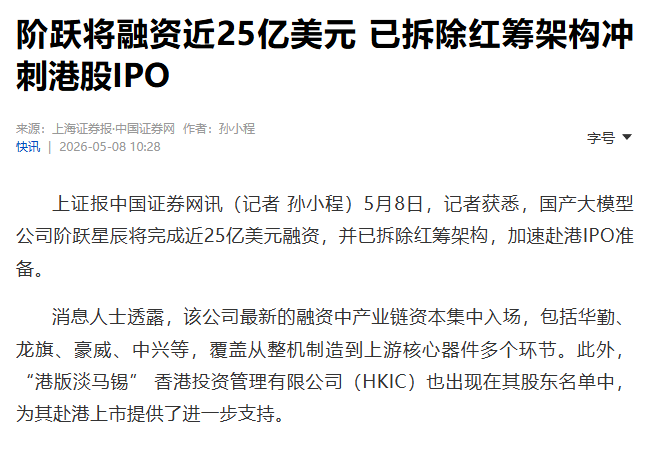
Image source: Shanghai Securities News · China Securities Network
For the large model industry, financing scale exceeding revenue is a common phenomenon, and the industry as a whole is already in a high-investment cycle. What sets StepFun apart, though, is that it must invest on two fronts simultaneously: on the one hand, it must keep iterating its foundation model; on the other, it must also invest in terminal hardware R&D, supply chain refinement, and channel development. According to Investors Network, StepFun has not yet achieved a profitable model. If it cannot lay out in its prospectus a clear path for gross margin improvement and expectations for a cash flow turning point, "the high-valuation narrative will face a fundamental test."
Meanwhile, the Hong Kong IPO process is underway. StepFun has confidentially submitted a listing application to the Hong Kong Stock Exchange, and major investors have assigned it a maximum valuation of up to 12 billion US dollars. Listing can replenish new ammunition, but it also brings stricter information disclosure and performance scrutiny.
The three constraints ultimately converge into the same core issue: time. It will take two to three years for edge chips to mature, the ecosystem opening of super apps involves multi-party interest games, and the speed of capital consumption determines how long StepFun can endure investment without seeing clear returns.
In external communications, Yin Qi remarked: "Moving forward will still be very difficult, but this may also be the truly interesting part of AI entrepreneurship." Within a company's strategic narrative, this sentence is a reasonable expression of mindset. But within business logic, it means StepFun has chosen the hardest path—and whether it can succeed is still a question for which there are not yet enough facts to answer.
-
XFusion Set for Listing Review: A Bet on Computing Power in the Agent Era and a Growth Model for Domestic Computing Power Breakthroughs
-
![]()
StepFun Refuses to Be Just a Cloud-Side Water Seller
-
![]()
Another Computing Power Company IPOs: 70% of Revenue from ByteDance, with Oracle Close Behind
-
![]()
Who Is Squeezing Crystal Optech's Profits as Exclusive Supplier to a Major North American Customer?
-
![]()
Zhongrun Optics Finalizes New Management Team with Completed Board Reshuffle
-
![]()
Between the Pupil Function and the MTF Lies a Fourier Transform
-
Apple, Huawei, and Xiaomi Sales Over the Past 8 Years: Who Really Took Away Huawei's Users?
-
![]()
Huawei Starlight Phone Faces Uncertainty Even Before Launch: Stores Say No Notice Yet, and It Won't Come Cheap