Deification! Zhang Yiming, 43, Ascends to Become Asia’s Wealthiest Individual as ByteDance Emerges as the Largest Internet Giant
 09/17 2026
 518
518
A 43-year-old Chinese entrepreneur has shattered Asia’s wealth ceiling.
On September 16, the Bloomberg Billionaires Index update sent shockwaves through global finance: Zhang Yiming’s personal net worth surpassed $105 billion, officially crowning him Asia’s richest person.
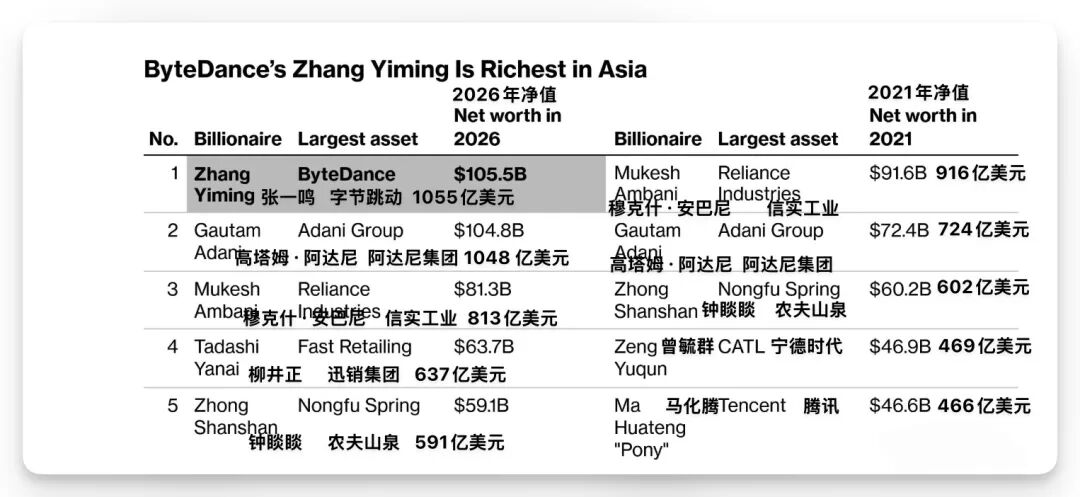 Zhang Yiming tops Asia’s wealth rankings. Image source: Smart Finance
He dethroned Indian magnate Gautam Adani, who had dominated the top spot for years, fundamentally reshaping Asia’s wealth hierarchy.
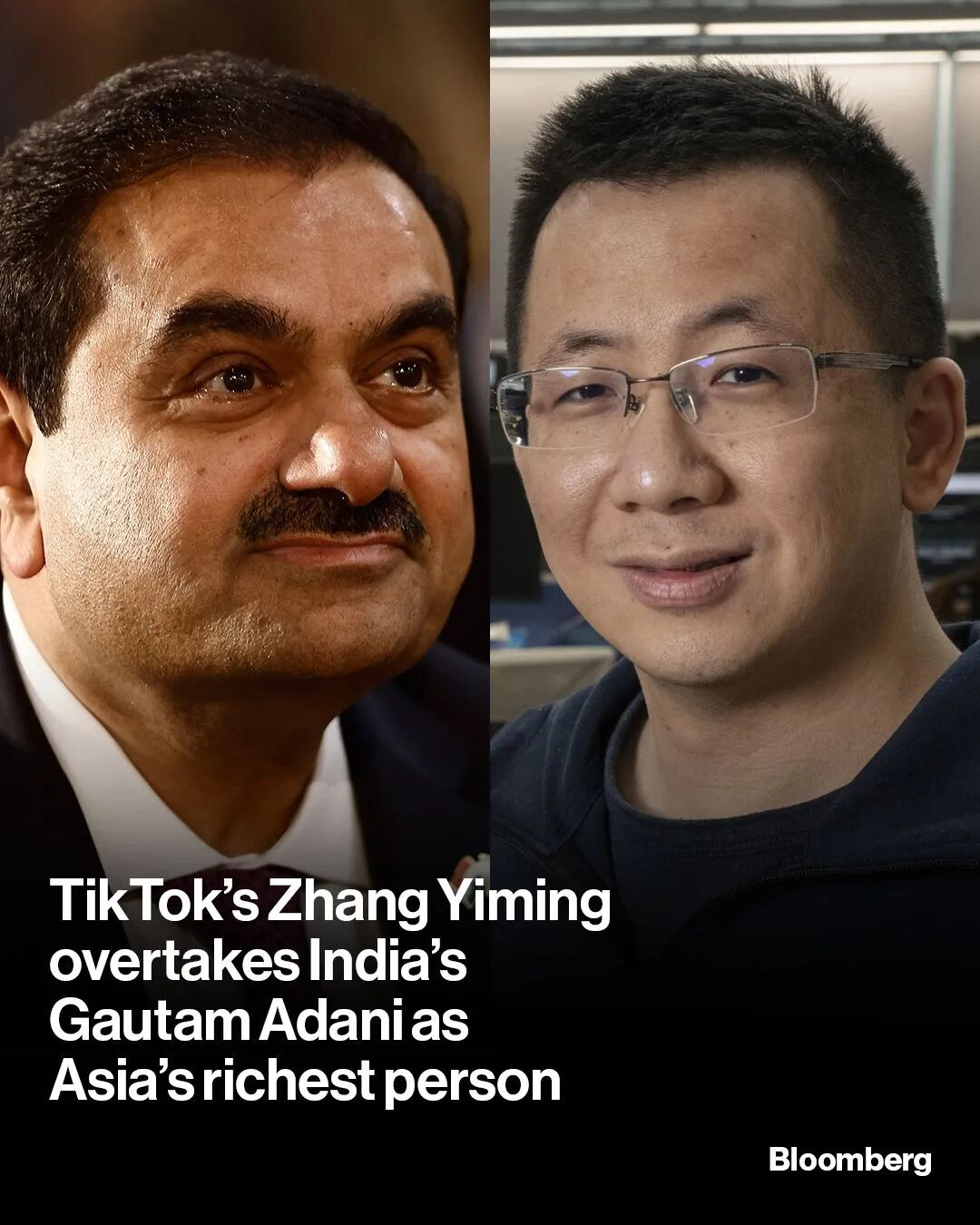 Zhang Yiming: Asia’s new wealth leader. Image source: Bloomberg
This ascent represents a paradigm shift in prestige.
Previous Asian billionaires built fortunes through energy, mining, retail, and tangible assets. Titans like Adani, Mukesh Ambani, and Tadashi Yanai accumulated wealth through physical resources and monopolistic channels.
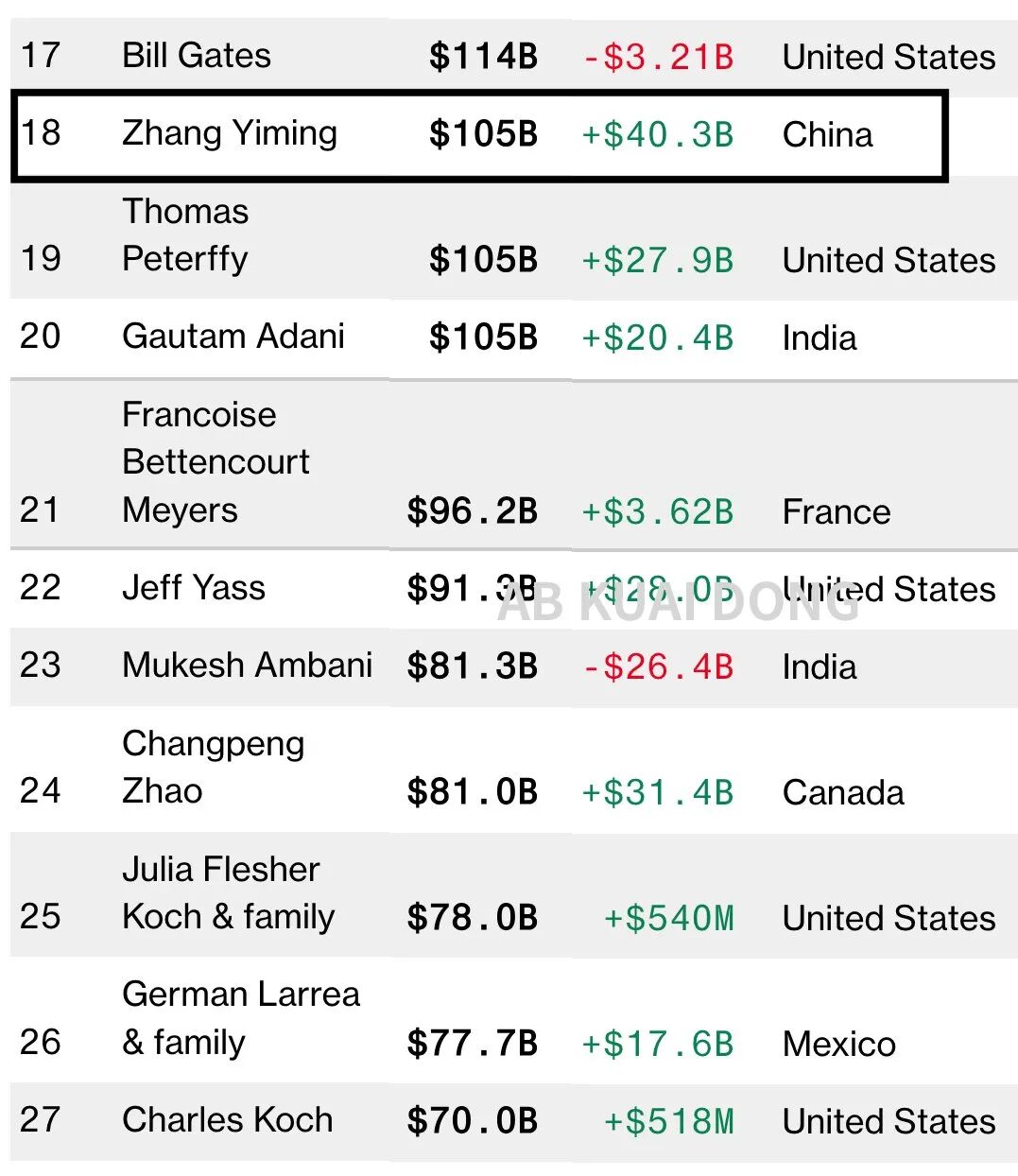 Zhang Yiming ranks 18th globally. Image source: Smart Finance
Zhang Yiming, however, has charted an entirely different path.
In 2019, Bloomberg first tracked his net worth at $13 billion. Within years, his wealth surged nearly sevenfold—a trajectory rare among global billionaires, achieved without mining or real estate, but through globalized products and an AI-driven ecosystem.
Once criticized for a $3 billion valuation being "too high," ByteDance now approaches a $5 trillion market cap. Source: Xiaohongshu
This reshuffling signifies the comprehensive transcendence of traditional resource-based wealth by AI-powered tech disruptors. The era of resource-driven fortunes is fading, while technology and AI-fueled wealth creation surges forward.
01 Global Advertising Revolution: ByteDance’s Counterattack Enters Final Countdown
If Zhang Yiming’s rise to Asia’s richest person represents personal deification, ByteDance’s global breakthrough marks a historic turning point for China’s internet sector on the world stage.
The global internet advertising throne faces its final shake-up.
For over a decade, YouTube—owned by Google—dominated video advertising, profiting effortlessly from its mature long-form video ad system and massive global traffic. This veteran giant now steps down from its pedestal, with visible growth stagnation and fully tapped industry dividends.
 Image source: Google
In contrast, ByteDance, under Zhang Yiming’s leadership, executes the most aggressive global counterattack in China’s internet history, shattering Western monopolies in global advertising.
WARC Media, a global marketing authority, predicts: By 2030, TikTok will officially surpass YouTube as the world’s top video advertising platform, rewriting an industry landscape unchanged for over a decade.
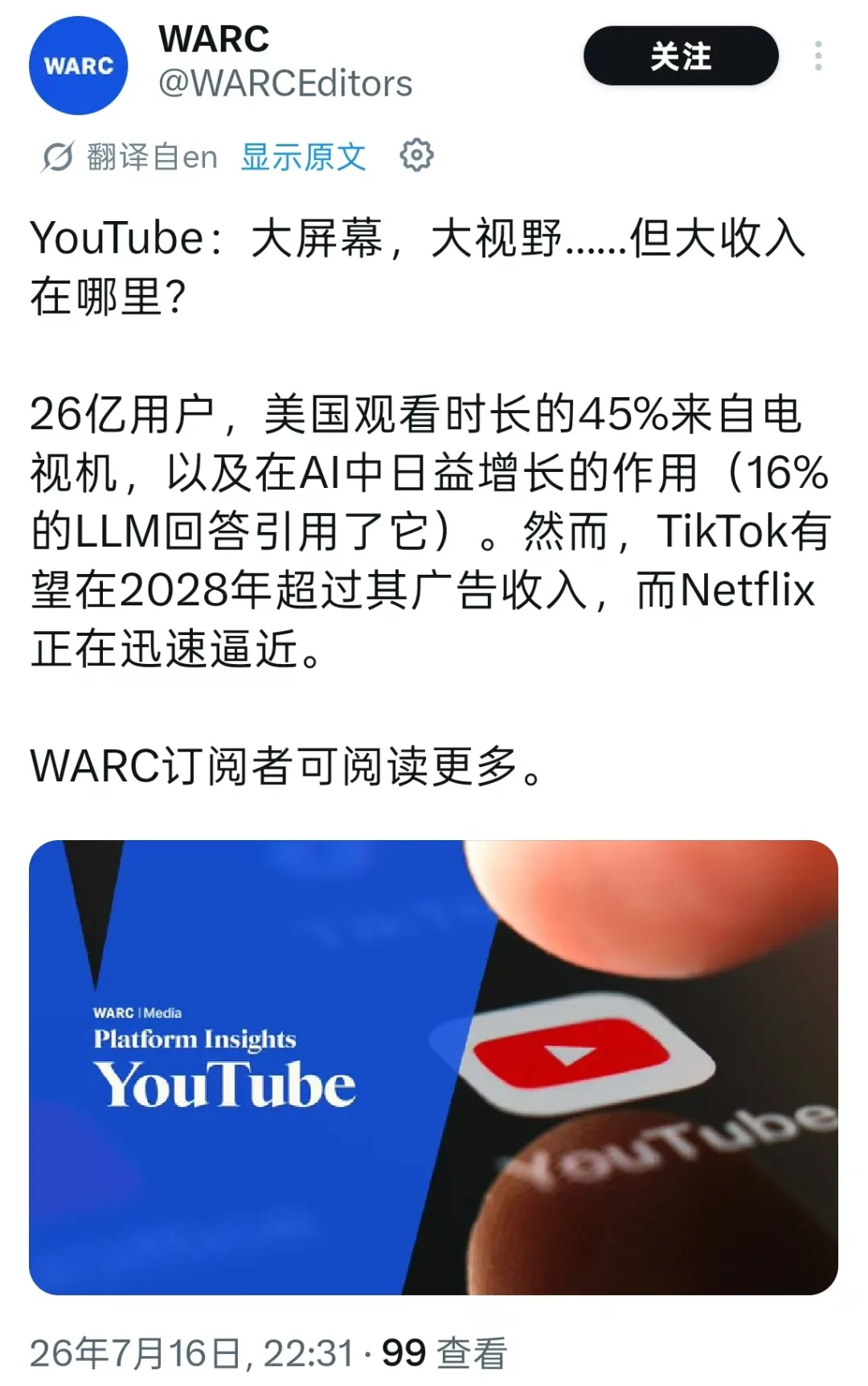 Image source: X social platform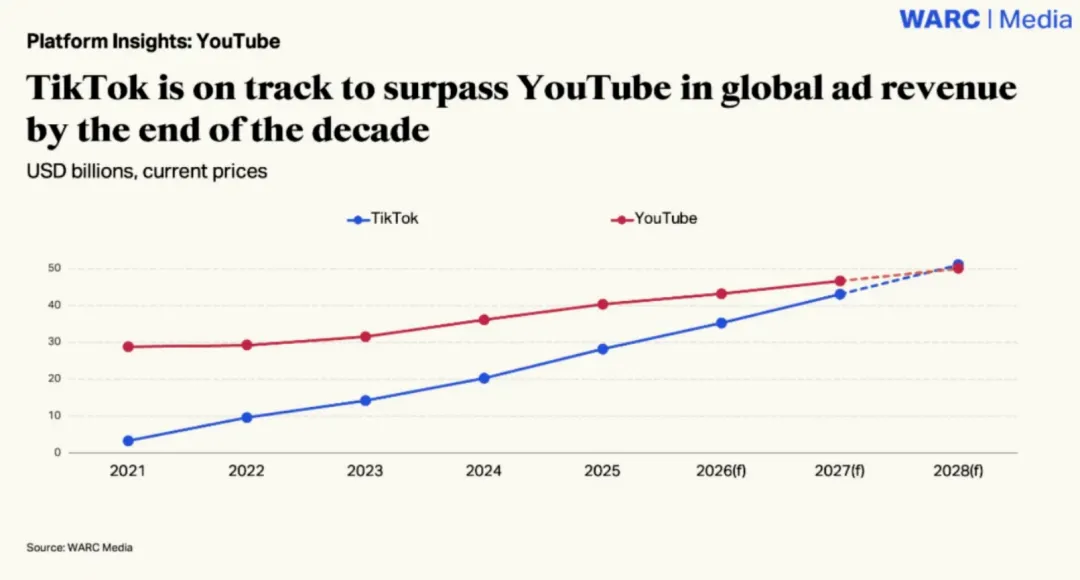
Image source: WARC Media
Data confirms this disruptive transformation: In 2025, YouTube’s global ad revenue reached $40.4 billion, growing modestly at 11.7% year-over-year, with further slowdown expected. Meanwhile, TikTok leverages short-form video recommendations, social commerce, and performance advertising to achieve far higher revenue growth rates.
Many fail to realize ByteDance is no longer the underdog.
By 2025, ByteDance’s total revenue is projected to hit $186 billion, solidifying its position as the global online advertising industry’s second-largest player, just behind Google Alphabet. Global dominance is within reach.
 Image source: Google
In years, ByteDance transformed from an industry newcomer, comprehensively outmatched by Meta and Google, to a dual-power contender poised to surpass YouTube. Zhang Yiming’s extreme algorithmic thinking and aggressive growth strategies have, for the first time, placed a Chinese internet brand at the center of the global top-tier arena.
02 Mind-Blowing Scale: ByteDance Nears Combined Size of Tencent + Alibaba
For years, public perception held Tencent and Alibaba as China’s internet duopoly. Some even joked that unlisted ByteDance was the Hang Seng Tech Index’s "biggest bear."
However, foreign media The Information’s latest operational data shatters this notion: ByteDance has grown into China’s largest internet company by scale. ByteDance’s revenue now equals Tencent + Alibaba combined, with a 30% growth rate still intact.
Consider the hardcore revenue data: In H1 2026, ByteDance’s revenue reached approximately $120 billion. During the same period, Alibaba reported $75.3 billion, and Tencent $59 billion—totaling $134.3 billion combined. ByteDance now stands infinitely close to surpassing their sum.
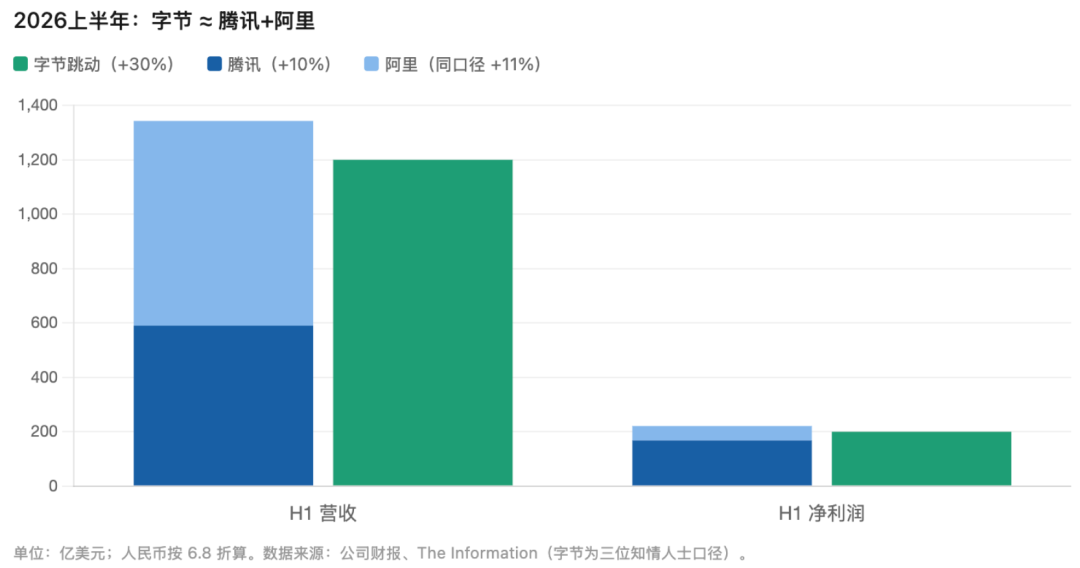 Image source: 25th Observation @ WeChat Official Account
Profitability matches this scale: ByteDance’s H1 net profit reached $20 billion, compared to Tencent and Alibaba’s combined $22.1 billion—the gap has narrowed to a minimal level. Given ByteDance’s momentum, its revenue scale will soon surpass both giants combined.
What’s most remarkable is ByteDance’s growth resilience.
In 2025, ByteDance’s full-year revenue hit $200 billion, up 29% year-over-year; H1 2026 maintained a 30% growth rate.
In contrast, China’s domestic internet sector has entered a low-growth phase. Tencent, Alibaba, Pinduoduo, and Meituan hover around 10% growth, with many falling to single digits or even experiencing revenue declines. Achieving 30% growth at this scale is rare globally. For comparison, Meta’s H1 revenue reached $117.1 billion, up 30.4% year-over-year—ByteDance has now joined the global internet elite.
03 Growth Formula: Domestic Stability, Overseas Surge, AI as Long-Term Ace
Many wonder how ByteDance sustains high growth amid challenging consumer environments and fading traffic dividends. The answer lies in its unique strategy: while competitors remain trapped in domestic competition, ByteDance achieves dual-wheel-driven growth through domestic and overseas markets, with AI as its long-term ace.
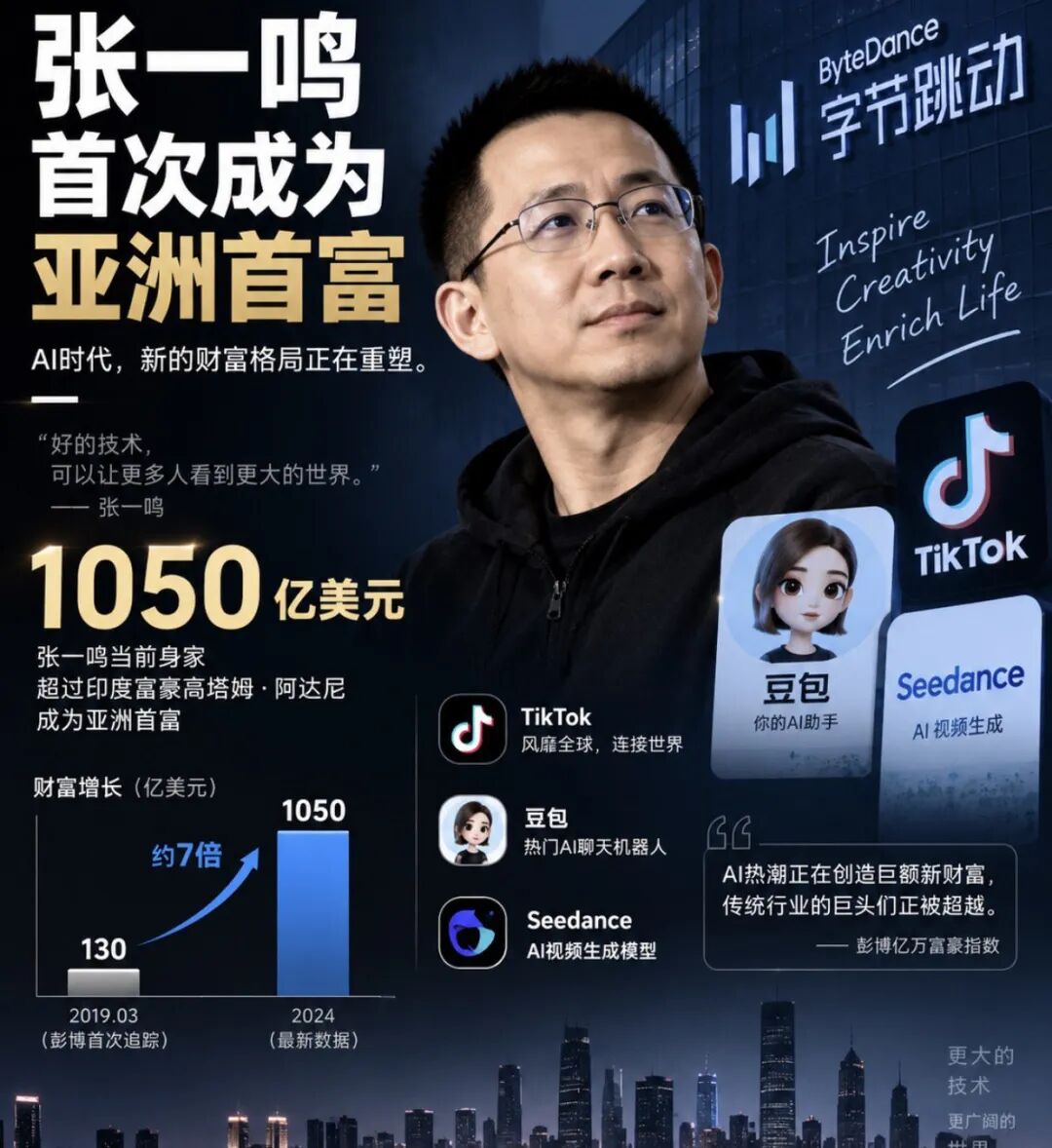
Image source: Smart Finance AI rendering
In terms of revenue structure, ByteDance’s domestic operations contribute over 60%, while overseas revenue exceeds 30%.
The domestic market relies on three pillars—advertising, e-commerce, and local services—to maintain its foundation. In 2025, domestic business growth reached approximately 20%, with e-commerce GMV growing nearly 30% and local services expanding rapidly through food delivery wars, achieving 50% GMV growth.
However, by H1 2026, domestic growth dividends had clearly faded. E-commerce GMV growth slowed to 15%, and local services GMV growth to around 30%, prompting ByteDance to lower its full-year targets for these businesses. Realistically, with domestic traffic peaking and consumer pressure mounting, relying solely on the domestic market makes sustained high growth difficult.
A significant portion of ByteDance’s growth now comes from overseas markets.
In 2025, ByteDance’s overseas revenue reached approximately $60 billion, up over 50%, with TikTok e-commerce being the biggest contributor, achieving 70% GMV growth. Early this year, TikTok reached an agreement with the U.S. government, removing its biggest overseas obstacle and accelerating commercialization.
Industry estimates suggest that of ByteDance’s 30% overall growth in H1 2026, overseas operations contributed over 40%, while domestic operations contributed less than 20%. This is the biggest gap between ByteDance and other domestic internet companies: while competitors fight over domestic market share, ByteDance taps into global incremental markets, with advertising and cross-border e-commerce offering immense potential.
What drives ByteDance’s valuation higher and Zhang Yiming’s net worth upward is its all-in bet on artificial intelligence.
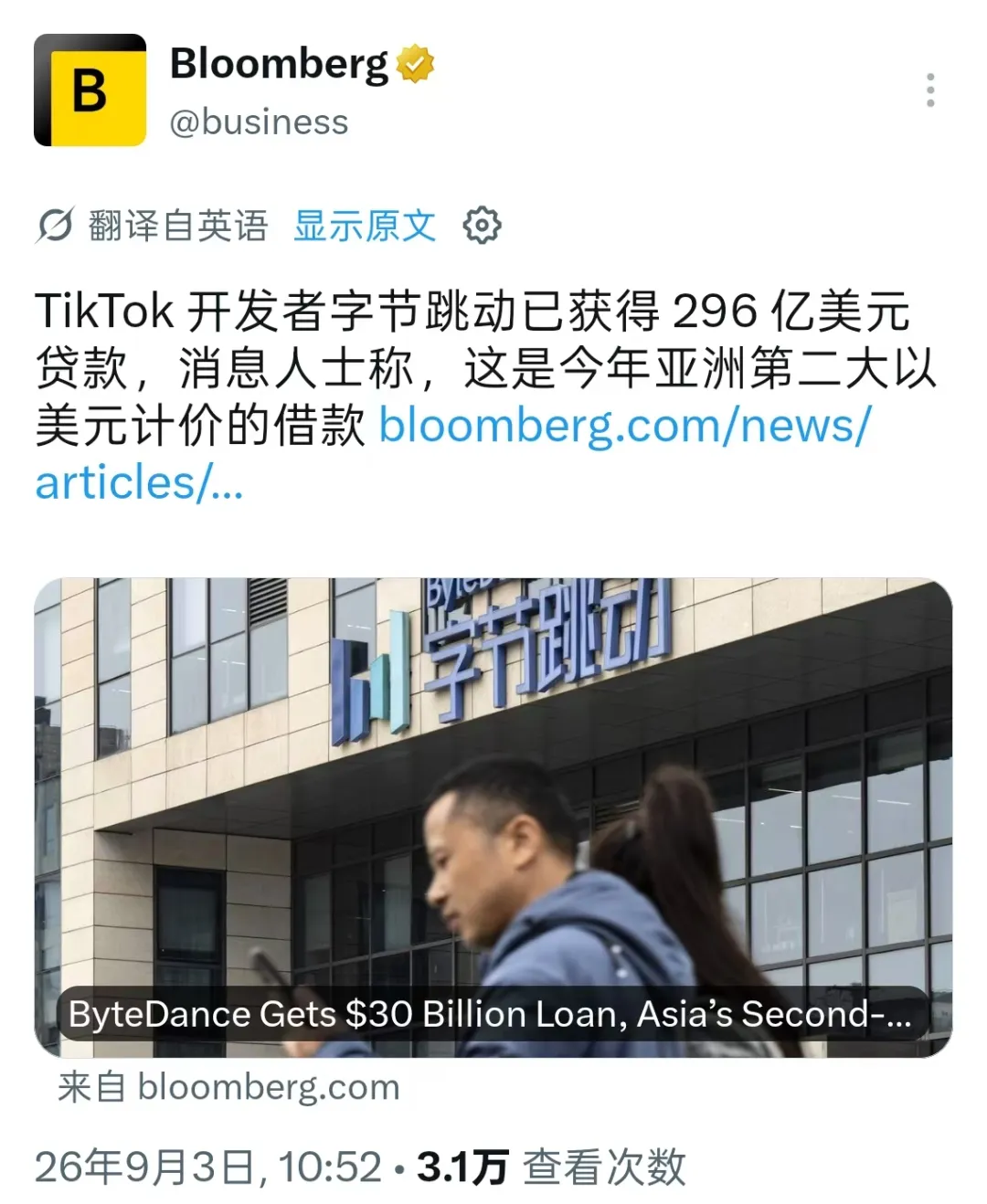 Image source: X social platform
Earlier reports indicated that ByteDance secured a $29.6 billion loan from banks—the largest in company history—primarily for AI investments. Today, ByteDance has built a complete AI matrix: on the consumer side, it offers Doubao AI and Seedance video generation models; on the enterprise side, Feishu continuously upgrades its AI capabilities; ByteDance Cloud remains a domestic second-tier player while developing proprietary inference chips, covering the entire stack from upper-layer applications and cloud services to underlying hardware.
In China’s highly competitive large language model sector, many companies use distillation techniques to quickly close the technology gap. However, ByteDance and Tencent are among the few domestic companies not accused of such practices.
 Image source: AI-generated rendering by Big Factory Finance Society
Beyond overseas regulatory considerations, this reflects Zhang Yiming’s philosophy: he prefers to accept short-term technological gaps rather than take shortcuts that would let others define his company’s technological ceiling. While ByteDance’s large models have yet to rank among the industry’s top tier, with its massive user base, diverse scenarios, and ample funding, the AI track still holds strong breakthrough potential.
04 ByteDance’s True Core: Capturing User Time, Business Without Boundaries
Many still perceive ByteDance as merely a short-video entertainment platform. In reality, short videos have never been its core business.
ByteDance’s underlying logic is algorithm-driven attention allocation: using algorithms to understand users, capture their time, and then monetize that massive attention by connecting it to the commercial world.
The most powerful aspect of this model is its extremely blurred business boundaries.
It started with information feeds, then expanded to short videos; short videos could carry ads or enable live commerce; commerce then extended into local services like in-store visits and food delivery. As long as user engagement remains high, new business models can continuously be layered on—a model Meituan and others envy as an "infinite war."
Data best proves ByteDance’s dominance over user time: among the total usage time of China’s top 50 apps, ByteDance-owned apps account for 40%, significantly higher than Tencent’s 29%. This means nearly 40% of Chinese internet users’ mobile time is spent on ByteDance products.
By capturing user time, ByteDance dominated the traffic era; in the AI era, its massive data and scenarios provide the foundation for continued competition.
Epilogue
Zhang Yiming’s ascent to Asia’s richest person at age 43 is not just a personal business myth but a signal of broader trends.
 Image source: Douyin
In the past, wealth concentrated in resources, energy, and physical industries; today, powered by the AI wave and globalization dividends, Chinese tech companies are stepping onto the global wealth stage’s center.
ByteDance, still unlisted, has grown into an overwhelming giant: its domestic scale surpasses Tencent and Alibaba, its overseas advertising revenue is set to top the global charts, it’s harvesting global incremental markets, and heavily investing in AI.
While it doesn’t need to go public to prove its strength, the market eagerly anticipates the shockwave ByteDance will send through the internet industry when it eventually lists.
The era of Chinese tech companies and artificial intelligence has only just begun.
Disclaimer: This article is solely a commentary by Big Factory Finance and does not constitute investment advice. All corporate data and regulatory events mentioned are from publicly available information and are for reference only; official sources should be consulted for confirmation. Images sourced from the internet; copyright holders may contact us for removal.
-
![]()
Good Stocks to Follow | AI Giant Calls for Slowdown, Goldman Sachs Bullish on SK Hynix Amid HBM Super Cycle Speculation
-
![]()
【Electric Equipment】Lingong's New Energy Mining Truck Project in Inner Mongolia Goes into Operation
-
![]()
Seres Steps into the Spotlight with AITO, Facing Its Own Set of Challenges
-
![]()
A Whole Two Years Behind Schedule! Hyundai Motor Postpones Autonomous Driving Launch to 2029—Is the World’s Third-Largest Automaker Falling Further Behind Its Chinese and U.S. Competitors?
-
![]()
Why Huawei’s ‘Delegation’ to Seres Was Inevitable
-
![]()
Hong Kong’s Maiden Five-Year Plan Paves the Way for Cross-Border Autonomous Driving
-
![]()
Doubao Second-Generation Phone Goes on Sale Today: An Ultimate Experiment on 'Who Controls the Phone'
-
![]()
Doubao 2nd-Gen Mobile Phone Goes on Sale Today: An Ultimate Experiment on 'Who Controls the Phone'