A Whole Two Years Behind Schedule! Hyundai Motor Postpones Autonomous Driving Launch to 2029—Is the World’s Third-Largest Automaker Falling Further Behind Its Chinese and U.S. Competitors?
 09/17 2026
 518
518
Introduction
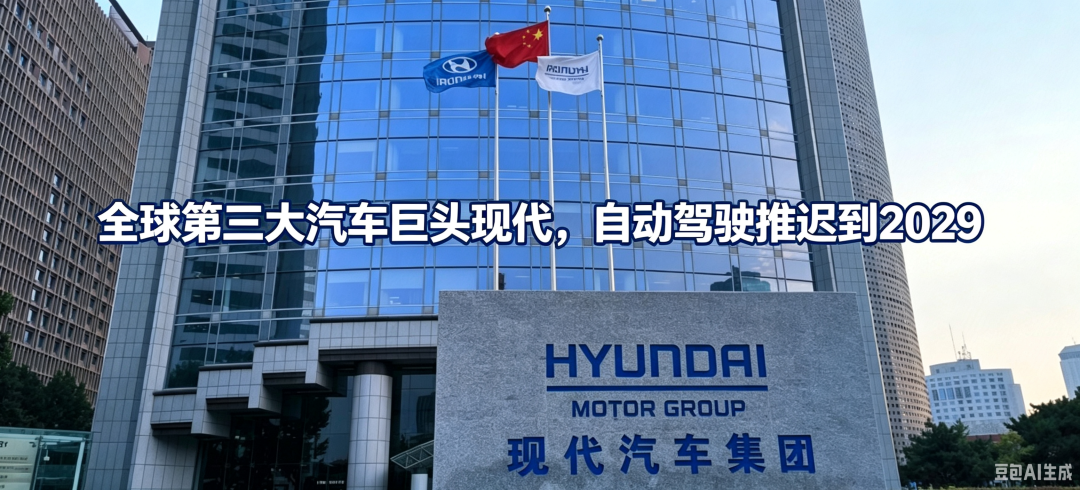
Despite annual sales exceeding 7 million vehicles and holding the title of the world’s third-largest automaker, Hyundai has pushed back the launch of its in-house autonomous driving software by a full two years.
Hyundai Motor Group recently announced that its proprietary driving assistance software, Atria, will be delayed from late 2027 to late 2029, with NVIDIA stepping in to bridge the gap during this transition.
Industry observers are raising concerns: Could this South Korean automotive powerhouse be falling even further behind Tesla and its Chinese rivals in the race for autonomous driving supremacy?
Let’s delve into this topic with insights from Self-Driving Car Era, a WeChat Official Account.
(For further reading, please click: "Hyundai Motor Partners with Momenta: Betting on China’s Intelligent Driving! Global Auto Giants like Mercedes-Benz, BMW, Audi, Cadillac, Buick, and Toyota Are All Collaborating with Chinese Leaders like Huawei and Momenta")
I. The Significance of a Two-Year Delay
On September 13, 2026, a Reuters report cast a shadow over Hyundai Motor Group’s autonomous driving ambitions.
The report revealed that Hyundai would postpone the release of its self-developed driving assistance software until the end of 2029—a full two years later than initially planned. In the interim, Hyundai will partner with NVIDIA to launch Level 2+ and Level 2++ driving assistance systems in 2028.
“Level 2+” typically denotes advanced driving assistance for highway driving, while “Level 2++” can handle more complex urban driving scenarios, with performance nearing that of Tesla’s FSD system. Both levels require the driver to remain fully attentive at all times.
What does a two-year delay mean in the fast-paced autonomous driving industry?
Tesla’s FSD has already progressed from v12 to v15, Baidu Apollo has achieved fully driverless operations in cities like Beijing, Wuhan, and Shenzhen, and companies such as WeRide and Pony.ai have launched commercial projects in the Middle East and Europe.
While competitors are pushing boundaries every quarter, a two-year delay could transform a “catch-up player” into a “laggard.”
Hyundai Motor Group’s Executive Chairman Chung Eui-sun acknowledged by late 2025, “We are a bit late. There may be some gaps between Hyundai Motor Group and Tesla or our Chinese competitors.”
II. Leadership Changes and Strategic Shifts: Hyundai’s “Three-Pronged Rescue Plan”
Hyundai Motor is not oblivious to its challenges. In fact, the South Korean giant has made three key strategic adjustments over the past year.
Move 1: Leadership Overhaul
In January 2026, Hyundai Motor recruited Park Min-woo, a former NVIDIA executive, as President of the Advanced Platform Division and CEO of its autonomous driving subsidiary, 42dot.
Park was a core member of Tesla’s early Autopilot team and led the design of Tesla Vision. He later oversaw autonomous driving perception technology at NVIDIA. His appointment signaled Hyundai’s shift from “self-development first” to “collaboration first”—a stark contrast to his predecessor, Song Chang-hyeon, who had vigorously promoted software self-development before suddenly resigning in December 2025.

Park Min-woo. Source: Hyundai Motor Group’s official website
Move 2: Strategic Partnerships
Hyundai chose to deepen its collaboration with NVIDIA, developing its intelligent driving system based on the latter’s Hyperion 10 platform.
At a media briefing, Park sought to reassure stakeholders: “Our collaboration with NVIDIA does not mean we are handing over our fate entirely to them.”
He emphasized that Hyundai would co-design technology with NVIDIA and use the generated data to train its self-developed platform, Atria.
Move 3: Cost Optimization
A notable detail is that Hyundai’s initial models based on NVIDIA’s platform will forgo expensive LiDAR sensors in favor of a solution combining cameras, ultrasonic sensors, and radar.
Park stated that LiDAR might be considered for more advanced L3 systems but did not provide a commercialization timeline.
This approach contrasts with the industry’s mainstream trend, as leading Chinese Robotaxi companies generally adopt multi-sensor fusion solutions to ensure safety through redundant perception.
III. Quantifying the Gap: The Numbers Speak for Themselves
Hyundai Motor’s confidence stems from its massive global vehicle fleet. Hyundai and Kia combined sell over 7 million vehicles annually, ranking third globally.
Park stated that he plans to leverage this scale advantage to collect data, expecting cumulative driving data to surpass competitors by 2033.
But the reality is: When your rivals are also accumulating data at the same or even faster pace, being a “latecomer” does not guarantee you will “arrive first.”
Let’s compare a few key metrics:
Tesla: Boasts the largest FSD fleet globally, with cumulative autonomous driving miles continuing to lead the industry.
Pony.ai: As of August 2026, its Robotaxi fleet totaled 1,975 vehicles, with cumulative autonomous driving miles exceeding 100 million kilometers. It plans to expand to 3,500 vehicles by the end of the year and complete deployment in 20 major cities worldwide.
WeRide: Partnering with Uber, it plans to deploy at least 1,200 Robotaxis in the Middle East, with services in Abu Dhabi already achieving dozens of orders per vehicle per day, approaching the break-even point for the Bicycle Economy Model (per-vehicle economic model).
Hyundai Motor: Currently has only about 40 dedicated data collection vehicles, with its autonomous driving fleet size far behind leading Chinese companies.
More noteworthy is the changing industry landscape.
From Abu Dhabi to Hong Kong, from Singapore to Croatia, Chinese autonomous driving companies are accelerating their global expansion through a model of “technology empowerment + local assets + platform traffic.”
As Chinese companies advance commercialization in multiple cities worldwide, Hyundai’s “2029” target seems increasingly distant.
IV. The Deeper Issue: Hardware Giants’ “Software Anxiety”
Hyundai Motor’s predicament reflects a broader challenge: Can traditional hardware giants’ organizational capabilities keep pace as the automotive industry’s competitive core shifts from “vehicle manufacturing” to “software”?
Hyundai Motor possesses world-class manufacturing capabilities, a global supply chain, and a distribution network.
However, in the race for autonomous driving—which requires rapid iteration, tolerance for trial and error, and data as fuel—the “engineering mindset” of hardware companies may become a liability.
An analysis by South Korea’s Korea Daily hit the nail on the head: “Hyundai Motor Group faces structural limitations in the software-driven competition for autonomous driving technology. Hardware engineers and software developers inevitably differ in their pace and understanding of technological development—this is a problem that requires changing the company’s DNA.”
The departure of Park’s predecessor, Song Chang-hyeon, speaks volumes.
This tech leader, whom Chung Eui-sun had high hopes for and who had acquired his startup 42dot for 427.6 billion won, ultimately left in disgrace due to “slow progress in self-developed autonomous driving business.”
The successor, Park Min-woo’s, strategic shift from “self-development first” to “collaboration first” is both a pragmatic choice and a reluctant compromise.
In conclusion, Self-Driving Car Era believes:
For Hyundai, 2029 is not the finish line but the starting point of a major test.
Even if Atria AI is installed on vehicles as scheduled, it must still pass the test of large-scale real-world driving conditions and compete with rivals that have already established data-driven feedback loops.
Hyundai’s delay serves as a wake-up call to all traditional automakers: Massive sales volumes do not automatically translate into competitiveness in the software era.
What do you think, dear readers?
References: Public reports from Global Market Report, ECNS, Hyundai Motor Group’s official website, Hong Kong News Network, Gasgoo, Economic Network, Web Portal, etc.
-
![]()
Beauty Joins In, ByteDance Ramps Up Investment Game
-
![]()
Jensen Huang Hits Back at Ray Dalio: Is AI the Next Big Financial Bubble?
-
![]()
Battle for the Gateway to the World Model: ByteDance Leans Left, JD.com Leans Right
-
![]()
The Deeper Automakers Venture into Self-Developed Batteries, the More Apparent the Greatest Challenge Becomes
-
![]()
Seres No Longer Relies on Huawei for Growth
-
![]()
Good Stocks to Follow | AI Giant Calls for Slowdown, Goldman Sachs Bullish on SK Hynix Amid HBM Super Cycle Speculation
-
![]()
【Electric Equipment】Lingong's New Energy Mining Truck Project in Inner Mongolia Goes into Operation
-
![]()
Seres Steps into the Spotlight with AITO, Facing Its Own Set of Challenges