Good Stocks to Follow | AI Giant Calls for Slowdown, Goldman Sachs Bullish on SK Hynix Amid HBM Super Cycle Speculation
 09/17 2026
 495
495
The AI safety controversies have introduced new uncertainties into the surging computational power investments. However, Trump and Huang Renxun's opposition to a slowdown, coupled with cloud vendors continuing to increase their capital expenditures, indicates that the construction of AI infrastructure has not truly cooled down. As the leader in the HBM market, SK Hynix is locking in demand through long-term agreements while significantly increasing its capital expenditures and accelerating new capacity construction, attempting to translate its technological lead into longer-term profitability advantages. However, with Samsung and Micron accelerating their pursuit, along with the gradual release of new industry capacity, whether SK Hynix can maintain its market share and high-profit levels still depends on the growth rate of HBM demand, product iteration capabilities, and the ROI of new capacity.
Design 丨 Tian
AI 'Slowdown' Sparks Stock Price Volatility, Goldman Sachs Remains Bullish on SK Hynix
On September 12, Anthropic CEO Dario Amodei called for a 'slowdown in the development of frontier models.' OpenAI CEO Sam Altman and Elon Musk subsequently expressed agreement, prompting market concerns over a cooling demand for AI computational power and collectively pressuring Nvidia, AMD, and Asian memory stocks.
Two days later, the situation took a turn. On September 14, during his speech at the All-In Summit in Los Angeles, Nvidia CEO Huang Renxun received a call from U.S. President Trump. Trump dismissed claims of AI runaway risks and calls for a slowdown as a 'hoax,' arguing that the U.S. should not cede its leading position to China. Huang responded on the spot: 'We will not let an AI slowdown happen.'
Also on this day, Goldman Sachs released a research report on the memory industry, maintaining a 'buy' rating on Samsung Electronics and SK Hynix, with a 12-month target price of 3.5 million won for SK Hynix—approximately 107% higher than its closing price of 1.69 million won on September 15.
On one side, AI companies are proactively discussing a slowdown, while on the other, the U.S. government, Nvidia, and capital markets continue to drive AI infrastructure expansion. Behind these two narratives, the real question worth studying is not whose voice is louder but whether the HBM super cycle that SK Hynix is betting on has sufficient demand and cash flow support.
AI Hype Hasn't Disappeared; It's Just Shifting from Model Competition to Capital Returns
Amodei's call for a 'slowdown' primarily targets more capable, higher-risk frontier models and does not equate to halting data center construction or canceling existing GPU and HBM orders.
Trump's public call with Huang Renxun clearly signals that the U.S. government will not push for a comprehensive AI pause for now. By linking AI competition to U.S.-China tech rivalry, Trump implies that even if some model companies voluntarily slow down iteration, the U.S. government remains motivated to drive continued expansion in chips, data centers, power, and cloud computing infrastructure.
Real capital expenditure data also shows no signs of cooling AI investments. FactSet estimates that the combined capital expenditures of five major cloud vendors—Alphabet, Amazon, Meta, Microsoft, and Oracle—will exceed $690 billion in fiscal 2026, up more than 80% year-over-year. Including finance leases and customer prepayments, capital expenditures could approach $800 billion in 2026.
This indicates that the primary issue facing the AI industry is not whether to continue investing but when such massive investments will translate into revenue and cash flow. By 2026, except for Alphabet and Microsoft, the free cash flow of the other cloud vendors is expected to approach zero or turn negative. While absolute AI investment amounts continue to rise, the market is beginning to demand that cloud vendors prove these GPUs and data centers are not just cash drains.
For SK Hynix, this is both a favorable and risky shift. As long as capital expenditures keep growing, HBM and server DRAM demand will remain supported. However, if AI commercialization fails to cover depreciation, interest, and operating costs, future capital expenditure cuts may stem not from safety regulations but from free cash flow pressures.
SK Hynix Transforms from Cycle Follower to Core AI Memory Supplier
By the end of Q2, SK Hynix had signed long-term supply agreements with nearly all global core AI chip and cloud computing clients, with contract terms generally exceeding five years and covering over half of its high-end memory shipments. These agreements employ tiered pricing mechanisms with differentiated adjustment rules, prioritizing supply stability and smoothing out cyclical fluctuations over maximizing short-term price hikes.
SK Hynix is one of the most direct beneficiaries of this round of AI infrastructure expansion.
Sustained growth in AI capital expenditures will ultimately flow through servers and GPUs to the memory segment, with HBM being the core of this memory cycle. As AI models rapidly increase their bandwidth and capacity requirements, HBM demand continues to expand. SK Hynix, which was the first to enter Nvidia's supply chain for HBM3 and HBM3E and began mass shipping HBM4 in Q2 2026, has shifted from a follower in traditional memory cycles to a core beneficiary of AI infrastructure expansion.
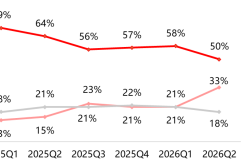
Having led in HBM3 and HBM3E adoption within Nvidia's supply chain, SK Hynix commenced volume shipments of HBM4 in Q2 2026, with HBM4E samples completed in the first half of the year. According to Counterpoint, SK Hynix held approximately 50% of global HBM market revenue in Q2 2026, remaining the global leader, though Samsung's share rose to about 33%, significantly narrowing the gap.
This data reflects SK Hynix's most critical challenge: while still the HBM leader, it no longer enjoys the same dominant market position as two years ago.
In Q1 2025, SK Hynix held about 69% of the HBM shipment share. By Q2 2026, its revenue share had fallen to 50%, indicating that Samsung and Micron's pursuit is starting to materialize. Future growth for SK Hynix cannot rely solely on overall HBM market expansion; it must also defend core clients like Nvidia and secure above-average industry share in HBM4 and HBM4E.
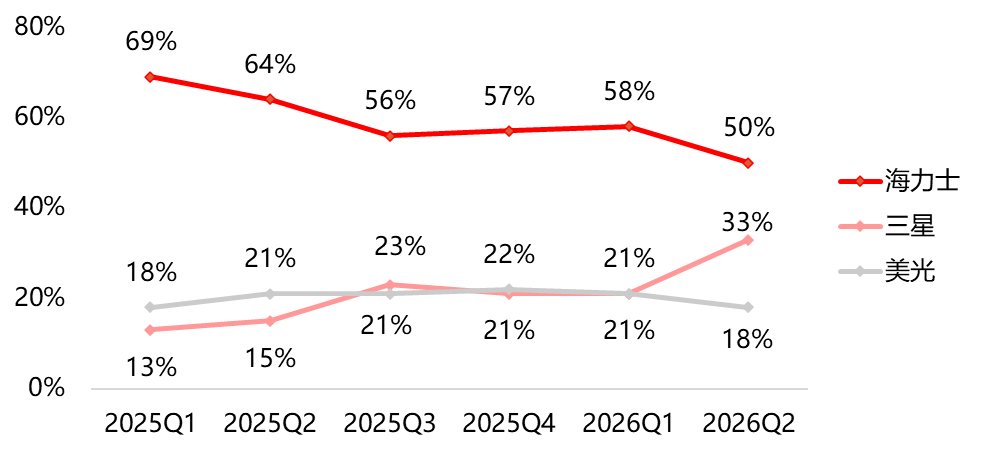
Source: Counterpoint
HBM Leadership: More Than Just 'Early Mass Production'
SK Hynix's competitive edge in the HBM market stems from four key areas.
First is its multi-generation mass production experience. HBM's commercial competitiveness hinges not on laboratory samples but on maintaining stable yields in large-scale production. From HBM3 and HBM3E to HBM4, SK Hynix has accumulated more wafer, stacking, and packaging data, enabling faster resolution of defects and thermal management issues during mass production.
Second is advanced packaging capabilities. HBM requires vertical stacking of multiple DRAM layers, with higher stack counts complicating heat dissipation, warpage, and yield control. SK Hynix employs packaging technologies like MR-MUF, gaining an early advantage in high-layer products. For HBM4E and beyond, advanced packaging will become even more critical.
Third is joint development with clients. HBM4 introduces more complex base dies, requiring memory vendors to engage earlier in GPU and ASIC chip design. Once products are certified and integrated into client platforms, switching suppliers incurs high costs. SK Hynix's multi-generation collaboration with Nvidia encompasses not just procurement contracts but also design, verification, packaging, and delivery systems.
Finally, effective capacity matters. HBM market competition hinges not on planned capacity but on certified, yield-targeted, and timely-delivered effective capacity. While Samsung boasts larger manufacturing scale and Micron is accelerating expansion, delayed product certification and yield ramp-ups can prevent nominal capacity from immediately translating into market share.
However, these advantages are not unbeatable. Samsung's integrated DRAM, foundry, and advanced packaging capabilities could amplify its vertical integration edge once HBM4 base dies adopt advanced nodes. Micron, though smaller overall, iterates technologies rapidly and benefits from U.S. supply chain advantages.
The true value of SK Hynix's current lead lies in its ability to continuously transition across two to three product generations—not in perpetually monopolizing the HBM market.
Capital Expenditures Surge from 30 Trillion to Nearly 50 Trillion Won
Responding to sustained customer demand, SK Hynix is undertaking the largest capacity expansion in its history.
In 2025, capital expenditures reached approximately 30.2 trillion won; in 2026, they are set to rise to nearly 50 trillion won, a year-over-year increase exceeding 50%. The company explains that the increase primarily aims to advance M15X mass production and prepare for rapid expansion after the cleanroom commissioning of its Yongin Phase 1 facility.
M15X, located in Cheongju, South Korea, is SK Hynix's core project for expanding advanced DRAM and HBM capacity. The company is accelerating its mass production timeline to meet demand for HBM4 and high-end server DRAM.
The Yongin semiconductor cluster represents a longer-term expansion hub. SK Hynix plans to open Phase 1 cleanrooms in early 2027 and has added approximately 21.6 trillion won in investment for its first wafer fab. Compared to M15X, Yongin will shoulder larger-scale wafer capacity expansion post-2027, with returns dependent on whether AI memory demand persists into the next cycle.
Beyond front-end wafer fabs, SK Hynix is constructing P&T7 advanced packaging facilities to address HBM backend packaging bottlenecks, while M17 focuses on NAND capacity and process upgrades. The company is also building an HBM advanced packaging base in Indiana, U.S., to shorten supply chain distances with North American AI clients.
In August 2026, the board approved approximately 54.3 trillion won ($38 billion) in investment plans for Korean factories. SK Hynix's expansion spans wafer manufacturing, HBM packaging, NAND, and overseas supply chains—not just adding HBM production lines.
This signifies a at least five-year capacity gamble by SK Hynix. If HBM demand sustained growth (continues to grow), early cleanroom and packaging capacity construction will help defend market share. If demand growth slows after 2027, new capacity could reintroduce industry oversupply.
HBM Expansion Also Drives Up Regular DRAM Prices
HBM demand's impact on SK Hynix extends beyond HBM revenue. HBM capacity expansion is squeezing regular DRAM capacity. As SK Hynix shifts more advanced capacity to HBM, regular DRAM supply tightens concurrently, further driving memory price increases.
In Q2 2026, SK Hynix's average DRAM selling price rose approximately 30% quarter-over-quarter, while NAND prices surged 50–60%. The company's profit growth stems from both HBM product mix upgrades and regular DRAM/NAND price hikes.
However, this logic is reflexive. Once new wafer fabs come online, if HBM demand fails to grow synchronously, excess capacity could flow back into the regular DRAM market, causing across-the-board price declines.
Thus, more aggressive expansion boosts current profits but heightens future supply risks.
Profits and Cash Flow Improve Sharply; Cash Reserves Support Expansion
Financially, SK Hynix has shed the funding pressures of the previous memory downturn.
In Q2 2026, revenue reached 79.32 trillion won, up 257% year-over-year; operating profit hit 60.54 trillion won, up 557%, with an operating margin of 76%. First-half revenue exceeded 100 trillion won for the first time.
Cash and cash equivalents reached 88 trillion won at period-end, up 33.6 trillion won from Q1; total debt fell to 18.6 trillion won, yielding a net cash position of 69.4 trillion won. At current profit and cash levels, the company's nearly 50 trillion won in annual capital expenditures will not immediately strain its balance sheet. However, Q2's 93.92 trillion won in net profit significantly exceeded its 60.54 trillion won in operating profit due to sizable investment gains and other non-operating items, so this net profit figure does not directly reflect sustained profitability.
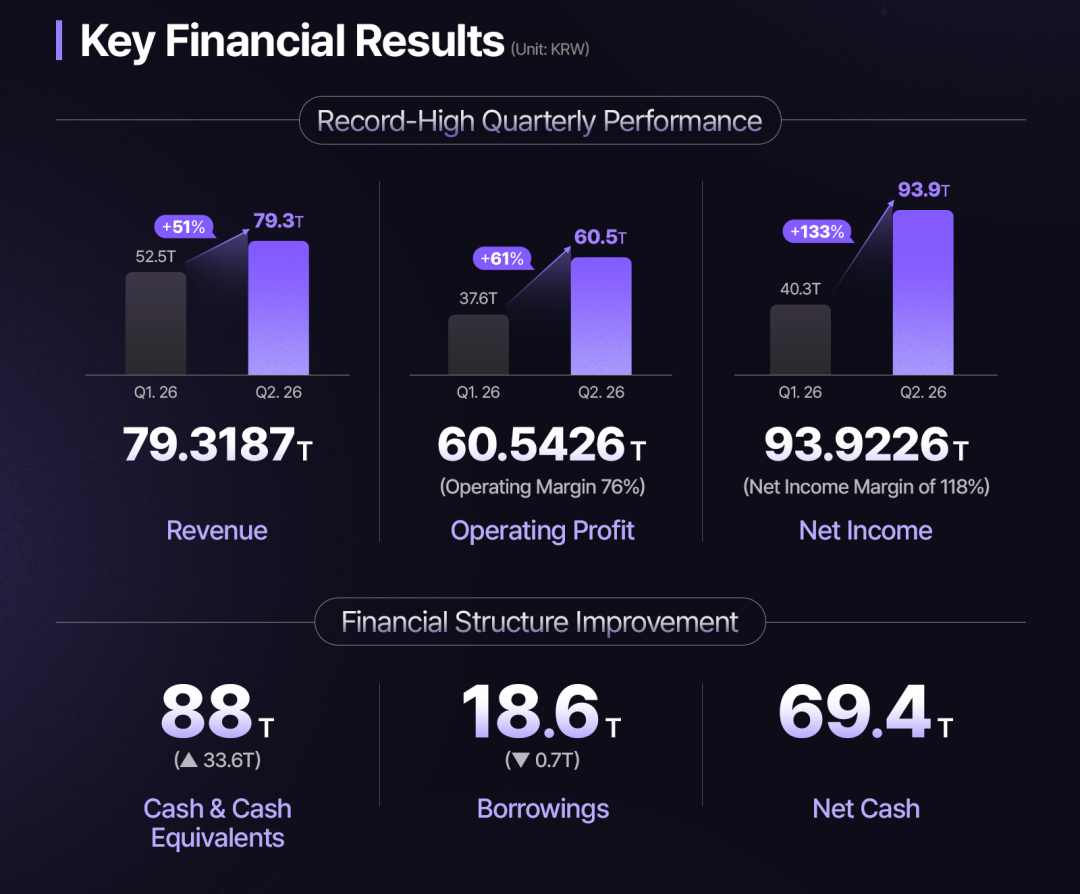
Source: SK Hynix Official Website
SK Hynix also announced a 40 trillion won share buyback and cancellation, pledging to allocate over 50% of cumulative free cash flow from 2025–2027 to shareholder returns. This reflects how the current AI memory boom has translated into real cash but also increases capital allocation pressures: the company must simultaneously fund expansion, shareholder returns, and employee profit-sharing.
For SK Hynix, the question has shifted from 'Can we afford to expand?' in the previous cycle to 'Can expansion continue to deliver sufficiently high ROI?'
Long-Term Agreements Enhance Visibility but Don't Eliminate Cycles
SK Hynix has finalized long-term supply agreements with about 10 core clients, extending contract terms from primarily annual negotiations to 3–5 years and introducing prepayments of 10–30% of contract value. Clients are locking in capacity with real cash upfront, strengthening contract enforceability and providing clearer demand guidance and cash support for SK Hynix's M15X, Yongin, and advanced packaging expansions.
More critical is the pricing shift. Traditional long-term agreements typically set both price floors and ceilings, with vendors trading some upside for stable orders. SK Hynix's new agreements remove price ceilings while retaining floors, offering downside protection during price declines and allowing further price hikes during supply tightness, preserving full profit elasticity in upcycles. This more favorable contract structure reflects how, amid current memory supply shortages, pricing power is shifting from clients to leading memory makers.
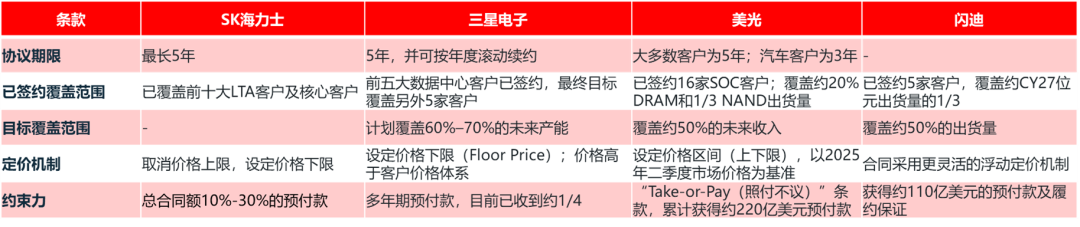
Source: Goldman Sachs, Public Information Compilation
However, pricing terms vary by client, and contracts do not cover all capacity. Prices remain subject to market supply-demand dynamics. Thus, while long-term agreements reduce risks of sudden order cancellations and price crashes, improving visibility into future revenue, cash flow, and expansion ROI, they cannot fully eliminate memory cycles driven by supply-demand shifts.
Market Share and Expansion ROI Will Determine Success in 2027
Goldman Sachs expects HBM's comprehensive average selling price to rise approximately 100% year-over-year in 2027 and assigns SK Hynix a 3.5 million won target price. Its valuation method uses average forecast EPS for 2026 and 2027, applying a 9x target P/E ratio.
The use of average two-year profits instead of directly using the single-year profit of 2026 actually acknowledges that SK Hynix still exhibits distinct cyclical characteristics. Goldman Sachs' bullish stance is primarily based on the belief that the market's concerns over AI deceleration, peak memory prices, and expansion by Chinese manufacturers have already been largely reflected. However, the 2027 HBM4 product upgrades, supply constraints, and price increases in ordinary DRAM could still drive earnings revisions upward.
However, for SK Hynix to reach this target price, at least four conditions must be met: cloud providers' capital expenditures do not experience significant downward adjustments; the yield rates for mass production of HBM4 and HBM4E remain leading; Samsung's market share gains do not trigger intense price competition; and the new capacity additions at M15X and Yongin achieve sufficiently high returns.
The most apparent risk currently is a decline in market share. SK Hynix's HBM share has fallen from over 60% to around 50%, while Samsung's has risen to approximately 33%. If Samsung continues to narrow the gap during the HBM4 phase, SK Hynix, even if it remains in the top position, may lose its near-monopolistic bargaining power of the past.
The second risk stems from the free cash flow of cloud providers. The continuous upward revisions of capital expenditures in 2026 are positive for SK Hynix; however, the increasing proportion of external financing and leasing indicates that AI spending is becoming increasingly difficult to cover solely with internal cash flow. If AI service revenue growth lags behind depreciation, interest, and operating costs, capital expenditures from 2027 to 2028 may face stricter return assessments.
The third risk arises from SK Hynix's own capacity expansions. Annual capital expenditures approaching KRW 50 trillion, the early mass production of M15X, and the simultaneous progress of the Yongin project will lead to sustained increases in depreciation and fixed costs. As long as supply remains tight, the new capacity can quickly translate into profits; however, once prices decline, high fixed costs will also amplify profit declines.
Summary
The phone call between Trump and Huang Renxun indicates that the U.S. government will not proactively apply the brakes on infrastructure investment due to AI safety controversies for the time being. The continued upward revisions of capital expenditures by cloud providers also suggest that there has not been a significant cooling in actual orders.
SK Hynix is translating this assessment into annual capital expenditures of nearly KRW 50 trillion, along with a series of expansion projects, including M15X, Yongin, P&T7, M17, and an advanced packaging base in the United States. Its bet is not just on the undersupply of HBM in 2026 but on the sustained AI memory demand beyond 2027.
Based on the current situation, SK Hynix holds the largest market share in HBM, possesses multi-generation mass production experience, advanced packaging capabilities, core customer partnerships, and KRW 69.4 trillion in net cash, making it indeed one of the most capable companies to participate in this expansion race. However, it has also transitioned from being the 'biggest beneficiary of undersupply' to a stage where it 'needs to prove the returns on expansion.'
The core indicators for assessing SK Hynix should no longer be solely HBM revenue growth but should shift to HBM4 yield rates, market share, unit capital expenditure output, free cash flow, and ROE after the commissioning of new capacity. If these indicators continue to remain high, SK Hynix may gradually break free from the valuation constraints of traditional cyclical stocks. However, if Samsung catches up, cloud providers reduce investments, and new capacity is released simultaneously, this round of the HBM supercycle may ultimately revert to the oversupply familiar to the memory industry.
Disclaimer:
1. This article is based solely on publicly available information and aims to provide factual observations and industry research references. It does not constitute any form of investment advice or an offer to buy or sell securities. The data regarding companies, stock prices, valuations, market shares, etc., mentioned in the article are sourced from publicly disclosed documents by issuers, HKEX's Disclosure of Interests, public news reports, and third-party research. This account does not provide any explicit or implicit guarantees regarding their completeness or accuracy.
2. Any investment decisions made by readers based on this article are at their own risk and consequence. Regulatory requirements differ between the Hong Kong and mainland markets, and cross-border investments require attention to policy, exchange rate, liquidity, and compliance risks.
3. Investment involves risks; decisions should be made cautiously.
-
![]()
Beauty Joins In, ByteDance Ramps Up Investment Game
-
![]()
Jensen Huang Hits Back at Ray Dalio: Is AI the Next Big Financial Bubble?
-
![]()
Battle for the Gateway to the World Model: ByteDance Leans Left, JD.com Leans Right
-
![]()
The Deeper Automakers Venture into Self-Developed Batteries, the More Apparent the Greatest Challenge Becomes
-
![]()
Seres No Longer Relies on Huawei for Growth
-
![]()
Good Stocks to Follow | AI Giant Calls for Slowdown, Goldman Sachs Bullish on SK Hynix Amid HBM Super Cycle Speculation
-
![]()
【Electric Equipment】Lingong's New Energy Mining Truck Project in Inner Mongolia Goes into Operation
-
![]()
Seres Steps into the Spotlight with AITO, Facing Its Own Set of Challenges