Net Worth Skyrockets! Liang Wenfeng Might Overtake Zhang Yiming as China’s Wealthiest Individual
 09/18 2026
 504
504
 Image Source: Smart Finance and Economics
In 2026, the world's premier 'wealth creation arena' will shift from consumer goods and new energy to the AI sector, sparking a new wave of wealth generation and discussion.
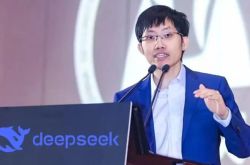
On September 9, news rippled through major financial circles: DeepSeek has confirmed CITIC Securities as its sponsor and is gearing up intensively for an IPO on the Science and Technology Innovation Board. Once the news broke, founder Liang Wenfeng was immediately catapulted into the public spotlight, hailed as the 'next Chinese richest man' and 'next Asian richest man.'
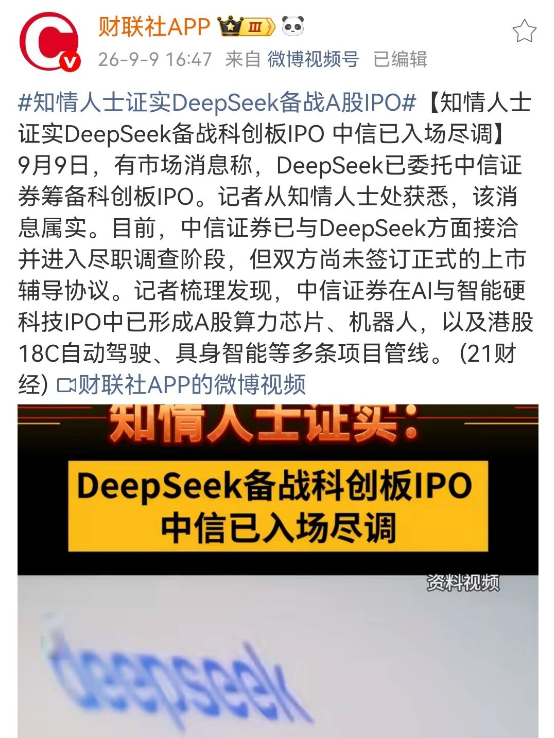 Image Source: Weibo
Let's do a simple calculation: Liang Wenfeng holds approximately 78% of DeepSeek's equity, making him the de facto controller of the company. Based on optimistic market expectations, if the company's market cap stabilizes at 1 trillion yuan after listing, his personal net worth would reach 780 billion yuan (approximately $116.24 billion).
On September 16, the Bloomberg Billionaires Index updated, stirring the wealth circle: Zhang Yiming’s personal net worth soared past 704.55 billion yuan (approximately $105 billion), officially crowning him Asia's richest man. In other words, as long as DeepSeek maintains a trillion-yuan market cap, Liang Wenfeng has the opportunity to surpass Zhang Yiming and claim the title of the wealthiest individual.
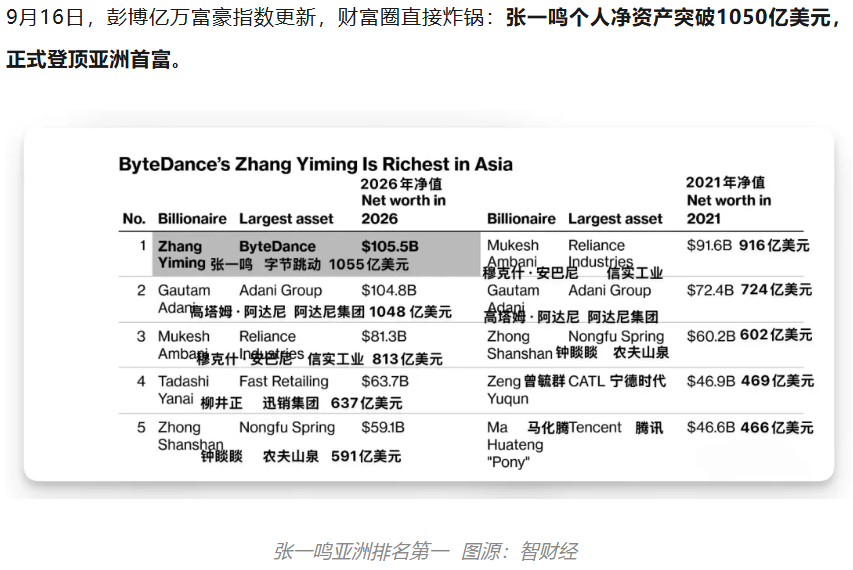
Zhang Yiming has just dethroned Indian tycoon Gautam Adani, who dominated Asia's wealth rankings for years, fundamentally reshaping Asia's wealth landscape. Within the next year, Liang Wenfeng may surpass Zhang Yiming to become China's and Asia's richest man.
While many focus on the 'change of the richest man' as a trending topic, this wealth story is fundamentally different from past ones. Zhang Yiming's wealth stems from the internet-era dividends of short videos and traffic advertising. In contrast, Liang Wenfeng's paper wealth essentially represents capital markets betting on breakthroughs in domestic large models overcoming overseas technical blockades—a vote of confidence in China's cutting-edge AI.
Once Committed to Three 'No's,' Now Fully Focused on IPO
Few would have predicted today's scenario two years ago.
DeepSeek was once known as the 'aloof outlier' in the AI circle. At its inception in 2023, Liang Wenfeng set three strict rules: no financing, no commercialization, and no roadshows. While other large model companies actively sought investments, DeepSeek quietly conducted closed-door R&D in Hangzhou, refusing any external funding.
This confidence stemmed from its backing by High-Flyer Quantitative, a top private equity firm with strong profitability capable of self-funding R&D without relying on capital markets.
However, the AI industry's arms race caught everyone off guard. By 2026, the industry's logic had completely changed. AI was no longer a laboratory technology game but had evolved into a cash-burning competition focused on computing power, infrastructure, and top talent. Clinging to old rules meant falling behind.
Liang Wenfeng personally overturned his own rules, initiating aggressive capital operations. In April this year, DeepSeek launched its first funding round, securing 51 billion yuan by June. The National Artificial Intelligence Industry Fund, Tencent, and CATL all participated, pushing the post-investment valuation to 400 billion yuan. The largest contributor in this round was not a corporate giant but Liang Wenfeng himself, who invested 20 billion yuan to maintain control.
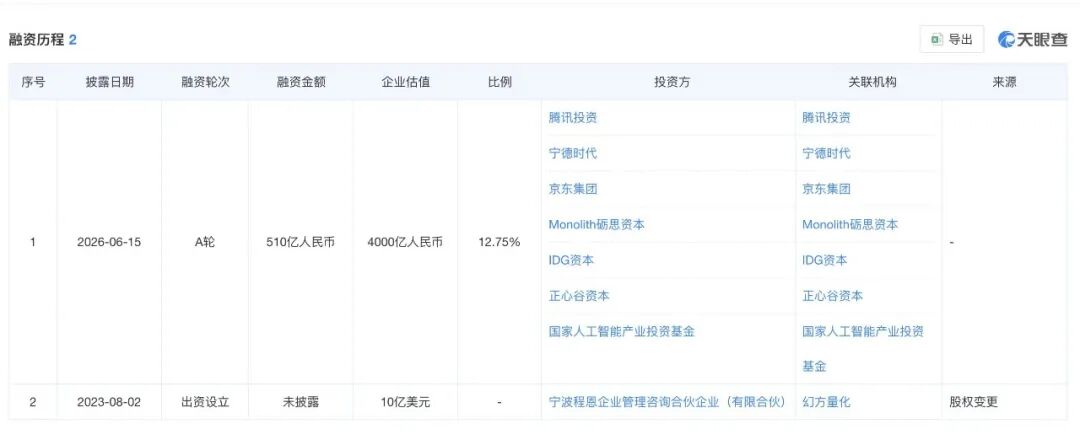
In June this year, DeepSeek completed its first external funding round.
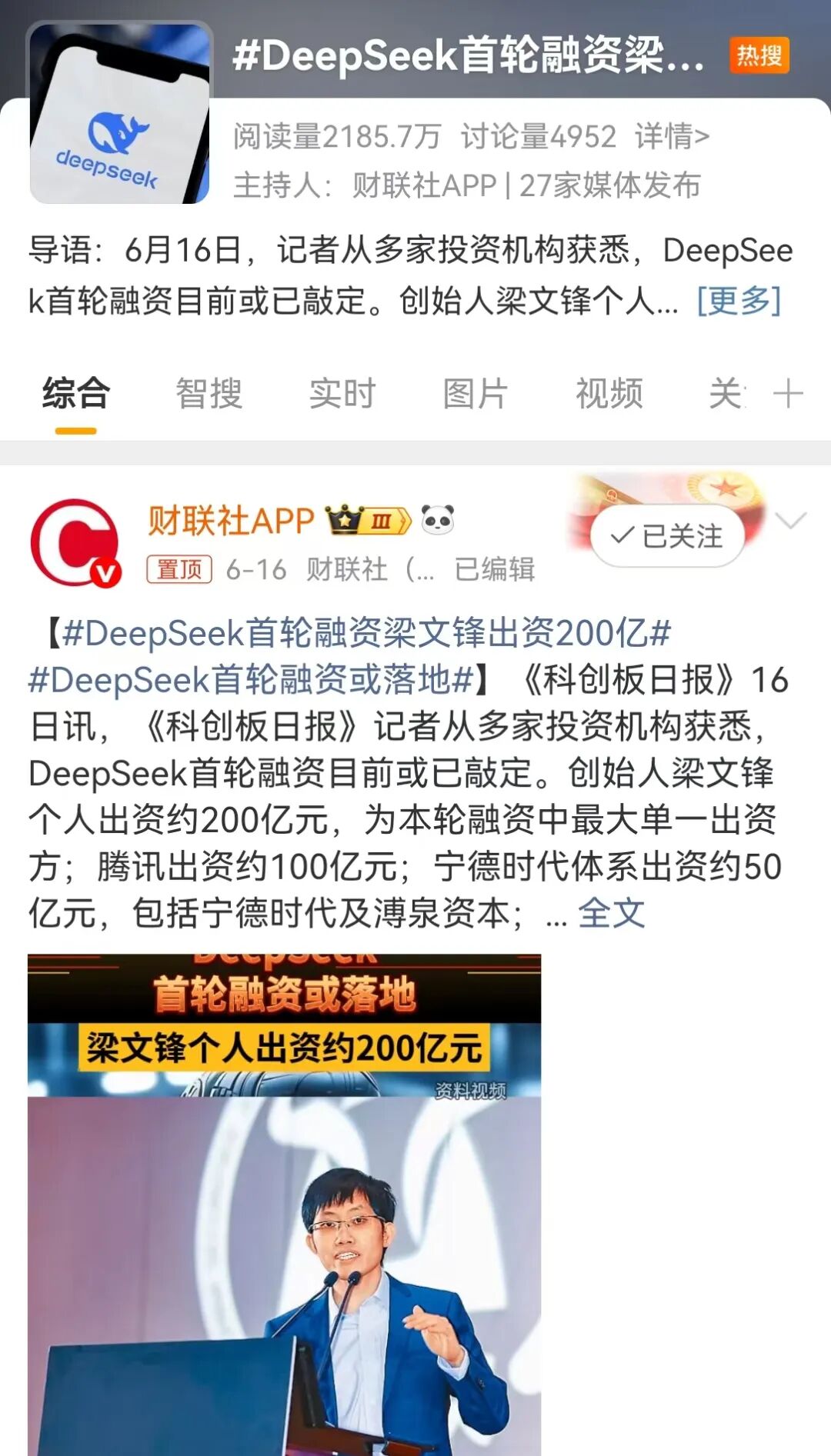 Image Source: Weibo
Shortly after the first round closed, a second 50 billion yuan funding round was launched, with the pre-investment valuation rising to 500 billion yuan. In just five months, DeepSeek went from rejecting external financing to preparing for a Science and Technology Innovation Board IPO.
Among the world's billionaires with the fastest-growing net worth, DeepSeek founder Liang Wenfeng ranks first globally in wealth growth speed.
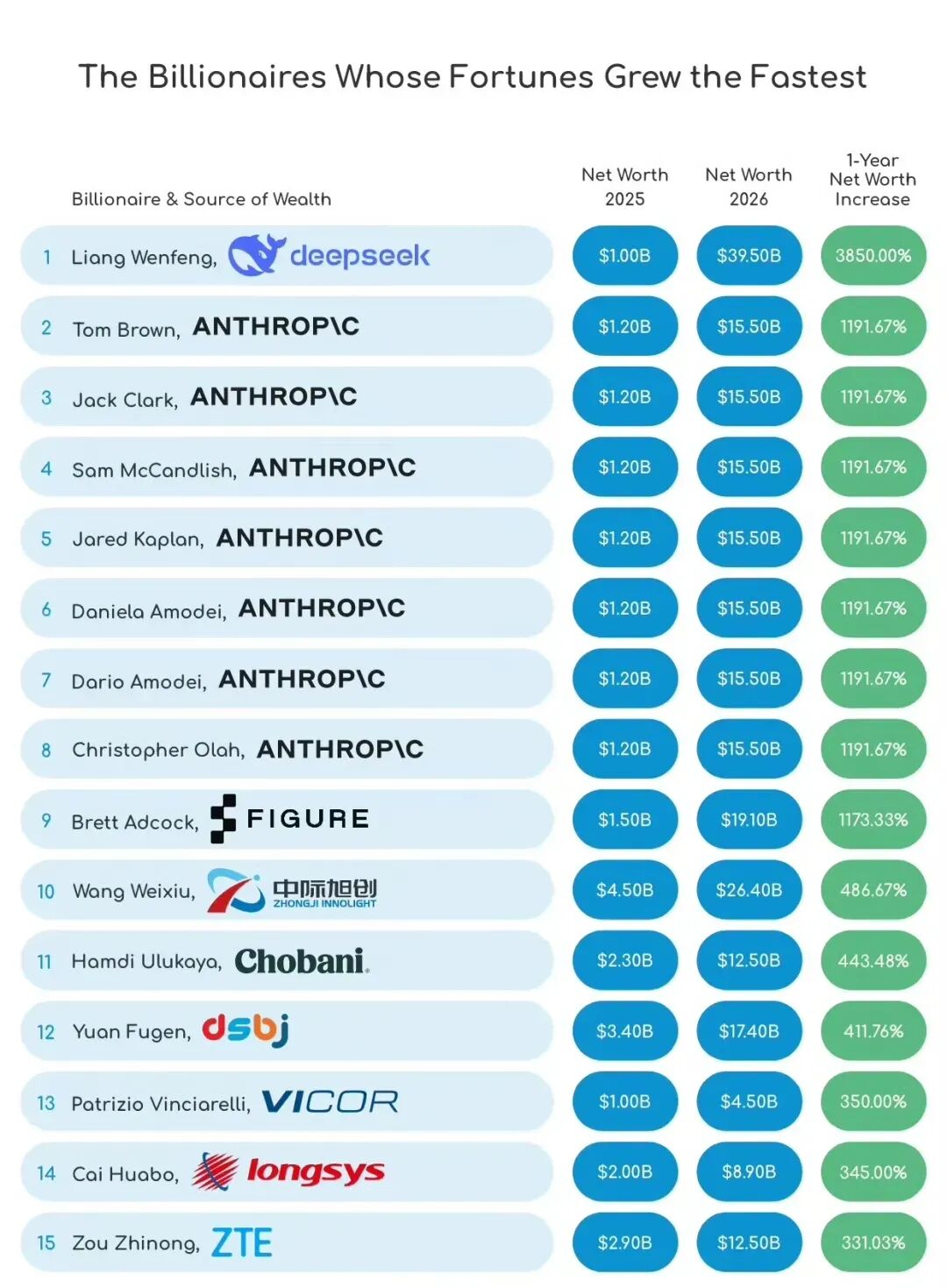
Image Source: Weibo
Data shows Liang Wenfeng's personal net worth surged from $1 billion (approximately 6.755 billion yuan) in 2025 to $39.5 billion (approximately 266.837 billion yuan) in this period, marking a 3,850% increase in one year and placing him among the world's 50 richest individuals.
Liang Wenfeng's astonishing wealth growth curve did not emerge out of thin air. It stems from DeepSeek's rapid rise in AI and capital markets' nearly frenzied valuation expectations for the AI large model sector.
This equity structure deserves special attention: no foreign capital is introduced, external investors enter through partnership platforms without voting rights, and a five-year lock-up period applies. While securing massive development funds, absolute control is retained—a case study repeatedly discussed in the primary market.
Outmaneuvering Rivals with 'Resource-Poor' Strategies Despite Hardware Disadvantages
The reality of Sino-U.S. AI competition is stark: NVIDIA GPUs continue iterating, while high-end chip supplies to China are cut off. OpenAI and Anthropic, with abundant resources, rely on top-tier GPUs to stack computing power and parameters, enhancing model capabilities. Hardware limitations leave China at an inherent disadvantage, unable to compete directly.
Since hardware offers no edge, DeepSeek adopted an asymmetric approach: maximizing algorithmic efficiency despite hardware shortcomings.
In early 2025, DeepSeekR1's debut stunned the overseas industry. While OpenAI spent $100 million to achieve certain model capabilities, DeepSeek accomplished similar results with just $5.57 million—1/18th the cost for comparable model performance.
Subsequent iterations accelerated: abandoning industry-standard supervised fine-tuning in favor of reinforcement learning to enhance deep thinking; developing self-researched sparse attention to address multimodal shortcomings; and launching the V4.1 Flash version on September 10, optimized for lightweight Agent intelligence.
The most accessible hardcore tech highlight for general readers: KV Cache achieved 437x compression. Simply put, while peers require massive video memory resources for the same tasks, DeepSeek's algorithmic compression drastically reduces resource consumption. Even deployed on domestic Huawei Ascend chips, its API business maintains an 83% gross margin.
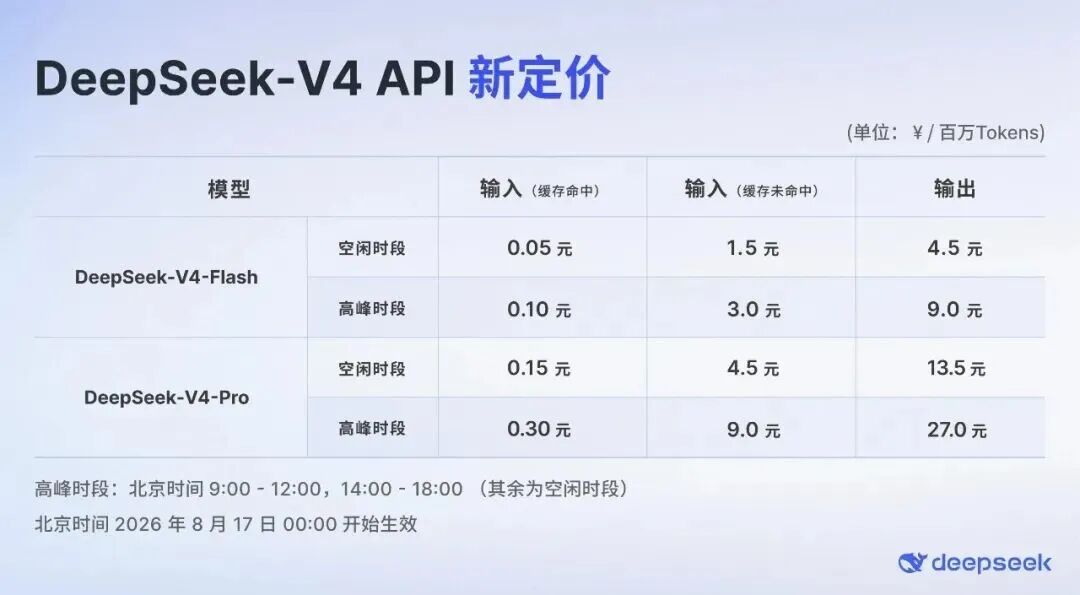

DeepSeek raised prices in August (top) and lowered them in September (bottom).
However, commercialization hasn't been smooth. In August, DeepSeek raised API pricing, only to face price wars from competitors, causing cost-sensitive small and medium developers to switch. Within just over 20 days, the company swiftly adjusted strategies, slashing prices with the new version's release—cache input costs dropped by up to 60%, regaining its cost-performance edge. This ability to withstand pressure and quickly correct course is a unique trait of this tech company.
Valuation Soars as All Funds Pour into Computing Infrastructure
Many netizens question: Why is DeepSeek still losing money despite its 500 billion yuan valuation?
The AI industry's core logic has shifted: short-term profitability is no longer the top priority. Securing computing resources, building data centers, and retaining top talent are now survival imperatives.
Public data shows DeepSeek's revenue reached 475 million yuan in the first seven months of 2026, ten times 2025's full-year total, with strong growth momentum. Its API gross margin ranks among China's best, yet it still posted a 715 million yuan net loss.
The 'losses' weren't wasted—nearly all went into long-term construction. Infrastructure spending hit 11 billion yuan this year, with a 1-gigawatt super data center built in Ulanqab, Inner Mongolia, deploying 160,000 Huawei Ascend 950DT chips to construct a massive domestic computing cluster.
Simultaneously, the company aggressively expanded hiring amid fierce competition for large model talent, with core team members constantly poached by rivals. A significant portion of future IPO proceeds will fund stock option incentives to stabilize the R&D team.
Even with High-Flyer Quantitative's strong profitability, it couldn't sustain such massive continuous investment. Liang Wenfeng's IPO push isn't about cashing out but securing secondary market ammunition to survive brutal industry competition.
Domestic Large Model Competition Intensifies, Head Tier Gaps Widen
After the Science and Technology Innovation Board and HKEX opened special tech listing channels, domestic large model companies flocked to capital markets. Zhipu AI and MiniMax have already listed in Hong Kong, while Moonshot AI is secretly advancing its HKEX IPO, with companies competing on funding, valuation, and commercialization speed.
The domestic independent large model valuation hierarchy is clear:
- DeepSeek: $71 billion, firmly industry leader
- Moonshot AI: $50 billion, close behind
- Zhipu AI: $49.5 billion
- MiniMax: $13.1 billion
- Stepwise Stellar, Zero One all things, and Baichuan Intelligence all have valuations below $3 billion, creating a vast gap with the top tier.
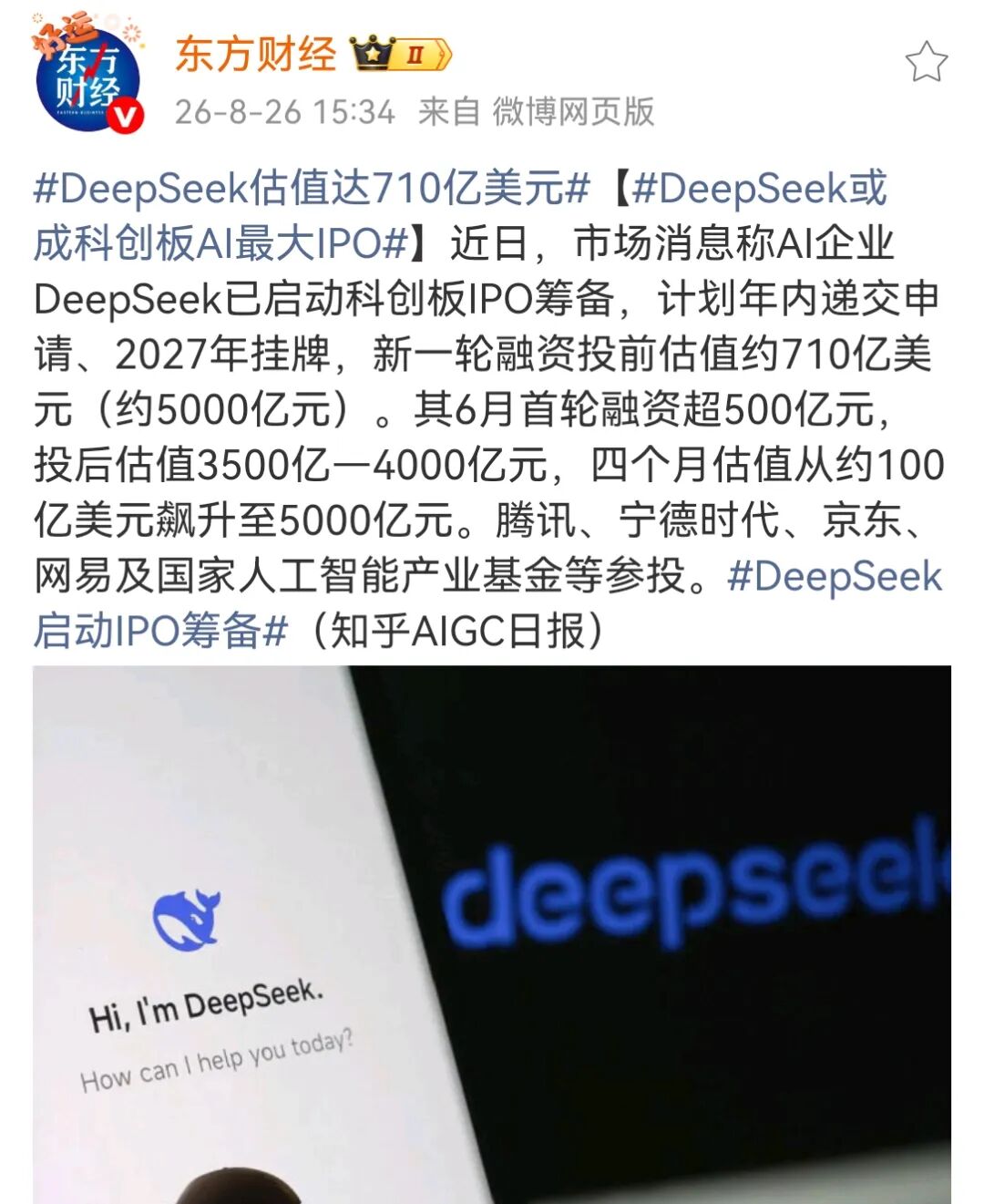
Image Source: Weibo
Switching to ARR (Annual Recurring Revenue) as a commercialization metric changes the landscape: Zhipu AI leads with 1.6 billion yuan ARR, Moonshot AI reaches 1 billion yuan through Kimi, MiniMax hits 800 million yuan from overseas markets, and DeepSeek stands at $500 million. While not the highest in revenue, DeepSeek's API gross margin leads by a wide margin, indicating superior profit quality.
The harsh reality is that all top independent large model companies remain unprofitable. MiniMax lost 2.5 billion yuan in the first half, while Zhipu AI lost 2.072 billion yuan. Compared to peers, DeepSeek's loss control is excellent. ByteDance, Baidu, Alibaba, and Tencent's large model businesses aren't independently split, making direct comparisons inappropriate.
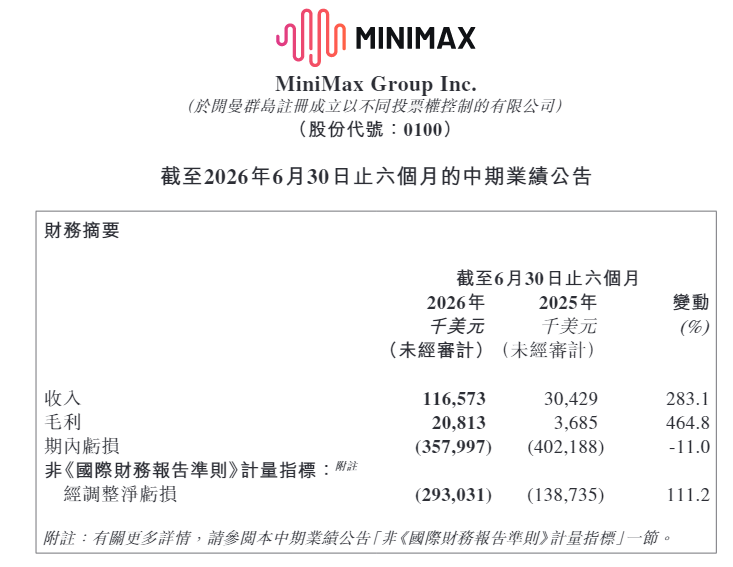
MiniMax Interim Results Announcement Image Source: Company Financials
Harsh Reality: A Tenfold Valuation Gap Between China and the U.S.
While AI enthusiasm runs high in China, the gap with overseas giants remains substantial. OpenAI targets a $1 trillion valuation upon listing, while Anthropic aims for $2 trillion. Both exceeded $13 billion in H1 revenue, with Anthropic achieving profitability.
In contrast, even if DeepSeek reaches 1.5 trillion yuan ($200 billion) upon listing, it would be just one-tenth of Anthropic's target valuation.
External geopolitical pressures continue mounting. On September 8, the U.S. Treasury Secretary publicly denied the possibility of China surpassing in AI, with multiple U.S. agencies issuing notices targeting domestic large model companies. Anthropic's reports also singled out several Chinese firms.
This containment, coupled with hardware disparities, is the reality facing domestic large models. While algorithmic optimization has ceilings—software ingenuity can narrow gaps but not eliminate hardware shortcomings—China's AI must rely on companies like DeepSeek for short-term algorithmic breakthroughs. Long-term success hinges on breakthroughs in domestic chips, HBM memory, and advanced manufacturing.
'Richest Man' Title Remains Speculative Amid Multiple Uncertainties
While trillion-yuan valuations and new richest man titles make for compelling headlines, these remain optimistic market projections, far from established facts.
First, the listing timeline is uncertain. DeepSeek hasn't completed Zhejiang CSRC tutoring registration yet. Under Science and Technology Innovation Board rules, tutoring lasts at least three months, and with review processes, listing might only happen in Q1 2027 at the earliest.
Second, the trillion-yuan valuation rests on multiple optimistic assumptions: sustained technological leadership, steady commercialization, and enduring AI sector enthusiasm. If market sentiment cools or industry price wars intensify, valuations could be reassessed.
Third, equity dilution is inevitable. Future employee stock incentives and IPO share issuances will reduce the founder's stake. If dilution exceeds expectations, Liang Wenfeng might not retain the richest man title even if the company hits a trillion-yuan valuation.
Putting aside the buzzword label of 'the richest person,' a signal of the times has emerged: the era of wealth creation through real estate and internet traffic is gradually coming to an end, and hard tech entrepreneurs are now taking center stage.
The story of Liang Wenfeng and DeepSeek is not just a capital market spectacle but also reflects the struggles and hopes of China's AI industry in breaking through external blockades. Whether the throne of China's richest person will be passed to hard tech entrepreneurs remains to be tested by the market and time.
Interactive Topic: Do you think DeepSeek can sustain a trillion-dollar market cap? Share your thoughts in the comments section.
Disclaimer: This article serves merely as an in-depth commentary on significant financial and economic trends and should in no way be considered as investment advice. The corporate data and details about regulatory events mentioned in this article are sourced from publicly accessible information and are provided solely for reference purposes. For the precise details, one should refer to official announcements. The images used in this article are obtained from the internet. In case of any copyright concerns, please do not hesitate to contact us for their prompt removal.
-
![]()
Under the Wave of Restructuring, Are the Struggling Neta and Zotye Making a Comeback?
-
![]()
Bumper Bookings! BAIC Unveils New Car, Securing Over 30,000 Reservations in Just One Hour!
-
![]()
Li Auto i9 Priced at 369,800 Yuan 'Shakes Up the Market': Is NIO ES8's 'Sales Dominance' Under Threat?
-
![]()
Net Worth Skyrockets! Liang Wenfeng Might Overtake Zhang Yiming as China’s Wealthiest Individual
-
![]()
Final Decision Unveiled: The Importance of FAW and GAC Signing the Letter of Intent
-
![]()
The Latest Statement from the Godfather of AI: Don't Trust Industry Self-Regulation, It Will Be Too Late When You React
-
![]()
Perfect Model, Zero Business Impact - The Last Mile of AI Commercialization | FDE Industry Research Report
-
![]()
Is Liang Wenfeng Set to Become China’s Wealthiest Individual by Appointing a Post-90s CFO?