Doubao Mobile Phone II: Can Its 'Knock' Feature Secure 380 Million Monthly Active Users Amidst Ecosystem Openness and Scheduling Rights Challenges?
 09/18 2026
 361
361
A New Era Dawns
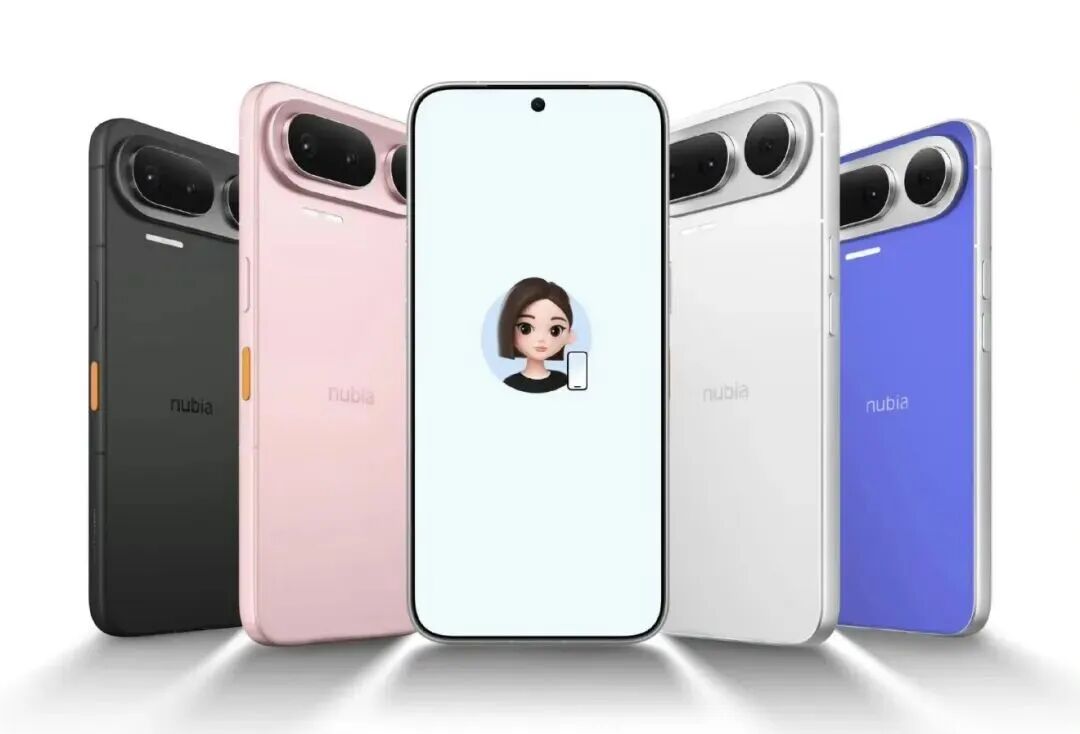
On the afternoon of September 16, Doubao Mobile Phone II made its grand debut, boasting a starting price of 5,999 yuan, or 5,499 yuan post-national subsidies.
This device, the Nubia NaviX Ultra, is a collaborative masterpiece between ZTE and ByteDance, following in the footsteps of the Nubia M153 (Doubao Mobile Phone I). Prior to its official release, the product garnered nearly 400,000 pre-orders on JD.com, firmly establishing itself as the world's inaugural AI agent smartphone.
In contrast to conventional smartphones, Doubao Mobile Phone's unique selling proposition lies in its ability to 'accomplish tasks with a single sentence.' This means AI can seamlessly execute a series of cross-app operations based on user directives, such as booking flights, sending messages, and hailing rides. During Doubao Mobile Phone I's tenure, the technical validation of this process was already accomplished. The industry consensus is that the proficiency in 'getting things done with one sentence' will continue to evolve with AI advancements. In fact, the allure of this capability was so strong that Doubao Mobile Phone I was once resold for over 13,000 yuan.
However, the path ahead was not as smooth as anticipated. When super apps imposed restrictions on ecosystem and operational permissions, and phone manufacturers tightened their grip on system-level scheduling, Doubao Mobile Phone I swiftly became obsolete in the hands of early adopters. Now, Doubao Mobile Phone II is making a triumphant return, but the products activatable with 'one sentence' remain confined within the ByteDance ecosystem and a select few open third-party applications, with the core conflict still unresolved.
From 'Breaking In' to 'Knocking': The Compromises of Doubao Mobile Phone II
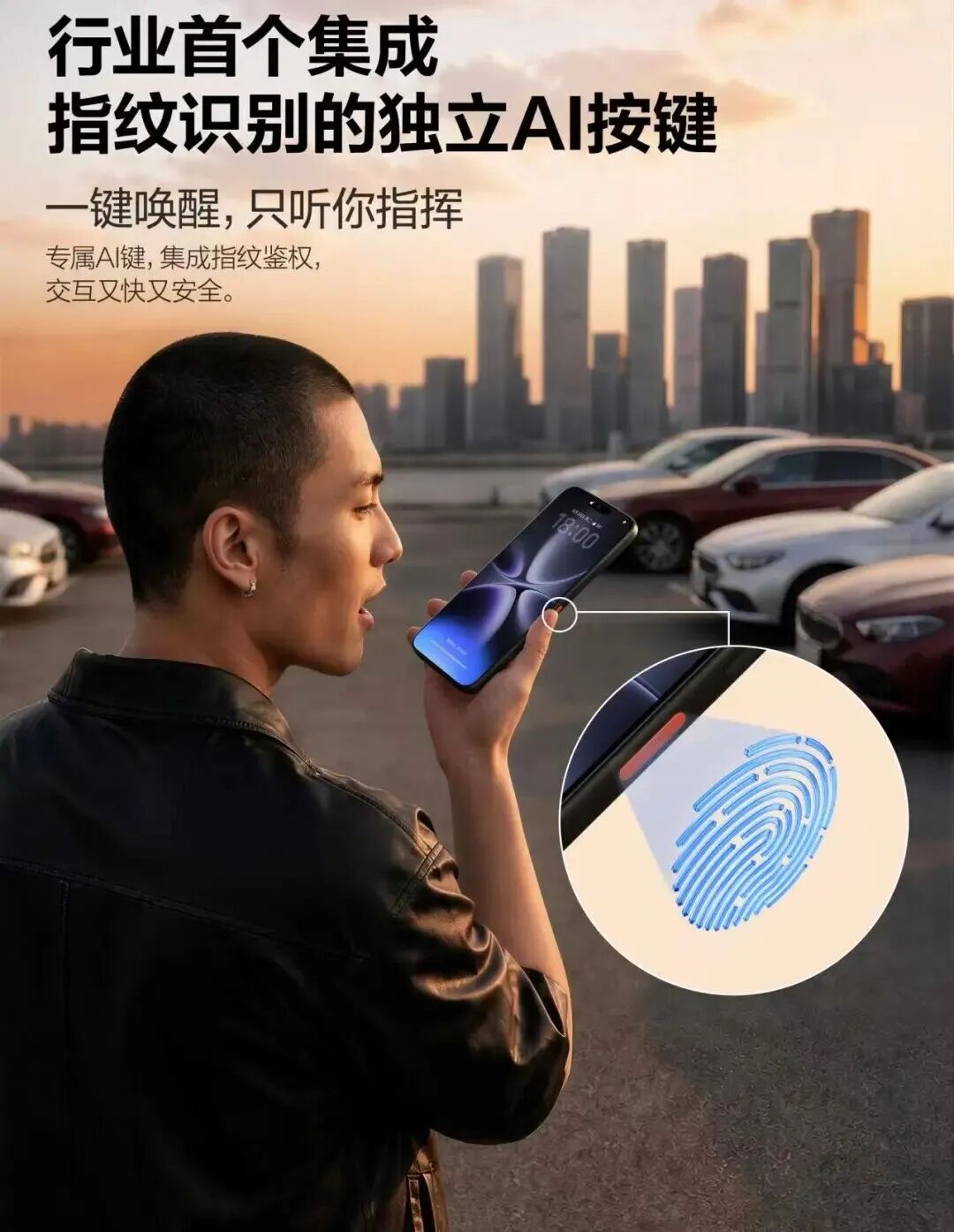
From a product innovation standpoint, Doubao Mobile Phone II introduces two significant changes. The first is the inclusion of an AI activation button, where the fingerprint unlock key on the phone's right side now doubles as an AI assistant activator, placing the AI activation entry before users access mobile apps.
The second change pertains to the execution process of the Agent (intelligent agent).
Understanding the core of 'getting things done with one sentence' is crucial; it revolves around 'letting the phone handle tasks for the user through an Agent.' Yet, the entire operation still necessitates crossing multiple app boundaries. Doubao Mobile Phone I achieved this by simulating GUI clicks, enabling AI to navigate corresponding apps and fulfill user instructions. However, this approach swiftly triggered risk warnings from super apps like WeChat, Taobao, and Alipay, leading to a concerted counterattack.
The crux of the issue lies in the fact that AI automation services lacked permission from the respective apps, rendering the operations akin to 'viruses' and constituting 'forced entry.' A deeper concern is that most internet platforms rely on user attention for revenue. Advertising services, a primary revenue stream for many platforms, hinge on user attention generated from browsing. Agent-based operations, however, 'eliminate' this attention, potentially disrupting existing business models—the key reason behind the platforms' countermeasures.
Thus, the most significant transformation in Doubao Mobile Phone II lies in its approach: Agents now execute user instructions through a combination of protocol calls like MCP and A2A, supplemented by GUI, with a clear preference for protocols. In essence, Doubao no longer operates in isolation but collaborates with Agents from other apps. In other words, Doubao 'knocks' before entering relevant apps. If permission is granted, it proceeds autonomously; if not, it relays user instructions to the corresponding app's Agent for completion based on the protocol. Tasks without an agreed protocol remain unfulfilled.
Currently, super apps favor the A2A model, which keeps Agent operations entirely within the platform's control. For instance, in June this year, reports surfaced about WeChat collaborating with phone manufacturers like Huawei, Honor, Xiaomi, and OPPO to introduce A2A assistant capabilities. At the time, Tencent customer service confirmed that multiple manufacturers had already completed integration.
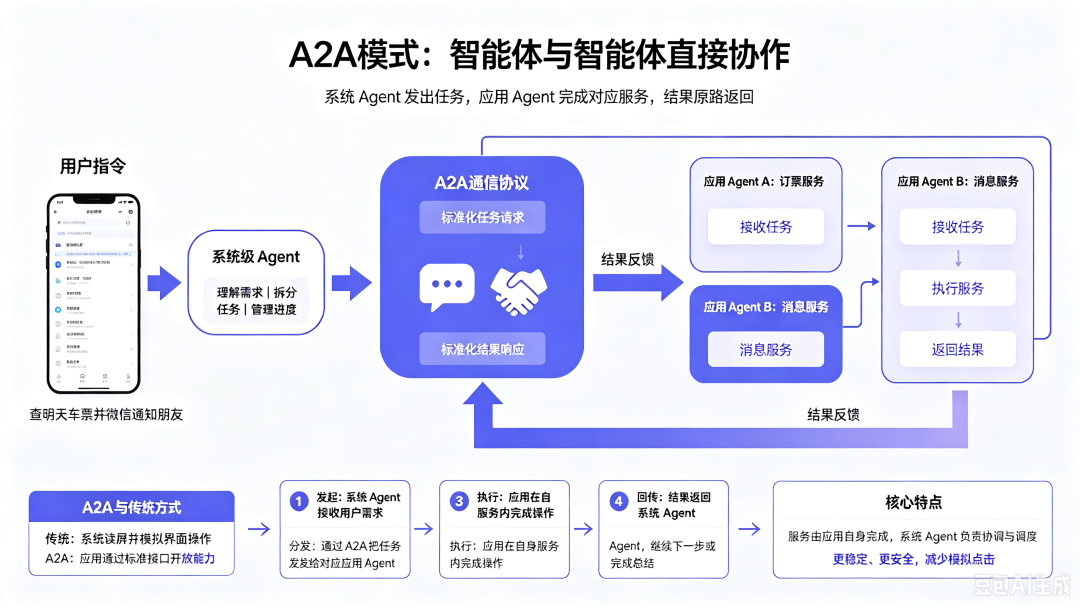
This directly underscores that the 'ecosystem wall' issue faced by Doubao Mobile Phone I remains unresolved, essentially a tug-of-war between Agents vying for user access and super apps defending their traffic sovereignty.
However, Doubao Mobile Phone II has also unveiled a new strategy. On September 14, the official launched SAEP (Screen Automation Operation Declaration Protocol), stating: Apps will not be operated by GUI agents during a 30-day public notice period unless they actively declare acceptance. If the notice period expires without an email notification or rejection declaration through the SAEP protocol, Doubao will enable GUI agent operation capabilities for the app.
To some extent, this represents a strategic retreat. As Doubao Mobile Phone II moves towards mass production, this declarative protocol means that apps that do not reject will further enrich its product capabilities. If they reject, it signals that it is not Doubao Mobile Phone that cannot perform the operations, but rather the relevant apps that refuse to allow them. The shift is that Doubao now aligns with users. With a concrete reference for agent smartphones, if more users expect Doubao to do more, the resulting increased demand expectations could potentially compel the industry to open up its ecosystem.
The Struggle for Scheduling Rights: Three Paths Forward
Securing system-level scheduling rights is equally challenging as gaining ecosystem access.
This pertains to who first receives user instructions, schedules apps, and coordinates arrangements post-instruction issuance. Doubao's primary objective is this permission, and its decision to partner with ZTE stems from ZTE's willingness to grant it system scheduling rights. In contrast, major players like Huawei, Xiaomi, OPPO, and Vivo, with hundreds of millions of users, prefer to reserve system scheduling for their own AI assistants.
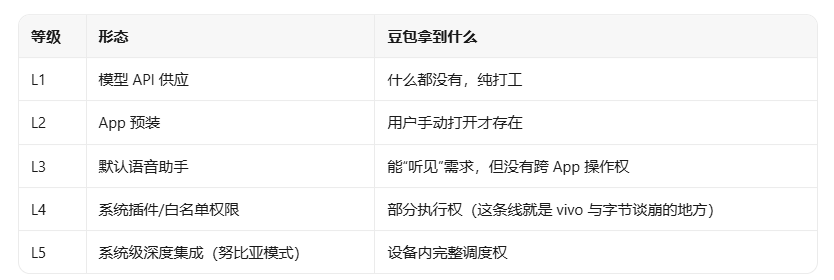
The reasons can be elucidated from two perspectives. Firstly, new business opportunities abound: The necessary Token consumption in the Agent era may lead to paid subscriptions. An AI assistant with system scheduling rights can decide the priority of app activation. For example, after receiving the instruction to 'order milk tea,' the system-level AI could decide whether to open Taobao Flash Sale or Meituan by default. Such changes could drive a new round of 'bid ranking.'
Secondly, another selling point of AI phones is local memory. After prolonged use of a specific agent, user preferences, habits, and memories are stored in the system, creating a closed loop where the phone increasingly understands the user, and the user becomes increasingly dependent on it. The secrecy of this locally stored memory is extremely high, and migration can only be completed through the system's built-in device transfer service, inadvertently raising the cost for users to switch brands. Phone manufacturers are unwilling to relinquish system-level permissions to keep the local memory formed through AI interactions firmly under their control.
Under these circumstances, the industry is currently exploring three directions.
1) Model manufacturers directly collaborate with phone manufacturers, trading model strength and market influence for system scheduling rights, as exemplified by Doubao Mobile Phone II.
However, given its current inventory of 200,000 units, Doubao Mobile Phone II is still in the verification stage. The more direct impact of this step is to transform conceptual products into tangible, user-perceivable on-device AI entities, proving that 'getting things done with one sentence' is achievable, creating demand expectations, and thereby amplifying its voice in the scheduling rights game.
2) Phone manufacturers tighten their grip on system scheduling rights and pursue the A2A route.
Just one day before the official launch of Doubao Mobile Phone II, Honor released MagicOS 11, officially positioned as the industry's first mobile operating system to achieve commercial deployment of system-level Agent Harness. Based on Alibaba's QianWen model, the system's scheduling rights belong to Honor's self-developed voice assistant, YOYO, which can execute long-range tasks of over a hundred steps. It currently integrates 700 tools and 500 open Skills, with proactive services covering over 1,000 scenarios.
In comparison, leading phone manufacturers like Honor focus more on scheduling, with model capabilities and app execution being collaboratively completed. This is the key difference from Doubao Mobile Phone II.
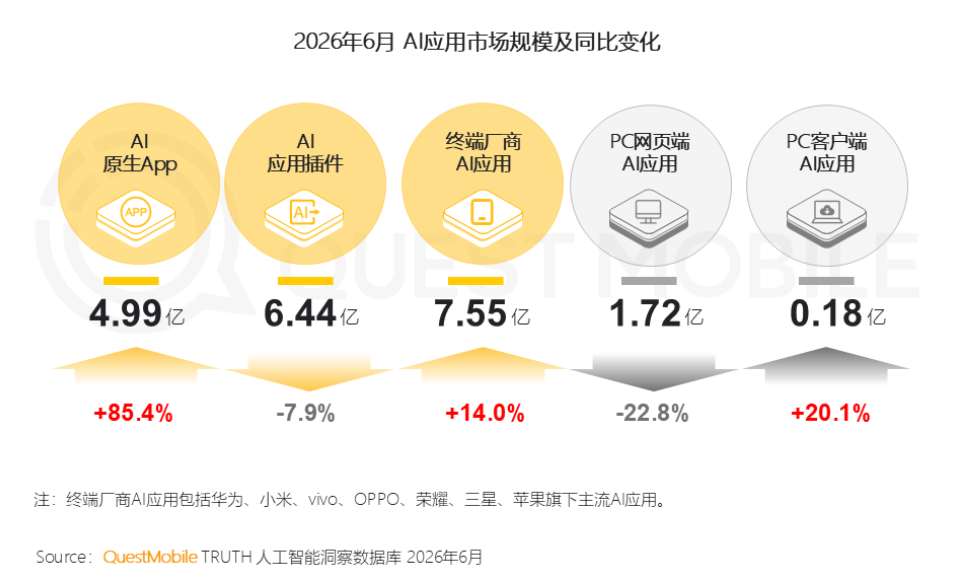
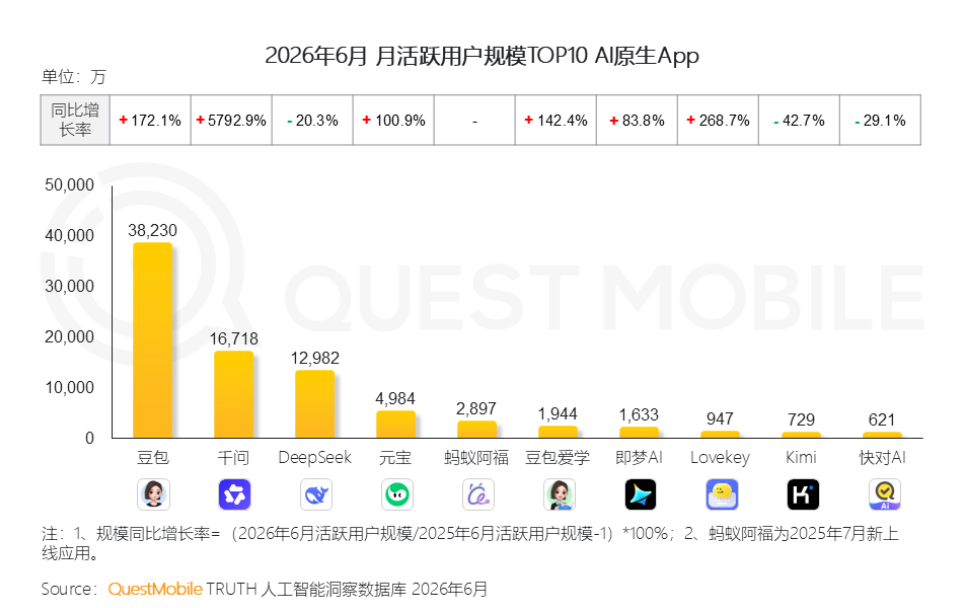
The underlying reason is that ByteDance lacks hardware products, but Doubao has already established a dominant market position. According to QuestMobile's '2026 H1 AI Application Market Development Insights Report,' in June this year, the monthly active user base for AI applications from terminal manufacturers reached 755 million, up 14% year-over-year, while native AI applications had 499 million monthly active users, growing at a rapid 85.4%. Among native AI applications, Doubao leads with 380 million monthly active users. This is why ByteDance dares to attempt forcing ecosystem openness and system scheduling through demand expectations.
3) Model manufacturers create their own hardware to grasp scheduling rights from the ground up.
On July 13, model manufacturer StepFun launched its first large model-native AI terminal brand, STEPX, and simultaneously introduced the native agent smartphone (Agentic Phone) STEPX Neo. The company aims to establish a complete chain from base models to agent systems and hardware terminals. Currently, this is the most aggressive approach among model manufacturers, with its commercial viability and market acceptance yet to be observed.
More Players Join the Fray: Information Security and Genuine Demand Warrant Discussion
The number of players continues to grow, and the AI-driven evolution of smartphones is an irreversible trend.
In July this year, cybersecurity authorities conducted the first separate Filing and Public Announcement for 'on-device generative AI services for mobile phones,' covering on-device large models from seven major smartphone brands: Apple, Huawei, OPPO, vivo, Xiaomi, Samsung, and Nubia. It is foreseeable that phone manufacturers will accelerate their deployments in this area.
However, it is crucial to note that this round of technological upgrades and product launches is not primarily driven by demand-side factors. The demand expectations that Doubao Mobile Phone II values have not yet fully materialized. From a consumer perspective, many people still harbor concerns about whether 'AI-driven tasks' are secure, especially when it comes to transactional processes. Granting AI payment permissions is not entirely reassuring.
Additionally, the genuine demand for an AI assistant capable of handling tasks remains questionable. On one hand, compared to simply launching apps, having AI complete relatively complex instructions may not necessarily be more efficient or convenient than doing it oneself. On the other hand, given that many people view 'playing with their phones' as a form of entertainment, is there sufficient imagination for AI to handle tasks? Beyond entertainment scenarios like watching videos, playing games, and socializing, can AI adequately address tasks that users find annoying or cumbersome?
These are questions that necessitate repeated validation during the industry's initial exploration phase, reflecting that market demand has not yet been unleashed, and the current industry development leans more towards a forced supply-side popularization.
The reasons are not hard to fathom. For model manufacturers, significant upfront investments require monetization scenarios, and in the Agent era, on-device AI is one of the deployment directions. For phone manufacturers, mobile smart devices have reached a point of 'diminishing returns,' and the industry needs new narratives to drive consumption and capital growth.
More visibly, global smartphone sales have been declining, with the latest data from market research firm Counterpoint Research showing an 8% year-over-year drop in global smartphone sales during the 20th week of 2026, marking the ninth consecutive week of decline. However, smartphone prices are rising. As AI-related industries continue to increase demand for storage resources, smartphone costs are going up, and many manufacturers have already raised prices. During the recent back-to-school season, the domestic smartphone market witnessed a rare phenomenon of multiple brands raising prices simultaneously.
Given this scenario, even if market demand has not yet emerged on a large scale, manufacturers and platforms will continue to weave new narratives, during which users will gradually adapt through waves of technological iterations. From this vantage point, Doubao Mobile Phone II, moving towards mass production, has already toppled the first domino in the commercialization of AI agent smartphones.
-
From Rent Collection to Vehicle Management, Didi Land's Hong Kong Stock Market Journey Still Has the Second Half to Go
-
![]()
The 'AI Apocalypse' Drama Staged by Five Individuals
-
![]()
Doubao Mobile Phone II: Can Its 'Knock' Feature Secure 380 Million Monthly Active Users Amidst Ecosystem Openness and Scheduling Rights Challenges?
-
![]()
Can Doubao Mobile Phone II, Which Has Learned to 'Knock,' Exchange 380 Million Monthly Active Users for Ecosystem Openness and Scheduling Rights?
-
Congratulations! In iPhone Duo, China’s Supply Chain Secures a Leading 40% Value Share
-
![]()
GAC Acquires Stake in FAW Toyota: The Merger of North and South Toyota Unveils the Complex Landscape of China’s Auto Market
-
![]()
[Electrical Equipment] 45 BRT Pure Electric Mining Trucks Supplied to Chaonaoliang Coal Mine
-
![]()
FAW Acquires Stake in Leapmotor