Decoding the '4S' Architecture | Report on Enterprise-Level AI Services in China
 09/20 2026
 395
395

What industrial architecture has formed around enterprise-level AI services? In which areas does its commercial value manifest? How should Chinese AI companies go global?
Xiaoguang Think Tank releases the

Enterprise-level AI services are not a single format but a complete stack structure from underlying computing power to upper-layer applications.
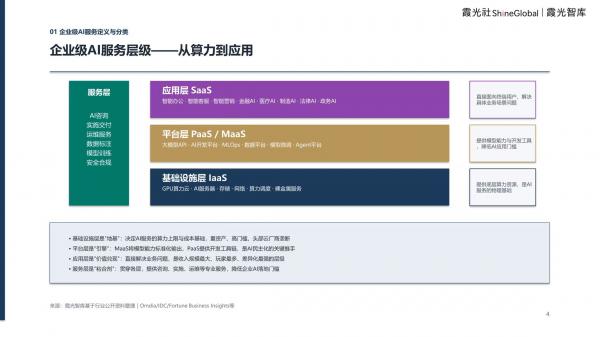
· Infrastructure Layer: Determines the computing power upper limit (upper limit) and cost basis of AI services. It is asset-heavy and high-threshold, dominated by leading cloud providers.
· Platform Layer: MaaS standardizes and outputs model capabilities, while PaaS provides development toolchains, serving as the key to AI democratization.
· Application Layer: Directly solves business problems and represents the tier with the largest revenue scale, the most players, and the greatest differentiation.
· Service Layer: Professional services such as consulting, implementation, and maintenance run through all layers, further lowering the barrier to AI adoption.
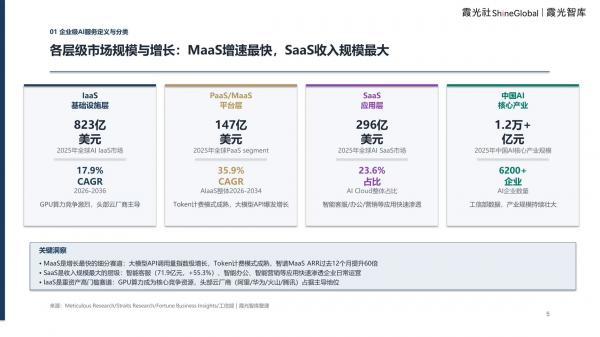
In terms of market size, the global IaaS market will reach $82.3 billion in 2025, SaaS $29.6 billion, and MaaS, though only $14.7 billion, is the fastest-growing segment with a 35.9% CAGR. SaaS carries the current AI commercialization with the largest revenue scale, while MaaS defines the future of AI commercialization with the highest growth rate.

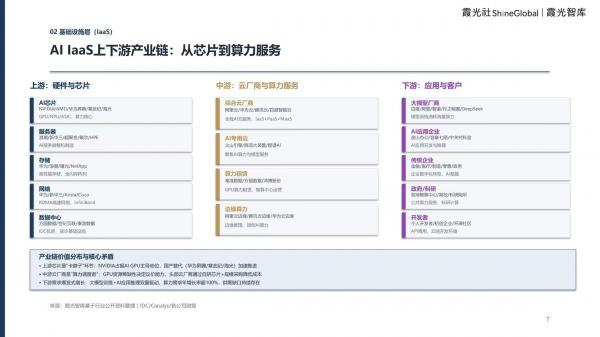
The core contradiction in the current AI IaaS industry lies in:
Upstream chips represent a bottleneck, with NVIDIA still dominating AI GPUs, but domestic alternatives like Huawei Ascend, Cambrian, and Hygon are accelerating.
Midstream cloud providers act as computing power schedulers, with their bargaining power determined by the scarcity of GPU resources. Leading players build barriers through "self-developed chips + large-scale procurement."
Downstream demand is exploding, driven by both large model training and AI application inference, with computing power demand growing over 100% annually.
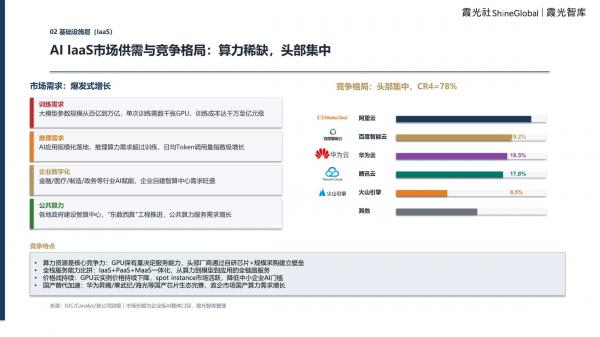
China's AI IaaS market has a CR4 of 78%, dominated by Alibaba Cloud, Huawei Cloud, Tencent Cloud, and Baidu Intelligent Cloud, with Volcano Engine following closely at 8.5%. Computing power resources are the core focus, full-stack service capabilities are the competitive edge, price wars continue to squeeze out SMEs, and domestic alternatives are accelerating penetration in government and enterprise services.
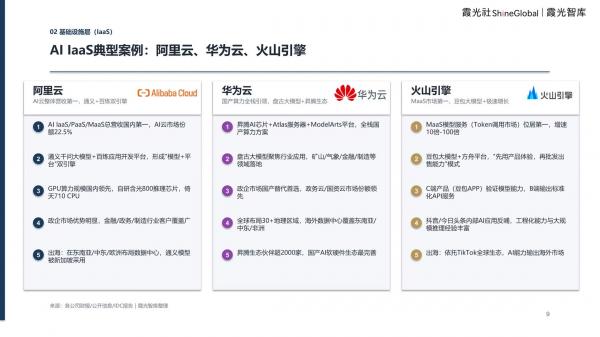
Alibaba Cloud drives growth with its "Tongyi + Bailian" dual engines, leading domestically with a 22.5% market share in AI cloud. Huawei Cloud builds a full-stack domestic computing power solution with "Ascend AI chips + Atlas servers + Model Arts platform," becoming the top choice for domestic alternatives in government and enterprise services. Volcano Engine ranks first in the MaaS model service market with its Doubao large model and Fangzhou platform, achieving 10-100x growth.

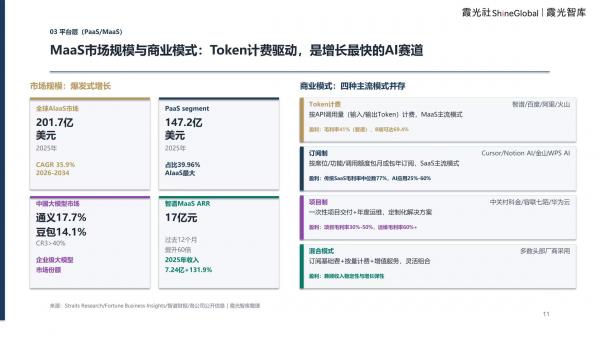
MaaS has the clearest business model and fastest growth among current enterprise-level AI service tracks. The global PaaS segment will reach $14.72 billion in 2025, accounting for 39.96% of AIaaS, with exponential growth in large model API calls and a mature Token-based billing model. Zhipu MaaS ARR increased 60x in the past 12 months, reaching RMB 724 million in 2025, up 131.9% YoY.
Four mainstream business models coexist:
Token-based billing: Charges based on input/output Token volume, with a 41% gross margin (69.4% for B2B).
Subscription: Monthly/annual fees based on seats/features/quotas, with a median gross margin of 77% for traditional SaaS and 25%-60% for AI applications.
Project-based: One-time delivery + annual maintenance, with a 30%-50% gross margin (60%+ for maintenance).
Hybrid model: Subscription base fee + usage-based billing + value-added services, balancing revenue stability and growth flexibility.
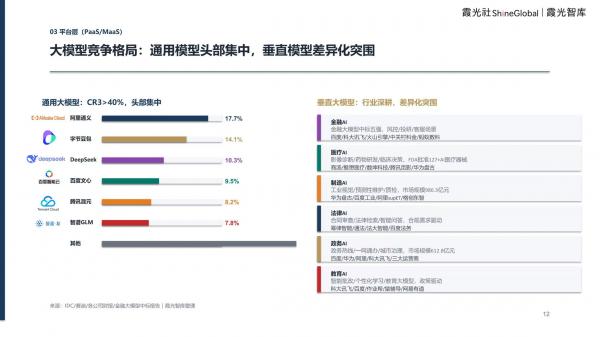
In terms of competitive landscape, general-purpose large models are concentrated among top players: Alibaba Tongyi 17.7%, ByteDance Doubao 14.1%, DeepSeek 10.3%, with CR3 exceeding 40%. However, vertical large models are differentiating: In financial AI, Baidu, Volcano Engine, iFLYTEK, Ant Digital, and Zhongguancun Kejin lead in bids; in medical AI, SenseTime, Infervision, and Shukun Technology focus on imaging diagnostics and drug R&D; in manufacturing AI, the market size has reached RMB 98.63 billion, led by Huawei Pangu, Baidu Industrial, and Alibaba supET.
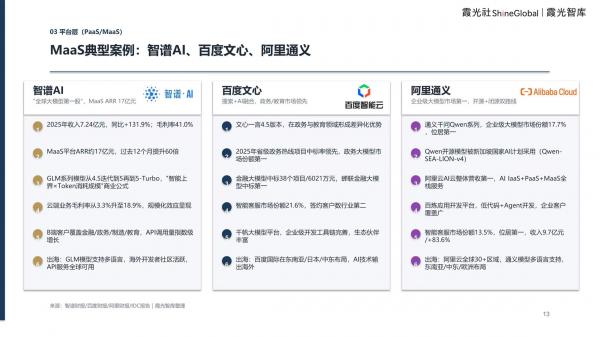
Zhipu AI, as the "first global large model IPO," iterated its GLM series from 4.5 to 5, with cloud business gross margins rising from 3.3% to 18.9%, showing scaling effects. Baidu Wenxin integrates "search + AI," forming differentiated advantages in government and education, winning 38 financial large model bids worth RMB 60.21 million. Alibaba Tongyi's Qwen open-source model was adopted by Singapore's National AI Program, leading the enterprise-level large model market with a 17.7% share.

The application layer is the ultimate link (link) for AI value realization. General-purpose AI applications have achieved scaling (large-scale) penetration in scenarios like intelligent office, marketing, customer service, finance, legal, and HR.
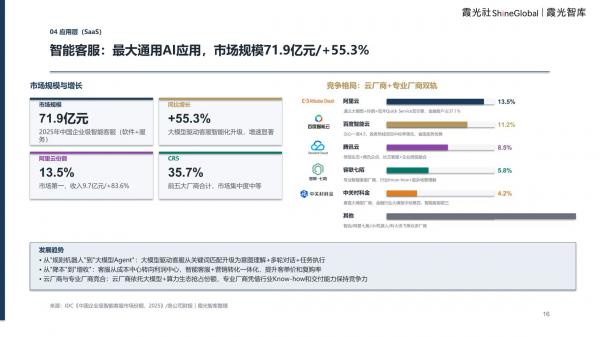
Among them, intelligent customer service is the largest general-purpose AI application, with China's enterprise-level intelligent customer service market reaching RMB 7.19 billion in 2025, up 55.3% YoY.
The competitive landscape features a dual-track of cloud providers + specialized vendors: Alibaba Cloud leads with a 13.5% share, followed by Baidu Intelligent Cloud at 11.2%, Tencent Cloud at 8.5%, Ronglian Qimo at 5.8%, and Zhongguancun Kejin at 4.2%, with CR5 at 35.7% (moderate market concentration). From a development perspective, customer service is upgrading from "rule-based bots" to "large model Agents," shifting from cost reduction to revenue growth, with co-opetition between cloud providers and specialized vendors.
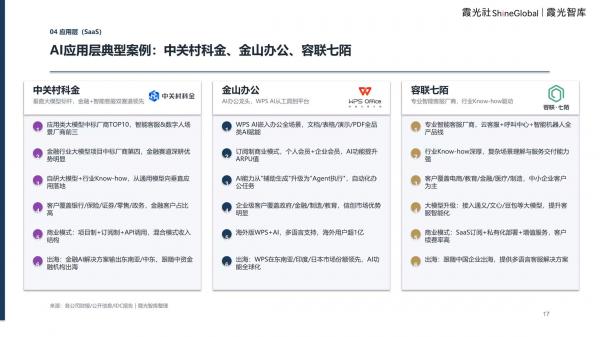
Zhongguancun Kejin leads in both "finance + intelligent customer service" as a vertical large model benchmark, ranking among the top 10 application-type large model bid winners, with a hybrid business model combining "project-based + subscription + API calls." Kingsoft Office embeds WPS AI across all office scenarios, upgrading from assisted generation to Agent execution, with multi-language support for its overseas version WPS+AI and over 100 million overseas users. Ronglian Qimo leverages deep industry know-how, integrating large models like Tongyi/Wenxin/Doubao to enhance customer service intelligence, achieving high customer retention rates.

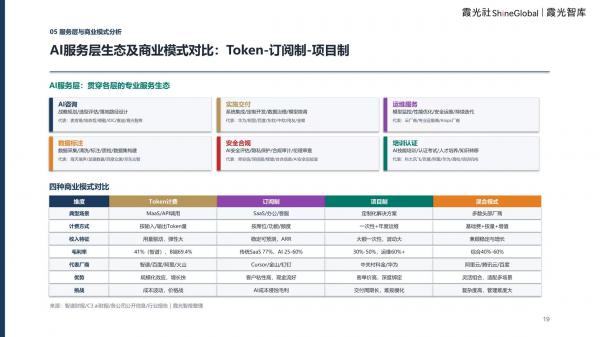
The service layer represents the "last mile" of AI adoption. Six service formats—AI consulting, implementation delivery, maintenance services, data annotation, security compliance, and training certification—run through all layers.
Token-based billing is usage-driven and flexible, with a 41% gross margin (Zhipu), reaching 69.4% for B2B. Subscription models offer high customer stickiness and cash flow, with a 77% gross margin for traditional SaaS and 25%-60% for AI applications. Project-based models have high average contract values and deep binding, with a 30%-50% gross margin (60%+ for maintenance). Hybrid models offer flexible combinations for multiple scenarios, with a 40%-60% comprehensive gross margin.
However, no single business model is universal. MaaS vendors pursue scaling effects, SaaS vendors pursue customer stickiness, project-based models pursue deep binding, while leading vendors use hybrid models to balance revenue stability and growth flexibility.

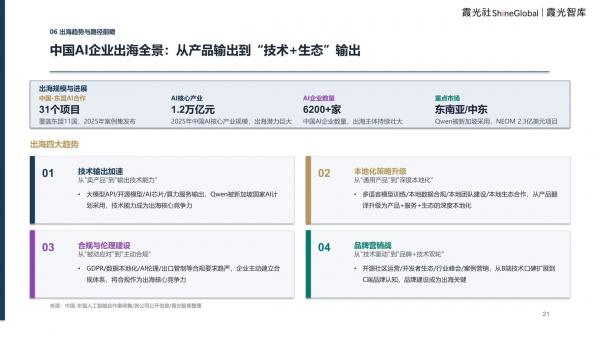
China's core AI industry will reach RMB 1.2 trillion in scale by 2025, with over 6,200 AI companies expanding globally. China-ASEAN AI cooperation covers all 11 ASEAN countries, with 31 projects landed. Qwen was adopted by Singapore's National AI Program, and the NEOM $230 million project marks a landmark case for China's AI global expansion.
Current global expansion trends feature four main directions:
Accelerated technology export, shifting from "selling products" to "exporting technological capabilities," with large model APIs/open-source models/AI chips/computing power services becoming core competitiveness.
Upgraded localization strategies, moving from "generic products" to "deep localization," requiring multi-language model training/local data compliance/local team building/local ecosystem cooperation.
Compliance and ethics construction, transitioning from "passive response" to "proactive compliance," with stricter requirements like GDPR/EU AI Act/data localization/export controls making compliance a core competitiveness.
Brand marketing wars, shifting from "technology-driven" to "brand + technology dual-wheel," with open-source community operations/developer ecosystems/industry summits/case marketing becoming key to brand building.
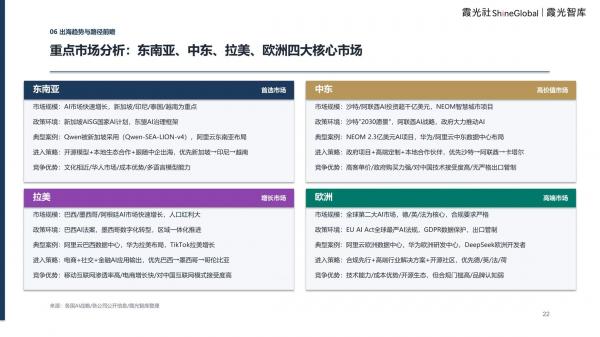
Market-wise, Southeast Asia is the top choice, with Singapore/Indonesia/Thailand/Vietnam as key countries. Qwen was adopted by Singapore, and Alibaba Cloud has a deep presence in Southeast Asia, with competitive advantages in cultural proximity, Chinese markets, cost advantages, and multi-language model capabilities. The Middle East is a high-value market, with Saudi Arabia/UAE AI investments exceeding $100 billion. The NEOM smart city project has landed, and Huawei/Alibaba Cloud have Middle East data center layouts, featuring high average contract values, strong government purchasing power, and high acceptance of Chinese technology. Latin America is a growth market, with Brazil/Mexico/Argentina AI markets growing rapidly. Alibaba Cloud's Brazil data center, Huawei's Latin America Layout (layout), and TikTok's Latin America growth benefit from high mobile internet penetration and fast e-commerce growth. Europe is a premium market, centered on Germany/UK/France, with the EU AI Act representing the strictest global AI regulations. Alibaba Cloud's European data centers, Huawei's European R&D centers, and DeepSeek's European developer Layout (layout) show clear technical and cost advantages but face high compliance barriers and weak brand recognition.
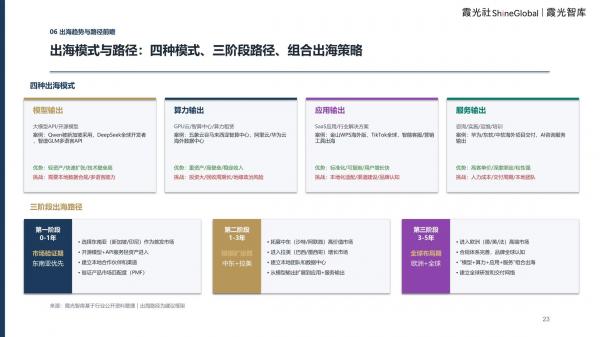
When it comes to going-global models, each of the four paths has its own pros and cons:
Model Output: Asset-light, rapid expansion, high technical barriers, but requires local data compliance and multilingual capabilities;
Computing Power Output: Asset-heavy, high barriers, stable revenue, but involves significant investment, long payback periods, and high geopolitical risks;
Application Output: Standardized, replicable, fast user growth, but faces challenges in localization adaptation, channel construction, and brand recognition;
Service Output: High average revenue per user, deeply bind , strong stickiness, but is constrained by labor costs, delivery cycles, and local teams.

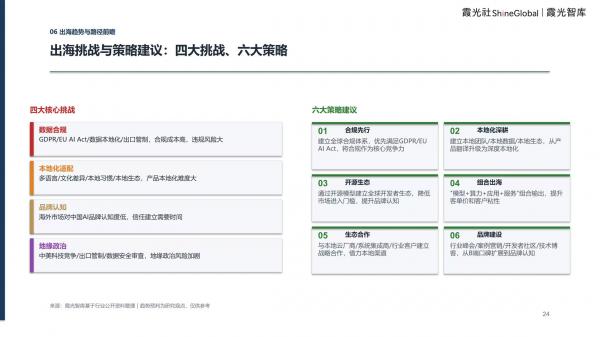
The road to going global is not smooth. Data compliance, localization adaptation, brand recognition, and geopolitical risks are the four core challenges.
The corresponding strategic recommendations are as follows:
Prioritize compliance by establishing a global compliance system, prioritizing compliance with GDPR/EU AI Act, and making compliance a core competitive advantage;
Deepen localization by establishing local teams/local data/local ecosystems, upgrading from product translation to deep localization;
Leverage open-source ecosystems to build a global developer ecosystem through open-source models, lowering market entry barriers and enhancing brand recognition;
Adopt a combined going-global approach by outputting a combination of 'models + computing power + applications + services' to increase average revenue per user and customer stickiness;
Foster ecological cooperation by establishing strategic partnerships with local cloud providers/system integrators/industry clients, leveraging local channels;
Strengthen brand building through industry summits/case marketing/developer communities/technical blogs, expanding from B-end reputation to brand recognition.
Enterprise AI services are undergoing a critical transition from 'technology-driven' to 'business-driven.' The value delivery of the four-layer architecture, the coexistence and competition of the four business models, and the differentiated strategies for the four major going-global markets together form a complete picture of this trillion-dollar market.
For practitioners, computing power is the threshold, models are the engine, applications are the value, and services are the stickiness. For going-global enterprises, compliance is the bottom line, localization is the path, open-source is the lever, and brand is the moat.
-
![]()
Samsung, Spurred by Apple, Steps Up Its Game, with LY Technology Reaping the Greatest Benefits
-
Blue Heart Xiaov Set to Introduce Paid Pro Version, Revealing vivo’s Large Model Strategy
-
Three-Way Struggle for Market Share: BYD, Chery, and Geely Challenge Great Wall, Posing Immediate Risks to Wei Jianjun
-
![]()
The Reason Behind Valve's Headset Price Surge of 2400 Yuan: The End of an Era of Selling at a Loss
-
![]()
Decoding the '4S' Architecture | Report on Enterprise-Level AI Services in China
-
![]()
Li Auto Aims to Sell Three Technologies, First Buyers Unlikely to Be Major Automakers
-
![]()
Liu Zongcheng Declares Haste Makes Waste in Car Manufacturing, Yet Seres Seems to Be Rushing Headlong!
-
![]()
Did Trump Make Concessions? Chinese Automakers Are Invited to Establish Factories in the U.S., but Importing Fully Assembled Vehicles Is Off the Table