US$1.2 Million for 'Digital Territory': Global Tech Giants Scramble for '.ai' Domain Names
 09/24 2026
 358
358

Image generated by AI
The 'Enclosure Movement' in the AI Era
Written by/ Meng Huiyuan
Edited by/ Li Wenjie
Layout by/ Annalee
alibaba.ai, on the face of it, is a domain name with a very clear focus, but it did not previously belong to Alibaba.
In July 2026, an investor purchased the domain on the Spaceship trading platform for $3,333 and subsequently listed it for sale at $33,333. However, a month later, the Czech Arbitration Court (CAC) ruled that the holder had knowingly acquired the domain in awareness of Alibaba's brand, using it solely for resale at a markup without any genuine use, constituting 'opportunistic bad faith.' Ultimately, the domain was forcibly transferred to Alibaba Group.
This is not an isolated case. Over the past few months, Alibaba has filed multiple complaints regarding domains such as goofish.ai, taobao.ai, qwenchat.ai, and alibaba.ai, ultimately resulting in the transfer of these domains to Alibaba-related entities. However, its application for 1688.ai was rejected.
Alibaba is not the only internet company vying for '.ai' domains: Tencent initiated dispute proceedings for multiple domains, including tencent.ai, while Baidu also took action to protect baidu.ai.
If the arbitration by major companies is about securing 'brand sovereignty,' the transaction figures in the secondary market are even more astonishing. For instance, in February 2026, Bot.ai was sold for US$1.2 million on the Sedo platform, marking the first seven-figure public transaction for a .ai suffix.
Clearly, '.ai' is not just a lucrative business but is also redefining the competitive rules of a global industry.
The 'Ransom' is High, but It Must Be Paid
In 1995, '.ai' was designated by IANA as the country code top-level domain (ccTLD) for Anguilla, a British Overseas Territory. As the AI wave swept the globe, this once-obscure national code domain unexpectedly became the hottest 'virtual real estate' in the digital age.
Following the release of ChatGPT, the suffix quickly became an identity marker for the AI industry, with some practitioners believing that acquiring a '.ai' domain is part of their brand strategy while also sending a clear signal: 'We are an AI company.'
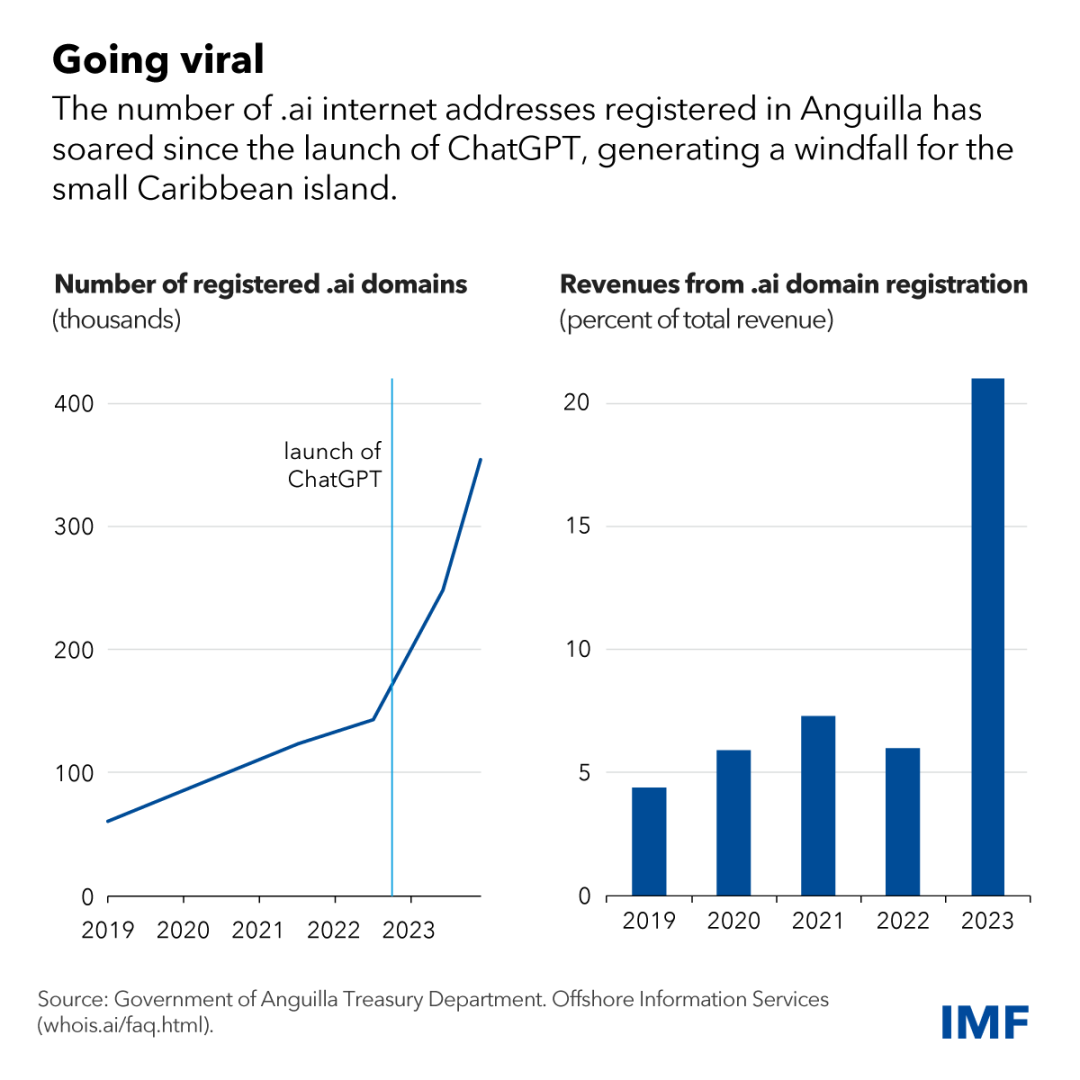
Surge in '.ai' Internet Addresses Registered in Anguilla
IMF data shows that 144,000 '.ai' domains were registered in 2022. Domain industry statistics indicate that by early January 2026, '.ai' domain registrations had surged to over 1 million.
Before enterprises strongly associated with '.ai' domains entered the market, many of these over 1 million domains had fallen into the hands of others, often becoming thorns in the side of corporate brand strategies. This meant users could be misled to fake websites, resulting in information confusion at best and phishing scams at worst.
For tech giants like Alibaba, Tencent, and Baidu, which have already established vast ecosystems, a '.ai' domain held by a third party is not just a loss of traffic but also a dilution of brand recognition and even a risk of being 'held hostage' by competitors or speculators.
Therefore, initiating arbitration through mechanisms like the UDRP (Uniform Domain-Name Dispute-Resolution Policy) has become a conventional weapons (conventional weapon) for major companies to reclaim 'brand sovereignty.' The focus of rights protection (rights protection) lies in proving that the brand name itself is a registered trademark and that the domain holder cannot demonstrate good faith use. Arbitration tribunals repeatedly emphasize a principle: registering a domain solely for resale at a high price to the trademark owner constitutes 'opportunistic bad faith.' This principle was also key to Alibaba's victory in cases like goofish.ai and taobao.ai.
Unfortunately, arbitration does not always succeed. Google's loss in the NanoBananaAI.com case is a typical counterexample. The tribunal argued that 'NanoBanana' is not a registered trademark of Google and that Google failed to prove the term had acquired a 'secondary meaning' through use, meaning the public already associated it uniquely with Google.
The aforementioned ruling reveals the core logic of the UDRP mechanism: it protects trademark rights, not mere brand associations or business opportunities. This means not all '.ai' domains related to a brand can be easily reclaimed by major companies. If the domain holder can prove a legitimate reason for registration or if the term itself has an independent literal meaning, the complaint may be rejected.
In such cases, negotiating a purchase becomes another common approach, but this method is Destined to incur high costs (destined to be costly). Take 1688.ai as an example; reports indicate that the domain was once listed for $168,888 by its holder. To some extent, the price difference between registering a premium '.ai' domain and transferring it can reach up to a thousandfold: the annual registration cost for a domain is usually only a few tens of dollars, while second-hand transfer quotes for high-quality domains can sometimes reach hundreds of thousands of dollars.
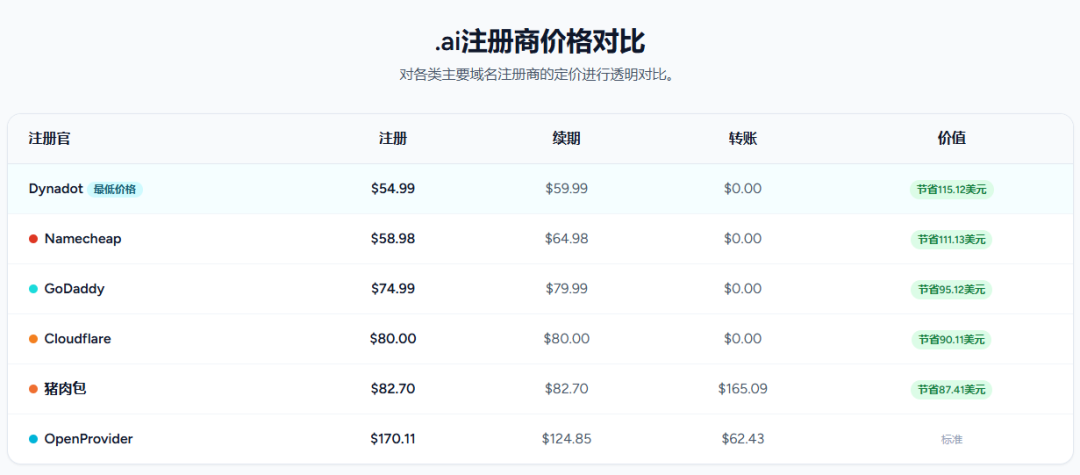
Price Comparison Across Different Registrars
When holding costs are extremely low and transfer returns are extremely high, holding a domain itself becomes a 'call option,' directly spawning a professional domain name investment industry chain.
Sky-high transactions in the secondary market continue to emerge: in October 2023, the you.ai domain sold for $700,000 in an auction, with the buyer being Dharmesh Shah, co-founder of HubSpot; in October 2025, wisdom.ai sold for $750,000; in February 2026, bot.ai sold for $1.2 million on the domain trading platform Sedo, marking the industry's first publicly recorded million-dollar '.ai' domain transaction.
These cases not only confirm the scarcity and strategic value of '.ai' domains (which serve as AI product acquisition entry points, financing narrative materials, and ecological positioning tools, among other attributes) but also further validate the market's valuation logic for this suffix: short, precise, and accurate domains possess irreplaceable recognizability and memory advantages during the AI industry's boom period.
What's Being Priced Is Never Just the Domain
'Domain farmers' (a colloquial term in the domain investment circle) cannot afford to overlook these developments. On the contrary, they are the most astute catchers of this valuation logic. Whenever a new concept ignites public discourse, domain names related to its keywords are often snapped up in bulk within hours.
The offensive and defensive dynamics have thus reversed. In the past, individual investors relied on bulk registering good domains and waiting for buyers; today, domain investment shows a trend of institutional hoarding. Some institutions even establish dedicated domain funds to bulk-acquire high-quality domains in hot sectors, awaiting repurchase by related companies.
AI businesses are rapidly iterating, while corporate trademark and brand management processes lag behind. This time gap presents an opportunity window for third-party squatters.
Crucially, the profit of the entire industry chain lies not in the registration process but in subsequent Game negotiation (gameplay negotiations). Major companies have mature legal teams and international arbitration channels and can afford to purchase domains when necessary; however, startups, open-source projects, and small-to-medium teams often lack bargaining power and are forced to choose between renaming their projects and paying high prices for domains.
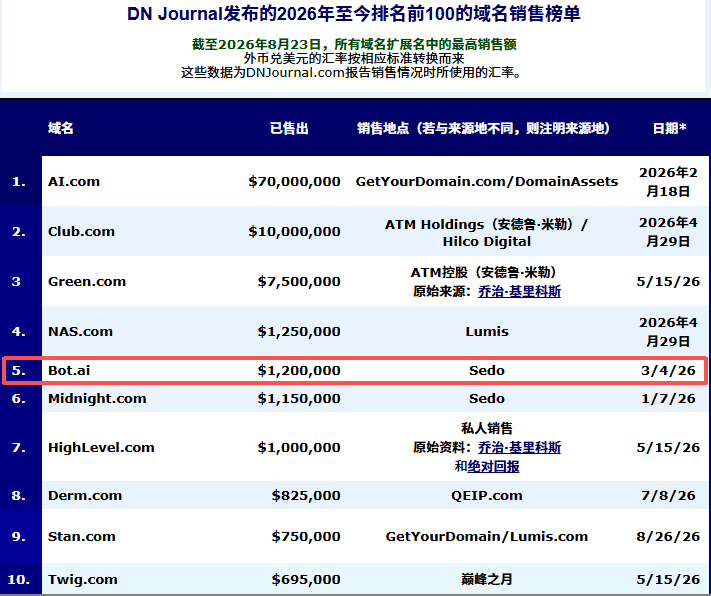
DNJournal Domain Sales Rankings
This asymmetric bargaining landscape is also reshaping AI entrepreneurs' naming strategies and brand logic. Previously, many entrepreneurs were accustomed to developing products first and considering domain names later, with brand names often formally established during the financing or market promotion stages. However, in the battle for '.ai' domains, this sequence has been completely reversed.
More and more founding teams now have to complete a domain name offensive and defensive battle before writing their first line of code: checking WHOIS, sending inquiry emails, assessing arbitration feasibility, and even being forced to pay for domains in the early stages of entrepreneurship. For early-stage teams that have not yet secured financing, this expense may be enough to consume several months' operational budgets, while abandoning a desired domain means long-term damage to brand recognition.
A more concealed risk lies in the fact that domain squatters are not always solitary 'domain farmers.' Institutional players systematically scan platforms like GitHub (code repositories), arXiv (academic papers), and Product Hunt (new product releases) for newly added content, capturing project names that show potential but have not yet been officially released or trademarked, and registering them before the entrepreneurs can apply for trademarks or go public. By the time entrepreneurs realize the issue, the domains are already listed at high prices, exposing them not just to financial costs but also to compound losses from user confusion, traffic hijacking, and brand dilution.
Legal remedies are also narrow. While the UDRP provides an arbitration channel for trademark owners, its application threshold is not low. Meanwhile, for early-stage projects without registered trademarks or names with generic meanings, the UDRP is often ineffective. Pursuing court litigation means double consumption of time and money, almost unbearable for AI teams with iteration cycles measured in weeks.
Thus, a new industry consensus is gradually forming: rather than being passively attacked over domain names, it is better to proactively incorporate naming rights into product strategy. Some incubators and accelerators now list 'domain availability' as one of the mandatory criteria for project selection; some founders turn to more descriptive, easier-to-register compound words or neologisms, sacrificing some brand aesthetics for legal security. Meanwhile, insurance, escrow, and dispute resolution services surrounding '.ai' domains are also emerging, attempting to carve out a share of this gray industry chain.
However, the fundamental contradiction remains unresolved. As long as the valuation premium of the AI industry persists and the '.ai' suffix is still seen as an identity label for technological frontiers, domains are not just traffic entry points but also part of capital narratives.

When a domain's transaction price can exceed the valuation of an early-stage company, and when the leverage between holding costs and transfer returns reaches a thousandfold, the struggle over these characters will not cease. It reflects an industry's fierce competition for scarce cognitive resources during its boom period and is also a microcosm of the redistribution of power and capital in the entrepreneurial ecosystem.
What's being priced is never just the domain but the very ticket to enter the AI race.
-
Yunbao Intelligence Charges Towards IPO: Over 5,000-Fold Revenue Surge in 2.5 Years, Tencent Contributes Nearly 98% of Revenue
-
Field Test of Doubao at Work: Can a Company That Helps Users Kill Time Build a Product That Saves Them Time?", "Doubao, AI, Office Agent, User Growth, Commercialization
-
Ofilm Wins Consecutive Orders for Xiaomi’s Flagship Periscope Telephoto Modules Across Two Generations!
-
![]()
Net Profit Soars by 578% in First Half of the Year! How Promising Is Hycreate Optoelectronics’ IPO on the Beijing Stock Exchange?
-
Reshaping the Supply Chain Landscape: CATL Faces a New Industry Cycle
-
![]()
US$1.2 Million for 'Digital Territory': Global Tech Giants Scramble for '.ai' Domain Names
-
![]()
Apple’s Dependence on Scalpers Hits an All-Time High
-
![]()
Lei Jun’s 200 Billion Yuan Gamble: Why Does He Wait for Trends to Solidify Before Making Big Moves?