Apple’s Dependence on Scalpers Hits an All-Time High
 09/24 2026
 567
567

Who Exactly is Fueling the iPhone Duo Buzz?
Yesterday, I had a conversation with a friend about foldable screens, and inevitably, we touched upon Apple’s newly launched iPhone Duo. Neither of us is the type to blindly follow tech trends, nor do we obsess over benchmark scores. When it comes to choosing digital products, we prioritize user experience and practicality.
My friend sang its praises, highlighting its exceptional engineering with a nearly imperceptible crease, calling it one of Apple’s few genuinely impressive works in recent years.
I remained neutral. While Apple’s software and hardware ecosystem is still unparalleled, without hands-on experience, any review lacks credibility.
So, I made a special trip to the Apple Store in Sanlitun. The staff informed me that the iPhone Duo wouldn’t be available for display until its official launch on October 23.
I noticed that Apple has deliberately prolonged the "futures" delivery period. Over the past five years, its fall flagship devices typically took an average of 3 days from announcement to pre-sale and about 10 days to hit the market. The iPhone Duo, however, has extended these intervals to 36 and 43 days, respectively.
In other words, this phone is still a "future" product, yet the hype surrounding it is unprecedented: some are listing it for as much as 99,000 RMB on Xianyu, with actual sales reaching 49,999 RMB on Dewu, and JD pre-orders surpassing one million.
Before the product even reaches consumers, it has already completed a market cycle through specific channels.
I also observed two interesting details. First, there were fewer scalpers outside the Sanlitun store compared to previous years, and they were much quieter. As I walked past, they merely inquired, "Want a phone?" and then lost interest.
Second, three days after the iPhone 18 Pro series went on sale, my social media feed, which would typically be inundated with unboxing posts, was unusually quiet this year. On third-party e-commerce platforms, the iPhone 18 Pro's price dropped below its launch price immediately, and related models were not as scarce as in previous years.
Is Apple losing its edge, or are consumers becoming more rational? This raises a question: Who exactly is driving the iPhone Duo hype?
In fact, Apple has been dabbling with foldable phones for years. Renowned Apple reporter Mark Gurman revealed that around 2020, after a trip to Asia, Tim Cook expressed "unusual enthusiasm" for foldable screens.
Having witnessed more consumers in China and other Asian regions using foldable devices from brands like Samsung and Huawei, Cook returned to the U.S. convinced that Apple "must make a move in this field" and pushed the company to accelerate foldable iPhone development.
By the time the iPhone Duo was announced, the market had already been nurtured by competitors for seven years and was largely mature. Take the two leading brands: Huawei captured 71.8% of China’s foldable market in 2025, with its Pura X Max shipping over 1.2 million units in four months; Samsung maintained its global lead with around a 40% share.
Interestingly, in the days following the Duo's announcement, data showed Huawei's Pura X Max sales surged by about 76% against the trend.
Apple’s first foldable phone gave its competitors a boost.
Historically, every time Apple entered a category—be it the iPod, iPhone, iPad, Watch, or AirPods—it matured or even redefined the market.
With foldables, the opposite happened: Apple watched competitors iterate for seven years to pave the way before jumping in to reap the rewards.
When Apple no longer "redefines" products, its brand premium must be "reweighed." The iPhone Duo, priced as the "most expensive ever," leaves unclear how much of its value comes from product strength, brand power, or scalper-inflated hype.
What is certain is that everyone shares a common mindset: they're waiting for Apple to enter, strip foldables of their "niche" label, and reprice the category. Major players like Samsung, Huawei, and Honor worry about Apple's arrival but also hope for it—without iPhone's "seal of approval," foldables won't go mainstream. Apple's supply chain awaits new orders, brokers hope for a narrative boost around new phone forms, scalpers aim for another round of profit, and users likely want a social status symbol.
The iPhone Duo, "eagerly anticipated" by all, has become a scarce asset. Its pricing mechanism and product maturity inevitably attract scalpers, just like Moutai liquor, Hermès bags, or concert tickets.
In this context, scalpers are essentially the shadow of pricing. If Apple doesn’t capture the premium itself, it becomes profit for scalpers.
For years, phone makers have maintained a tangled relationship with scalpers. But this time, Apple needs scalpers more than ever to orchestrate a high-profile hype campaign for free.
Apple's new CEO, John Ternus, made his debut in the early hours of September 10. The "legacy" Cook left him would be considered miraculous at any other company—but it also came with many pitfalls.
For instance, hardware innovation has dulled. The Vision Pro's high pricing underperformed market expectations; a decade-long car project burned through billions without a splash; the HomePod has remained lukewarm despite years of tweaking.
Apple's growth narrative has peaked. Its 4 trillion USD valuation is tied to "sustained high growth" expectations, but the global consumer electronics market is fully saturated, and Apple has yet to find a new growth curve.
Ternus desperately needs a sure win to establish himself, and the iPhone Duo is currently his only bet. To some extent, "scalpers' frenzied hype has become Apple's cheapest marketing"—not just a joke, but likely a strategic choice for Ternus's first financial report.
Meanwhile, Ternus is also "adding spice" to his persona. He invoked Steve Jobs's philosophy of "where technology and humanity intersect" to package the iPhone Duo, but the plan to support Apple Pencil contradicted Jobs's ideals and ultimately failed. This crack reveals Apple's anxiety over its innovation narrative.
Moreover, the iPhone Duo isn't as formidable as it seems. To reduce thickness, Apple removed the telephoto lens—the first iPhone to ditch it since 2019—and Face ID, a first since the iPhone X. The flagship model moved the fingerprint sensor to the side power button, a design previously criticized when competitors used it. Even MagSafe was sacrificed.
How long the new product's hype lasts will ultimately depend on the product and experience. According to Jiemian News, citing Foxconn supply chain sources, the iPhone Duo's initial mass-production yield rate is just over 60%. Current issues focus on body structure and tolerance fit, with stability likely taking 6–12 months. Production awaits Apple's decision on adjusting quality standards.
At this point, Apple needs an external force to create "reasons to buy." Scalper-driven premiums transform the iPhone Duo's scarcity from "demand overflow" into a "patch for Apple's innovation narrative."
But this is a tightrope walk. The iPhone X was once hyped to 20,000 RMB by scalpers but collapsed within a week.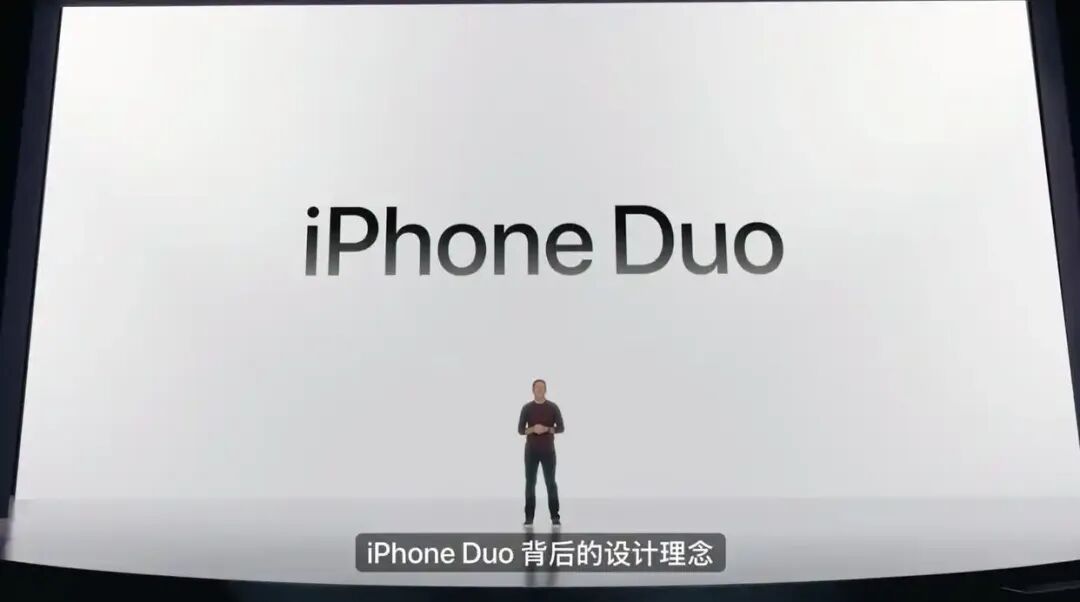
Ternus's debut work. Source: Livestream screenshot
More critically, Apple's pricing power in the supply chain is slipping. Cook's pride was his supply chain management, but this approach faltered with the iPhone Duo. For example, Apple accepted a nearly doubled NAND price from Kioxia in February and reportedly signed a 3–5-year contract in September with no price cap.
ChangXin Storage was even more direct: its capacity is locked by Huawei, Xiaomi, and other local clients until 2027. When Apple negotiated for lower LPDDR5X prices, it was flatly rejected, with pricing held no lower than Samsung and SK Hynix.
Consumer-side price hikes and supply-chain concessions are a first for Apple.
During the iPhone X era, Apple used products to create hype; with Vision Pro, it used pricing; this time, its hype tactics are weaker, and scalpers play a heavier role.
But some things can't be hyped up—including Apple Intelligence (AI). As I've said before, Apple's AI is nearly fully lagging. The root cause lies in Cook's management system, which prioritizes hardware and conservatively develops software. The AI team lacks independence, iterates slowly, and can't keep pace with industry competition.
Siri debuted 12 years before ChatGPT yet became a laughingstock in the generative AI wave; Apple Intelligence delayed twice, with core AI talent leaving en masse, continuously disrupting internal R&D rhythms.
This is why the latest Chinese version of iOS 27 keeps AI features disabled, with Siri AI and new Apple Intelligence functions unavailable in mainland China.
Even though the iPhone Duo's introduction emphasizes "prepared for Apple Intelligence," the implication is clear: the hardware is ready, but AI isn't.
Meanwhile, IDC predicts China will ship 147 million next-gen AI phones in 2026, with a 53% penetration rate, surpassing non-AI phones for the first time. Some argue that phone companies have no choice—AI is the only visible growth driver in the industry.
For foldables, the iPhone Duo cannot avoid the reality that AI is the core experience. Large-screen multitasking, split-screen scheduling, and cross-app data transfer all rely on AI.
For example, Huawei's Xiaoyi recommends split-screen combinations based on user habits; Samsung's Galaxy AI breaks tasks into steps across apps; Honor and Xiaomi have embedded agents at the system level.
The iPhone Duo, however, mainly offers users two screens, with cross-app functionality stuck in the manual era: split-screen requires manual dragging, content must be copied and pasted, and there's no scheduling or agents to automate cross-app tasks.
This creates an awkward situation for iPhone Duo users: all foldables come with AI, but Apple's foldable is waiting for AI. While others offer a half-workstation, the iPhone Duo remains just two screens.
In my view, the iPhone Duo, arriving late on the shoulders of competitors, is indeed an excellent product. But its value to Apple and the phone industry doesn't match the iPhone X's impact.
Scalper hype will fade. What will Apple have left then? A "qualification certificate" for the foldable market, or an "admission ticket" to the AI era?
As Huawei, Samsung, and Xiaomi use AI to redefine foldable experiences, how long can Apple's "dual-screen" story last? Apple itself may not have an answer.
References: Tang Chen, "Cook Steps Back, and the Apple Ternus Inherits Is a Hot Potato"
-
Yunbao Intelligence Charges Towards IPO: Over 5,000-Fold Revenue Surge in 2.5 Years, Tencent Contributes Nearly 98% of Revenue
-
Field Test of Doubao at Work: Can a Company That Helps Users Kill Time Build a Product That Saves Them Time?", "Doubao, AI, Office Agent, User Growth, Commercialization
-
Ofilm Wins Consecutive Orders for Xiaomi’s Flagship Periscope Telephoto Modules Across Two Generations!
-
![]()
Net Profit Soars by 578% in First Half of the Year! How Promising Is Hycreate Optoelectronics’ IPO on the Beijing Stock Exchange?
-
Reshaping the Supply Chain Landscape: CATL Faces a New Industry Cycle
-
![]()
US$1.2 Million for 'Digital Territory': Global Tech Giants Scramble for '.ai' Domain Names
-
![]()
Apple’s Dependence on Scalpers Hits an All-Time High
-
![]()
Lei Jun’s 200 Billion Yuan Gamble: Why Does He Wait for Trends to Solidify Before Making Big Moves?