What Supports Chinese Cinema in the Absence of Blockbusters During the National Day Holiday? | 2026 Chinese Film Report and Overseas Trends
 09/29 2026
 413
413
12 New Films Assemble, with Genre Films Taking the Lead.
With just a few days left until the National Day holiday, the lineup for the 2026 National Day holiday season has been finalized. As of September 27, a total of 12 films are set for release during the Golden Week, covering a variety of genres including criminal investigation, comedy, family, animation, and horror.
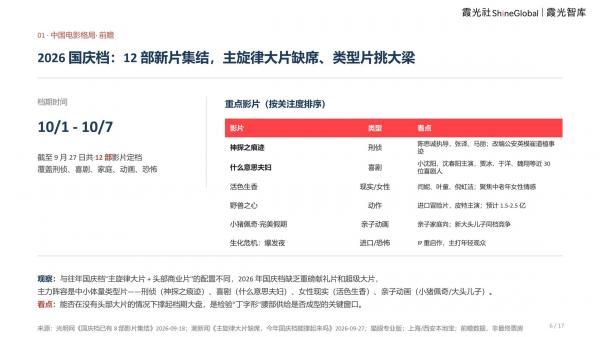
The standard lineup of 'patriotic blockbusters + major commercial films' during past National Day holidays is absent this year.
There are no major tribute films or super blockbusters. This year’s main lineup consists mostly of mid-to-small-budget genre films.
And this is precisely what makes this year’s National Day holiday season worth watching: Can the supply of mid-budget films sustain the overall market without major blockbusters?
To understand the situation of the National Day holiday season, let’s first look at the backdrop of the Chinese film market this year.
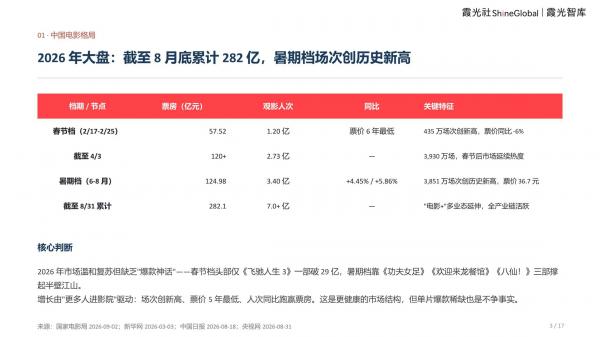
As of August 31, the cumulative box office for the Chinese film market in 2026 stood at RMB 28.21 billion, with over 700 million admissions. While not spectacular, the market structure is improving.
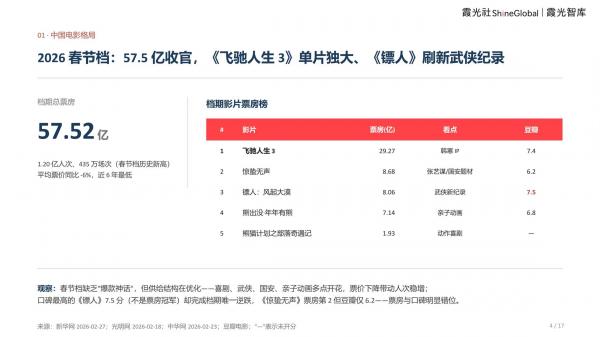
The Spring Festival holiday season closed with RMB 5.752 billion, setting new historical records with 120 million admissions and 4.35 million screenings. The average ticket price decreased by 6% year-on-year, reaching its lowest level in six years.
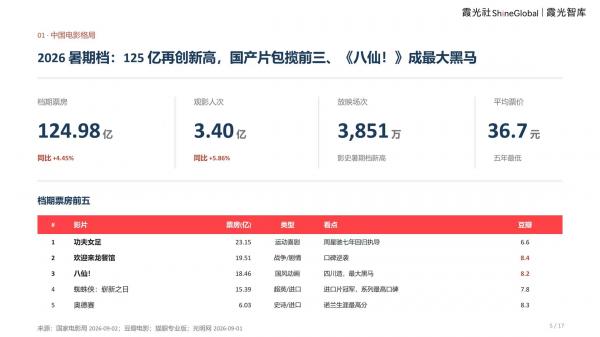
The summer holiday season reached a new high with RMB 12.498 billion, featuring 340 million admissions and 38.51 million screenings, up 5.86% and 4.45% year-on-year, respectively. The average ticket price was RMB 36.7, the lowest in five years.
Growth has been driven by 'more people going to the cinema,' not by ticket prices. While prices have dropped to a low, the number of screenings has hit a new high, and admissions have outperformed box office growth—indicating a healthier market structure. However, the scarcity of blockbuster hits remains an undeniable fact.
During the Spring Festival holiday season, only
The 'blockbuster myth' of 2025, where
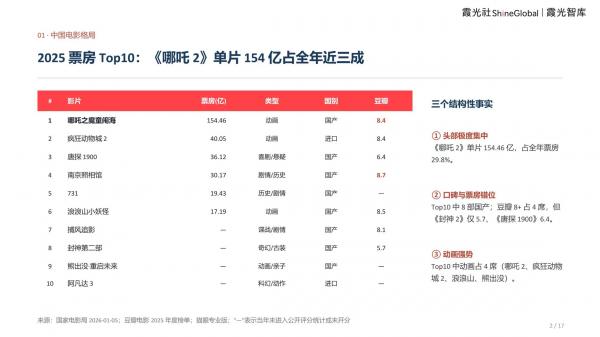

Box Office Performance and Word-of-Mouth: Increasingly Divergent Paths
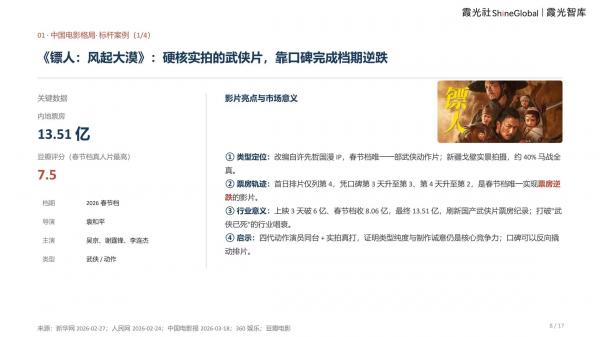
During the summer holiday season, the relationship between word-of-mouth and box office performance became more complex.
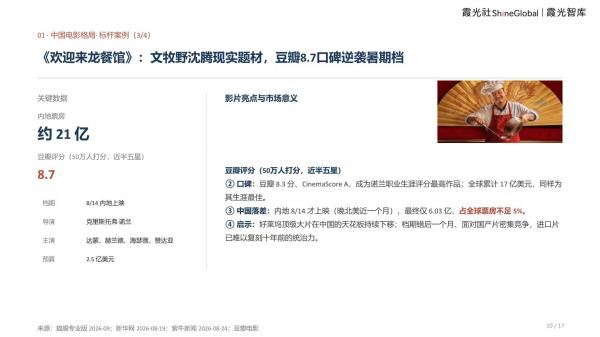
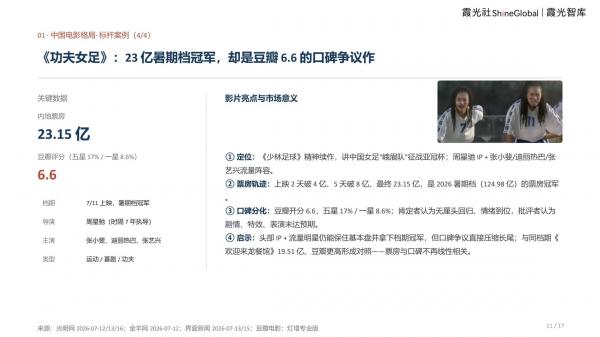
The summer holiday season champion,
The batch of mid-to-small-budget genre films in the National Day holiday season faces the same challenge: Without established IP or star power, word-of-mouth becomes nearly the only lever for success.

The Strength of Mid-Budget Films Determines the Season’s Success
Several predictions for this year’s National Day holiday season:
First, the overall box office is likely to fall short of previous years. The absence of major blockbusters and patriotic tribute films means none of the 12 films have the potential to surpass RMB 2 billion. The total box office for the season may fall within the RMB 2-3 billion range, depending on whether
Second, while genre diversity is an advantage, there is a lack of 'must-see' reasons. Criminal investigation, comedy, female-centric realism, family animation, and imported horror films each have their core audiences, but every film faces competition within its genre or an audience ceiling. Family animations include
Third, the true significance lies not in box office numbers but in whether a 'T-shaped' mid-budget film supply has taken shape. This is a critical window to test whether mid-budget films can sustain the market without major blockbusters. If the 12 films collectively achieve a respectable box office, it indicates that the Chinese film market is shifting from 'relying on blockbusters' to 'depending on a systematic approach.'
Looking Ahead to the 2027 Spring Festival Holiday Season: A Clash of Three Blockbusters
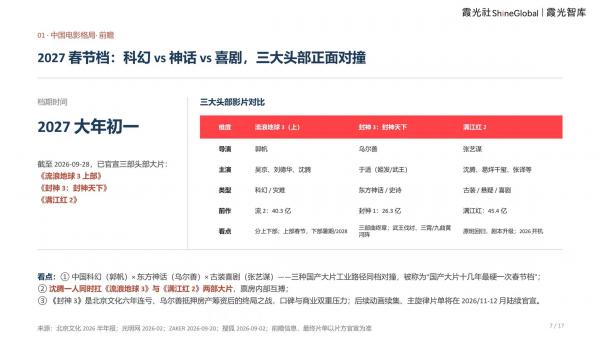
After the National Day holiday season, the next major 'blockbuster season' will be the 2027 Spring Festival, which has already locked in the most intense showdown in the history of Chinese cinema.
As of September 28, three major blockbusters have officially announced their release dates for the first day of the 2027 Lunar New Year:
Frant Gwo’s sci-fi, Wuershan’s Eastern mythology, and Zhang Yimou’s Ancient costume suspense comedy (costume mystery comedy)—three distinct paths of Chinese blockbusters competing in the same season have been dubbed 'the toughest Spring Festival holiday season for domestic blockbusters in over a decade.' Shen Teng stars in both

Overseas Expansion: From 'Single Blockbusters' to 'Systematic Global Reach'
Shifting focus overseas, Chinese cinema’s global expansion is undergoing structural changes.
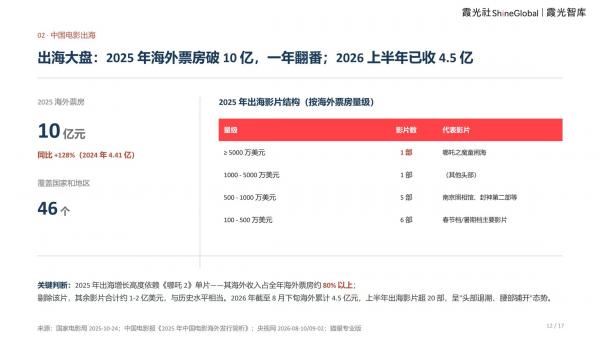
In 2025, overseas box office revenue surpassed RMB 1 billion, doubling year-on-year (2024: RMB 441 million), covering 46 countries and regions. However, growth heavily relied on
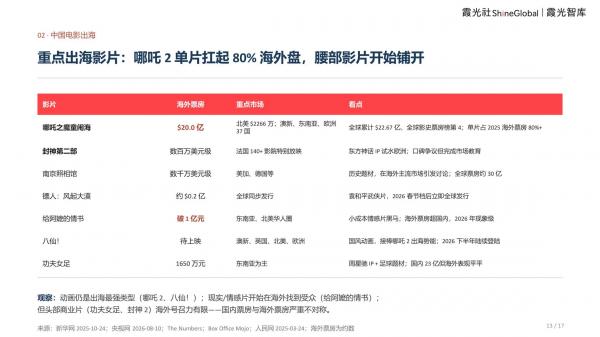
As of late August 2026, cumulative overseas earnings reached RMB 450 million, with over 20 films released overseas in the first half of the year, showing a trend of 'declining reliance on blockbusters and expanding mid-budget films.' surpassed RMB 100 million in Southeast Asia and North American Chinese communities, with overseas box office exceeding domestic earnings;
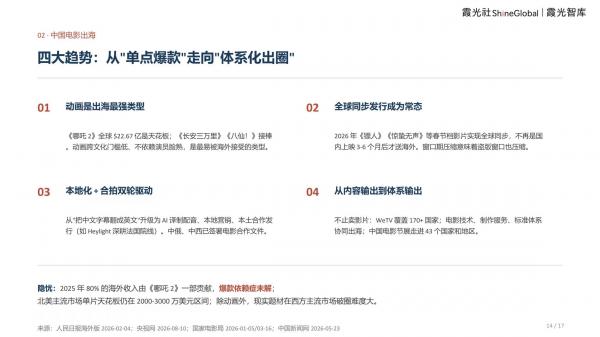
Animation is the strongest genre for overseas expansion. With low cross-cultural barriers and no reliance on recognizable actors,
Global simultaneous releases have become the norm. In 2026, Spring Festival holiday season films such as
Localization and co-productions drive growth. The approach has evolved from 'Chinese subtitles translated into English' to AI-powered dubbing, local marketing, and co-distribution partnerships. China has signed film cooperation agreements with Russia and Spain.
The shift from content export to systemic output. WeTV now covers over 170 countries, with Chinese film technology, production services, and standard systems expanding globally. Chinese film festivals have reached 43 countries and regions.
However, concerns remain: 80% of overseas earnings still come from
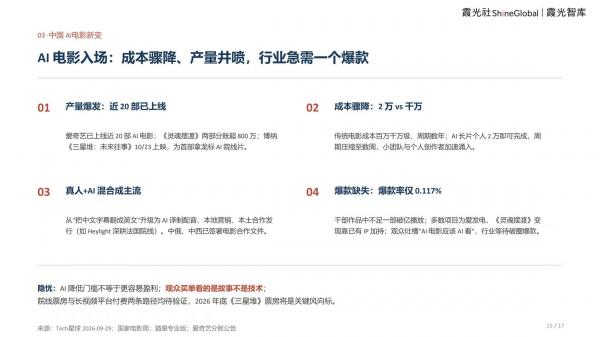

The Next Game-Changer for Chinese Cinema: AI
The next chapter for Chinese cinema may no longer be about 'a single film saving the market,' but rather 'a systematic foundation.' Beyond 'systems,' an even more transformative force is approaching—AI.
In 2026, China’s first AI hyper-realistic theatrical film,
What does this mean for Chinese cinema?
Cost structures are changing. Virtual production can reduce scene construction costs by up to 85%, while digital human modeling costs 80% less than actor salaries. Projects previously shelved due to budget constraints can now enter production at one-tenth the cost.
Overseas expansion barriers are lowering. The approach has evolved from 'Chinese subtitles translated into English' to AI-powered dubbing, local marketing, and co-distribution partnerships. Chinese films can now enter multilingual markets at lower cost and with greater precision.
When AI can generate 'acceptable' visuals, the core competitiveness of cinema returns to what AI cannot replicate—life experience, emotional depth, and artistic judgment.
The 'mid-budget trial' of the National Day holiday season asks: Without blockbusters, what sustains the market?
The 'blockbuster clash' of the 2027 Spring Festival holiday season asks: Who will raise the ceiling?
The 'systematic global reach' of overseas expansion asks: How far can Chinese cinema go?
And AI asks the question for the next cycle: When production costs no longer pose an absolute barrier, what distinguishes cinema from other forms of visual media?
Mid-budget films determine the floor, blockbusters determine the ceiling, and technology determines the breadth. The clash of blockbusters, the transformation of overseas expansion, and AI reshaping production dynamics reflect different facets of the film industry as it seeks a new equilibrium.
-
The Financial Agent Boom: A Genuine AI Challenge Emerges
-
![]()
Seres Struggles to Escape Huawei's 'Influence'
-
The AI 'Golden Rice Bowl' of FDE Amid Massive Layoffs
-
![]()
NIO and Geely Cross-Hold Shares: Pioneering a New Auto Industry Joint Venture Focused on Battery Swapping
-
![]()
From 1.3 Trillion to 300 Billion: The Vanishing Trillions in Market Value—Is the Zhipu AI Boom Over?
-
![]()
What Supports Chinese Cinema in the Absence of Blockbusters During the National Day Holiday? | 2026 Chinese Film Report and Overseas Trends
-
US$8.2 Billion: Silicon Valley's Top-Tier 'Girls Help Girls'
-
![]()
Are DOE and Metasurfaces Truly Distinct Entities?