Seres Struggles to Escape Huawei's 'Influence'
 09/29 2026
 393
393

By Zhou Liying
Edited by Zhang Xiao
During a CCTV live broadcast in late 2024, the host, Sa Beining, joked with Seres Group founder Zhang Xinghai, saying:
"Rumors have it that since partnering with Huawei, you've been unable to sleep soundly, waking up in the middle of the night with laughter—so much so that you can't drift back to sleep. Is that true?"
Zhang Xinghai responded, "I still sleep when it's time... but I am truly delighted."
At that moment, Seres was riding high on success. In 2024, the AITO brand delivered a total of 387,100 vehicles, marking a year-on-year increase of 268%. This success was mirrored in its financial performance, with Seres achieving revenue of 145.276 billion yuan, a year-on-year surge of 305.04%, and a net profit attributable to the parent company of 5.946 billion yuan, reversing six consecutive years of net losses after accounting for non-recurring items.
However, the greater the influence—often termed as the 'halo effect'—that Huawei brought, the higher the skepticism Seres now faces.
Over the past half month, market discussions about potential changes in their cooperation model have remained intense. Complex emotions have trickled down from the top, resulting in a decline in stock prices, cancellations by potential car buyers, and panic among dealers.
Behind the scenes, Seres' growth quality has been subpar since 2024, with mounting performance pressures.
In the first half of this year, Seres' revenue stood at 57.493 billion yuan, a year-on-year decrease of 7.9%. Its net profit attributable to the parent company shifted from a profit of 2.941 billion yuan in the same period last year to a loss of 1.717 billion yuan, with a net loss after accounting for non-recurring items amounting to 2.379 billion yuan.
Against this backdrop, Seres opted to regain control over product definition, design, brand marketing, channel retail, and service systems, allowing Huawei's consumer business to "participate and empower"—in essence, aiming to break free from Huawei's 'influence'.
For instance, Seres would no longer need to pay hefty service fees to the Harmony Intelligent Mobility Alliance, and it would face less resource competition with other brands.
On September 24, during a visit to a Harmony Intelligent Mobility Alliance store in Hefei, Yu Chengdong responded that the adjustment of the AITO brand was initiated by Seres, stating, "Seres has significantly enhanced its capabilities through cooperation with us over the past few years and now wants to take the lead. We support them."
But the crucial question remains: Can growth be sustained after regaining dominance?
01 AITO's Halo and Influence
In 2019, Seres was not yet known as Seres; it was Sokon, a company selling mini-vans. Its main model, the Sokon Dongfeng, was priced around 30,000-60,000 yuan. In 2019, its net profit after accounting for non-recurring items was -950 million yuan, and it struggled to find a breakthrough in its new energy transformation.
Meanwhile, Huawei was also on the lookout for in-depth complete vehicle partners, but few automakers were willing to relinquish control over product and brand dominance. Huawei's exploration of vehicle cooperation models faced several setbacks.
Huawei's cooperation models with automakers can be categorized into three types: component supply mode, Hi mode (Huawei Inside), and Harmony Intelligent Mobility Alliance mode (Smart Selection), with increasing dependency on Huawei. In the component supply mode, automakers only purchase individual technologies; in the Hi mode, automakers retain brand dominance and jointly implement full-suite intelligent solutions with Huawei; in the Harmony Intelligent Mobility Alliance Smart Selection mode, Huawei is deeply involved in the entire chain, with automakers primarily responsible for vehicle manufacturing and after-sales.
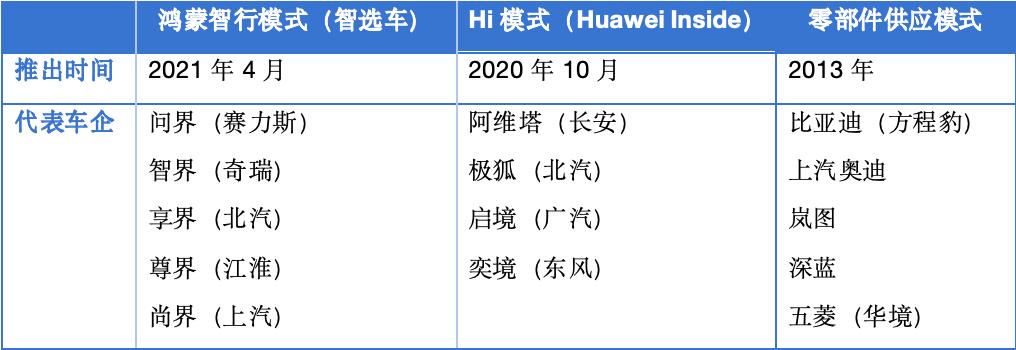
Figure/Produced by Tingchao TI
On one side was Sokon, desperately in need of technological advancement to break out of the low-end bottleneck, and on the other side was Huawei, eager to validate its vehicle-level cooperation model. Once their core demands aligned, cooperation was swiftly finalized, and a comprehensive cooperation agreement was signed in January 2019.
The first cooperation model between Huawei and Sokon, the Smart Selection SF5, was launched in April 2021 but sold only a few dozen units in half a year, marking a disappointing debut. However, this failure did not shake the foundation of their cooperation. Instead, it prompted Huawei to become more deeply involved, transitioning from a technology supplier to full-chain operations, with continuously expanding cooperation boundaries.
As Huawei advanced further, Seres had to step back. In 2022, Huawei systematically integrated the Harmony cockpit, Qiankun Intelligent Driving, Tuling platform, and Jugeng battery into the "AITO M5." At the same time, dominance over product definition and channel marketing was consolidated under Huawei, with Seres only responsible for vehicle manufacturing and after-sales.
Seres' "concession" on decision-making power led to the tremendous success of the AITO brand. In less than a year, the AITO M5 delivered over 76,000 units in 2022, and its starting price of 249,800 yuan significantly raised Seres' average vehicle price.
From then on, AITO grew rapidly. Timeline-wise, in mid-to-late 2022, it launched the large SUV AITO M7 priced at 300,000 yuan; in 2023, it introduced the AITO M5 Intelligent Driving Edition and the refreshed M7, all equipped with intelligent driving; in 2024, monthly deliveries of the M7 exceeded 30,000 units, and it began scaling deliveries of its flagship model, the AITO M9, breaking into the luxury SUV market priced above 500,000 yuan; in January 2026, the 1 millionth AITO vehicle rolled off the production line, taking approximately 46 months and setting a record for delivery speed in China's high-end new energy market.
The financial returns were equally significant. Seres accumulated losses of about 9.8 billion yuan from 2020 to 2023 but achieved profitability for the first time in 2024, being hailed by the outside world as the fourth new energy automaker globally to turn a profit; in 2025, revenue reached 165.054 billion yuan, with a net profit attributable to the parent company of 5.957 billion yuan. In the same year, AITO topped the sales rankings among new forces with 164 billion yuan in sales, accounting for 71.8% of the total 589,100 vehicles sold under the Harmony Intelligent Mobility Alliance.
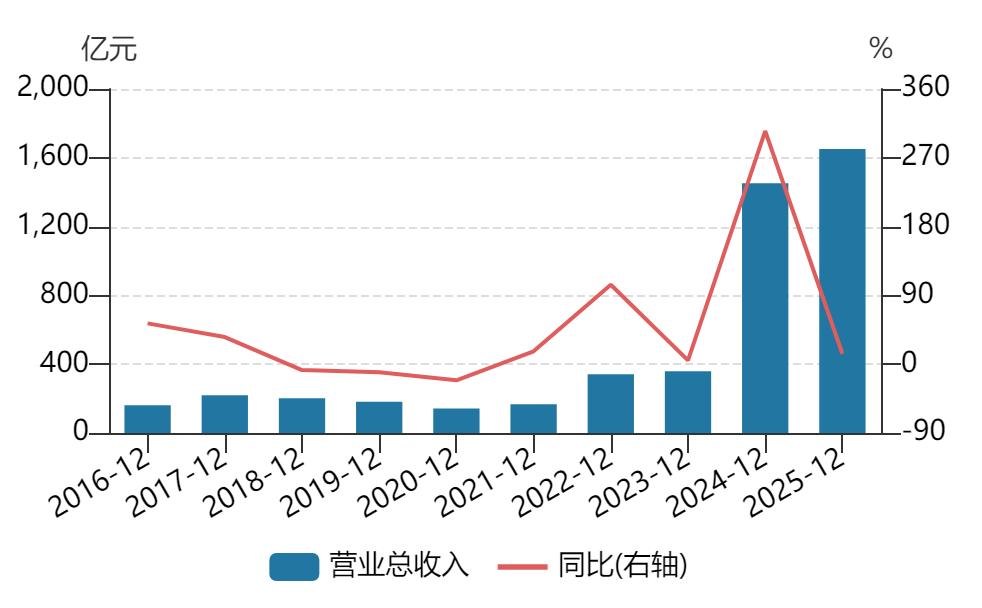
Figure/Wind
Starting from scratch, AITO quickly rose to the first tier of domestic high-end new energy vehicles, becoming the most valuable brand under the "Huawei-made car" concept. Seres' revenue, sales volume, and market capitalization achieved leapfrog growth simultaneously, transitioning from sustained losses to profitability and becoming the most direct beneficiary of this cooperation model.
What Huawei brought to Seres was not just technology itself but also a complete set of solutions to address brand, channel, and mindset shortcomings. The Harmony cockpit and ADS Intelligent Driving formed a product differentiation moat; Huawei's brand momentum overcame the trust barrier for new brands; the natural traffic in Huawei stores opened up customer acquisition and conversion channels for high-end new energy vehicles.
But beneath the halo, the influence was already in place.
The underlying logic of the Smart Selection mode is a high degree of binding between rights, responsibilities, and benefits: Huawei outputs a full suite of capabilities in exchange for brand premium, sales volume, and ecological discourse power; Seres bears the assets, manufacturing, and delivery in exchange for brand leapfrogging and scale growth.
During the upcycle, growth dividends were sufficient to mask frictions over profit distribution, decision-making dominance, and brand ownership; once growth slowed and competition intensified, the burdens weighing on Seres surfaced.
02 Why is Seres Eager to Regain Dominance?
As AITO grew into a brand with millions of users, differences in business objectives, risk-reward allocation, and brand direction between the two sides began to emerge concentratedly.
The first to buckle was performance. In the first half of 2026, Seres' revenue was 57.493 billion yuan, a year-on-year decrease of 7.87%; its net profit after accounting for non-recurring items was -2.379 billion yuan, and its net cash flow from operating activities plummeted from 14.437 billion yuan to -12.376 billion yuan. Overall gross margin for the first half was 23.3%, a year-on-year decline of 5.6 percentage points.
Breaking it down, Seres' pressure came from two levels: vehicles were selling for less, but costs were higher.
First, the average vehicle price declined, dropping from about 388,000 yuan in the same period last year to about 335,000 yuan in the first half of this year. The decline in average price directly corresponded to a downward shift in product mix, with a lower proportion of high-value models like the M9 and M8. Seres explained this by saying that its main models were in a transitional phase of product iteration, with production capacity and sales scale effects not fully realized.
On the cost side, the unit price of memory chips rose from about 20 yuan to nearly 100 yuan, and battery-grade lithium carbonate increased from about 80,000 yuan per ton to about 180,000 yuan per ton. Zhang Xinghai, chairman of Seres, publicly stated that the manufacturing cost per AITO vehicle increased by 15,000-20,000 yuan as a result.
Furthermore, who ultimately bears these costs depends on who holds the discourse power.
Under the old Smart Selection mode, product definition, technological iteration, and pricing strategies were dominated by Huawei, while the pain of technological iteration and costs were absorbed by Seres. The fees Seres paid to the Huawei system roughly included hardware procurement fees for intelligent driving, cockpit, and three electric systems, technology licensing fees of about 2% of the vehicle's selling price, and channel marketing service fees of about 8%, totaling over 10% of the vehicle price.
In 2025, Seres' selling expenses were 24.190 billion yuan, a year-on-year increase of 26%, of which "advertising, flagship store construction, and service fees" reached 22.95 billion yuan, accounting for 94.8% of selling expenses, with per-vehicle selling expenses of about 51,000 yuan—a significant portion of AITO's high-end premium was exchanged for channel rent.
Another layer of pressure came from within the ecosystem. Huawei's logic is to monetize technology at scale: more partners mean more revenue, but for AITO, it means diluted resources and scarcity.
The cooperation landscape for Qiankun Intelligent Driving expanded to 25 brands and over 50 models, with an estimated 3 million units expected to be equipped by 2026. The Harmony Intelligent Mobility Alliance grew from "one AITO" to "five brands" operating in parallel, with limited resources such as store display space, launch event duration, and technological first-mover rights. AITO's sales share within the Harmony Intelligent Mobility Alliance dropped from over 80% at its peak to about 50% in July 2026.
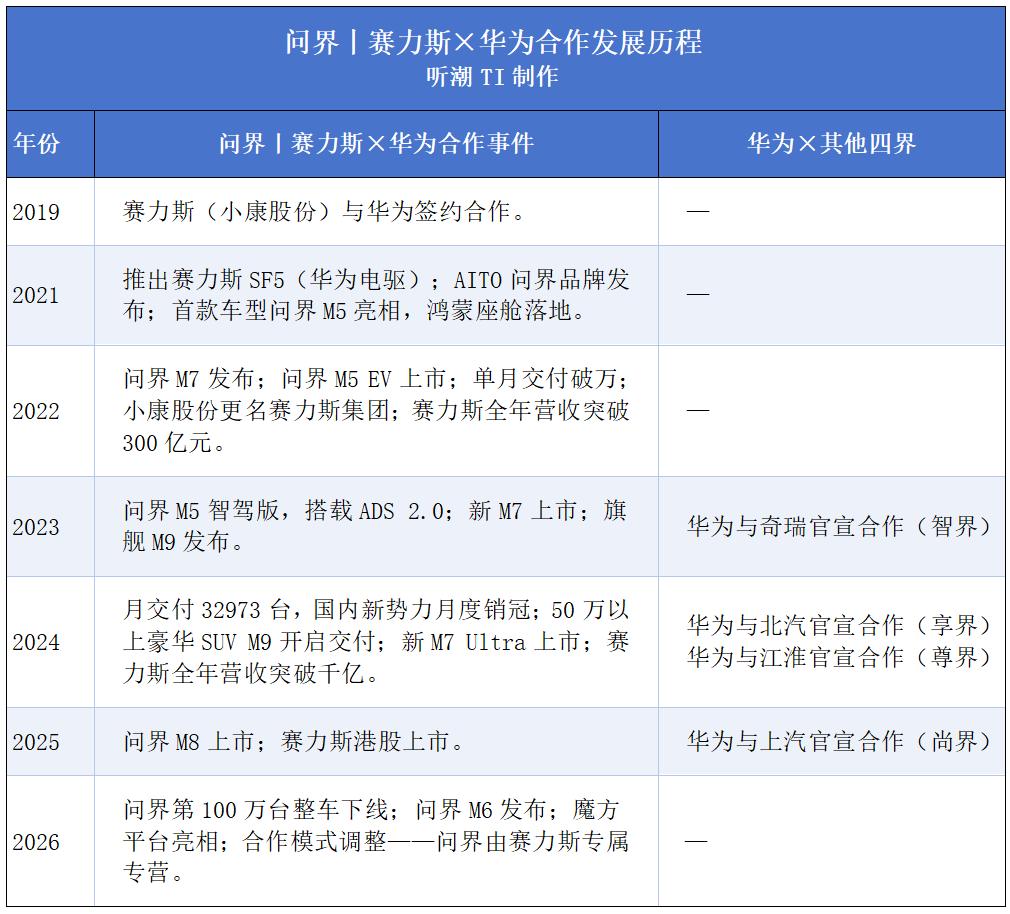
Figure/Produced by Tingchao TI
With high costs, substantial expenses, and diluted resources within the ecosystem, regaining operational dominance over AITO became Seres' chosen path to break free from the impasse. However, regaining dominance does not mean the challenges are over; the tests AITO faces next are far more complex than securing dominance.
03 AITO's Next Step: Greater Pressure
AITO's "solo flight" is inevitable, and Seres is not unprepared.
In terms of brand assets, in July 2024, Seres acquired 919 AITO series trademarks and 44 design patents for 2.5 billion yuan, completing the confirmation of brand assets; at the equity level, it invested 11.5 billion yuan in August of the same year to acquire a 10% stake in Yinwang and obtained a board seat, forming a "business + equity" dual binding; on the channel front, starting in 2024, Seres actively recruited luxury brand dealers to switch to selling AITO, proactively building its own channels; technologically, in April 2026, it launched the "Magic Cube Technology Platform," clearly stating that the vehicle architecture would be dominated by itself.
Financially, it also built a substantial safety net. As of the first half of 2026, cash and equivalents and related financial assets exceeded 73.1 billion yuan, accounting for 57% of total assets, with interest-bearing liabilities accounting for only 3.2%; R&D investment in the first half was 7.007 billion yuan, a year-on-year increase of 34.8%.
However, regaining dominance is not the endpoint; it is more like receiving a bill. As Huawei's halo gradually fades, AITO must face major challenges across four dimensions: brand, channels, technology, and market.
The most direct test is the reconstruction of brand perception. Over the past four-plus years, AITO's core selling points could be highly condensed into: Huawei's traffic, the Harmony cockpit, and Qiankun Intelligent Driving. Now, these three elements have either retreated to an "empowerment" position or become industry standards. When the same intelligent driving appears on other "four brands" priced 100,000 yuan lower, what unique advantages does AITO have?

Next is the cost and efficiency test of channel switching. What Huawei stores brought to AITO was not just an 8% channel service fee but also precise high-net-worth traffic, standardized high-end service experiences, and strong trust endorsements. Shifting to a "dedicated and exclusive" self-built channel system means Seres must complete a series of heavy-asset investments, including dealer network expansion, store location selection and renovation, sales and service team training, and after-sales system construction—all of which represent significant expenditures.
Greater pressure arises from the need to reconstruct barriers to technological differentiation. Previously, AITO's uniqueness stemmed from its "Huawei technology first-mover advantage + deep customization" and its privileged resource allocation within the ecosystem. Now, however, "Huawei content" has transitioned from a scarce asset to an industry norm. Seres' self-developed "Magic Cube Technology Platform" serves as its key differentiator, yet catching up in fundamental capabilities such as vehicle architecture, tri-electric efficiency (battery, motor, and electric control), and chassis tuning will not deliver immediate results.
Against the backdrop of the broader industry, AITO's independent trajectory aligns with the new energy market's shift from incremental to stock growth. AITO's past rapid growth was largely attributable to its first-mover advantage in the high-end extended-range SUV segment. However, by 2026, the high-end new energy SUV market had transformed into a fiercely competitive "red ocean": BBA's electrification efforts are intensifying their counteroffensive, while brands like Li Auto and Xiaomi are strategically positioning themselves within specific price bands. Additionally, AITO faces internal competition from the other "four brands" within the same ecosystem.
Having lost Huawei's resource allocation and first-mover advantages, AITO must now rely on its own product strength, brand influence, and channel capabilities to safeguard its market position. Shedding Huawei's "constraints" is merely the first step; the true challenge lies in whether AITO can cultivate its own unique competitive edges once the initial halo effect diminishes.
-
![]()
Why Is Luxshare Precision Covering the Costs for Chenling Optics, Despite Harson’s Aborted Acquisition?
-
![]()
Dialogue with Phoenix Optics: Riding the 'Optics + AI' Wave with Six Decades of Expertise
-
![]()
Competing on Assets, Not Just Price: 10 Key Insights from NIO and Geely's Battery Swap Integration
-
![]()
Fliggy is Becoming More and More Like a Plugin
-
![]()
RMB 10.3 Billion! Guangzhou Computing Power Company Bags Two Major Contracts, Yet Reaps Only Slim Profits
-
The Financial Agent Boom: A Genuine AI Challenge Emerges
-
![]()
Seres Struggles to Escape Huawei's 'Influence'
-
The AI 'Golden Rice Bowl' of FDE Amid Massive Layoffs