A Staggering $50 Billion Valuation! The Resurgence of a Tsinghua-Educated Engineer’s Venture
 10/09 2026
 394
394
On October 6, various news outlets reported that Moonshot AI had concluded its final round of private financing ahead of an initial public offering (IPO), boasting a valuation of approximately $50 billion. The company is reportedly aiming for a listing on the Hong Kong Stock Exchange in the first quarter of 2027.
Preliminary discussions with potential investors could commence as early as this month. From its inception in 2023 to reaching this impressive valuation, Moonshot AI has achieved this feat in just over three years. 
The pace at which Moonshot AI's valuation has soared is remarkable. For clarity, this information stems from sources familiar with the matter who spoke to the media. The timeline for the listing is subject to change and should not be interpreted as an official announcement from the company.
What makes this even more fascinating is the rationale behind such a high valuation. Investors are undoubtedly drawn to the advancements in the company's model. However, for a valuation of $50 billion to hold, there must be consistent and substantial demand. 
Details regarding the amount raised in this round, the lead investor, and co-investors have not been disclosed.
As of October 6, when this article was finalized, public reports did not provide complete information. Among the known shareholders are Alibaba, Tencent, and Wuyuan Capital, but their participation in this financing round remains unconfirmed. 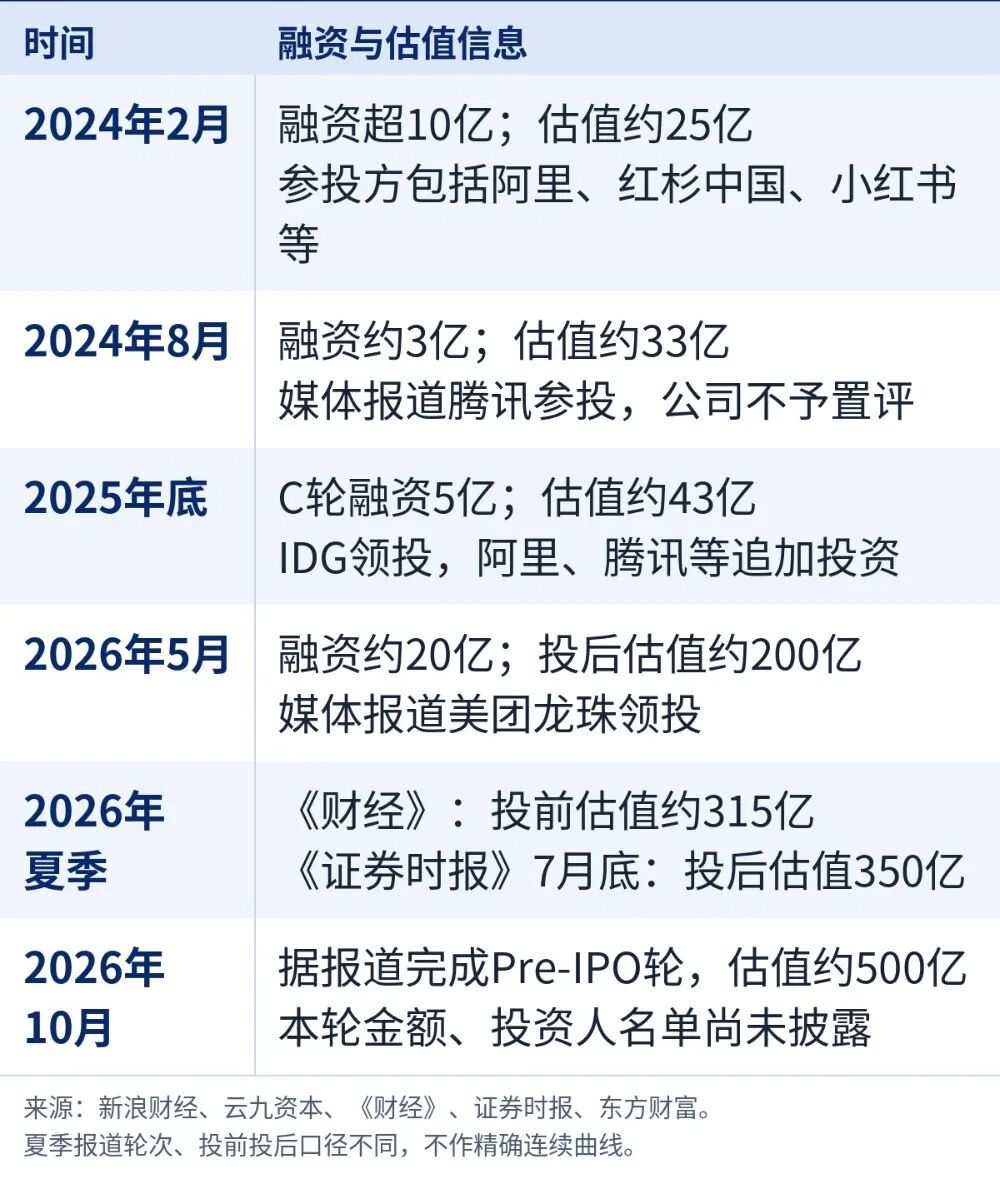
Previous financing rounds are relatively well-documented. In February 2024, media outlets reported that Moonshot AI had raised over $1 billion at a valuation of approximately $2.5 billion. In August of the same year, Kechuang Board Daily reported a funding round of about $300 million, valuing the company at around $3.3 billion, a claim the company declined to comment on.
By the end of 2025, Moonshot AI had secured a $500 million Series C funding round.
Cloud Nine Capital revealed that IDG led this round, with existing shareholders Alibaba and Tencent increasing their stakes. Caijing reported a valuation of approximately $4.3 billion for this round.
In May of this year, Caijing reported that the company had raised about $2 billion, pushing its valuation to approximately $20 billion.
By summer, Caijing reported a new pre-money valuation of about $31.5 billion, while the Securities Times reported in late July a funding round of over $3.5 billion and a post-money valuation of $35 billion.
It is evident that multiple capital firms are increasingly optimistic about Kimi. However, as its valuation climbs, so do the performance benchmarks it must achieve. The applause at the financing table will eventually need to be mirrored in the company's financial statements.
From academic pursuits to industry leadership: The inspiring journey of Moonshot AI founder Yang Zhilin. A Tsinghua University undergraduate and Carnegie Mellon University Ph.D. graduate, Yang conducted AI research at Google Brain and Meta before founding Moonshot AI in 2023. 
Early on, Kimi gained recognition for its long-text processing capabilities. For many users, its most valuable feature was its ability to assist in reading through extensive materials.
Today, merely reading and summarizing is no longer sufficient. Over the past year, Kimi has gradually expanded its capabilities to include programming, office tasks, and intelligent agents. In layman's terms, an intelligent agent enables AI to call tools and execute steps to complete a task as thoroughly as possible. 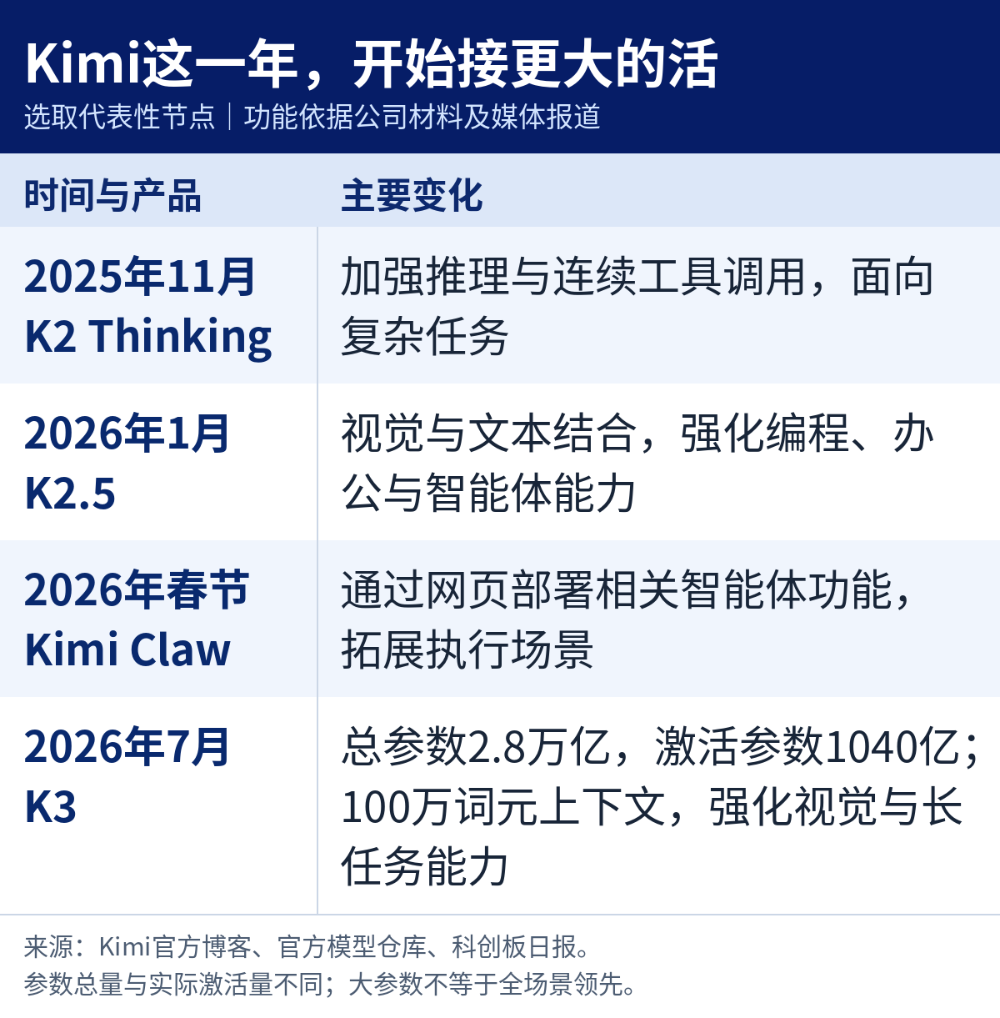
In November 2025, K2 Thinking enhanced reasoning and tool-calling abilities. K2.5, launched in January this year, further integrated visual, programming, and intelligent agent capabilities. Kimi Claw, released during the Spring Festival, expanded scenarios for deploying and using intelligent agents via web pages.
K3, launched in July, features 28 trillion total parameters, with 104 billion actually activated, supporting context windows of about 1 million tokens.
The company's official materials emphasize visual understanding, extended programming, and knowledge work capabilities. These technological advancements carry significant commercial implications.
Users may not be willing to pay for ten minutes of casual AI chat. However, if it can assist in processing tables, checking code, and reducing time spent on revisions, there is a more tangible reason to pay.
Moonshot AI's current commercialization channels include individual memberships and model interface services. Interface services involve selling model capabilities to developers and enterprises, allowing them to integrate into their own products and pay based on usage.
This enables Kimi to extend beyond individual chat windows and into more workflows. However, an open-source model being downloaded does not equate to official services being sold. Developers can deploy it themselves or switch to other models.
The company must still rely on effectiveness, price, and stability to retain customers.
Revenue is growing rapidly, but profits remain elusive. Media reports disclose that Moonshot AI's current ARR (Annualized Recurring Revenue) is approximately $1 billion, with an expected rise to $2 billion by December. The figure reported in June was around $300 million. 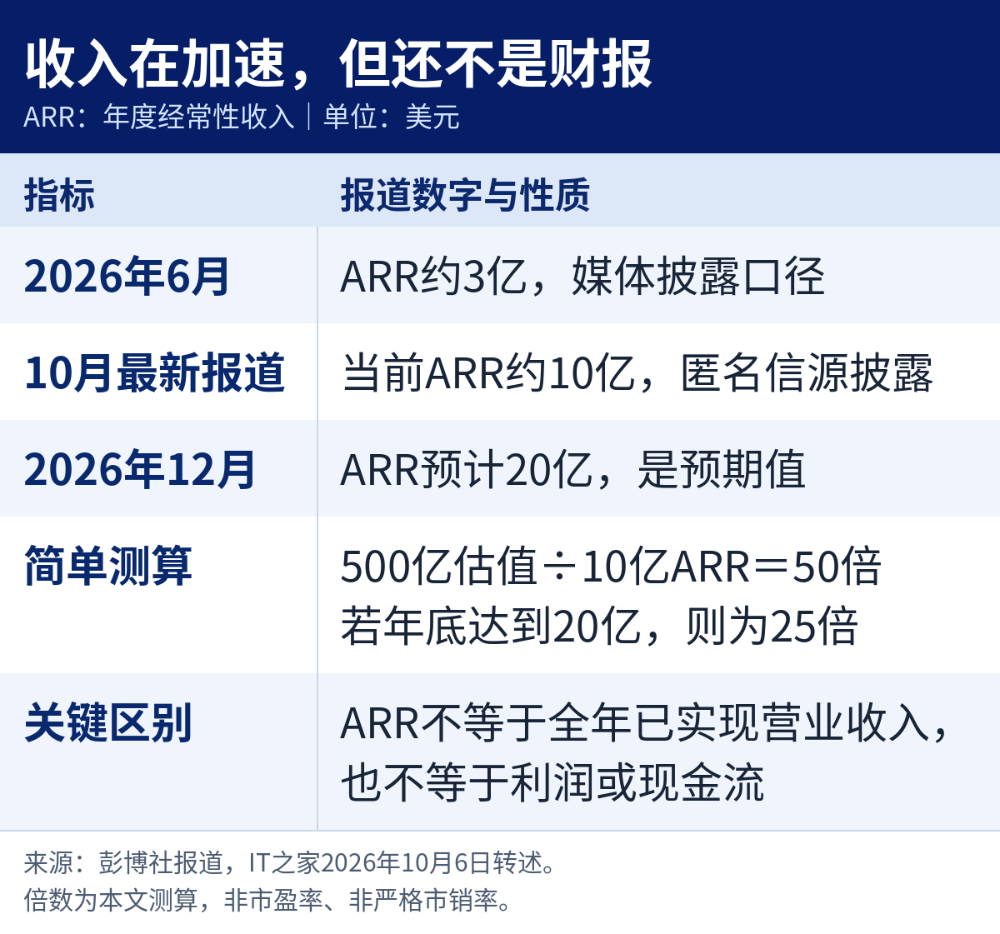
The growth rate is attractive, but this is where misinterpretations are most likely to occur. ARR, typically translated as Annualized Recurring Revenue, is an annualized metric for observing revenue scale. It does not mean the company has already received $1 billion this year, nor can it be directly equated with full-year operating revenue.
Model interface revenue fluctuates with usage volume, and how it is annualized or what it includes still requires further disclosure from the company.
The $2 billion figure by year-end is an expectation reported in the media and should not be treated as current performance. Based on simple calculations from reported figures, the $50 billion valuation is about 50 times the current $1 billion ARR. If it reaches $2 billion by year-end, it would be about 25 times.
This is not a price-to-earnings ratio nor a strict price-to-sales ratio; it merely helps understand how highly the market has priced growth expectations.
Investors are paying for the expectation of continued future revenue growth. However, future revenue will not automatically translate into profits. Every model response consumes computing power; complex tasks may require multiple reasoning steps and tool calls. While users save time, whether the company can also make money requires a different set of calculations. 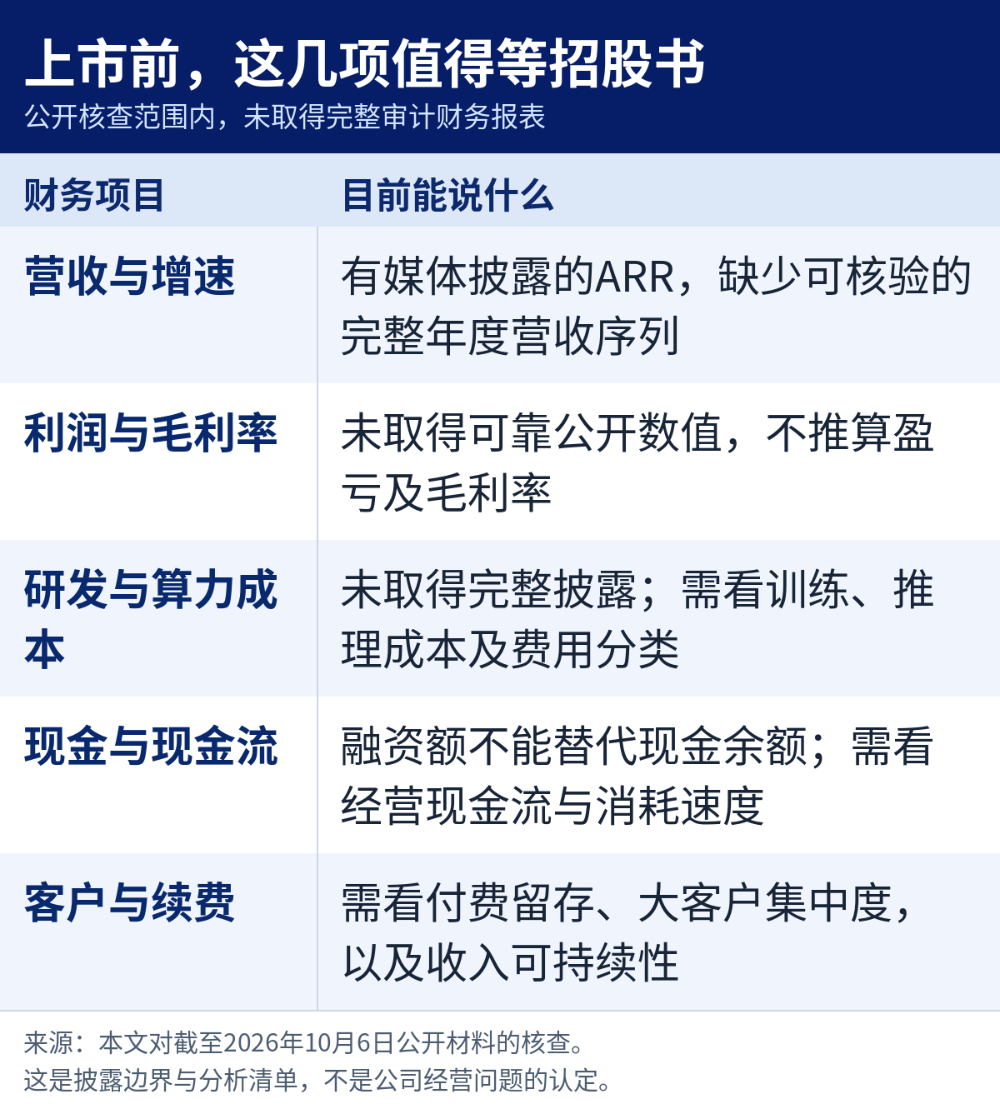
As of this public verification, complete audited financial statements from Moonshot AI have not been obtained, making it impossible to reliably list annual revenue, net profit, gross margin, or cash balances.
Therefore, it cannot be determined whether the company is profitable, nor can cumulative financing amounts be used to estimate how many years of cash remain. Once the prospectus is released, the most critical points to watch are: how quickly computing costs rise as revenue increases, whether paying customers renew their subscriptions, and whether cash flow improves after R&D investments.
Revenue growth answers whether there is demand. Costs and renewals further answer whether the business can last.
The market is vast, but customers are discerning. The latest report from CNNIC shows that as of the first half of 2026, China's generative AI user base surpassed 700 million, with a penetration rate exceeding 50%.
This indicates that AI usage is becoming increasingly common, but it does not mean that all 700 million users are ready to pay for memberships. Free users care about accessibility, paying users care about value, and enterprises also compare data security, service stability, and procurement costs. Entering these markets means facing different competitors. 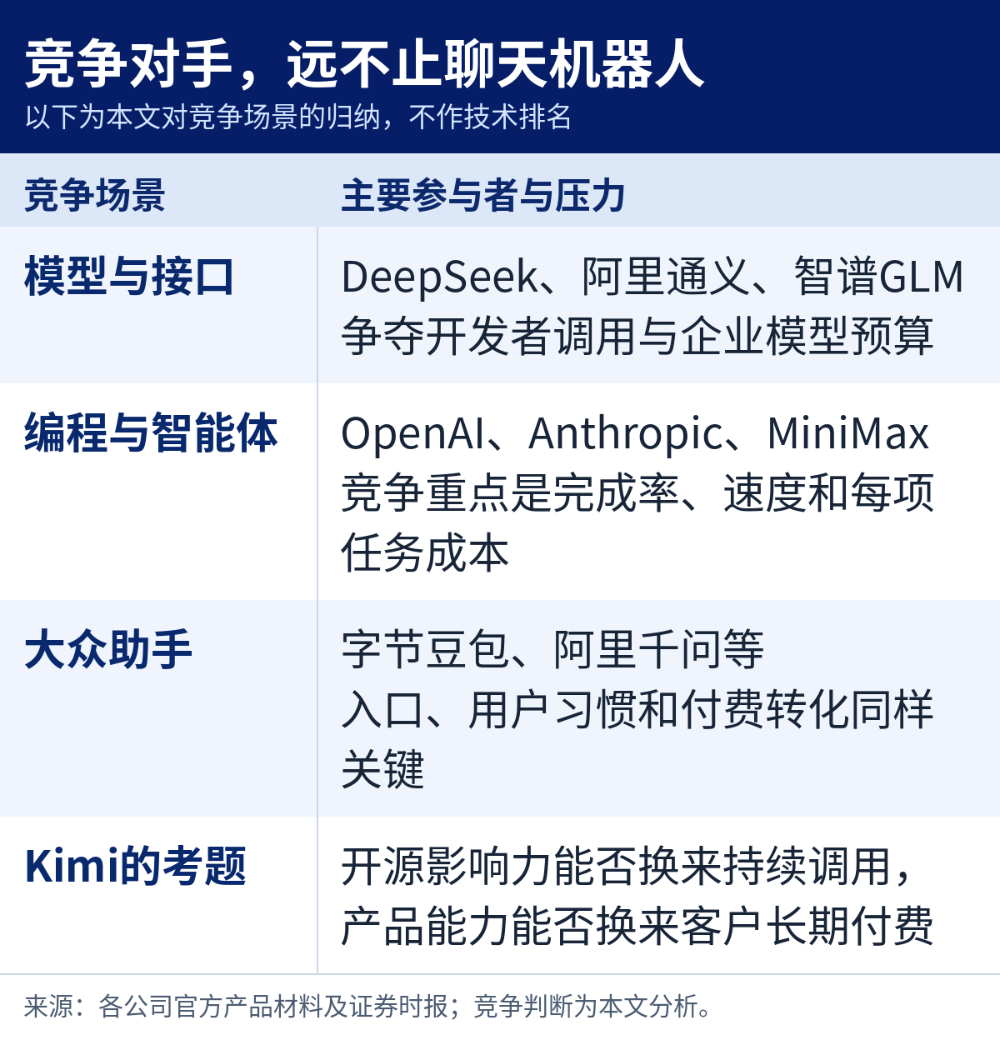
From a product perspective, model interfaces compete with options like DeepSeek, Tongyi, and Zhipu GLM. Programming and intelligent agents vie for budgets against OpenAI, Anthropic, and MiniMax. Mass-market assistants face products like Doubao and Qianwen. These competitions are not unified benchmark races.
A company leading in one test may not win all customers.
For users, task completion rates, response speeds, and rework frequencies matter more than rankings in daily work.
Enterprise procurement is even more pragmatic: Given the same budget, who can get the job done more reliably? This is where open-source routes find opportunities.
More trials and deployments help expand influence. However, customers have more choices and can switch models more easily. Technological leadership requires constant updates, while customer relationships depend on long-term service accumulation.
Kimi must excel at both to turn today's product enthusiasm into next year's sustained revenue. 
With valuations soaring, who will step in next?
Moonshot AI deserves recognition for its product progress to attract such capital attention. Investors are willing to pay because they believe the company has significant room for growth.
However, more money does not simplify operations. A financing round brings resources for R&D and expansion but also raises expectations for higher returns.
Especially after going public, the market will more frequently ask: Has a new model been released, and how much has revenue increased? With more clients, have profits kept pace?
Short-term losses do not automatically indicate failed investments; cutting-edge R&D does take time. What truly requires vigilance is a company growing larger yet unable to clearly explain why each growth spurt is worthwhile.
For Moonshot AI, the next challenge is specific: Turn technological capabilities into reliable delivery, then convert delivery into sustained payments. When financing, investors vote for the future. When operating, customers vote anew every day.
Yang Zhilin's story is legendary: A young man born in 1992 from Shantou, relying on code and persistence, pushed a 300-person company to a $50 billion valuation in three and a half years. Along the way, he faced doubts and was overshadowed by competitors but never changed direction.
Going public is not the finish line; it is the starting point for this tech believer to face public market scrutiny. Here's wishing him continued success.
What are your thoughts on this topic? We welcome your civil and rational insights in the comments section.
Disclaimer: This article is solely for financial hotspot analysis, citing publicly available information, company announcements, and Huitong IFinD data. The views expressed are for reference only and do not constitute investment or consumption advice.
#FinancialHotspots #InDepthAnalysis #BusinessFinance #InvestmentBanking #ListedCompanies #PrimaryMarket #IPO #MoonshotAI #KimiValuation Thanks for reading. Feel free to click 'Like' if you found this helpful.
-
![]()
What is the boundary of collaboration between FAW Toyota and GAC Toyota behind FAW Toyota's 'independent survival'?
-
![]()
Optical Waveguide Route Selection and Performance Optimization: Four Questions Integrators Must Answer Correctly
-
![]()
The Collective Surge of Major AI Models Toward Public Listing: The High-Stakes Race Behind the Buzz
-
![]()
A Staggering $50 Billion Valuation! The Resurgence of a Tsinghua-Educated Engineer’s Venture
-
![]()
In His Inaugural Year, Porsche CEO Implements Three Daring Strategies: 9,000 Job Cuts, 20% Price Increase, and Reintroduction of Gasoline Cars
-
![]()
JAC’s Stock Plummets to Limit Down! Dcd Auto Tests Zunjie V800, Three Consecutive Cars Experience Brake Failures: Extreme Testing or Defective Product? | Mingjingpro
-
![]()
【Electric Equipment】Fengcheng Zhuoxin Logistics Signs Contract for 150 SANY Electric Heavy Trucks
-
![]()
[Intelligentization] Huawei and Seres Sign New Five-Year Cooperation