The Collective Surge of Major AI Models Toward Public Listing: The High-Stakes Race Behind the Buzz
 10/09 2026
 478
478
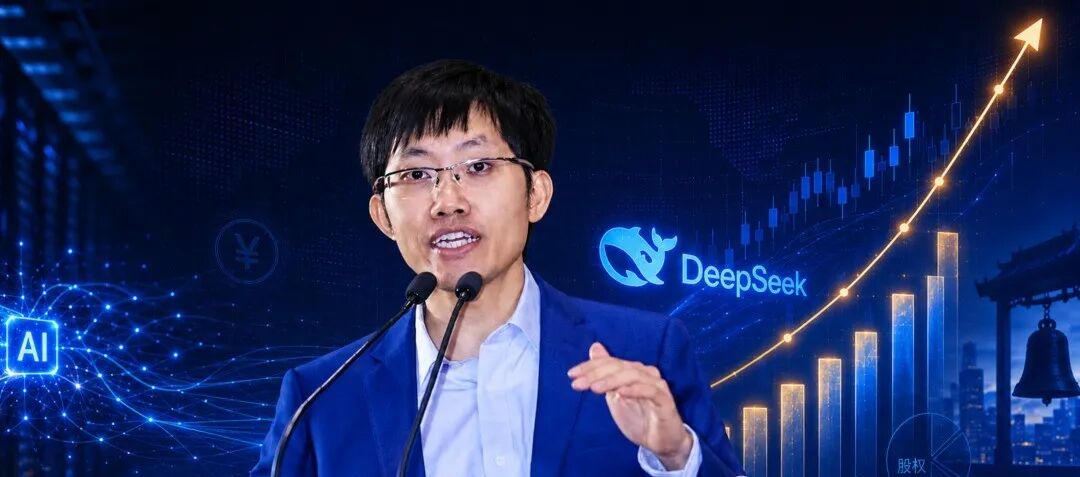
On October 6th, Bloomberg dropped two bombshell announcements. Yuezhi'anmian finalized its pre-IPO private funding round, reaching an estimated valuation of $50 billion, and is set to launch its IPO in Hong Kong in the first quarter of the following year, aiming to raise up to $5 billion.
On the same day, DeepSeek was reportedly nearing the completion of a new funding round, securing at least RMB 80 billion—significantly surpassing its initial RMB 50 billion target. Led by CATL and Tencent, DeepSeek is expected to list on the mainland market in early 2027.
To put it candidly, there's an overwhelming influx of capital—so much so that even the companies themselves were taken aback.
According to insiders, DeepSeek's total financing in this round is anticipated to approach RMB 100 billion, far exceeding the company's original RMB 50 billion goal. Investor enthusiasm soared following the release of its latest model, pushing the financing to its maximum capacity.
In September, Reuters reported that DeepSeek had engaged CITIC Securities to prepare for a potential IPO on the STAR Market. However, the timing, scale, and valuation of the offering remained unconfirmed. It's important to note that preparing for a listing, submitting an application, and receiving approval to go public are distinct phases.
Yuezhi'anmian is no less impressive. From January to February 2026, it completed three consecutive funding rounds, with its valuation skyrocketing from $10 billion to $18 billion. After Series D funding in May, it reached $20 billion; Series E in June brought it to $31.5 billion; Series F in July to $35 billion; and now, its pre-IPO valuation has soared to $50 billion.
Over the past two months, the capital market has been rife with rumors that Yuezhi'anmian has discreetly submitted its IPO application to the Hong Kong Stock Exchange. The company has yet to address these speculations.
A fivefold increase in valuation within six months—a feat even the burgeoning electric vehicle industry couldn't achieve at its peak, and one that would make Bitcoin tip its hat in respect.
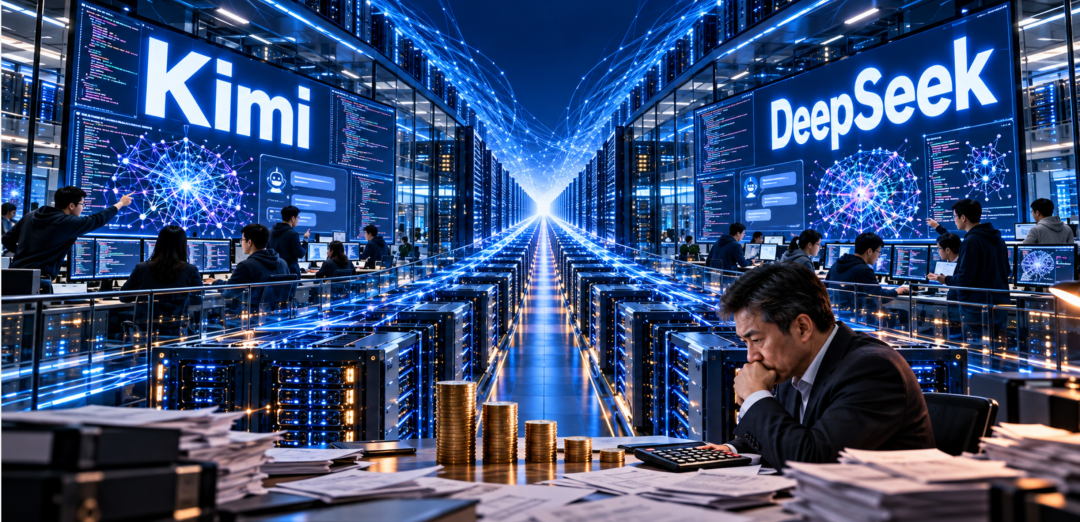
The enthusiasm of capital is indeed a significant indicator, but it doesn't guarantee early success for the company. 
While financing is booming, the financial obligations are even more daunting. This funding race extends far beyond just these two companies. Stepfun announced in January that it had secured over RMB 5 billion in Series B+ funding. In May, Sina Tech reported that Stepfun was nearing the completion of nearly $2.5 billion in financing and was advancing its preparations for a Hong Kong IPO. Zhipu, already a publicly listed company, still managed to arrange approximately $5 billion in placement and convertible bond financing in September. 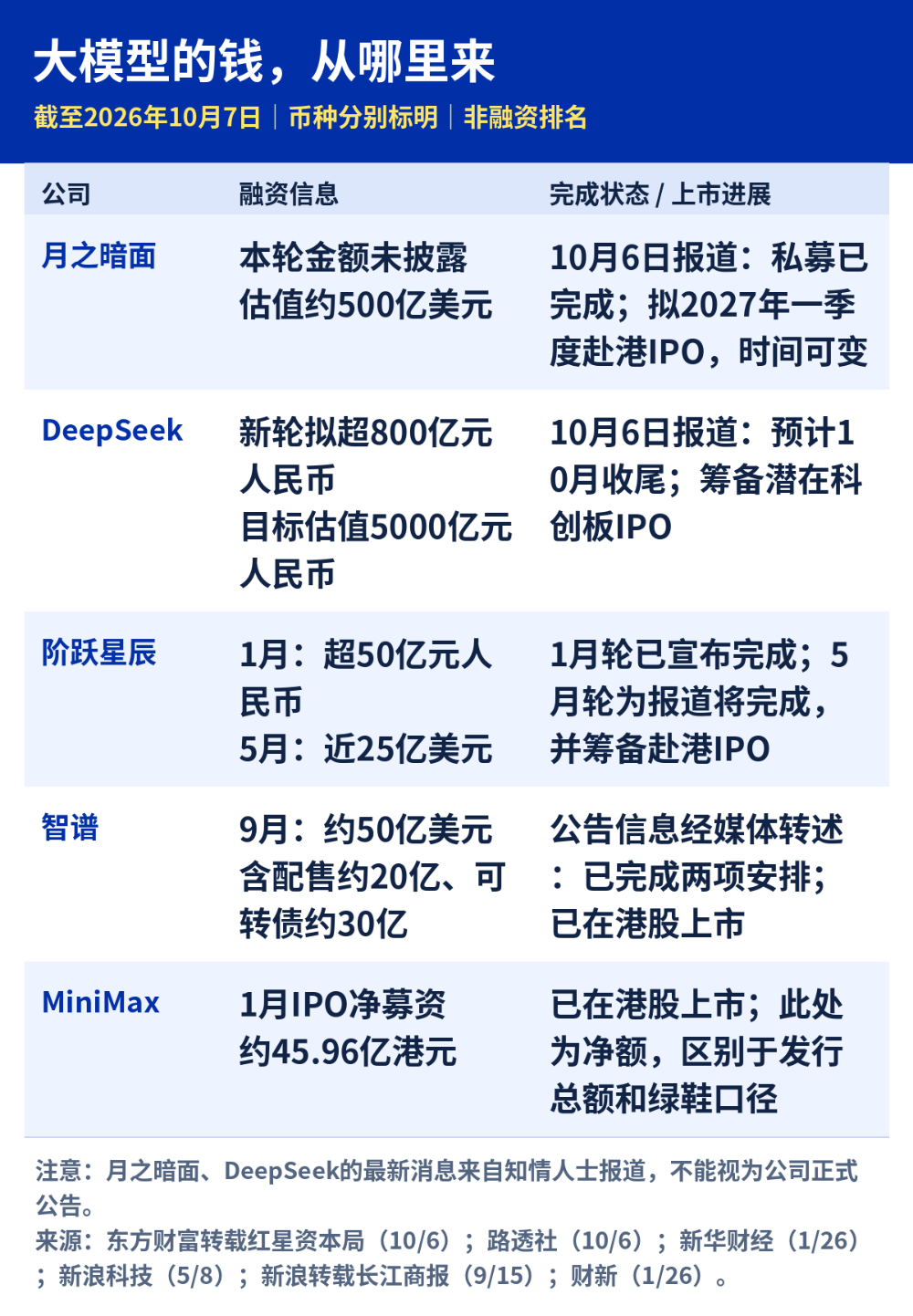
Going public hasn't halted the financing; instead, it has provided an additional funding avenue for these companies. A glance at their financial reports reveals why. In the first half of 2026, Zhipu's revenue reached RMB 954 million, a year-on-year increase of 399.7%; however, its R&D expenses amounted to RMB 2.131 billion, resulting in an adjusted net loss of RMB 1.964 billion. MiniMax's revenue was $116.6 million, a year-on-year increase of 283.1%; its R&D expenses were $296.9 million, with an adjusted net loss of $293 million. 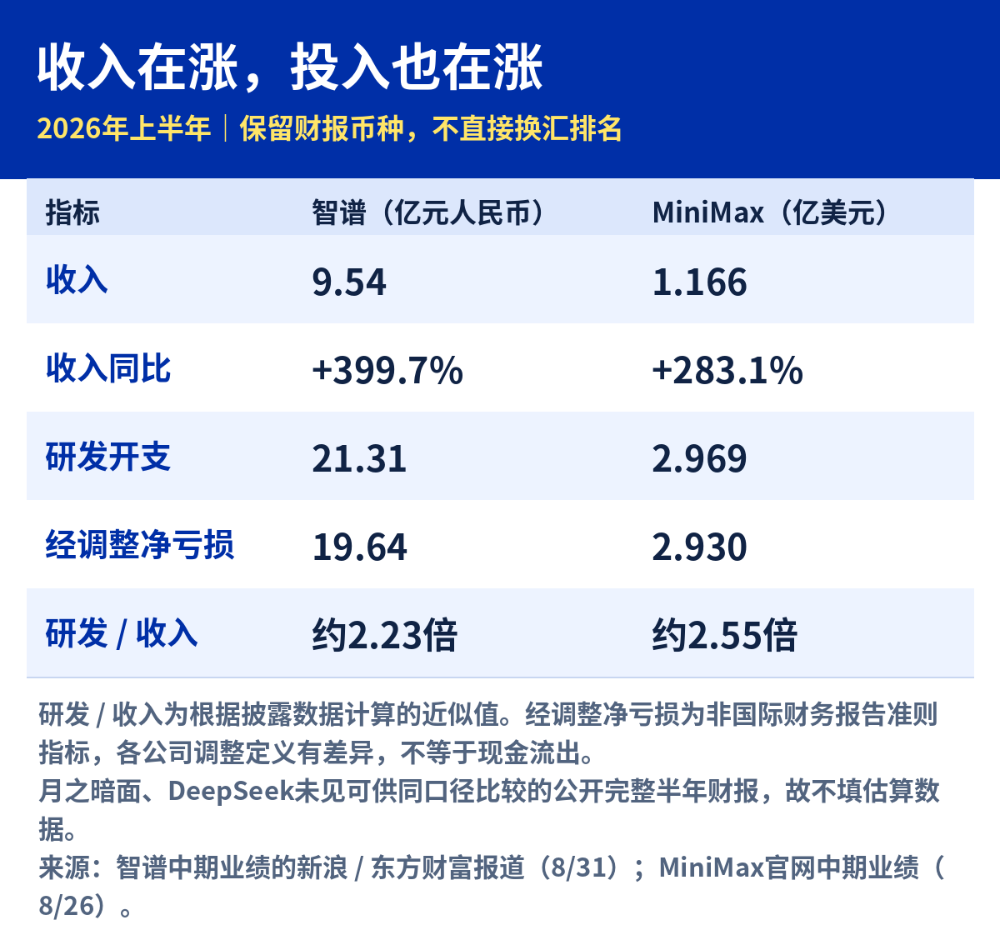
Based on the disclosed data, the R&D expenses of these two companies were approximately 2.23 times and 2.55 times their respective revenues for the same period. While revenue is growing rapidly, there's still a substantial gap to cover all investments.
Adjusted losses do not equate to cash outflows, and the adjustment methods vary between companies. As for Yuezhi'anmian and DeepSeek, no complete public half-year financial reports are available for direct comparison, so valuations cannot be taken as operational results. The funds are primarily allocated to computing power. Training incurs costs, and every user interaction also consumes computing resources.
As services evolve from answering questions to programming, researching, and performing continuous tasks, the service process may become longer and more complex. DeepSeek's official website states that the new model reduces cache resource requirements compared to the previous generation. This indicates that technical efficiency is improving, but it doesn't necessarily mean the company's total investment has decreased. 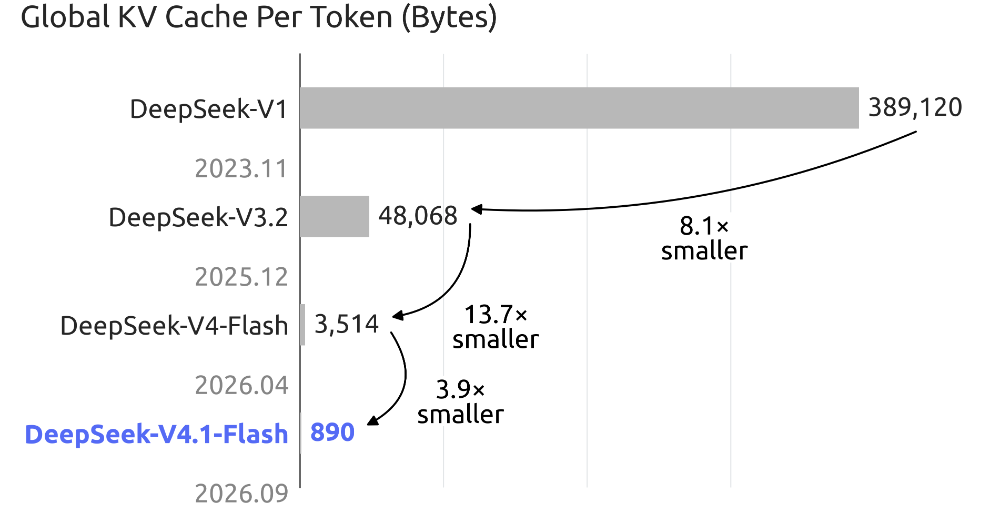
Image source: DeepSeek official website.
The technical indicators disclosed by the company do not signify a reduction in overall operating costs. If a car becomes more fuel-efficient but takes more trips, the annual fuel cost may still rise. Financing also buys time.
Expenditures on hiring, R&D, and infrastructure deployment typically occur first, with revenue following later. With sufficient financial reserves, the company has room to iterate and doesn't have to rush to change course due to the next bill.
Moreover, when the market is willing to assign valuations, raising funds in advance holds practical significance. Waiting until cash is tight to seek investors means losing some leverage at the negotiating table. However, financing amounts cannot be simply added up: private equity, public offerings, and convertible bonds each bring different levels of equity dilution, repayment obligations, and investor demands.
The Toughest Race Lies Beyond the Rankings. The market is not lacking in demand. The latest report from CNNIC shows that as of the first half of 2026, the number of generative AI users in China has exceeded 700 million, with a penetration rate of over 50%.
The question is, while many people may use it, how many are willing to pay for it long-term? Consumers can install several AI apps, and enterprises can access multiple models simultaneously. As long as migration costs are low, a temporary lead does not guarantee long-term orders. The hype generated by free trials needs to be validated by renewals and actual usage. 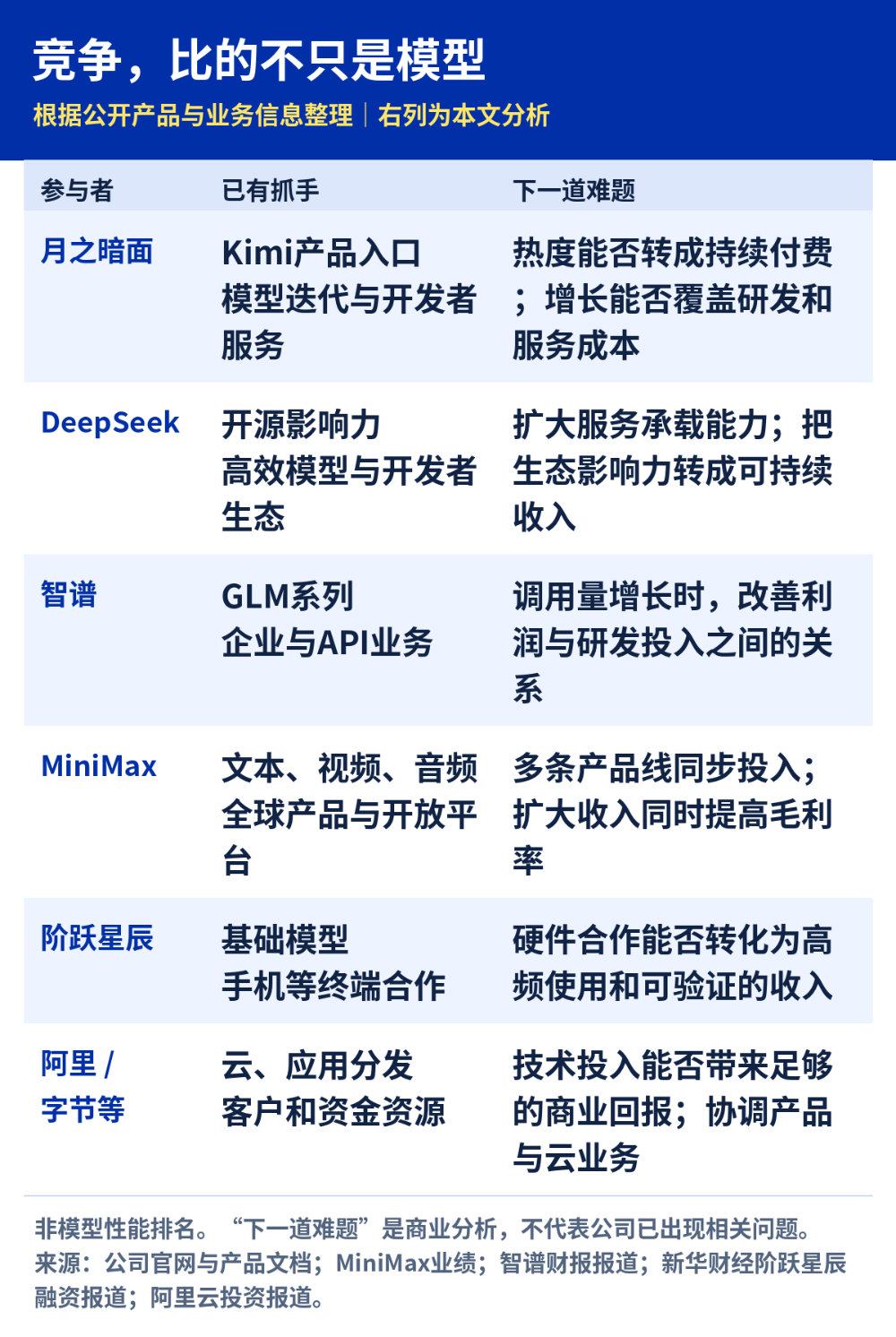
Judging from publicly available products and services, each company's approach now differs. Yuezhi'anmian offers the Kimi product portal, with its official website showcasing capabilities extending to programming, in-depth research, and office tasks. It aims to prove that a user's initial curiosity can turn into sustained usage, which in turn generates revenue.
DeepSeek's open-source influence and efficiency-focused approach make its developer ecosystem a key advantage. However, widespread adoption of the model does not mean that all related revenue goes to the model's developer. Translating influence into sustainable business is the next challenge.
Zhipu already has enterprise and API businesses, while MiniMax is simultaneously developing text, video, audio, and global products. The former needs to improve the relationship between usage and revenue as calls increase, while the latter must manage the costs of expanding multiple product lines simultaneously.
Stepfun has chosen to combine foundational models with end-user devices. Industrial investors can provide equipment and collaboration opportunities, but getting the model onto a phone and having users engage with it daily are two different things.
These companies must also contend with giants like Alibaba and ByteDance. Cloud services, traffic, app access points, and existing clients can all influence model distribution and procurement. Alibaba's 2025 announcement of investing over RMB 380 billion in the next three years to build cloud and AI hardware infrastructure also underscores the scale of investment in this competition.
The aforementioned shortcomings are analyses of business models and do not imply that any specific company is already facing related issues. Looking ahead, investors will focus on three key areas. First is task delivery. Enterprises invest in AI with the expectation that code will run, processes will complete, and errors will be traceable.
A beautiful answer is just the beginning. Next is the cost per effective task. More calls do not necessarily mean greater value. Fewer reworks and shorter wait times are more likely to keep clients renewing and allow suppliers to maintain profitability.
Finally, whether each company can find its rightful place. Some compete on foundational models, some on industry applications, and others integrate capabilities into devices. The company with the most financing may not necessarily dominate every market.
The Ledger Continues After the Bell. This round of financing demonstrates that capital is willing to invest in the next phase of China's large AI models and reflects the need for more long-term financial support in the technological competition. Losses should not be seen as a denial of R&D efforts.
Foundational technology requires investment and time. However, rising valuations should not be mistaken for resolved commercial issues. Going public increases funding sources but also brings greater disclosure and operational pressures.
In the past, the potential of the next-generation model could be discussed; going forward, explanations for this quarter's revenue, costs, and customer retention will be needed.
For ordinary people, what is worth expecting is that this money can make AI more reliable, reduce trial-and-error costs for enterprises, and make it affordable and user-friendly for individuals.
During financing, investors are willing to pay; after the business succeeds, customers are willing to pay repeatedly. Both types of recognition are crucial.
The latter determines how far an AI company can go. What are your thoughts on the accelerated financing of domestic large AI models? We welcome you to share your insights in the comments section in a civil and rational manner.
Disclaimer: This article is solely for financial hotspot analysis, with data and references sourced from public queries, company announcements, and Tonghuashun IFinD. The views are for reference only and do not constitute any investment or consumption advice.
#FinancialHotspots #InDepthAnalysis #BusinessFinance #InvestmentBankingCircle #ListedCompanies #PrimaryMarket #IPO #DomesticLargeAIModels. Thanks for reading patiently; feel free to click 'Like' if you enjoyed it.
-
![]()
What is the boundary of collaboration between FAW Toyota and GAC Toyota behind FAW Toyota's 'independent survival'?
-
![]()
Optical Waveguide Route Selection and Performance Optimization: Four Questions Integrators Must Answer Correctly
-
![]()
The Collective Surge of Major AI Models Toward Public Listing: The High-Stakes Race Behind the Buzz
-
![]()
A Staggering $50 Billion Valuation! The Resurgence of a Tsinghua-Educated Engineer’s Venture
-
![]()
In His Inaugural Year, Porsche CEO Implements Three Daring Strategies: 9,000 Job Cuts, 20% Price Increase, and Reintroduction of Gasoline Cars
-
![]()
JAC’s Stock Plummets to Limit Down! Dcd Auto Tests Zunjie V800, Three Consecutive Cars Experience Brake Failures: Extreme Testing or Defective Product? | Mingjingpro
-
![]()
【Electric Equipment】Fengcheng Zhuoxin Logistics Signs Contract for 150 SANY Electric Heavy Trucks
-
![]()
[Intelligentization] Huawei and Seres Sign New Five-Year Cooperation