Why Are Overseas Analysts Re-evaluating Alibaba's 33% Stake in Ant Group?
 10/10 2026
 470
470
Editor | Key Focus Editor
Over the past period, Chinese assets have undergone a new round of scrutiny in global markets, and the evaluation logic of overseas investors toward Chinese tech companies has shifted. Beyond traditional sectors like e-commerce, gaming, and social media, super platforms undergoing technological restructuring and business boundary expansion in the AI era have once again become a focus of Wall Street's attention.
In this reshaping of valuation logic, Ant Group serves as a highly representative case.
Six years ago, when Ant was preparing for its IPO, it was widely regarded as a "fintech company" relying on Alipay's traffic, with its core business and market perception centered around payments, consumer credit, and wealth management. However, with the advent of the AI wave and Ant's own business advancements, the old valuation framework based on fintech can no longer accurately define today's Ant Group.
Recently, overseas investment research platform Seeking Alpha published an in-depth research article by senior equity analyst Dilantha De Silva. The article steps away from the traditional path of analyzing Alibaba's e-commerce or cloud businesses and directly focuses on Ant Group, in which Alibaba holds a 33% stake.
The article presents a core viewpoint: As Ant Group integrates AI capabilities into its business ecosystem and expands into markets such as healthcare and intelligent agent commerce, it has transformed into a diversified technology ecosystem. Therefore, it is time for the market to reprice the value of Alibaba's stake in Ant Group.
In Dilantha De Silva's view, Ant Group's underlying logic has shifted from being a tool to an ecosystem, and from purely financial services to cutting-edge AI technology. The analyst points out in the report that Ant, having broken its original boundaries, has now built three major growth engines expected to boost its profitability in the coming years:
The first major growth driver is AI-powered healthcare. By launching the AI health assistant "Ant Afu" and its doctor version, Ant has not only created a health application for users but also connected the demand and supply sides of medical transactions. This full-link business model, covering consultations and clinical decision support, has strong barriers in the Chinese market. Compared to OpenEvidence, a similar U.S. startup recently valued at $12 billion, Ant's commercialization potential in medical AI holds even greater imagination.
The second major growth driver is the AI-powered version of Alipay, "Abao." Alipay, with over 1 billion active users, is undergoing a business model transformation. Through AI agents, Alipay's value capture point has moved upstream. It is no longer just a payment channel but has become a transaction center that connects product discovery, purchase, and service acquisition, further expanding its future monetization potential.
The third major growth driver is payment infrastructure tailored to the AI era's demands. With the growing prevalence of AI agents, the market needs a trusted infrastructure supporting payments, risk control, and auditing. Ant has launched AI payments, AI wallets, and released a trust protocol for intelligent agent commerce. This strategy, serving both consumers and AI model companies through products like Token Pay, has been likened by overseas analysts to "Stripe for the AI era."
Beyond analyzing business engines, the article also highlights the perception gap in current capital markets from a financial valuation perspective. Ant is currently in a peak period of AI R&D investment, with R&D spending expected to reach $5.2 billion in 2025. This strategic investment has suppressed current profits, causing traditional P/E valuation methods to become distorted. However, with independent business units like Ant International completing overseas financing, external capital has begun to price its diversified businesses with real money. Analysts believe that even using relatively conservative net profit multiples to estimate its value floor remains reasonable, without yet factoring in future earnings expectations from new AI businesses like Afu and Abao.
Through this Wall Street perspective, the market sees a "new Ant" fully embracing AI technology. This article not only provides a fresh lens for global investors to re-examine Alibaba's asset value but also offers an objective reference for understanding the new value of Chinese tech companies like Ant in the AI era.
Below is the original Seeking Alpha article:
Alibaba: The Ant Group Stake Needs To Be Repriced
Alibaba: The Ant Group Stake Needs To Be Repriced
Abstract
I have conducted in-depth research on Alibaba's international e-commerce business and built valuation models for its cloud computing business. This article will focus on analyzing Ant Group, in which Alibaba holds a 33% stake.
As Ant Group actively expands into multiple high-growth markets such as AI-driven healthcare, it can no longer be simply viewed as a fintech company.
I believe Ant Group has three major growth drivers expected to boost profitability in the coming years.
This article will discuss Ant Group's anticipated growth and what it means for Alibaba's valuation.
Over the past few years, I have analyzed some of Alibaba's growth drivers that seem to have not been fully appreciated by the market, including in-depth research on Alibaba's international digital commerce business and valuation of its cloud computing business.
Today, this article will focus on Ant Group, in which Alibaba holds a 33% stake.
Alibaba accounts for this investment using the equity method, so Ant Group's contribution to Alibaba's net profit is reflected as a separate line item in Alibaba's income statement. In the second quarter of this year (quarter ending June), Alibaba recognized RMB 1.563 billion in investment income from Ant Group.
On September 23, CITIC Securities released a research report on Ant Group, giving me a reason to re-examine the company. CITIC Securities analysts believe that analyzing Ant Group solely as a fintech company is no longer appropriate.
The reason is that Ant has entered new markets such as healthcare and database services while deeply integrating advanced AI capabilities across its business ecosystem.
In 2020, Ant Group gained widespread attention as it prepared for its initial public offering (IPO). Through the development of its various businesses, Ant Group has transformed into a diversified enterprise with multiple fast-growing assets.
1. Understanding Ant Group
Alibaba holds approximately a 33% stake in Ant Group. As a holding platform, Ant Group owns multiple businesses.
Payments and fintech remain Ant's important core businesses. However, as shown below, Ant is expanding into multiple markets such as healthcare and enterprise tech services.
In Alibaba's 20-F annual report, the company describes Ant Group's important role within its ecosystem as follows:
The various products and services provided by Ant Group have become an essential part of the services and user experience we offer to platform consumers and merchants. These products and services are crucial to the development of our trading markets and ecosystem.
In particular, given the massive transaction volume on our platform, Alipay provides us with convenient payment processing and transaction guarantee services on favorable terms.
We also leverage the convenience, accessibility, and ease of use of Alipay and other Ant Group products and services, including consumer loans and insurance, to provide high-quality experiences and services to users, merchants, and other participants in our ecosystem.
Next, I will analyze how Ant Group leverages its long-established domestic payment network foundation to expand into higher-value markets and is expected to drive net profit growth over the next five years.
2. Three Major Growth Drivers Bring New Growth Prospects to Ant Group
As mentioned earlier, Alibaba accounts for its investment in Ant Group using the equity method. Therefore, assuming Alibaba's stake remains unchanged, growth in Ant Group's net profit will directly reflect in the equity method investment income recognized by Alibaba.
I believe Ant Group currently has three major growth drivers expected to boost its profitability in the coming years.
First Major Growth Driver: AI-Powered Healthcare Business
In June 2025, Ant Group launched the AI health assistant AQ. In December of the same year, AQ was rebranded as Ant Afu.
Users can access this AI health assistant through a standalone mobile app, official website, and Alipay mini-program.
Afu primarily offers three types of functions:
1. Health Q&A: Includes interpretation of medical test reports and symptom consultations.
2. Health Companionship: Includes setting health goals, smart reminders, and syncing health data from mainstream smartphone brands like Apple and Huawei.
3. Health Services: Includes doctor appointments, online consultations, and medication purchases.
Since the rebranding, Afu has one after another launched ("successively launched") multiple Featured Features ("special features") to expand its user base.
One notable feature is the AI doctor agent. Over 500 renowned doctors have created authorized AI avatars to answer users' health questions. These AI doctor avatars have answered over 27 million questions to date.
Another noteworthy feature of Afu is the introduction of human review for AI-generated answers, making it the first health application in China to offer this functionality to users.
Until last month, Afu's focus was on expanding its user base on the demand side. As of the end of August, Afu had served over 100 million users, indicating the success of its early user growth strategy.
However, in August, Ant incorporated the supply side into this business by launching "Ant Afu Doctor Edition" (AQ for Doctor), an upgraded version of "Haodf Doctor Edition," positioned as a comprehensive AI work platform for doctors.
A core function of Afu Doctor Edition is clinical decision support. Doctors can access resources such as approximately 60 million medical papers and 140,000 drug instructions through the platform while connecting to a network covering over 300,000 doctors.
Today, Afu covers both the demand and supply sides of medical transactions. In my view, this creates multiple new commercialization opportunities for Ant.
The figure below shows the healthcare ecosystem established by Ant.
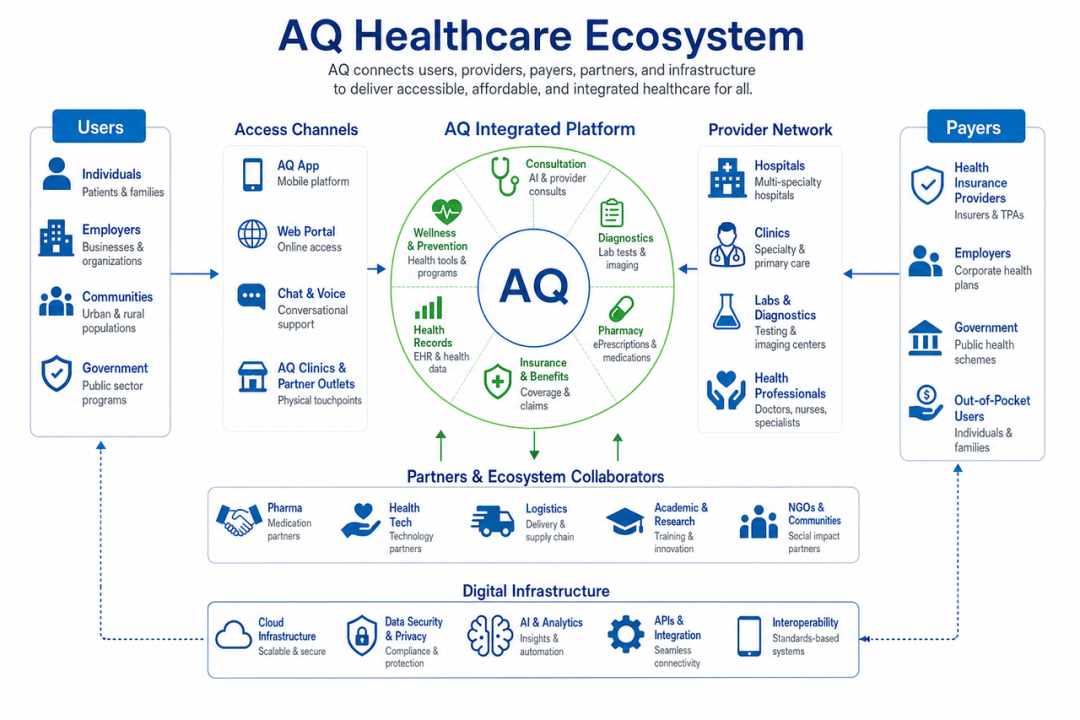
Ant's Healthcare Ecosystem
The timing of entering this market is also crucial.
The launch of Afu Doctor Edition and supply-side capabilities coincides with a phase where AI-driven healthcare demand is expected to surge significantly.
By 2030, China's AI-driven healthcare market is projected to grow at a compound annual growth rate (CAGR) of 42.5%, reaching a market size of approximately $19 billion. In contrast, the market size was only $1.59 billion in 2023.
While ensuring patient safety, China's healthcare regulatory authorities are promoting the application of AI in healthcare, particularly through policies under the "Healthy China 2030" initiative.
Policy support, combined with continuous advancements in AI technology capabilities, is expected to drive broader adoption of Afu by 2030.
With the integration of Afu Doctor Edition into the platform, I currently find it difficult to identify a Western company that fully corresponds to Afu.
If we only look at the supply side, the closest counterpart is OpenEvidence. The company recently completed a Series D funding round, reaching a valuation of $12 billion.
Considering that Afu provides a complete solution covering the entire patient journey across various healthcare service links, I believe that if Ant's healthcare business seeks external financing, investors may be willing to assign it a premium significantly higher than OpenEvidence's current valuation.
Second Major Growth Driver: Alipay's Intelligent Agent Service "Abao"
Ant Group's second major growth driver is the AI-powered version of Alipay, "Abao."
Abao was launched in June 2026. Alipay users can access Abao directly through the Alipay homepage.
By entering text commands or engaging in voice interactions, users can have this AI agent platform complete various tasks, including ordering food, sending parcels, hailing rides, and even purchasing investment products like mutual funds.
After launching an invitation-only beta version in June, Alipay released a public beta version in July, offering approximately 70 skills or services.
Alipay currently has over 1 billion active users, while over 80 million merchants use Alipay.
Abao's value may not necessarily lie in further expanding Alipay's user base but more in creating new commercialization avenues for the platform.
As of August, Abao had AI-enabled over 10,000 services.
To expand the coverage and usability of this agent platform, Ant has also formed several important partnerships, including with smartphone manufacturers like Huawei and OPPO, as well as with 16 automotive manufacturers such as BYD and Geely.
From a commercialization perspective, I believe that Abao's rapid adoption will fundamentally transform Alipay's business model.
Over the past 20 years, Alipay has primarily monetized through payment processing.
However, Abao's agent capabilities, covering product discovery, purchase, and service acquisition, mean that Alipay's future monetization potential is expected to expand further. This is because Alipay may have opportunities to capture commercial value from the transaction chain even before payment occurs.
For example, through paid product listings, charging for merchant lead generation services, and cross-selling Ant Group's financial services products such as wealth management and insurance.
Of course, Abao's growth will also positively impact the total transaction volume processed by Alipay.
Given the expected development of intelligent agent commerce, the timing of Ant's launch of Abao is also noteworthy.
According to Mordor Intelligence, the AI retail and e-commerce market is expected to maintain a CAGR of 29% until 2031, reaching a market size of $218 billion.
Regionally, the Asia-Pacific region is expected to see the fastest growth, with a CAGR of nearly 35%.
Against this growth backdrop, global payment platforms are vying to become the preferred transaction infrastructure for intelligent agent commerce transactions.
China is expected to become one of the world's largest intelligent agent commerce markets. With Abao's continued rollout, Alipay appears well-positioned to dominate this market.
Third Major Growth Driver: Payment Infrastructure Tailored to the AI Era's Demands
Ant Group's third major growth driver is its payment infrastructure capable of meeting the demands of the AI era.
As AI agents become increasingly prevalent, the market needs a trusted infrastructure to support payment processing, refunds, audit trails, and fraud risk control.
Ant Group's various businesses cover these areas, giving it a unique advantage to seize this market opportunity.
The table below summarizes some of the key products in Ant Group's intelligent agent AI trust infrastructure.
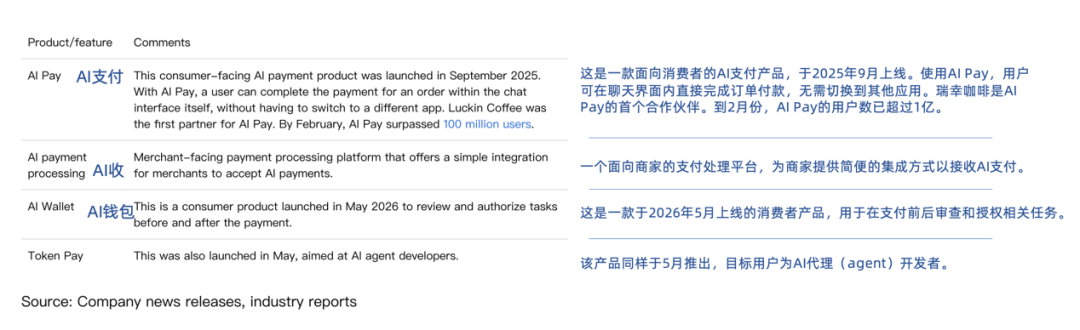
In addition to its newly launched products, Ant Group continues to focus on the governance of AI-powered payments.
Ant Group has released China's first Agentic Commerce Trust Protocol and established a dedicated security system to monitor AI-driven transactions.
Additionally, Ant Group has introduced an incentive program for developers, offering Token rewards to attract them to build AI-powered payment-enabled agent applications.
In the payment processing infrastructure market, Ant Group is exploring a business expansion direction similar to Stripe: serving both consumers and AI model companies.
Stripe has extended its business into billing infrastructure for AI model companies through the acquisition of Metronome. Similarly, Ant Group is expanding its payment service market for AI model companies through its Token Pay product.
3. Impact on Alibaba's Valuation
I believe that, driven by the development of its healthcare business, the commercialization potential of Abao, and the increasing prevalence of AI-adapted payment infrastructure, Ant Group has strong growth prospects over the next five years.
For a rapidly growing company like Ant Group, traditional valuation models that rely heavily on historical cash flows may not be applicable.
It is important to note that Ant Group is currently increasing its investment in AI while expanding into new markets.
Ant Group's R&D spending has increased from $3.1 billion in 2023 to $5.2 billion in 2025. These investments are primarily focused on foundational large language models, AI-powered healthcare services, and AI-driven payment infrastructure.
The significant R&D expenditures have already been recorded in the current income statement, but the expected returns from these investments may not be reflected in Ant Group's financial statements in the short term.
This also means that a simple price-to-earnings (P/E) multiple valuation approach faces challenges.
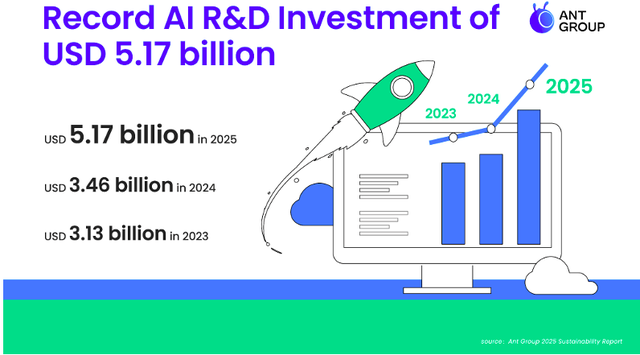
Ant Group's R&D Investment
From a valuation perspective, I believe the best way to understand Ant Group is to view it as a company composed of multiple relatively independent business segments.
Notably, these independent business segments are now beginning to seek external capital.
We already know that earlier this year, Ant International completed a $1.2 billion financing round at a pre-money valuation of approximately $10 billion. It is important to emphasize that this represents only one of Ant Group's business segments, not the entire company.
This financing clearly demonstrates that the value of Ant Group's business segments has been recognized by external investors.
Following the successful financing of Ant International, I would not be surprised if other business segments, such as Ant Digital Technologies and OceanBase, also begin to seek external financing to support further growth.
For the fintech business, the simplest valuation method is to start with the investment income accounted for under the equity method.
In the second quarter of this year (quarter ending June), Alibaba recognized a net investment income of RMB 1.563 billion (approximately $230 million) from its investment in Ant Group.
This provides a good starting point for understanding the fundamental profitability of Ant Group's core business.
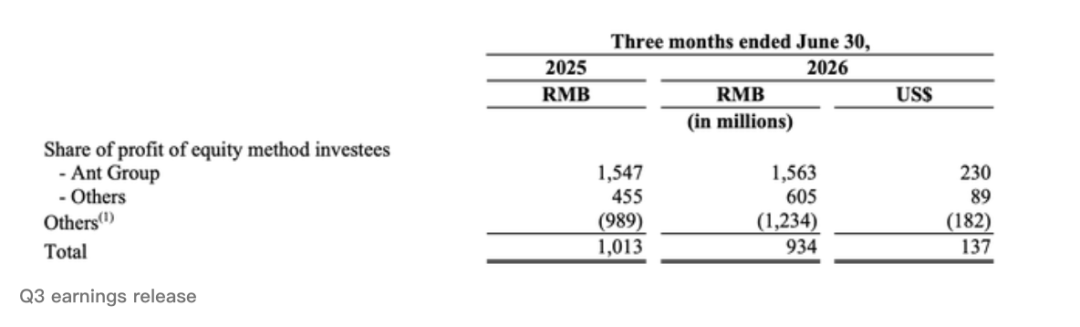
Equity Method Investee Performance for the Third Quarter (Quarter Ending June)
Source: Alibaba's Third Quarter Earnings Announcement
If we simply annualize this quarter's investment income, Alibaba's annual net income from Ant Group would be approximately RMB 6.25 billion (approximately $920 million).
Although I expect Ant Group's growth to accelerate in the coming years, it remains reasonable to use a relatively conservative net profit multiple to estimate the floor of its value.
At the same time, it should not be overlooked that Ant Group's current profitability is itself suppressed by large-scale AI and R&D investments.
The valuation of the core business mentioned above does not yet account for the potential future growth benefits from new businesses such as Afu and Abao.
These businesses provide additional upside potential for Ant Group's overall valuation.
Although these new businesses are still in a phase of continuous investment and cash consumption, as discussed earlier, there are already sufficient early signs indicating that these platforms are forming software business models with strong user stickiness and deep competitive barriers.
Ant Group is indeed transforming into a diversified technology ecosystem.
I believe that as the progress of this business diversification gradually gains investor attention, the market will eventually begin to re-evaluate the value of Alibaba's stake in Ant Group.
Conclusion
Alibaba is a technology giant with deep market penetration across multiple sectors.
In my view, its stake in Ant Group is one of the least discussed aspects of Alibaba's business ecosystem in the market.
Ant Group is actively expanding into new markets and rapidly growing into a diversified technology company.
I believe that the market's re-evaluation of the value of Alibaba's stake in Ant Group may come sooner than expected.
This is another reason why I remain bullish on Alibaba (BABA) at present.
Dilantha De Silva is a senior equity analyst and investment researcher with over 10 years of experience in the investment industry. He regularly writes analytical articles for financial investment platforms such as Seeking Alpha, GuruFocus, TipRanks, and ValueWalk. His research covers multiple industries, with a particular focus on small-cap stocks overlooked by Wall Street analysts.
Dilantha is currently a Level III candidate for the Chartered Financial Analyst (CFA) exam and holds relevant professional qualifications from the Chartered Institute for Securities & Investment (CISI) in the UK. In addition to equity research and writing, Dilantha also participates in private equity transactions, including corporate acquisitions and operations management.
-
![]()
Keynote Speaker Announcement | Wang Peng, Alibaba's QianWen Office Business Development Expert, Confirmed for WAIE (10th) 2026 AI Industry Conference & AI Agent Industry Application Summit
-
![]()
A Chaotic Battle in the Smartphone Market: Who is Redefining the Imaging War?
-
![]()
Chaotic Competition in the Smartphone Market: Who is Redefining the Imaging War?
-
![]()
AI Is Not a Get-Out-of-Jail-Free Card: Why Only Microsoft Is Being Rewarded for Its AI Investments
-
![]()
Li Auto’s 2026 i6: The Brand’s Debut Global All-Electric Model Headed to Europe
-
![]()
Kimi K3 Goes Viral and Suspends Service in 48 Hours: Model Wins Benchmarks, Compute Falls Short Against Big Players
-
![]()
Zhixiang Future Secures 2.1 Billion Yuan in Three Months of Financing, Yet Founder Maintains: 'We Haven't Achieved World-Model Status'
-
11 Days, Five Launch Events: The Battle Behind the 2026 Domestic Flagship Smartphones