AI Is Not a Get-Out-of-Jail-Free Card: Why Only Microsoft Is Being Rewarded for Its AI Investments
 10/10 2026
 343
343
Author|Gu Yan Editor|Lin Feng
Two contrasting market reactions emerged during the same earnings season.
Both Microsoft and Meta are pouring significant funds into AI, yet the market has responded to each in starkly different ways.
On July 29, Microsoft announced its quarterly earnings. Revenue for the April-June period reached $90 billion, marking an 18% year-over-year increase. Cloud revenue soared to $59.3 billion, up 27%, while revenue from the Azure cloud platform surged by 43%.
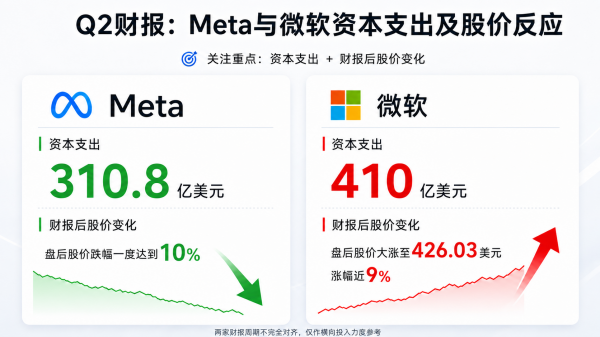
Following the earnings release, Microsoft's stock price surged to $426.03 in after-hours trading, climbing nearly 9%.
On the same day, Meta also reported earnings that surpassed revenue expectations. However, declining profits, pressure on free cash flow, and escalating AI expenditures triggered an opposite market reaction. Meta's stock plummeted as much as 10% in after-hours trading.
This outcome is somewhat counterintuitive.
In recent years, whenever a tech company announced its full commitment to AI, the market was quick to assign it a premium valuation. Large models, GPUs, data centers, smart assistants, enterprise Copilots—each of these terms alone could fuel a round of financing.
But this time, things are different.
Both Microsoft and Meta are making substantial AI investments. Microsoft's capital expenditures reached $41 billion this quarter, while Meta continues to raise the lower bound of its full-year capital spending forecast.
The market is no longer lumping them together under the same AI narrative. Instead, it's posing a more pragmatic question: When will these investments translate into revenue?
01
From Speculative Hype to Demanding Results
In the early days of generative AI, simply entering the field was enough for the market to reward companies with inflated valuations based on speculation.
Companies that could build models, acquire GPUs, or establish data centers were more likely to receive a valuation premium.
Back then, AI itself was the driving force behind high valuations.
Image source: pixabay
Whether it was tech giants like Microsoft, Meta, and Alphabet, or model companies like OpenAI and Anthropic, all were placing bets on AI in various ways. Some were building cloud infrastructure, some were training models, some were overhauling recommendation systems, and some were integrating AI into devices like phones and glasses.
But as AI became ubiquitous, it evolved from a scarce narrative into an arms race that tech companies felt compelled to join. Models, chips, and data centers have now become innovation costs that tech companies must bear to remain competitive.
The market's question has now become straightforward: Is this money being spent wisely?
In the past, investors were willing to listen to companies' visions of the future. Now, they demand tangible results.
02
Microsoft's AI Investments: Driving Expansion
Microsoft's AI spending is seamlessly integrated into its existing operations.
Enterprise customers purchase cloud services, which cater to their AI training and inference needs. AI tools are then incorporated into mature software ecosystems like Office, Teams, and GitHub.
Within Microsoft's business lines, Copilot can be sold to enterprise users, Azure can handle model training and inference, GitHub Copilot can be embedded in developer scenarios, and Microsoft 365 Copilot can be utilized in office settings.
This is Microsoft's greatest strength: layering AI on top of its existing customer base, contracts, and workflows.
Microsoft's official data indicates that by fiscal 2026, Azure revenue will exceed $100 billion, and Microsoft 365 Copilot will have over 30 million paid users.
These figures all address the same question: Where might the money invested in AI infrastructure be recouped in the future?

Image source: pixabay
Microsoft's AI spending logic resembles factory expansion: as factory orders increase, production lines are expanded, and capital expenditures rise. In the short term, more money is being spent; however, since the growing orders are genuine, the expansion is not wasteful—it's a prepaid cost for future revenue.
This is the narrative conveyed by Microsoft's earnings report.
AI has fueled enterprise demand for cloud services and computing power. Microsoft must continue to build data centers and infrastructure to meet these increased orders. As long as Azure keeps growing and Copilot keeps penetrating enterprise customers, the market is confident that these capital expenditures will eventually translate into tangible revenue.
03
Meta's AI Investments: A Long-Term Gamble
Meta's issue is not that it hasn't integrated AI into its existing business—quite the contrary. It may have been one of the first major companies to deeply integrate AI into its core operations. As early as 2006, Meta stated that AI was a foundational component of its core business.
Apps like Facebook, Instagram, and WhatsApp boast massive user bases, and advertising is Meta's most profitable business. AI helps Meta enhance recommendation efficiency, ad matching, and content distribution.
However, these benefits are challenging to isolate in earnings reports.
Ad growth could stem from AI, or from a recovery in macro ad demand, growth in Reels, recommendation algorithm optimizations, or changes in user engagement. If growth comes from AI, is it a long-term structural improvement or a short-term efficiency gain?
These questions are difficult for Meta to answer with a single metric.
In contrast, Microsoft can demonstrate Azure growth, cloud revenue, and Copilot paid users to address investor doubts about AI ROI.
Meta's more significant challenge is that it's not just betting on advertising AI.
Beyond overhauling recommendation and ad systems, Meta is also developing Meta AI assistants, open-source models, smart glasses, AR devices, and the next-generation computing platform.
These directions certainly offer ample room for imagination.
AI assistants could become new search entry points, smart glasses could be the next hardware platform, and AR devices might replace some phone interactions.
If these visions materialize one day, Meta could regain a massive commercial entry point.
But for today's market, these are still long-term stories. They're too distant from cash flow, too far removed from earnings reports, and too vague in terms of the 'path to ROI' that investors seek.
Meta's AI investments appear more like a long-term bill to investors. They might lead to the next platform, or they might continue to consume profits for an extended period.
This uncertainty is magnified in earnings reports: Meta's latest quarterly profit fell year-over-year, free cash flow dropped from $8.55 billion a year ago to $784 million, while expected spending continues to rise.
For a still highly profitable company, this doesn't signify that the core business is collapsing. But with AI investment scales continuing to grow, the market will be more sensitive to expense guidance, free cash flow, and ROI timelines.
04
The Real Divide: Path to ROI
This is the real shift in this earnings season.
The market still believes in AI's long-term value but is starting to differentiate the quality of companies' investments.
When Microsoft spends, investors see guaranteed cloud demand in return.
When Meta spends, investors see massive investments with uncertain ROI.
Microsoft's revenue path is relatively short. Azure, Copilot, enterprise customers, and pending cloud orders form a relatively clear path to AI ROI.
Meta has greater imagination space but is harder to validate. It needs to prove that AI isn't just an efficiency tool for recommendation systems but can also become new user and commercial entry points.
This scrutiny isn't limited to Meta—Alphabet's stock decline also underscores this point.
Financially, Alphabet's search and cloud businesses are still growing, and Gemini has amassed a huge user base. But due to expanding AI infrastructure investments, Alphabet's free cash flow has plummeted from $73.266 billion in 2025 to -$5.855 billion. The massive funds Alphabet has invested in AI haven't translated into matching revenue, and Gemini hasn't disclosed revenue data, making it difficult to stabilize market confidence.
This change is sufficient to prompt the market to reassess the impact of AI spending on cash flow. This is a risk that all tech companies participating in the AI arms race face. Data center construction, chip procurement, power supply, and depreciation pressures will all continue to affect cash flow.
In the coming quarters, the AI narrative in earnings reports will become increasingly specific: Can cloud business growth support capital expenditures? Can AI products convert to paid users? Will AI spending devour free cash flow? Can management provide a clearer ROI timeline?
Microsoft rises, Meta falls—essentially, the market is comparing the two companies' ability to turn AI spending into revenue and cash flow. AI remains the tech industry's most important growth story, but it no longer automatically translates into stock price gains. Only companies that can turn computing power into products, products into revenue, and revenue into cash flow will continue to be rewarded by the market.
- END -
Note: The cover/featured image was created with the assistance of AI. Public data sources include networks and public industry platforms.
-
![]()
A Chaotic Battle in the Smartphone Market: Who is Redefining the Imaging War?
-
![]()
Chaotic Competition in the Smartphone Market: Who is Redefining the Imaging War?
-
![]()
AI Is Not a Get-Out-of-Jail-Free Card: Why Only Microsoft Is Being Rewarded for Its AI Investments
-
![]()
Li Auto’s 2026 i6: The Brand’s Debut Global All-Electric Model Headed to Europe
-
![]()
Kimi K3 Goes Viral and Suspends Service in 48 Hours: Model Wins Benchmarks, Compute Falls Short Against Big Players
-
![]()
Zhixiang Future Secures 2.1 Billion Yuan in Three Months of Financing, Yet Founder Maintains: 'We Haven't Achieved World-Model Status'
-
11 Days, Five Launch Events: The Battle Behind the 2026 Domestic Flagship Smartphones
-
![]()
Lenovo's PC Shipments Plunge 22% Year-on-Year: The AIPC Narrative Faces Challenges