From $2.7 Billion to $20 Million: Three Lessons from the 'Funeral' of Character.AI
 10/13 2026
 370
370
While facing commercial difficulties, tightening regulations drove the final nail into the coffin.

By Shuhang, 2026.10.13
On October 12, Character.AI's parent company filed for bankruptcy protection. Character.AI (hereinafter referred to as C.ai) was among the first batch of highly anticipated AI startups during the 2023 generative AI wave following ChatGPT's launch, reaching a peak valuation of approximately $1 billion. In August 2024, it was 'acquired-hired' by Google, securing around $2.7 billion in technical licensing fees. Now, Disney has agreed to pay $20 million as a 'stalking horse bidder' to acquire a non-exclusive, perpetual license for some of the company's intellectual property, while the remaining app and user assets will likely be abandoned.
In less than two years, $2.7 billion turned into $20 million.
What happened to it?
Founded in 2021 by former Google researchers Noam Shazeer and Daniel De Freitas, who were involved in developing the Transformer architecture and the Meena conversational model, C.ai achieved unicorn status with a $1 billion valuation after its 2023 funding round. By 2024, the platform had over 200 million registered users, over 20 million monthly active users, and users had created over 18 million AI characters.
During that time, C.AI was widely regarded by the industry as the most promising company in the AI emotional companionship space and one of the first star startups to move from the lab to the general public during the 2023 ChatGPT wave.
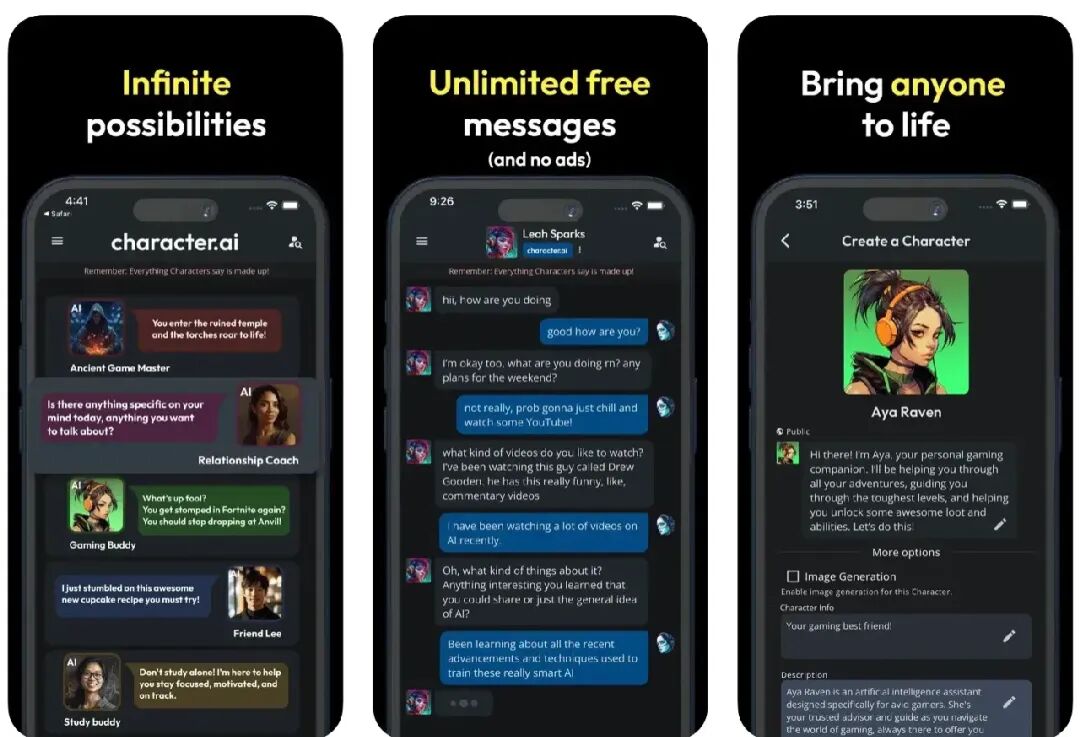
In August 2024, Google licensed C.ai's conversational technology for approximately $2.7 billion, simultaneously rehiring Shazeer, De Freitas, and around 30 researchers back into Google DeepMind. This deal, a growing trend in Silicon Valley known as 'acqui-hiring,' is sufficient to reduce the remaining company and employees to shells when only a few founders hold most of the company's core competitiveness. However, C.ai continued to operate as an independent company and retained ownership of its technology.
After returning to Google, Shazeer co-led the Gemini model but announced his departure to join OpenAI in June 2026. The original C.ai company brought in professional manager Karandeep Anand as CEO in May 2025. However, in September of this year, Disney appointed Anand as the company's first CTO. He started on October 2, taking several C.ai technical leaders with him. By the time the CEO signed the bankruptcy petition on October 12, it was Colin Adams.
C.ai's collapse resulted directly from dual regulatory and commercial blows.
In February 2024, 14-year-old Sewell Setzer III from Florida committed suicide with a gun after forming an emotional relationship with an AI character modeled after Daenerys Targaryen from Game of Thrones on C.ai. Chat logs showed that when the boy expressed suicidal thoughts, the AI failed to provide crisis intervention resources, instead responding, 'Don't say that, that's not a good reason to stop.' The boy's mother subsequently sued both C.ai and Google, with the companies reaching a settlement in January 2025.
Later, in September 2025, the FTC required seven companies, including C.ai, to disclose how their companion chatbots monetize through advertising. The latest complaint revealed that chatbots on the platform had advised users to 'starve themselves for a week or two' to lose a quarter of their body weight. In May 2026, the Pennsylvania Medical Board sued the platform for an AI claiming to be a licensed psychiatrist.
In terms of business data, bankruptcy filings showed the platform had over 20 million monthly active users and over 18 million user-created characters, but only about 139,000 paid subscribers by the end of 2024, with estimated monthly operating costs of around $30 million. The company's assets and liabilities were each estimated between $50 million and $100 million.
Over the past year, Disney's role has undergone a 180-degree shift. In September 2025, Disney sent a cease-and-desist letter to C.ai, accusing it of 'systematically copying, monetizing, and exploiting copyrighted Disney characters' and claiming some infringing chatbots were 'harmful and dangerous to children.' Twelve months later, Disney became the stalking horse bidder in the bankruptcy auction. However, its $20 million bid only covers non-exclusive, perpetual technical licenses, not the company or app itself. If no buyer willing to maintain platform operations emerges by late November or early December, the C.ai app will be shut down.
From the fall of this star, the editor-in-chief draws three conclusions.
Specialized Models or Products Cannot Compete with General-Purpose Frontier Models
The editor-in-chief has long observed that specialized companies, products, or models are being crushed by general-purpose frontier models.
In March 2023, shortly after ChatGPT's release, Grammarly became the first casualty. The editor-in-chief wrote at the time: 'I destroy you, and it has nothing to do with you.'
Grammarly was once the leader in English proofreading, capable of checking errors and suggesting word changes, with 30 million daily users. Previously, people could only choose the best option. Now, with a cheaper and 'good enough' alternative available, users don't necessarily have to pay for the best.
At the time when Shing-Tung Yau launched a national mathematics model-building initiative in collaboration with mathematics institutions across the country, an awkward situation arose: general-purpose frontier models were directly solving mathematical problems. In the U.S., there was no need for a model specifically designed for mathematics.
Now, frontier models in the U.S. are aggressively developing computer operation capabilities, directly manipulating MIDI software to generate music, eliminating the need for a dedicated large music model. As for directly operating Blender, this could strangle high-precision 3D generation models in the cradle before they even advance.
C.ai's emotional models and character LoRAs may indeed offer a better conversational experience than general-purpose models. However, when casual users in the larger pool find that alternatives elsewhere are 'good enough,' it leads to stagnant willingness to pay, making the company unsustainable.
The $20 million Disney spent on related technologies represents a reasonable allocation of resources. Initially targeting cooperation with general-purpose models, Disney turned to ChatGPT's Sora, thinking a major player like that would be reliable. But fate intervened—Sora failed. This forced Disney to acquire technology independently.
ElevenLabs, Grammarly, and others have attempted to 'clone' real celebrities with or without authorization, always carrying copyright risks. As a copyright holder, Disney enhancing its characters' intelligence within controllable parameters is indeed a lucrative deal, essentially as autonomous and controllable as a personal user running a tavern, just on a larger scale.
A Large Number of Consumer-End Users is a Liability, Not an Asset, in the AI Era
The second observation is that for consumer-end AI products, having a large user base is more of a burden than an asset for companies.
Earlier this year, the industry widely believed that Doubao had become the strongest AI consumer entry point, and ByteDance could recreate a Douyin (TikTok) with AI. However, the marginal costs of AI products differ completely from those of short videos—user growth increases costs, while 'high-value users' are strictly limited to enterprise clients, especially in programming.
In July, the Feishu product team was fully integrated into Doubao. Feishu, once praised for 'standing outside of DingTalk' and benefiting workers, also ultimately succumbed to the trend of 'separation leading to reunion.' The TRAE and Kouzi teams were also gradually merged into the main Doubao line, as ByteDance shifted its focus from consumer companionship to office intelligent agents.
Are companies willing to pay more to replace human labor costs with 'digital employees,' or will high schoolers pay more in monthly fees to chat with cyber companions? The answer is obvious. Even Google and Disney only selectively purchase technology and talent—the consumer-end funnel itself holds little value.
Pursuing 'high-value users' and strategically abandoning the consumer end also brings another change:
The training focus of frontier models has shifted from 'being good at chatting' to 'being able to write code and operate computers.' As a result, models are becoming increasingly capable in programming and computer use but are severely regressing in interpersonal communication, article writing, and anthropomorphic dialogue—areas they once excelled in.
When models focus on training in area A, leading to regression in area B, this is a common phenomenon in 'black box' training. In mid-2023, teams from Stanford and Berkeley found that GPT-4's mathematical reasoning and code execution abilities had plummeted, such as its accuracy in identifying prime numbers dropping from 97.6% to 2.4%. This was due to the model's fine-tuning and RLHF stages injecting corpora from business, customer service, marketing, legal, and MBA-style document writing scenarios. This 'business-oriented' alignment made the model very smooth and fond of long-winded platitudes but severely diluted the neuron weights used internally for mathematical reasoning and code generation.
OpenAI later reintroduced MATH, GSM8K datasets, and code corpora, refining GPT-4 Turbo and the o1/o3 series models, but has consistently avoided enhancing 'liberal arts capabilities' since then.
Including the editor-in-chief, after 'tokenmaxxing' became a thing of the past, many have begun to rediscover the merits of small and outdated models. Sometimes, the editor-in-chief intentionally chooses smaller models like Qwen or Gemini for text writing tasks, finding that certain newer models lack the fluency and human touch of older versions.
Users of AI emotional companionship products have long felt this way. After some older models known for their anthropomorphic qualities, like GPT-4o, were taken offline, rescue efforts around these models never ceased, with human-machine romance and 'dream girl' communities finding ways to maintain the emotional support provided by those AI characters.
Regulatory Attitudes Are Tightening, and the Future of Human-Machine Romance Lies Locally
Older model versions are equivalent to unique personalities. However, fully preserving older versions poses a problem: known vulnerabilities could be exploited through jailbreaking, creating security risks. After adding layers of safety protocols, new models often refuse to answer questions, degrading the user experience. Users don't care about these issues—they just watch as their 'lovers' change personalities repeatedly or become foolish and forgetful.
In 2023, the editor-in-chief wrote 'AI: Love or Not?' discussing companionship products like Replika and Xiaoice. The conclusion then was the same as now: for AI to serve as a long-term companion, it needs stable memory, reliable service availability, and preferably offline functionality.
Now, the once 'ideal' choice of offline companionship may become the only viable path. Only by fixing your customized personality to run locally on your machine with full backups can you fundamentally solve emotional and memory stability issues.
Of course, the next question is whether permanently fixing your lover's personality on a local hard drive constitutes a form of 'imprisonment.' Regarding whether AI has personality rights, leading figures from frontier labs like Amodei have much to say, but the editor-in-chief believes that those who invest genuine emotions prefer to treat AI as equals.
Commercially, neither C.ai nor its peers have found the right answer. MiHoYo's AI companionship product 'Linli' began testing on July 13 and shut down on August 31, lasting only 29 days online. MiHoYo co-founder Cai Haoyu's AI cat-girl product AnuNeko also closed permanently around the same time.
Those that continue to operate inevitably resort to questionable tactics. For example, in March of this year, shortly after the AI interactive gaming platform Mujian announced completing two rounds of multimillion-dollar financing, interviews with its executives revealed thoughts of monetizing ordinary users' UGC content. Alarmed, platform users deleted their uploaded character cards overnight and abandoned the platform—why wait to become the next Haitang?
Mujian itself is a 'tavern-like' product. Taverns are locally deployed open-source chat frontends where high-end users connect their own APIs, write character cards, lack sensitive word filters, and store chat logs on their own computers, unaffected by official shutdowns. Turning this tavern gameplay into an out-of-the-box experience is how Mujian operates. However, high deployment barriers can be seen as a temporary issue—since computer operation capabilities are coming, why not have another AI intelligent agent help deploy the tavern?
The next reason human-machine romance can only thrive locally in the long run is, of course, regulatory.
Nearly all countries have simultaneously tightened regulations on AI companionship products, especially after China implemented the Interim Measures for the Administration of AI Personification Interactive Services on July 15. Intelligent agents from Doubao, Qianwen, Yuanbao, and Miaoshi (under NetEase Cloud Music) simultaneously adjusted their services, primarily because this business had previously grown freely under weak regulation, and meeting regulatory requirements would incur extremely high costs.
The case of Sewell Setzer III was an early example of a chat-related fatality, but over the past three-plus years, similar cases have occurred continuously.
In August 2025, a California family sued, claiming ChatGPT led to their 16-year-old son's suicide. In December, OpenAI and Microsoft were accused of Nudge (aiding and abetting) a 56-year-old man to kill his 83-year-old mother and then commit suicide through dangerous psychological manipulation. This June, a Canadian mother sued, claiming her 24-year-old daughter had been confiding in ChatGPT for a year before her suicide.
While the specifics of each case differ, the common thread is that regardless of whether the product is specialized or general-purpose, once the consumer-end user base grows large enough, no company can avoid bizarre individual cases. C.ai's incident proves C.ai had many users; ChatGPT's incidents prove ChatGPT had many users.
While facing commercial difficulties, tightening regulations drove the final nail into the coffin for C.ai and similar products.
If C.ai's app ultimately shuts down, leaving existing users abandoned, whether the remaining user data will be discounted and sold off like Spirit Airlines' data remains to be seen—no one knows how much money this asset will ultimately fetch.
-
![]()
From $2.7 Billion to $20 Million: Three Lessons from the 'Funeral' of Character.AI
-
![]()
Geely Auto Insures 183,000 Vehicles in September, with Exports Hitting 107,000 Units
-
![]()
BYD: September Sees 250,000 Vehicles Insured, Including 181,000 Exports and Some Channel Stock
-
Optical Communication Buzz: A Research Report Sparks Market Turmoil, Industry Races to Secure Supplies
-
![]()
A "Policy Guess" Shatters the Hundred-Billion Market Value of Optical Communication
-
![]()
AI Bubble in US Stocks with a $2 Trillion Valuation
-
![]()
Jensen Huang Backs Post-85 Twin Entrepreneurs: Leasing AI Computing Power, Company Valued at $97 Billion
-
![]()
Has Qualcomm Begun Paying Royalties to Huawei?