A "Policy Guess" Shatters the Hundred-Billion Market Value of Optical Communication
 10/13 2026
 429
429

LAIKA
2026/10/08
Optical Chip Plunge Sends Money to Oil and Banks
On the first trading day after the holiday, A-shares opened high but closed low. By the close, the Shanghai Composite Index reported 3811.90 points, down 0.79%; the Shenzhen Component Index reported 12620.90 points, down 2.07%; the ChiNext Index reported 3036.66 points, down 3.15%; and the STAR 50 reported 1456.32 points, down 4.82%. Trading volume across the market reached 1,694.3 billion yuan, an increase of 244.2 billion yuan from the previous trading day, with over 3,700 stocks declining.
01
Half in Limits Down, Half at New Highs
The declining end was almost entirely in AI hardware. Semiconductors, CPO, glass substrates, memory chips, and fiber optics concepts topped the losers' list, with electronics in the Shenwan primary industries down 4.25% and telecommunications down 3.90%. Yuanjie Technology and Changguang Huaxin both hit the 20cm limit down, while Dongshan Precision, Woge Optoelectronics, and Joyson Electronic also hit the limit down. TFC Communication fell over 10% in the afternoon, and memory leader Changxin Technology closed down 7.79%.
The gaining end was all in resources and dividends. The petroleum and petrochemicals sector closed up 2.46%, topping the Shenwan primary industries, with Bomareco up 8.23%, Sinopec up 3.79%, and PetroChina up 3.39%. Transportation, utilities, coal, power, and banking also performed well, with Industrial and Commercial Bank of China, Bank of China, and Hangzhou Bank hitting new historical highs during the session. Driven by the Seven Departments' "15th Five-Year Plan for the Development of the New Battery Industry," Liwang shares hit the 30cm limit up, while Lingpai Technology hit the 20cm limit up; Shandong Molong hit the limit up in the final minutes, while COSCO Shipping Energy Transportation and China Merchants Nanyou also hit the limit up.
The index only fell 0.79% because oil and banks propped up the Shanghai Composite. The real decline is hidden in the STAR 50's 4.82% drop.
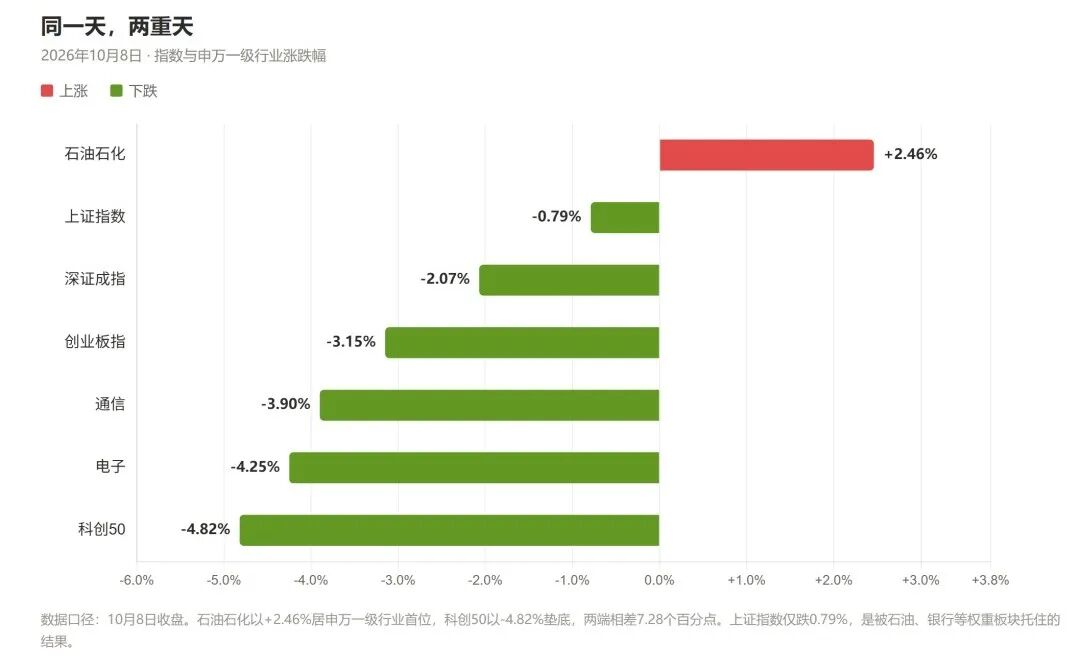
Two Extremes on the Same Day: Index vs. Shenwan Primary Industry Gains and Losses
Data Source: Shanghai and Shenzhen Stock Exchanges closing data on October 8
02
The Plunge Wasn't Driven by Performance but a "Policy Guess"
Today's sell-off in optical communications didn't originate from financial reports but from overseas. On October 1, Morgan Stanley released a report suggesting that potential U.S. FCC restrictions on Chinese-made optical modules could be implemented in phases through a "controlled list," most likely starting with the 3.2T generation, with the threshold requiring that the value proportion of U.S. companies in the bill of materials reach 65%—a level already close to being met by the combined value of U.S.-made DSPs and lasers.
It should be clarified that the report's information source was exchanges with a Washington legal team, and it used speculative terms like potential, likely, and could throughout, lacking any official FCC rule text or official announcement. It is a policy guess, not a policy.
However, the seven-day holiday was enough for the guess to ferment, compounded by three additional factors: the new FCC rule FCC26-50 will take effect on October 13; Huawei's rotating chairman Xu Zhijun stated at the Full Connect Conference a "firm commitment to the NPO path," raising concerns about the voice of independent optical module manufacturers in the next-generation architecture; and rumors of a price drop for 1.6T optical chips—Changguang Huaxin, Shijia Photonics, and Yongding Co., Ltd. have all responded, denying receipt of related information.
According to institutional breakdowns, the essence of this framework is to "protect the existing, block the future, and shift profits upstream": 800G/1.6T, already in large-scale commercial use, will remain unrestricted, leaving equipment manufacturers unaffected in the short term; 3.2T is expected to ramp up only by 2028, at which point if the 65% threshold must be met, the substitution space and export channels for domestic optical chips will be pressured. Thus, the hardest hit today were upstream optical chips, not equipment leaders.
This is not an isolated event today.
On September 28, the "Yi-Zhong-Tian" trio (Zhongji Innolight, Yitong Communication, and TFC Communication) already collectively plunged, with their combined market value evaporating by over 160 billion yuan in a single day. Over the past five trading days, TFC Communication fell 16.11%, Zhongji Innolight fell 16.23%, and Yitong Communication fell 17.20%, with the CPO sector down 14.26%.
In the first three quarters, electronics and telecommunications rose 25.47% and 23.74%, respectively, the top two gainers among the 31 Shenwan primary industries; during the same period, trade and retail fell 27.48%, and automobiles fell 21.37%. The hardest hit sectors were precisely those that rose the most this year. This is a rebalancing of valuations and crowding, not a fundamental issue.
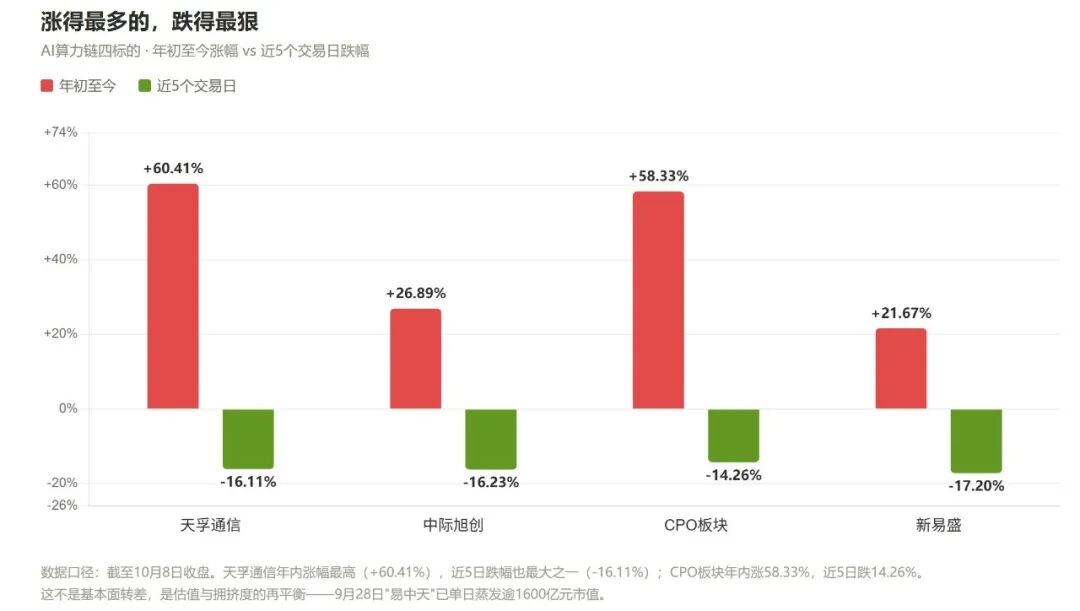
Year-to-Date Gains vs. 5-Day Declines in the AI Computing Chain
Data Source: Wind, as of October 8 closing
03
Where Did the Money Go?
Capital flows provide the answer: today, the electronics sector saw net principal outflows of 22.656 billion yuan, while the telecommunications sector saw net outflows of 9.705 billion yuan, totaling approximately 32.36 billion yuan; petroleum and petrochemicals saw net inflows of 563 million yuan. The catalysts are tangible: on October 7, Brent crude closed at $100.20 per barrel; the EIA raised its 2026 Brent crude average price forecast to approximately $98 per barrel; VLCC West Africa—China route TCE rose to a record high of $1.3268 million per day, with the crude oil transportation index surging 419.5% year-on-year.
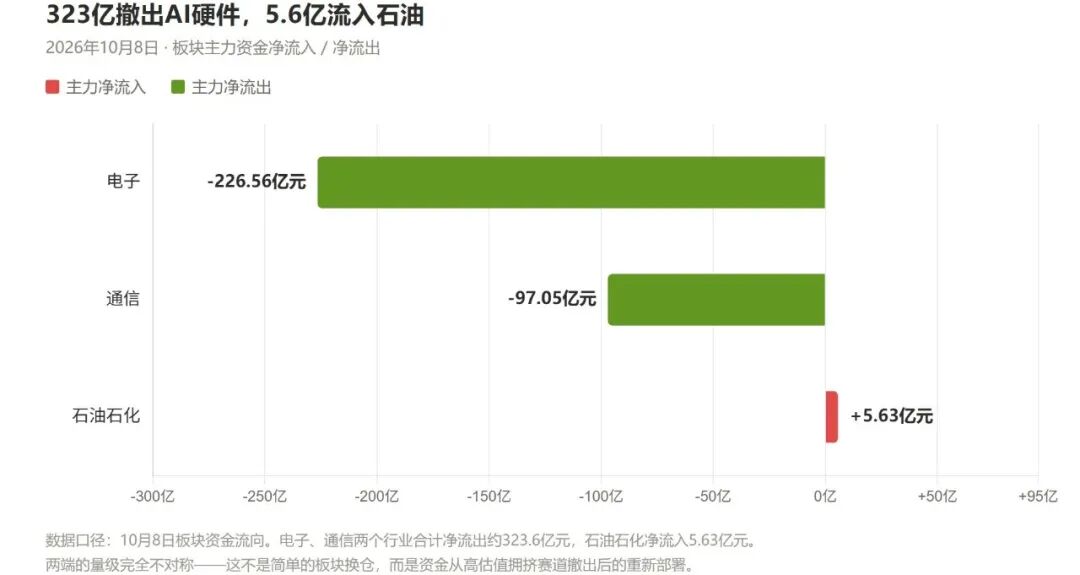
Net Principal Capital Flows by Sector
Data Source: October 8 sector capital flow statistics
Two things to watch tomorrow. First, the pace of FCC rule implementation. Currently, all analyses are based on speculation; if the scope narrows, there is room for sentiment recovery in optical communications, while an expansion would require a reassessment of equipment manufacturers' long-term gross margins. Second, the Undertake strength (supporting forces). Today saw a volume-driven decline, and as of September 30, the margin balance for Shanghai, Shenzhen, and Beijing was 2,569.853 billion yuan, down 39.138 billion yuan from the previous day. Whether this volume can be absorbed within one or two trading days is more noteworthy than today's decline itself.
Institutional divergence (disagreements) are also evident: China Merchants Securities sees October as a window for structural recovery and recommends a balanced allocation; Huatai Securities suggests avoiding pure thematic and high-valuation stocks; Kaiyuan Securities' baseline path is "rebound—high volatility oscillation (oscillation)"; CITIC Construction Investment judges that October enters the earnings validation period. The common thread—a balanced allocation between technology and dividends.
Data Source: Shanghai Stock Exchange, Shenzhen Stock Exchange (October 8 closing data), Securities Times · Data Treasure, Wind, company announcements, and public reports. "Net principal inflows/outflows" refer to sector-level capital flows, with slight variations among data providers.
- END -
-
![]()
From $2.7 Billion to $20 Million: Three Lessons from the 'Funeral' of Character.AI
-
![]()
Geely Auto Insures 183,000 Vehicles in September, with Exports Hitting 107,000 Units
-
![]()
BYD: September Sees 250,000 Vehicles Insured, Including 181,000 Exports and Some Channel Stock
-
Optical Communication Buzz: A Research Report Sparks Market Turmoil, Industry Races to Secure Supplies
-
![]()
A "Policy Guess" Shatters the Hundred-Billion Market Value of Optical Communication
-
![]()
AI Bubble in US Stocks with a $2 Trillion Valuation
-
![]()
Jensen Huang Backs Post-85 Twin Entrepreneurs: Leasing AI Computing Power, Company Valued at $97 Billion
-
![]()
Has Qualcomm Begun Paying Royalties to Huawei?