NVIDIA GTC Berlin: Setting the Rules for the Next Round of AI Competition in Advance?
 10/22 2026
 416
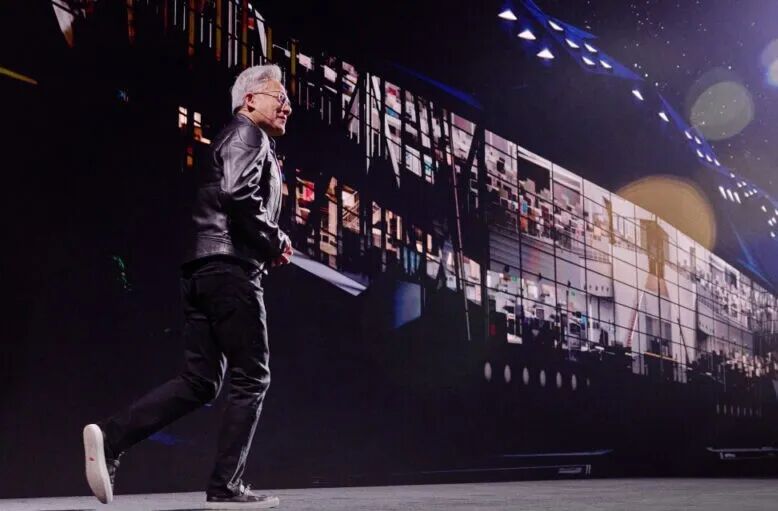
On October 21, NVIDIA held its keynote at GTC Berlin, where Jensen Huang announced offerings including Vera Rubin, DSX Pod, Open Shell, and the Agile 1S humanoid robot reference platform.
What does the convergence of these announcements reveal about the global competition logic for AI infrastructure?
To answer this, GTC Berlin must be placed within the broader contexts of global AI competition, Europe's sovereign AI agenda, and supply chain regionalization. For industry observers, this suite of announcements provides a reference point for judging the focus of the next round of competition: the shift from singular computational power metrics to a combination of deployment speed, security governance, and supply chain resilience.
NVIDIA is Turning AI Factories into 'Deliverable Standard Products'
The core message from NVIDIA at GTC Berlin can be summed up in one sentence: AI factories are transitioning from 'custom engineering' to 'standard products,' with Europe serving as the first complete testing ground for this productization logic.
$10 billion in European investment, the Vera Rubin European supply chain, the DSX Pod containerized AI factory, the Open Shell intelligent agent security runtime, and the Agile 1S open-source humanoid robot—while each of these announcements may seem like individual product news, together they form an infrastructure solution that is 'vertically optimized and horizontally open.'
The focus of this solution is on pace: while most vendors are still discussing 'how to build an AI factory,' NVIDIA is already addressing 'how to deliver AI factories in bulk, bring them online quickly, connect them to the power grid, and manage intelligent agents.'
This is not just about leading in individual technologies but about breaking down the entire lifecycle of infrastructure into modules and establishing reference implementations for each one.
Whoever defines the modules defines the procurement list.
The most impactful implementation example is the DSX Pod containerized computing unit.
According to NVIDIA, this is a fully assembled, fully tested, fully pre-built, and fully validated containerized AI factory unit. Traditional data center installations may take up to six months to complete rack setup, cabling, piping, validation, and connection to conventional physical data centers; the DSX Pod can compress this cycle to just 14 days.
The significance of this figure becomes clearer when viewed within the actual cost structure of AI factories: public data shows that AI factories have a power density of 50–100 kW per rack, five times that of standard hyperscale data centers; construction costs per megawatt reach $25 million, compared to just $11.3 million for standard data centers.
AI factories are not simply about 'buying a few more GPUs' but represent a systems engineering challenge involving power, land, approvals, and construction.
By extracting the most standardized and replicable parts into a containerized product, NVIDIA has effectively productized the 'delivery friction' that both customers and competitors must confront.
The DSX Pod targets rapid deployment scenarios at the hundred-megawatt level, while gigawatt-scale traditional data centers will continue to advance in parallel—but NVIDIA has already used a standard container to usher AI factories from 'custom engineering' into the era of 'productized delivery.'
Also noteworthy are the zero-water-use design and grid interaction capabilities of the DSX.
The warm-water closed-loop cooling system sets the cooling temperature at 45 degrees Celsius, relying on dry coolers, fans, and radiators for heat dissipation, eliminating evaporative water consumption.
The DSX Flex automated API allows data centers to dynamically scale down or defer non-critical operations during grid peak periods, feeding power back into the grid.
This design holds clear compliance value in Germany's regulatory environment, where PUE is capped at 1.2 and new data centers face a WUE limit of 0.4 L/kWh.
The fundamental trade-off in cooling engineering is that waterless systems typically consume more energy than evaporative cooling. NVIDIA's choice is to pay in terms of power and capital expenditure under Europe's regulatory framework to meet water usage targets—a strategic move to align with European regulatory rhythms in advance.
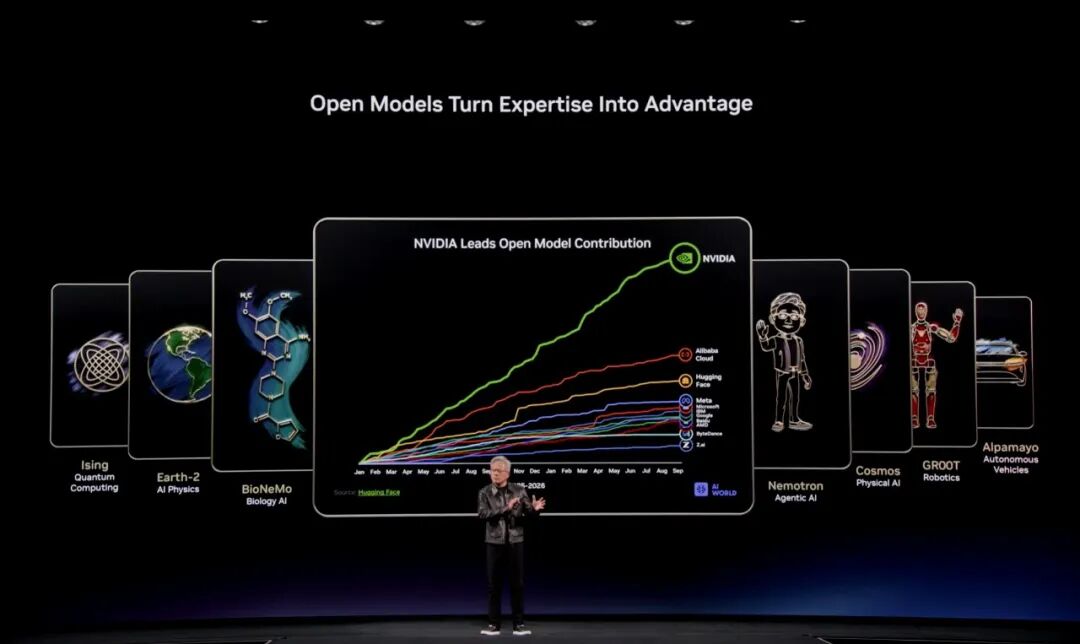
Open-Source Runtime Secures the Entry Point
Agent security was a focal point at the software level during GTC Berlin.
At the event, NVIDIA introduced Open Shell—an open-source, policy-controlled runtime based on the Apache 2 license. Deployed between agents and various resources within enterprise systems, it covers files, credentials, tools, APIs, models, and even networks.
The core mechanism is kernel-level isolated sandboxes: agents run within sandboxes, with a policy attestor function verifying access boundaries before agent execution. Models, applications, and business data remain outside the sandbox, with Open Shell uniformly managing access permissions and tracking communication interactions throughout.
There are already public signals regarding Open Shell's ecosystem adoption: Dell, HPE, and the SUSE AI Factory stack have adopted Open Shell; HPE plans to integrate it into HPE Private Cloud AI by Q4 2026; Red Hat runs Open Shell and DOCA on Red Hat AI Factory; and over 100 organizations have already connected at launch, including Anthropic, Cisco, CrowdStrike, Microsoft, SAP, and Salesforce.
This list demonstrates that Open Shell is not just an idle open-source project but is becoming the default security layer for enterprise AI factory stacks.
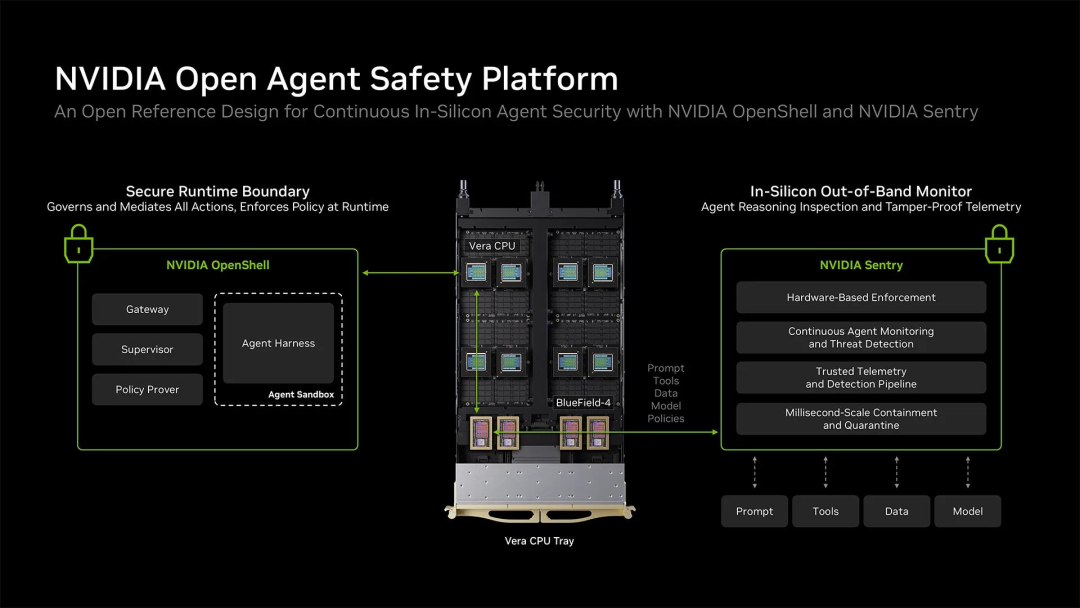
The structure of Open Shell warrants precise description: an open-source runtime + an NVIDIA-defined reference architecture + BlueField-4 DPU as an independent security monitor.
When Dell, HPE, and Red Hat's AI factory stacks all adopt Open Shell as their default security runtime, NVIDIA effectively turns the reference implementation for security governance into the de facto entry point for industry procurement through an Apache 2.0-licensed software.
This path has a precise analogy in infrastructure history: InfiniBand began as an open industry standard, but NVIDIA's manufacturing capabilities, CUDA software integration, and proprietary extensions like SHARP evolved it into a highly integrated technology stack.
Open Shell is following the same path today—the more widespread the open-source runtime becomes, the deeper NVIDIA's involvement in defining the default form of security infrastructure.
This is not a negative judgment but rather the key to understanding the business logic of open-source infrastructure: open standards and ecosystem entry points can coexist. Security governance is sinking from the model layer to the infrastructure layer, and NVIDIA is using Open Shell to participate in defining the technical implementation path for this sink layer.
While regulators are still discussing model alignment, NVIDIA has already turned 'executable governance' into a deployable component.
Europe's Procurement List Includes More Than One Name
NVIDIA Uses Supply Chain to Enhance Stickiness
Europe's sovereign AI agenda is the critical backdrop for understanding NVIDIA's European Layout (layout).
Over the past week, NVIDIA announced the landing of a shared AI supercomputer (Sferical One) in Sweden, committed $250 million in computing resources to AI safety research in the UK, and brought its cumulative investment and commitments in the European tech ecosystem to nearly $10 billion.
At the supply chain level, France's Bull company is expanding production in a 20,000-square-meter facility in Angers, with Foxconn's Czech factory handling component production and testing before final assembly in Angers; OEM vendors like Dell provide support for GB200 rack supply through European capacity, while Siemens advances an 800-volt DC power distribution solution for AI factories.
According to NVIDIA, its AI system supply chain covers more than a dozen European countries.
The forward-looking intent of this Layout (layout) is clear: NVIDIA is upgrading Europe from a 'sales market' to a 'manufacturing and delivery hub,' using regionalized supply chains to secure policy compliance and delivery certainty.
In Europe's sovereign AI procurement logic, 'where it is manufactured' is as important as 'who provides the technology.' By bringing its supply chain into Europe, NVIDIA effectively answers the political questions in advance.
Of course, European sovereign AI procurement is not a single-choice proposition.
The EuroHPC JU signed a €387.8 million LUMI-AI contract with Bull in September 2026, marking Europe's sixth official AI factory and selecting AMD Instinct MI430X as its core GPU.
Reports explicitly note that this is a landmark competitive result in European sovereign computing procurement, signaling that European buyers are willing to diversify risk away from the dominant GPU supplier.
The value of this information lies not in 'who wins or loses' but in its accurate description of the European market structure: sovereign AI funds are not an 'ATM' for any single supplier.
NVIDIA's response exemplifies its sophistication: its $10 billion European investment and supply chain Layout (layout) serve two purposes simultaneously—meeting the political requirement for 'European manufacturing' and ensuring that AI factories procured with European public funds physically pass through as many NVIDIA-defined components and reference architectures as possible.
The EU has signed letters of intent with AMD, NVIDIA, and Qualcomm to secure hardware supply, and this pluralistic pattern (landscape) is itself part of Europe's sovereign AI agenda. NVIDIA chooses to reinforce its position within this pluralistic pattern (landscape) through manufacturing localization.
Embodied AI: NVIDIA's Early Move to Secure the 'Physical World' Entry Point
The final piece of the puzzle at GTC Berlin was embodied AI.
NVIDIA provided a figure: physical AI covers 70% to 80% of global GDP related to the physical world, corresponding to a global market opportunity exceeding $50 trillion.
In the first half of 2026, NVIDIA's physical AI business revenue approached $11 billion, 30% higher than the entire previous year.
NVIDIA divides the physical AI computing stack into three layers: edge computers at the device level, the Omniverse simulation and testing system, and large-scale physical AI model training clusters.
At GTC Berlin, four embodied AI-related announcements were made: Siemens Healthineers reconstructed personalized radiation therapy using on-device AI; Volvo, Volkswagen, and other European automakers showcased L2 to L4 autonomous driving solutions based on NVIDIA's full-stack platform; the Halo Safe complete safety system opened its test suite; and in collaboration with Munich's Agile company, the open-source humanoid robot reference platform Agile 1S was launched, with its full software stack open to all researchers.
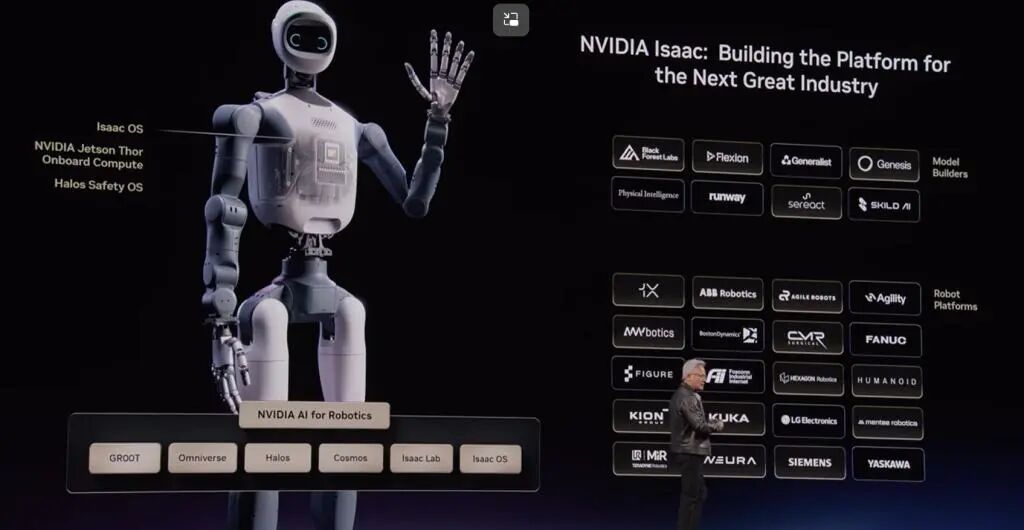
A critical judgment: physical AI is developing extremely rapidly in Europe due to its core of precision manufacturing and the presence of numerous small and medium-sized enterprises that previously lacked the technical capability to implement autonomous AI.
Today, with end-to-end models capable of inference and simulation, along with intelligent agent AI technology, these capabilities 'have undoubtedly reached a tipping point.' Siemens has fully introduced digital twin technology in its 55-year-old factory, deploying autonomous inspection AI agents based on intelligent agent AI to develop and execute daily plans, paired with general-purpose robots.
This reveals a trend: the large-scale deployment of embodied AI may not first occur in consumer-grade humanoid robots but in highly structured scenarios such as factories, healthcare, and logistics.
Europe's manufacturing heritage provides NVIDIA with an ideal testing ground for embodied AI, and through open-source reference platforms and simulation tools, NVIDIA is securing the standard entry point for this testing ground in advance.
What is open-source is the reference platform, but what is accumulated is scenario data and a developer ecosystem—this is NVIDIA's opening move to replicate the CUDA path in the physical AI domain.
Three Milestones
An Industry Signal
After October 21, three indicators are worth tracking: whether the DSX Pod secures verifiable repeat orders at the hundred-megawatt level in Europe, whether IREN's Sweetwater flagship site transitions from 'announced' to 'operational' as scheduled, and whether Open Shell enters actual production environments in at least three European regulated industries (finance, healthcare, energy). Additionally, during Germany's EnEfG PUE 1.2 enforcement, whether DSX warm-water cooling can pass third-party audits under real loads will be telling.
These three milestones respectively test the mettle of 'productized delivery,' 'security governance as infrastructure,' and 'European compliance adaptation.'
When viewed within the broader context of global AI competition, NVIDIA's intentions at GTC Berlin can be summarized in three layers: regional supply chain hedging, shifting from 'selling chips' to 'participating in defining standards,' and preemptively turning 'security' and 'governance' into deployable infrastructure components before regulations are fine-tuned.
In his Berlin keynote, Jensen Huang wove these threads into a narrative: AI factories are the infrastructure of the new era, intelligent agents are the labor force of the new era, and embodied AI is the real economy interface of the new era.
For the industry, the true signal of this launch lies not in the parameters of any single product but in the shift of competitive dimensions: AI infrastructure competition is moving from 'computational power scale' to a multidimensional contest of 'deployment speed, security governance, and supply chain resilience.'""Modules, reference architectures, and ecosystem entry points are becoming more critical competitive assets than single-point performance; whoever positions these assets in advance is more likely to participate in defining the procurement lists and delivery standards for the next round of AI infrastructure.
Europe is the first complete testing ground for this logic, and its subsequent implementation will directly influence the global pace of AI infrastructure competition.
-
![]()
A Whopping 20 Million Yuan Investment! Yubo Optics Eyes Shangrao with Annual Production of 6 Million Lens Sets
-
![]()
Single Quarter Yields Profit! SeeYA Technology’s Q3 2026 Revenue Skyrockets 409% Year-on-Year
-
![]()
NVIDIA GTC Berlin: Setting the Rules for the Next Round of AI Competition in Advance?
-
![]()
The Curtain Falls on the 'Wild Growth' Phase in the Automotive Sector: Blue Light Era Ends, Speedy Car Production Faces Ban?
-
![]()
Huawei AI Glasses Undergo Functional Enhancement: Now Support Scan-to-Pay in Parking Lots and Head Motion-Controlled Payments
-
BMW Faces Surge of 40,000 Employees Seeking Resignation: Maximum Compensation Hits €4.87 Million, Overloading Internal Systems
-
Anthropic Unveils New Governance Framework: Redefining Capital Rules for AI Companies
-
Flying Complaints and Instant Sellouts: Why the iPhone Continues to Fly Off the Shelves Despite Criticism