Single Quarter Yields Profit! SeeYA Technology’s Q3 2026 Revenue Skyrockets 409% Year-on-Year
 10/22 2026
 469
On October 21, SeeYA Technology unveiled its financial results for the third quarter of 2026. Revenue for the first three quarters soared to RMB 1.308 billion, marking a 346.73% increase year-on-year. The net profit attributable to the parent company reached RMB 31.0712 million, transitioning from losses to profits compared to the same period last year. After adjusting for non-recurring gains and losses, the net profit stood at RMB 21.9276 million.
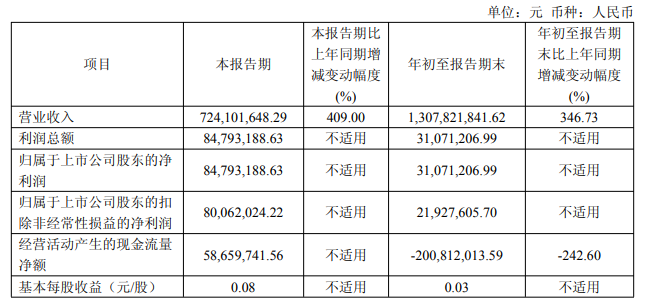
In the third quarter alone, revenue surged to RMB 724 million, a 409.00% jump year-on-year. The net profit attributable to the parent company hit RMB 84.7932 million, with the adjusted net profit reaching RMB 80.0620 million. The profits from this single quarter have more than compensated for the losses incurred in the first half of the year. The gross profit margin for the first three quarters reached 26.77%, and the net operating cash flow for Q3 was RMB 58.6597 million. This suggests that silicon-based OLED microdisplays are entering a phase where their operational leverage is being realized.
The company attributed the significant revenue growth to increased customer demand and a substantial rise in shipments during the reporting period.
When viewed within the broader industry context, SeeYA’s quarterly report takes on added significance. IDC predicts that global shipments of AI glasses from Chinese manufacturers will reach approximately 22.671 million units in 2026, a 56.3% increase year-on-year. In the Chinese market, shipments are expected to reach 4.508 million units, up 77.7% year-on-year, with growth primarily concentrated in audio, audio recording glasses, and AR/ER glasses.
It’s important to note that not all audio and audio recording glasses incorporate silicon-based OLED technology. The true driver of demand for silicon-based OLED lies in AR/ER and MR devices, which account for a smaller share of the total market than the overall figures might suggest. While growth in terminal shipments will boost demand for upstream microdisplays, the impact should be assessed within the AR/ER and MR segments.
Narrow-scope data from QYResearch indicates that global sales of silicon-based OLED reached approximately USD 649 million in 2025, with projections to rise to USD 5.305 billion by 2032. This represents a compound annual growth rate of about 35.0% from 2026 to 2032—a classic example of a niche market with “moderate total size but rapid growth.”
A more critical factor lies in the technological window of opportunity. CIOE 2026’s industry overview notes that while full-color Micro-LED samples have emerged, most remain engineering prototypes. Silicon-based OLED, however, is currently the most mature display solution for mass production and is poised to lead the first wave of large-scale AR shipments. SeeYA’s financial performance strongly supports this “mass production first” assessment.
However, financial improvement does not necessarily equate to the establishment of competitive barriers. The competitive landscape is evolving rapidly, and caution is warranted when describing the current market state with static market share figures. According to Frost & Sullivan, Sony accounted for approximately 50.8% of global XR device silicon-based OLED shipments in 2024, with SeeYA at about 35.2%, together covering 86% of the market. However, Omdia data shows that by 2026, SeeYA’s global market share had risen to 61.2%, while Sony’s declined to 25.9% and BOE’s stood at 3.4%. Given the differing data scopes and years, these figures cannot be directly compared. Instead, they collectively suggest a directional trend rather than quantifiable growth: SeeYA’s market share has been on the rise over the past two years, but part of this increase may stem from a scope effect—shifting from “XR device shipments” to the “global silicon-based OLED market”—rather than a fundamental shift in competitive position.
Meanwhile, SeeYA’s reliance on a few strategic customers and related-party transaction channels is deepening. Related-party transactions amounted to RMB 1.6 billion, accounting for 311.87% of the volume of similar business transactions in 2025. This indicates that revenue is highly dependent on the closed loop of “specific customer—Goertek—SeeYA” in the foreseeable future. The resilience of this channel in sustaining profits is just as significant as the long-term threat posed by Micro-LED, which could eventually substitute silicon-based OLED. Micro-LED’s theoretical advantages in brightness and power consumption remain relevant; once its yield and cost curves decline rapidly, silicon-based OLED’s first-mover advantage will face reevaluation.
Overall, the key takeaway from SeeYA’s third-quarter report is that the competitive focus for silicon-based OLED is shifting from “who can achieve mass production” to “who can achieve mass production with sustainable gross margins.” Single-quarter profitability confirms the authenticity of demand and the existence of operational leverage. However, the more critical question is whether these single-quarter profits can translate into steady profitability over time, given the challenges of customer concentration and technological iteration, before 2027.
-
![]()
A Whopping 20 Million Yuan Investment! Yubo Optics Eyes Shangrao with Annual Production of 6 Million Lens Sets
-
![]()
Single Quarter Yields Profit! SeeYA Technology’s Q3 2026 Revenue Skyrockets 409% Year-on-Year
-
![]()
NVIDIA GTC Berlin: Setting the Rules for the Next Round of AI Competition in Advance?
-
![]()
The Curtain Falls on the 'Wild Growth' Phase in the Automotive Sector: Blue Light Era Ends, Speedy Car Production Faces Ban?
-
![]()
Huawei AI Glasses Undergo Functional Enhancement: Now Support Scan-to-Pay in Parking Lots and Head Motion-Controlled Payments
-
BMW Faces Surge of 40,000 Employees Seeking Resignation: Maximum Compensation Hits €4.87 Million, Overloading Internal Systems
-
Anthropic Unveils New Governance Framework: Redefining Capital Rules for AI Companies
-
Flying Complaints and Instant Sellouts: Why the iPhone Continues to Fly Off the Shelves Despite Criticism