Hot Topic | Microsoft's 2nm Self-Developed Chip Hits Third Iteration, Shifting Inference Workloads Away from NVIDIA
 10/23 2026
 441
Foreword:
In October, at the Open Compute Project Summit in San Jose, Microsoft showcased a 950-watt chip on its exhibition stand. This chip is not for sale, nor will it be integrated into any customer’s server rack, yet Nadella hailed it as Microsoft’s biggest bet on self-developed chips.
Author | Fang Wensan
Image Source | Internet

Iterating Chips Every Nine Months: Microsoft Runs Chip Development on a Software Schedule
The Maia 300 is Microsoft’s third-generation self-developed AI accelerator, released less than nine months after the second-generation Maia 200. The first-generation Maia 100 took over two years to evolve into the second generation, with a delay at one point.
The Maia 100, unveiled in November 2023, was built using TSMC’s 5nm process, featuring 105 billion transistors and pushing the limits of photolithography mask dimensions.
The true mission of that generation was not to outperform competitors but to safely integrate a fully self-developed chip into Azure’s server racks. Packaging yield, custom Ethernet, liquid cooling subsystems, and firmware telemetry were all uncharted territory for Microsoft.
The Maia 200, released in January this year, focused on inference economics, built with a 3nm process, featuring 140 billion transistors, delivering over 10 PFLOPS of FP4 compute power, and equipped with 216GB of HBM3e memory. After deployment in Iowa’s data center, it directly handled GPT-5.2’s production traffic.
The Maia 300 takes the boldest step yet, with compute chiplets jumping to TSMC’s N2P process (a 2nm enhanced version), while IO and scheduling chiplets remain at 3nm—effectively assembling a single chip from two different process nodes.
Three generations, three missions. The first learned to walk, the second learned to manage costs, and the third is now jockeying for position.
Meta announced this year that it would update its self-developed chips every six months. Microsoft, with a nine-month interval, signals to the outside world that the competition for custom silicon has shifted from single-chip benchmarks to iteration speed itself.
The reasoning is straightforward: chips are optimized for large models, and cutting-edge models evolve rapidly every year. A chip takes 18 months from design freeze to mass production, serving models that won’t exist until 18 months later.
Every month the iteration cycle is compressed reduces the mismatch between hardware and models. Microsoft, accustomed to Windows version rhythms, now implants the same heartbeat into silicon.
Another often-overlooked detail: while the Maia 100 balanced training and inference, the Maia 300 eliminates training from its design goals entirely, focusing solely on inference.

Inference: A Power-Per-Watt Business, Microsoft Decides to Build Its Own Power Plant
Training is compute-hungry; inference, especially for long-context dialogues and multi-step agent tasks, is memory-bound. Every token output by the model requires reloading weights and caches—no matter how strong the compute, insufficient memory leads to idle spinning.
The Maia 300’s design directly addresses this bottleneck, featuring 288GB of HBM4 memory across eight stacks, 33% more capacity than its predecessor, with 18TB/s of bandwidth—2.5 times that of the Maia 200—and doubling the HBM bandwidth per watt.
A single server rack houses 96 chips, twice that of the Maia 200 rack, with a total power consumption of 167 kilowatts and a rack-level token throughput up to seven times that of the previous generation.
Microsoft claims the Maia 300 processes 40% more tokens per megawatt of power than leading GPU systems—without naming names, but pointing to its true metric: not FLOPS, but tokens per watt.
On the other side of the scale lies a heavy financial report: Microsoft’s capital expenditures reached $145.3 billion in fiscal 2026, with the 2026 calendar year budget once pointing to $190 billion, $25 billion of which came solely from price hikes in components like GPUs and CPUs.
Roughly two-thirds of quarterly capital expenditures flow into short-lived compute assets—chips that begin depreciating as soon as they enter the door, often without fully recouping costs.
In contrast, Microsoft’s AI business revenue has annualized to $37 billion, up 123% year-over-year, with Copilot paid seats surpassing 30 million.
Demand is scorching, but costs are even hotter. CFO Amy Hood once noted that using in-house chips helped improve profit margins over the past decade—a lesson learned from Cobalt processors saving money for Azure. Now, the same accounting applies to AI accelerators.
Industry-wide inference costs drop 5–10x every 12–18 months. With NVIDIA GPUs, a significant portion of this deflationary dividend goes to Santa Clara’s gross margins. With in-house chips, deflation translates entirely into improved profit margins.
While Google and Amazon choose to lease their self-developed chips for secondary revenue, Microsoft refuses—Maia chips exclusively feed its own Copilot, Foundry, and OpenAI models.
This restraint reveals Microsoft’s priorities: if inference is becoming a utility, Microsoft aims to shift from retail electricity pricing to in-house power plant cost structures.
Moving Away from NVIDIA: A Silent Departure
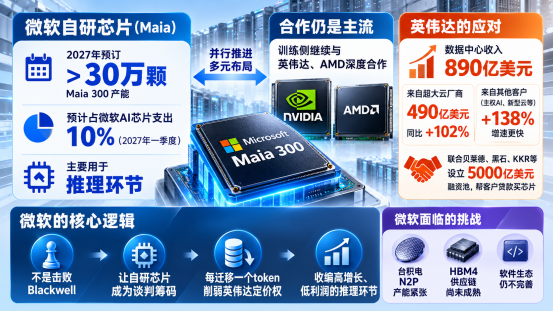
Translating ambition into numbers, the steps are small: The Information reports that Microsoft has booked over 300,000 units of Maia 300 capacity from TSMC for 2027.
While it sounds like a complete relocation, the numbers are more sobering. Evercore ISI analysts estimate that by Q1 2027, Maia will account for only about 10% of Microsoft’s AI chip spending.
On the training side, Microsoft continues deep collaboration with NVIDIA and AMD, still filling data centers with in-demand processors by the boxload. As customers demand multiple chip types for different workloads, Microsoft remains a major NVIDIA buyer.
Microsoft doesn’t need a chip that outperforms Blackwell—it just needs a sufficiently capable alternative permanently on the negotiating table.
Every token migrated to Maia is a token where NVIDIA loses pricing power; the value lies in existence itself.
NVIDIA clearly reads the signals: its data center revenue reached $89 billion last quarter, with roughly $49 billion from hyperscale cloud providers and the other half from sovereign AI, new cloud, and enterprise customers—the latter growing 138% year-over-year, obvious faster than the former’s 102%.
Jensen Huang is diversifying NVIDIA’s customer base, partnering with BlackRock, Blackstone, KKR, and others to establish a $500 billion financing pool to help customers buy NVIDIA chips on loan. When a shovel seller starts empowering gold miners, the picture itself is an honest response to the self-developed chip trend.
Microsoft’s vulnerabilities are also evident: TSMC’s N2P capacity is tight, the HBM4 supply chain remains untested in mass production, and Maia’s software ecosystem is young to the point of being thin—the compiler only needs to serve Microsoft’s own workloads, which is both an advantage and a ceiling.
What Microsoft aims to abandon is the buyer’s market price list. A 10% self-developed share is enough to leverage bargaining power with Huang Renxun while gradually bringing the fastest-growing, lowest-margin inference segment in-house.
OpenAI: Both Customer and Competitor, Microsoft Holds Dual Insurance
The most nuanced role in Maia’s story is OpenAI. The Maia 200 now runs GPT-5.2 in production—having the flagship model of its top partner run on in-house silicon is the highest endorsement a custom chip can receive.
Yet OpenAI announced in June its collaboration with Broadcom on a self-developed chip, planning gigawatt-scale deployment starting in late 2026, with Microsoft’s data centers among the landing sites.
This creates a peculiar scene: in Microsoft’s own data centers, Maia chips run OpenAI’s models while simultaneously powering and housing chips designed by OpenAI.
The two companies attack the same cost problem from opposite ends, with cooperation and competition growing on the same branch.
The revised agreement in April added context: Azure lost exclusive hosting rights for OpenAI models but secured licensing through 2032, plus a little-noticed clause granting Microsoft the right to use OpenAI’s early chip designs if its self-developed chips falter. Insurance upon insurance, trust laced with hedging—this is adulthood’s alliance.
Zooming out, Microsoft is not alone. Google’s TPU has reached its eighth generation and begun supplying external customers; Amazon’s Trainium 3 has solidified its third generation; Meta’s Iris entered production in September.
The underlying logic for hyperscale cloud providers is consistent: when inference traffic becomes predictable enough, custom silicon for fixed workloads guarantees profitability, while generic GPU premiums become squeezable margins.
Over half of NVIDIA’s revenue depends on these four or five buyers—each now holding a self-made key.

Conclusion:
Microsoft doesn’t necessarily aim to build a chip stronger than NVIDIA’s—it just wants NVIDIA to no longer be the only answer.
Inference is becoming a power-per-watt utility, and every extra 40% of tokens per megawatt is an independence declaration written on the electricity bill. Silicon stays silent; the bill speaks.
Partial References: Microsoft Official: "Microsoft to expand Azure Maia system to multi-gigawatt deployments," Microsoft Azure: "Deep dive into Azure Maia 300 architecture," Microsoft Official: "Microsoft Ignite 2023: AI transformation and the technology driving change," Reuters: "Microsoft plans huge deployment of its own AI chips, with an eye on saving costs"
-
![]()
Post-National Day Sales of Xiaomi Revealed, Netizens: Pengcheng's Sales Take a Dive!
-
![]()
Understanding NVIDIA GTC Berlin at a Glance: AI in Manufacturing, Physical AI, and Three Key Strategies
-
![]()
Final Verdict: Can Battery Swapping Become the Mainstream Energy Replenishment Approach for Electric Vehicles?
-
With a 350,000-Yuan Budget for a Luxury Off-Road SUV, Is the 2027 Tank 500 a Wise Purchase?
-
![]()
Why Are Interpersonal Relationships Emerging as a Business Superpower in the AI Era?
-
![]()
Hot Topic | Microsoft's 2nm Self-Developed Chip Hits Third Iteration, Shifting Inference Workloads Away from NVIDIA
-
DeepSeek Inches Closer to the Largest IPO Financing in Chinese History
-
![]()
Lei Jun Reiterates the Centrality of Safety: In the Auto Industry, Safety Underpins All Else