Understanding NVIDIA GTC Berlin at a Glance: AI in Manufacturing, Physical AI, and Three Key Strategies
 10/23 2026
 560
At this year's GTC Berlin on October 21, Jensen Huang took the stage in his signature leather jacket, speaking for an hour and a half.
This marked NVIDIA's first GTC event held in Berlin. The venue was packed, with 100 global viewing locations and 15,000 people watching online simultaneously.
Most online information lists a string of product names: Vera Rubin, DSX Pod, OpenShell, RTX Spark, Hyperion, Halos SAFE, Agile ONE SN—each name longer than the last, making it hard to connect the dots.
I watched the entire keynote from start to finish. I also cross-checked the opening livestream conversation with Mercedes-Benz CEO Ola Källenius and NVIDIA's latest announcements point by point.
My biggest takeaway: The stars of the show were AI factories and intelligent agents, with vehicles and robots taking up only about 7 minutes on stage.
However, those 7 minutes precisely represented where NVIDIA's entire vision connects with the physical world.
This article shares insights through three questions: What are NVIDIA's new perspectives on AI? What new products were announced? What do these mean for autonomous driving and robotics?
A One-Stop Guide for the Automotive and Robotics Tech Industry
94-minute keynote: ~2.7 minutes on autonomous driving, ~4.7 minutes on humanoid robots
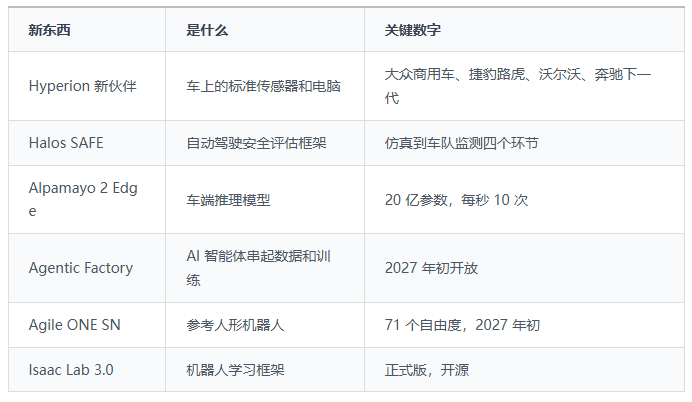
Hyperion expands to four new European brands: Volkswagen Commercial Vehicles, Jaguar Land Rover, Volvo, and next-gen Mercedes-Benz
Vehicle-side model Alpamayo 2 Edge: 2 billion parameters, 10 decisions per second
Bolt plans to deploy at least 25,000 Level 4-capable vehicles, with data collection starting in Madrid in 2027
Reference humanoid robot Agile ONE SN: 71 degrees of freedom, delivery expected in early 2027
01 New Perspective: AI as Manufacturing
Five-layer cake, intelligent agent toolkit, three computers
Jensen Huang began by settling some European accounts.
NVIDIA has operated in Europe for 33 years.
Its first chip, NV1, was manufactured in France and packaged in Malta. It entered Audi vehicles in 2005 and began autonomous driving collaboration with Mercedes-Benz in 2020.
Over the past year, NVIDIA has invested nearly $10 billion in Europe, partnering with over 12,000 companies.
After this setup, he presented his first major point of view (translated as 'perspective'): AI is manufacturing, not just software.
01 Diagram 1: Five-Layer Cake
At the base lies energy, above that computers, and then AI factories.
Factories produce tokens, which feed models that ultimately enhance every application.
His message was clear: To participate in the AI economy, don't just be a consumer—be a producer.
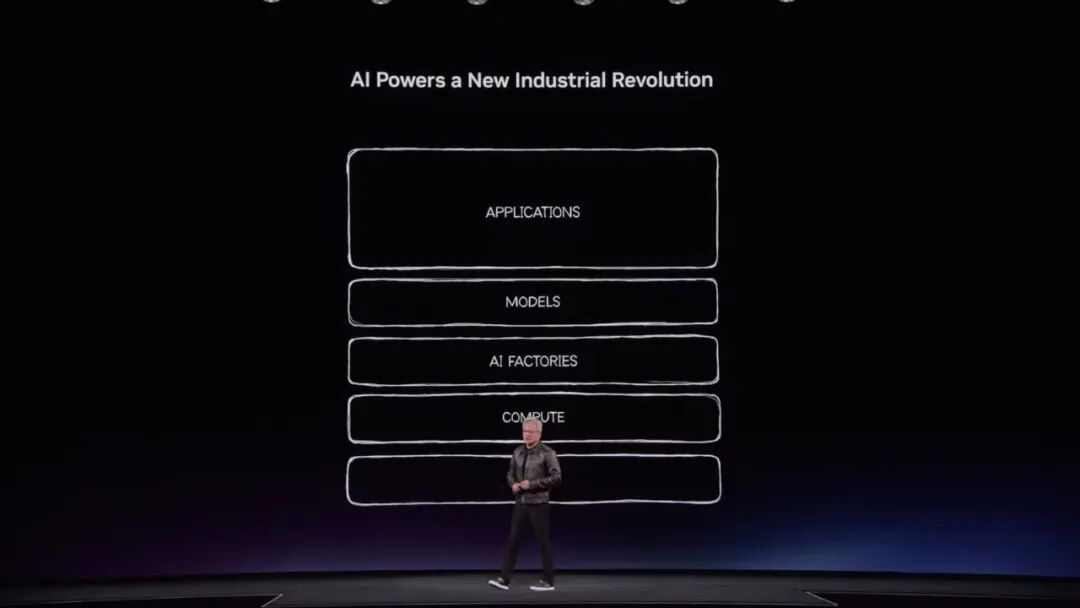
Each layer requires investment. He provided a figure: A 1-gigawatt AI factory costs about $50 billion. If it generates $40 billion annually, delaying launch by three months means losing approximately $10 billion.
This calculation directly translates into a new product later.
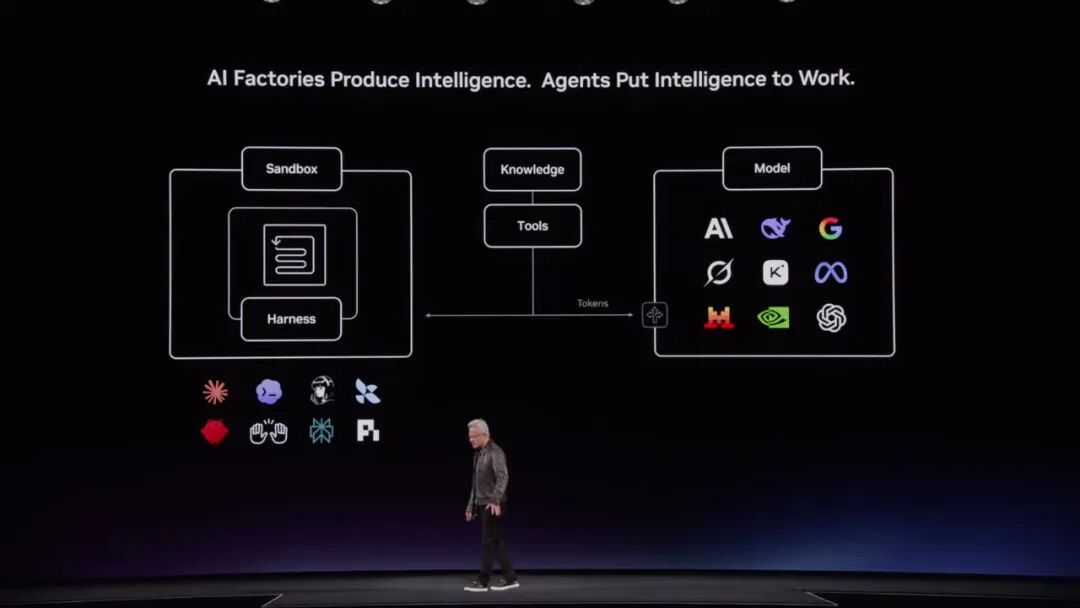
02 Diagram 2: Intelligent Agent Toolkit
The longest segment of the keynote focused on intelligent agents. He broke one down into five components:
1. Models: Responsible for perception, reasoning, and planning, using both closed-source and open-source models
2. Harness: What he calls the agent's 'exoskeleton,' managing memory, scheduling, and tool invocation
3. Sandbox: Contains the Harness with minimal permissions and constant monitoring
4. Knowledge: A company's proprietary documents and databases
5. Tools: NVIDIA's decades-accumulated CUDA-X acceleration libraries
He emphasized that the latter two are company-specific. While models are widely available, knowledge and tools constitute your unique expertise.
03 Diagram 3: Physical AI Requires Three Computers
Before discussing vehicles and robots, he presented his third framework:
The first computer trains models.
The second handles simulation, letting AI practice in digital twins before real-world deployment.
The third installs in vehicles and robots.
In vehicles, this is called Hyperion. It includes the computer itself, functional safety systems, active safety systems, and an OS designed for physical AI safety.
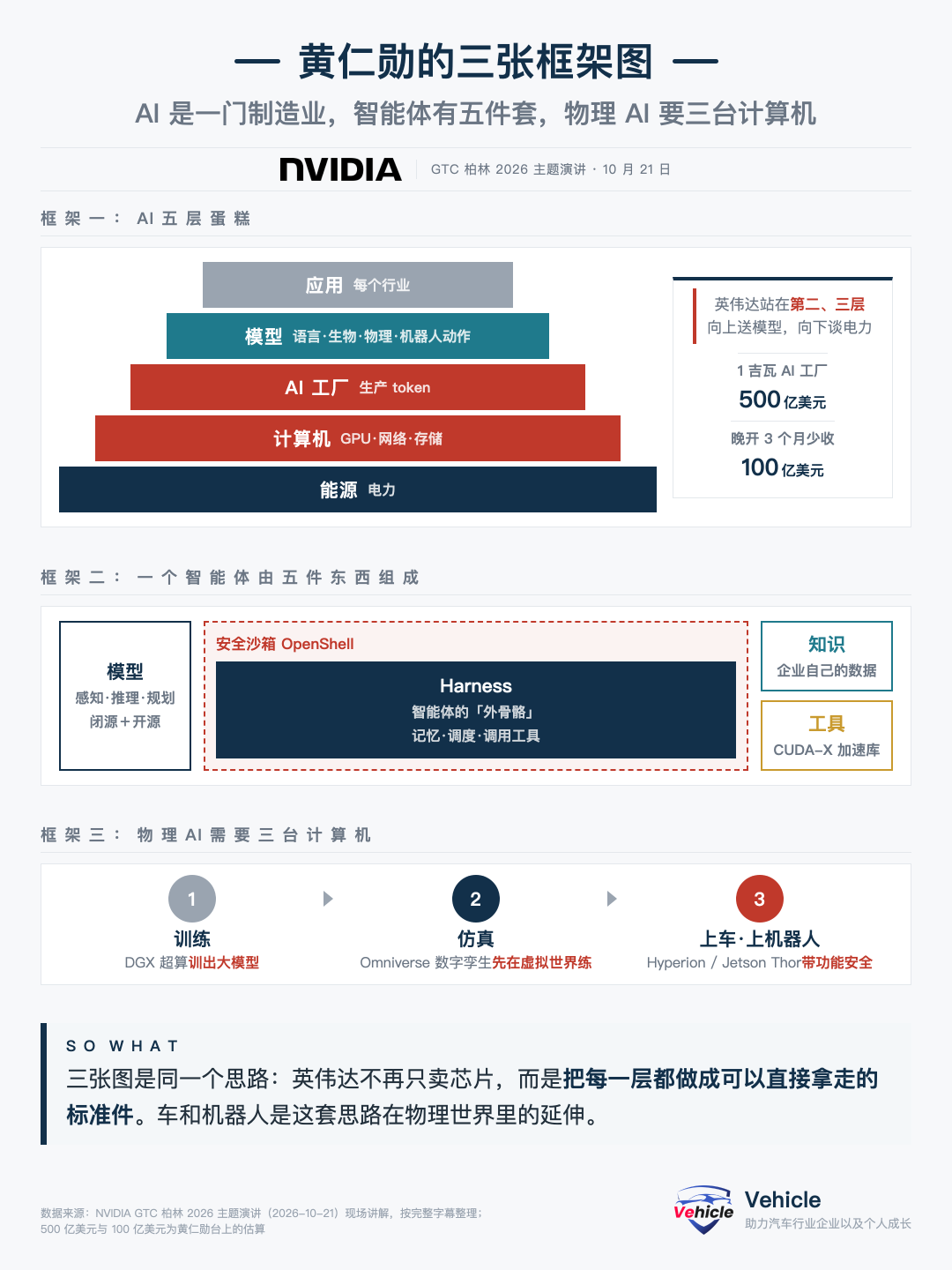
Viewing all three diagrams together reveals a consistent strategy: NVIDIA aims to standardize every layer for immediate adoption.
Server racks become standardized components, intelligent agent environments become standardized, and vehicle sensors and computers become standardized.
Vehicles and robots represent the physical extension of this 'standardized components' approach.
02 New Products: A Complete Checklist
AI factories, intelligent agents, and physical AI each debut new offerings
Counting by presentation order, over a dozen products were announced.
Time allocation: ~28 minutes on AI factory hardware, ~25 minutes on intelligent agents
Autonomous driving: ~2.7 minutes, humanoid robots: ~4.7 minutes
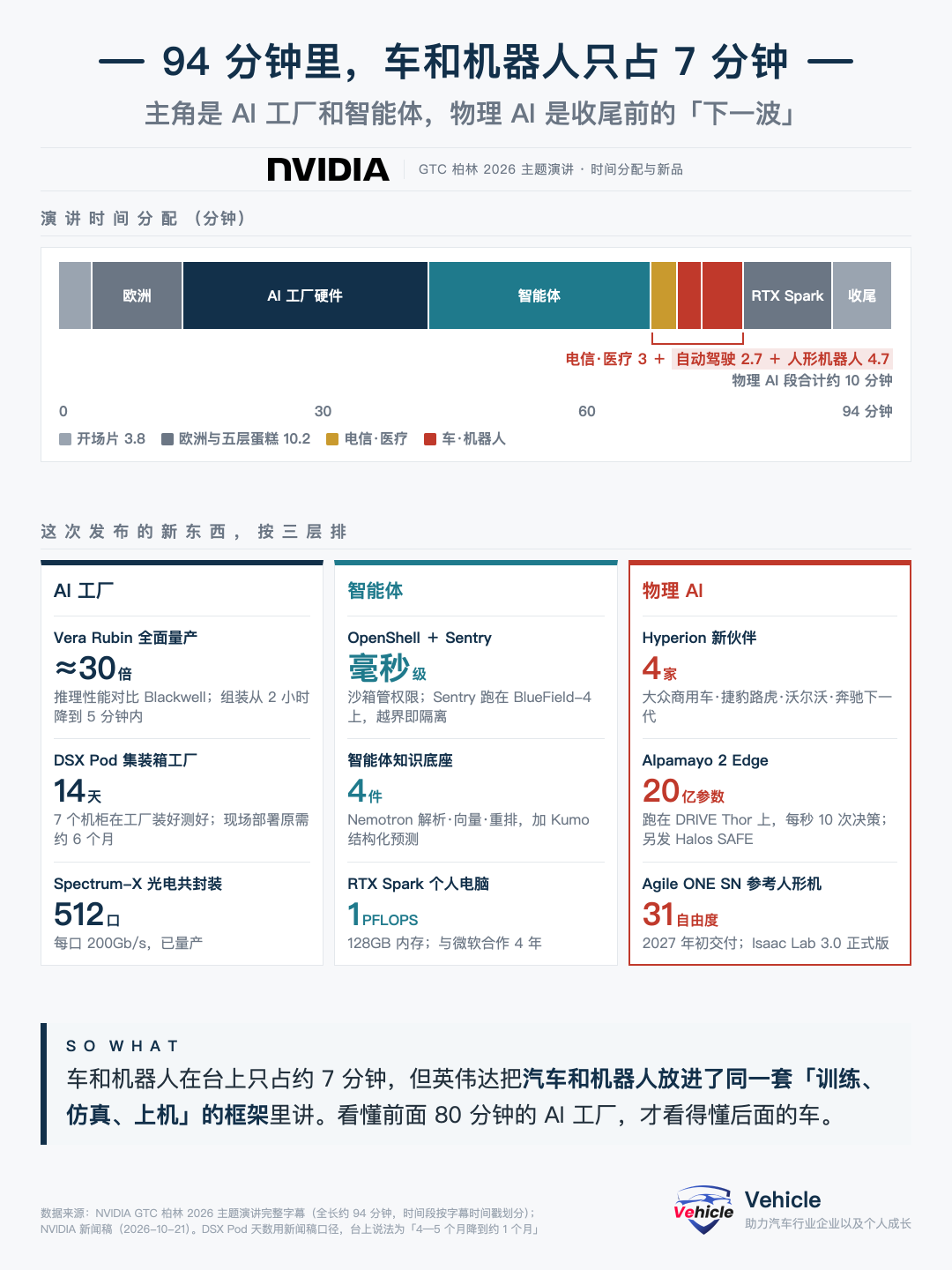
01 AI Factory Layer
Vera Rubin announced full-scale production. According to Huang, Blackwell processes large models about 30x faster than Hopper, and Vera Rubin will be another 30x faster than Blackwell two years later.
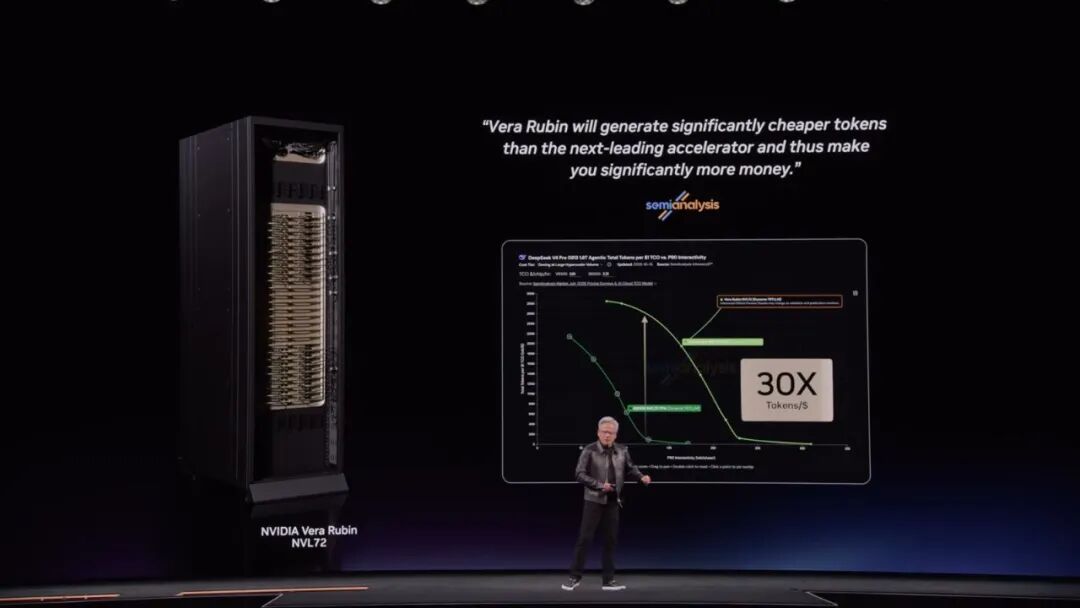
He unveiled a compute tray on stage: cable-free and 100% liquid-cooled. While previous generations took two hours to install a node, this now takes under five minutes.
The highlight was DSX Pod.
Seven liquid-cooled racks and 17 kilometers of networking cables come fully assembled and tested in the factory, then shipped in containers to deployment sites.
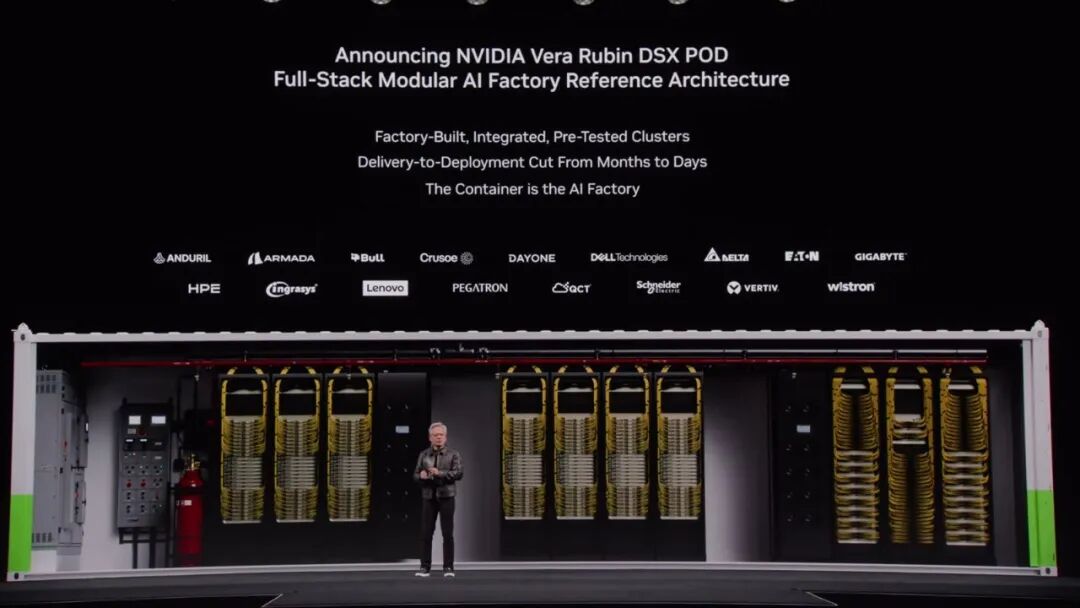
The earlier '$10 billion loss for three months' calculation paved the way for this. Press materials state deployment time shrinks from six months to 14 days once utilities are connected.
Also announced: Spectrum-X co-packaged optics switch with 512 ports at 200Gb/s each, now in mass production.
02 Intelligent Agent Layer
OpenShell is an open-source secure execution environment. It isolates each agent in a sandbox, strictly controlling which files it can access and websites it can connect to through system-level policies.
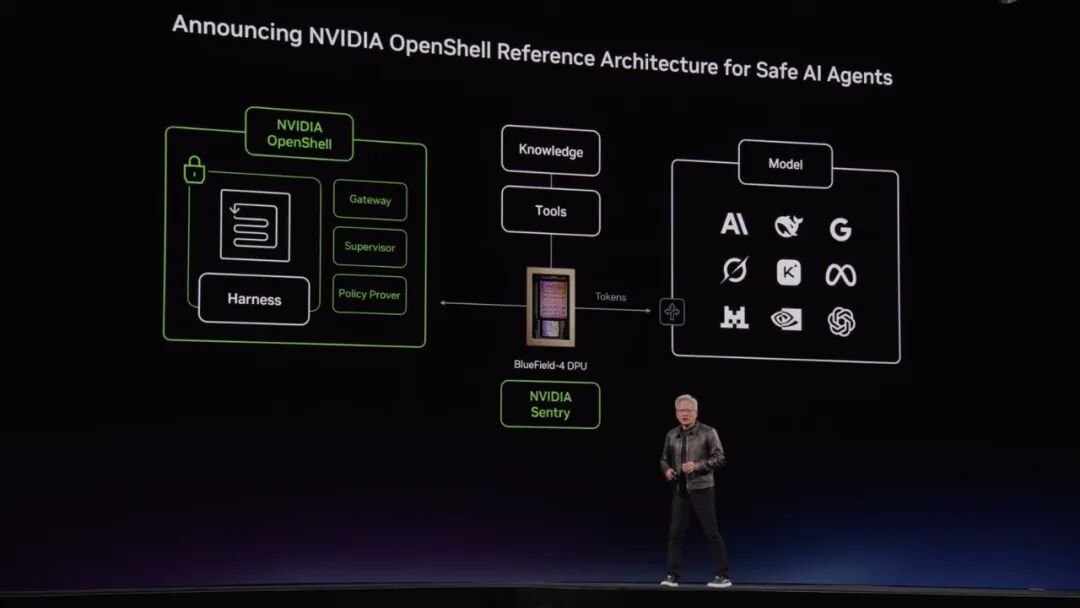
The promotional video put it humorously: 'The only way to stop agents from misbehaving now is politely asking them, 'Please don't delete things.''
Sentry adds a second layer of security, running on BlueField-4 to cut off model connections within milliseconds when boundaries are crossed.
Also introduced: An 'intelligent agent knowledge foundation' including document parsing, vector retrieval, result reranking, and Kumo for structured prediction.
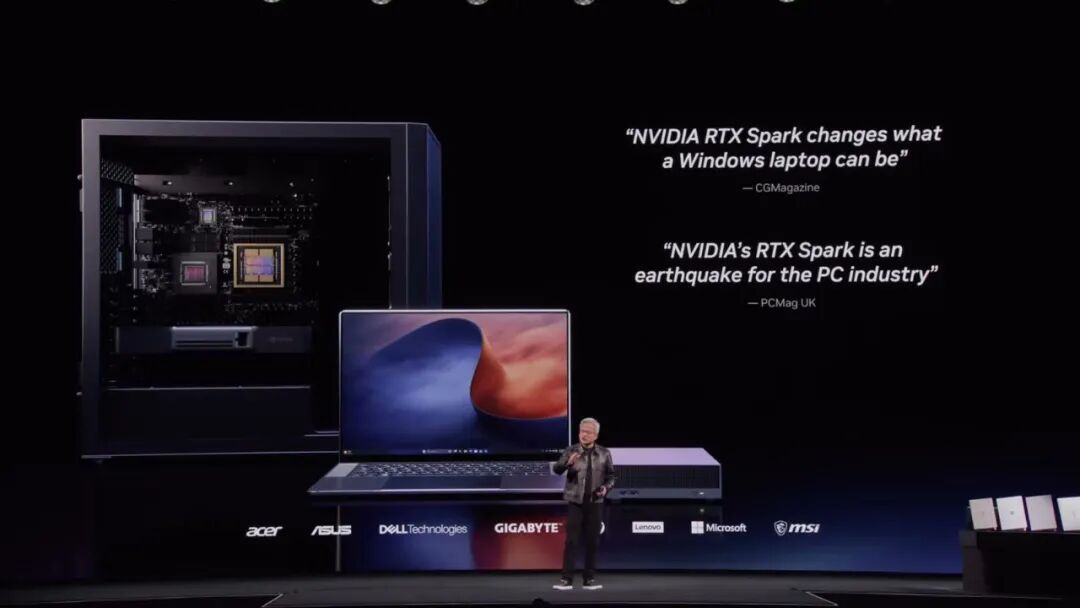
Finally, RTX Spark, developed with Microsoft over four years.
A handheld computer with 1 PFLOPS compute and 128GB memory.
Huang noted that in 2016, he gave OpenAI a DGX-1 with similar specs that required two people to carry upstairs.
03 Physical AI Layer
Looking back, the first two layers represent NVIDIA's core strengths, while the third represents its next bet.
For the remaining sections, I'll focus on this third layer.
03 Autonomous Driving: Standardizing Robotaxis
The Hyperion logic and a trillion-mile calculation
During his three minutes on vehicles, Huang opened with a bold claim:
Every single car company will want to make their cars part of the ride-hailing fleet.
- Jensen Huang, GTC Berlin Keynote
Today's ride-hailing platforms include Uber, Bolt, Grab, and Lyft. Future robotaxi fleets won't come from just one brand.
The challenge: Software represents the most expensive part of autonomous vehicles. With each automaker using different sensors, software must be individually tuned for each.
NVIDIA's solution: Standardize sensors and computers into one architecture called Hyperion.
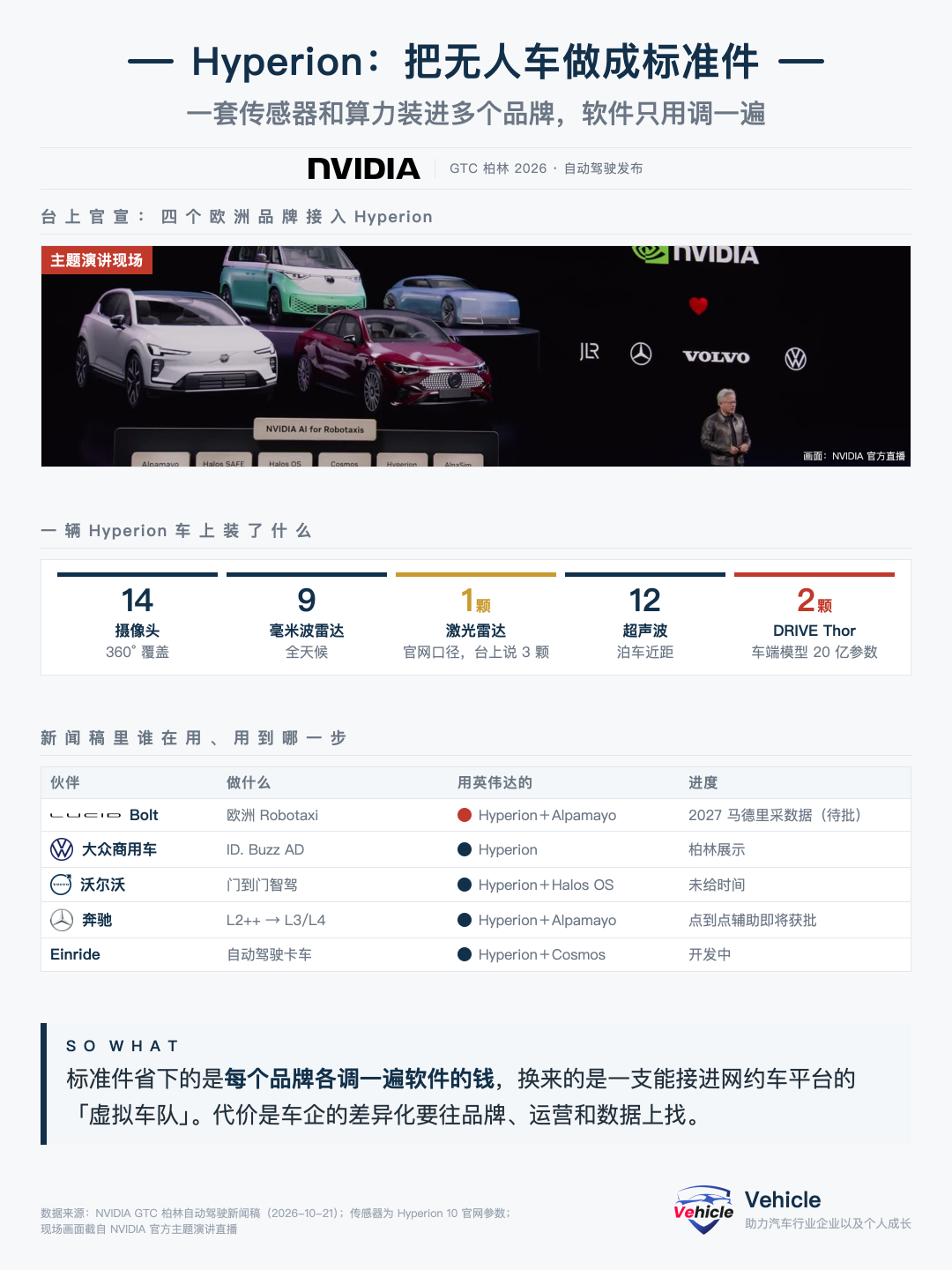
A Hyperion vehicle packs 14 cameras, 9 millimeter-wave radars, 12 ultrasonic sensors, plus two DRIVE Thor chips.
One clarification on LiDAR: The presentation mentioned three units, while Hyperion 10's official specs list one. This article follows official documentation.
With standardized hardware, software needs only one development cycle for multiple brands—similar to Android's smartphone strategy.
Four newly announced brands using Hyperion: Volkswagen ID. Buzz van, new Jaguar Land Rover models, Volvo, and next-gen Mercedes-Benz.
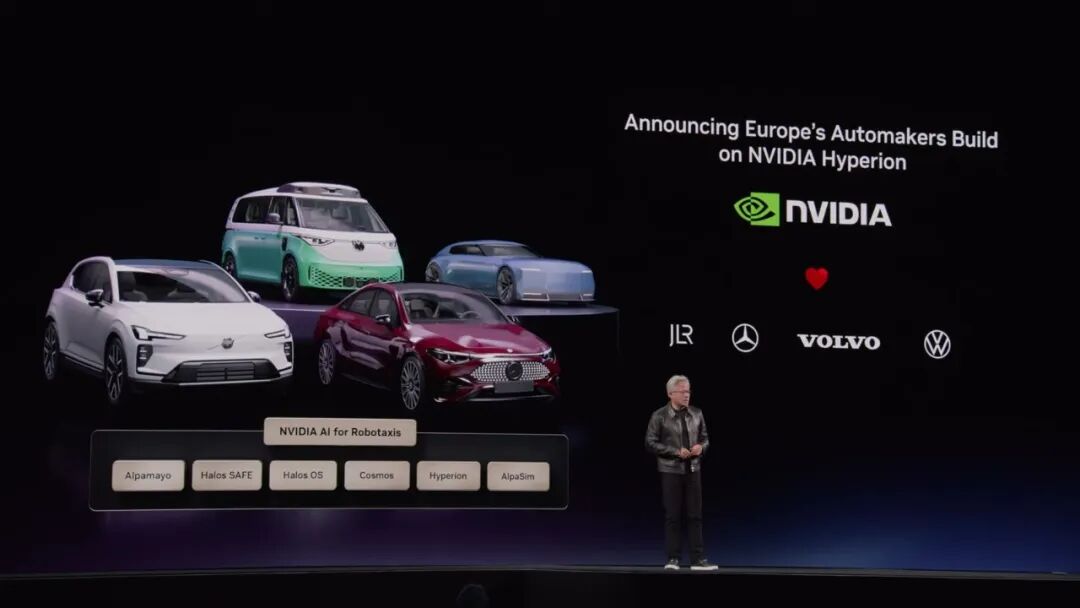
Jaguar Land Rover appears in Halos SAFE's ecosystem without a separate Hyperion vehicle project. Two other partners:
Einride uses Hyperion for next-gen autonomous trucks
TIER IV and Technical University of Munich plan Germany's autonomous buses using it
Aptiv, Valeo, and Schaeffler build Hyperion-based compute platforms for automakers' Level 4 systems
01 This PPT slide features many Chinese names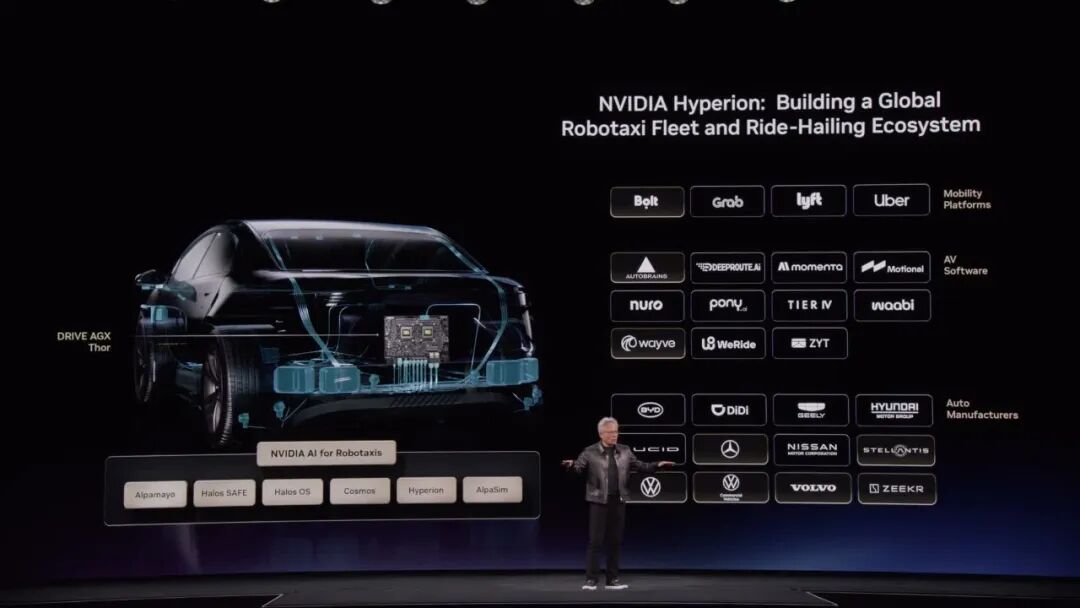
Keynote visual: Hyperion's global robotaxi ecosystem (Source: NVIDIA official livestream)
Partners are organized into three tiers: mobility platforms, autonomous driving software, and automakers.
The software tier includes Momenta, Yuanron, Pony.ai, and WeRide. The automaker tier lists BYD, Geely, Zeekr, and Didi.
This confirms NVIDIA's 'standardized components' approach isn't limited to Europe. Chinese automakers and self-driving companies are already integrated.
02 The trillion-mile calculation
How big is the opportunity? Huang multiplied: The world drives ~1 trillion miles annually, with many expected to shift to robotaxis at $1-2 per mile.
For context, the U.S. Federal Highway Administration reports over 3 trillion miles driven annually in America alone.
Thus, mileage itself isn't the variable. The real question is whether autonomous vehicles can reduce per-mile costs below $1-2.
Standardized components aim to solve this cost challenge.
One hardware suite, multiple automakers, one virtual fleet—this is NVIDIA's robotaxi roadmap.
04 Progress Varies by Timeline
Many announcements, few immediate deployments
The onstage narrative sounded ambitious. However, cross-checking press materials with Källenius's statements reveals significant timeline variations.
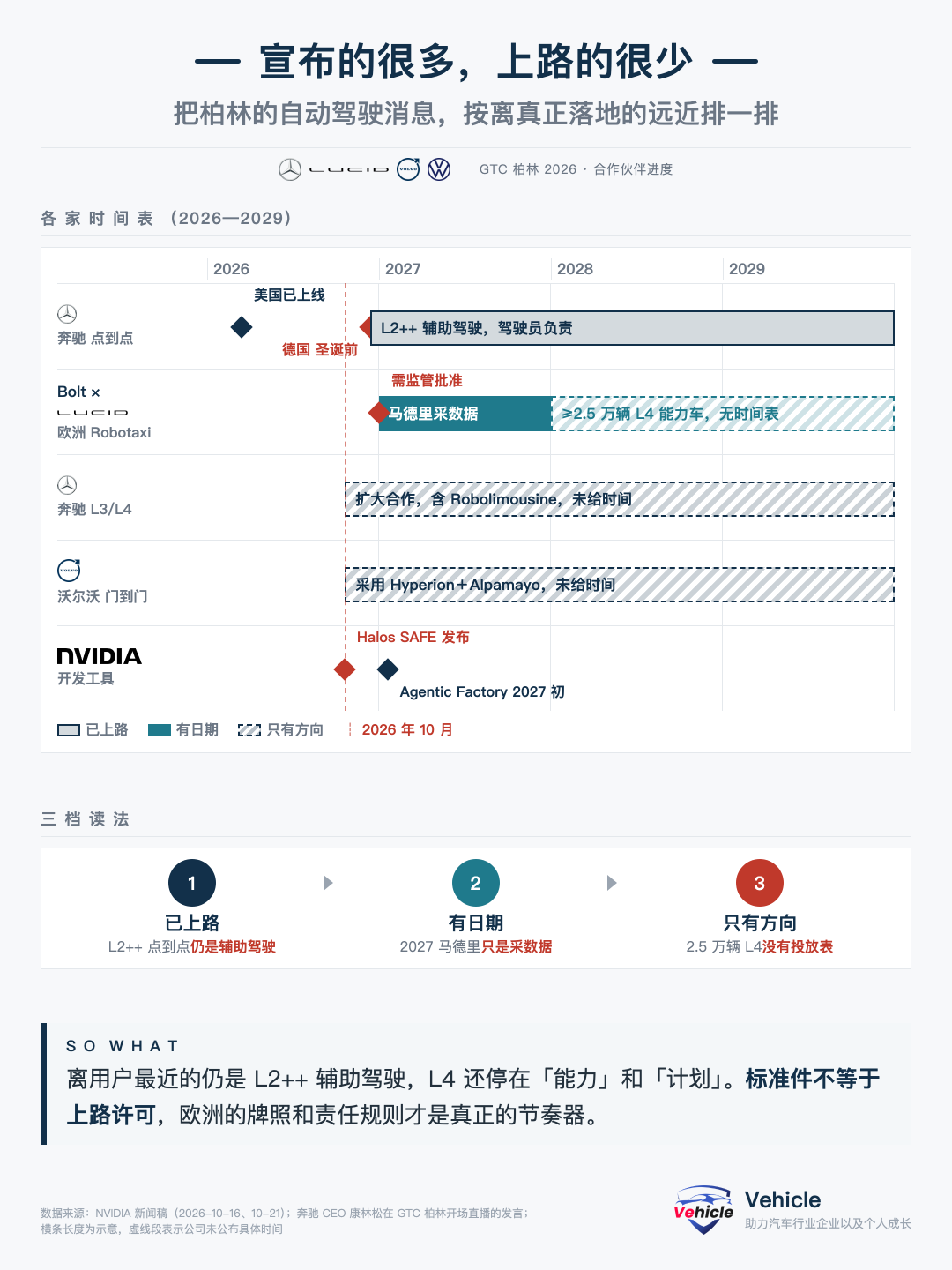
01 Tier 1: Already on the Road, Still Driver Assistance
The fastest is Mercedes-Benz. In the opening livestream, Ola Källenius said that point-to-point navigation-assisted driving was launched in the U.S. earlier this year, will be available in Germany before Christmas, and then rolled out across Europe.
He described it as Level 2++. The driver remains responsible throughout—this is not self-driving.
02 Tier 2: Dated, But Just Data Collection
Bolt selected NVIDIA's Alpamayo software, initially for Lucid's upcoming Hyperion-based vehicles.
The plan is to deploy at least 25,000 L4-capable vehicles in Europe, with Germany as the priority market.
But the first step is real-world data collection starting in Madrid in 2027, pending regulatory approval.
03 Tier 3: Only a Direction
Mercedes-Benz expanded its NVIDIA partnership to L3 and L4, including a Robolimousine. Volvo adopted Hyperion, Halos OS, and Alpamayo, targeting door-to-door operation.
Neither provided a timeline.
When asked in the livestream, “When will we have our own self-driving cars?” Källenius said, “Of course, it’s happening,” and suggested roughly the same timeframe as home robots.
The “three to five years” figure was added by the host.
Note: The 25,000 vehicles, L3/L4, and door-to-door are all partnership plans, not deployment timelines. Use precise wording when citing.
Standard components ≠ road approval—European licensing and liability rules are the real pace setters.
05 Safety Requires Evidence
Halos SAFE and a Full Data Factory
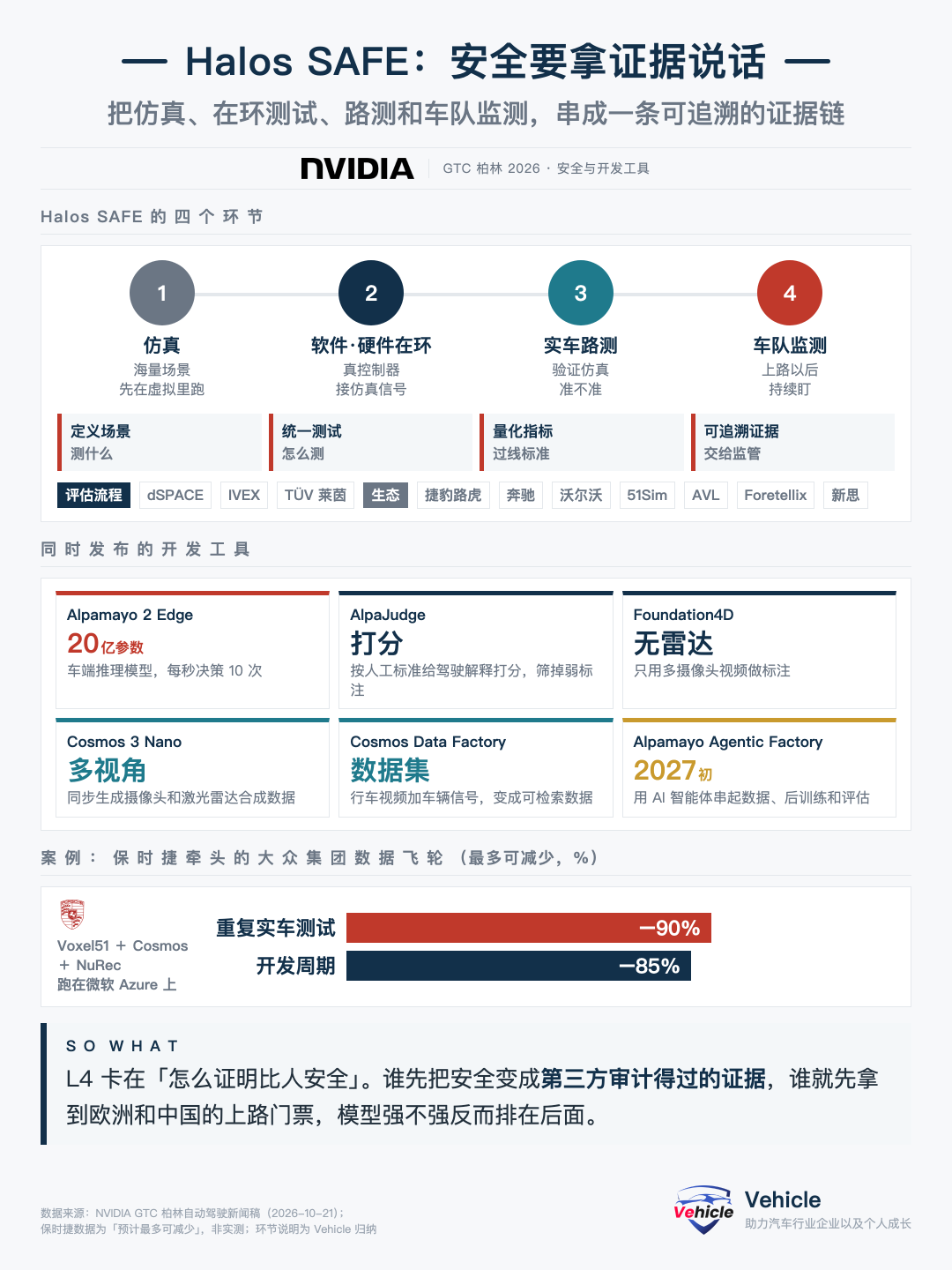
For vehicle discussions, the most valuable part isn’t new brands—it’s Halos SAFE.
Its full name is the Safety Assessment Framework.
The approach links four stages: simulation, software- and hardware-in-the-loop testing, real-world road testing, and fleet monitoring post-deployment.
Every scenario’s definition, testing method, and pass/fail criteria must be quantifiable and traceable, forming an evidence chain for regulators and insurers.
Assessment partners include dSPACE, IVEX, and TÜV Rheinland. The ecosystem also features Jaguar Land Rover, Mercedes-Benz, Volvo, 51Sim, AVL, Foretellix, and Synopsys.
Why the complexity? Källenius explained in the livestream: roughly 1 million people die globally in car crashes annually, nearly all due to human error.
For L4 to go mainstream, it must prove safer than humans. Simply saying, “We tested billions of kilometers” isn’t enough—regulators want auditable evidence.
01 Supporting Data Factory
Also announced: a suite of development tools covering the full pipeline from data to deployment.
Alpamayo 2 Edge: A 2B-parameter inference model based on Cosmos, running 10x/sec on DRIVE Thor for scene understanding and motion planning.
AlpaJudge: Scores driving explanations against human standards, filtering low-quality annotations.
Foundation4D: Annotates using multi-camera video only, no lidar.
Cosmos 3 Nano: Generates synthetic multi-view camera and lidar data simultaneously.
Alpamayo Agentic Factory: Uses AI agents to link data preparation, post-training, and simulation evaluation—launching in early 2027.
A concrete case: Porsche led a data flywheel across Volkswagen Group brands using Voxel51, Cosmos, and NuRec on Microsoft Azure.
Reduces real-world testing by up to 90% and development cycles by up to 85%. Note: “Up to” refers to projections, not measured results.
Separately, Uber is building a Cosmos data factory with NVIDIA for autonomous driving data.
Model strength is one thing; auditable evidence is another. The latter determines who gets approved first.
06 Robots: Build a Reference Machine First
Replicating the Standardization Flywheel of PCs and Phones
After vehicles, Huang Renxun said the next major industry is humanoid robots—and “likely very large.”
His reasoning is the clearest logic in the event.
Robots are hard because tasks are fragmented.
Designing a unique robot for each task fragments the market, preventing technical momentum.
PCs, phones, and NVIDIA’s own NVLink 72 cabinets advanced rapidly because standardized configurations served many clients, enabling volume and scale.
Humanoids may not excel at every task but can handle many, making them the most likely high-volume robot form.
If AI learns fast enough, SMEs without robotics teams could “demonstrate tasks to robots” for self-learning.
He also told the European audience no region has invested as deeply in mechatronics as Europe.
01 What Agile ONE SN Looks Like
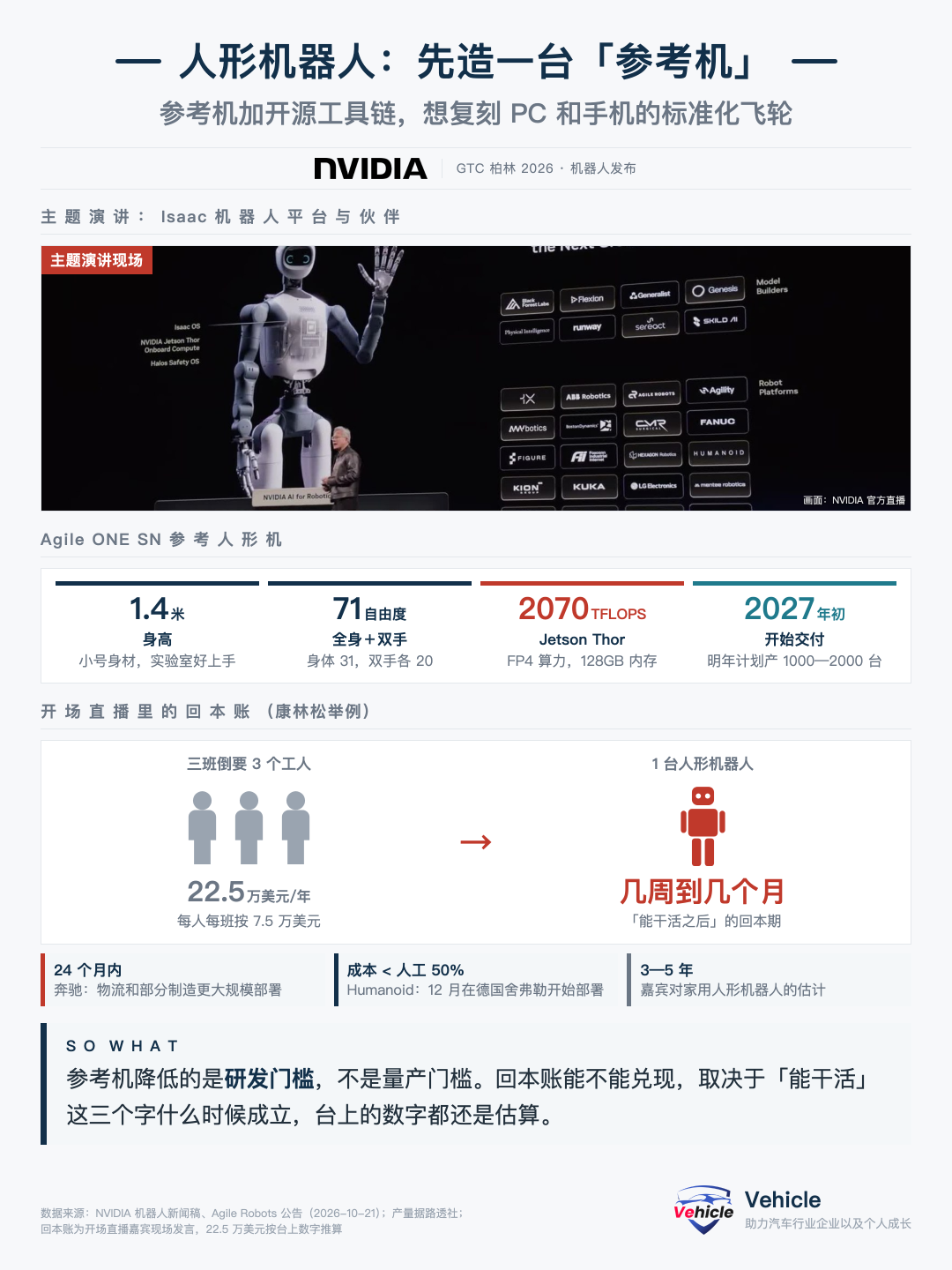
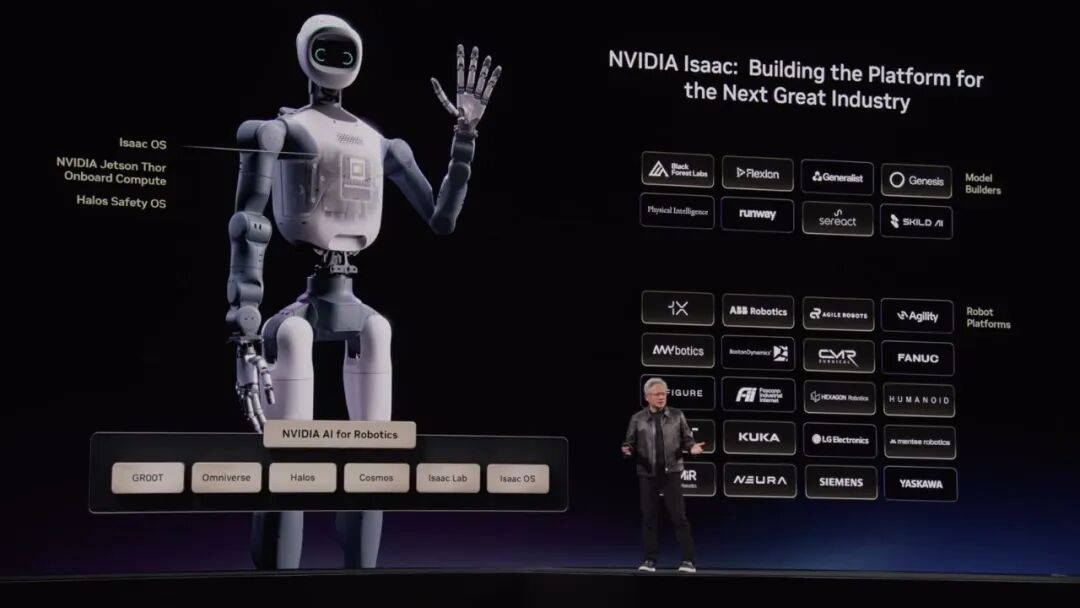
Just as vehicles need Hyperion (“the third computer”), robots need a reference machine. NVIDIA doesn’t want every team to assemble software, computers, sensors, and mechanics from scratch—that takes years.
So it partnered with Munich’s Agile Robots to create Agile ONE SN, a reference humanoid.
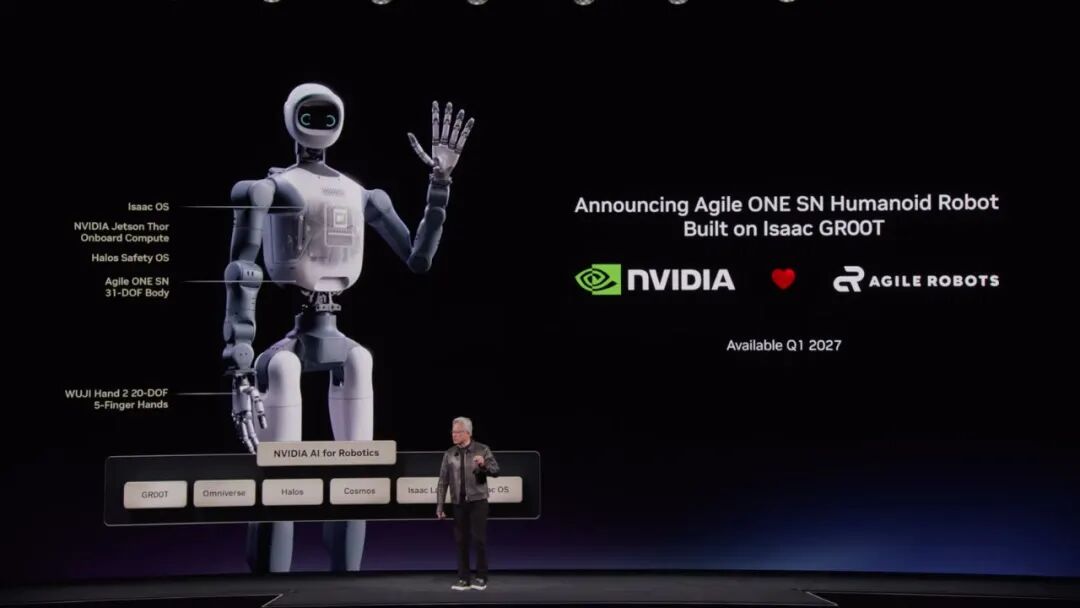
Height: 1.4m, 31 degrees of freedom in the body, 3kg load per arm.
Hands: WUJI five-finger dexterous hands, 20 degrees of freedom each, tactile feedback, totaling 71 degrees of freedom.
Onboard: Jetson Thor with 2070 TFLOPS (FP4), 128GB memory.
Preloaded: GR00T model and full workflow from demonstration capture, simulation, training, to deployment.
Deliveries start early 2027; Stanford and ETH Zurich are interested.
Agile’s CEO Chen Zhao Peng told Reuters they plan to produce 1,000–2,000 units next year for universities and corporate R&D.
Also included: Isaac OS runtime, Isaac Lab 3.0, 2,000+ simulation assets, and the Human 1M human motion dataset. Schaeffler contributed actuator tech as the foundation for the Newton physics engine.
02 The Little Ducks Onstage
The final demo was intriguing: an agent on an RTX Spark laptop planned a site, built a 3D model, created a simulation scenario, sent Hugging Face’s Microduck micro-robot to cloud training, and deployed the learned strategy back.
Four “little ducks” then took the stage, sitting, standing, and napping. Huang noted Pollen Robotics, the maker, has about 10 people and is already sold out.
The point: robot training is shifting from team-sized efforts to a laptop + agent.
03 ROI Estimates: Take with a Grain of Salt
In the livestream, guests calculated robot economics:
Humanoid’s CEO: Deployment starts at Schaeffler Germany in December, running 16 hours/day; robot cost per hour is <50% of labor, with ROI <1 year.
Källenius: A worker costs $75,000/year per shift; a humanoid can work three shifts, with ROI measured in weeks or months “once operational.”
Mercedes-Benz’s new Hungary factory already pilots humanoids in logistics; larger logistics and manufacturing deployment expected within 24 months.
These are onsite estimates. The “once operational” premise (prerequisite) is the hardest part.
The reference machine lowers R&D barriers but is still far from mass production.
07 Implications for Domestic Players
Three Observations for Reference
Based on GTC content, my takeaways:
01 Automakers: Differentiation Moves Upstream
If sensors and computers become commodities, hardware gaps between automakers will shrink.
Differentiation will split two ways: brand, cabin experience, and operations; versus proprietary data and models.
This aligns with Huang’s point on agents: models are purchasable, but knowledge and tools are yours.
02 AD Companies: From Algorithms to Evidence
Once frameworks like Halos SAFE become standard in Europe, exporters must offer more than flashy demos.
Domestically, GB 44721—2026 governs L3/L4 safety, taking effect July 1, 2027. Evidence chains are a shared challenge.
03 Robot Companies: Reference Machines Are Competitors and Ecosystems
Reference machines + open toolchains lower humanoid robot barriers, attracting new players.
For domestic incumbents, this means competition but also standardization of data formats, simulation assets, and training pipelines. Early integration is cheaper than building alone.
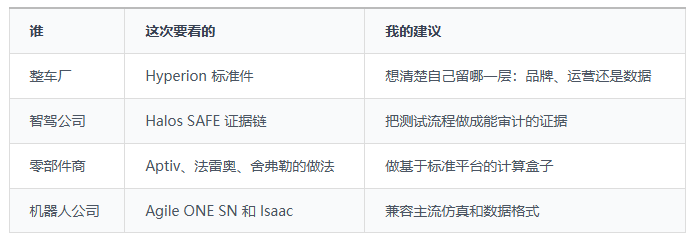
In the era of standard components, the most valuable parts are those that can’t be standardized.
08 Final Notes
Takeaways to Contextualize
The event was information-dense, but NVIDIA’s strategy is clear: from AI factories to agents to vehicles and robots, it’s standardizing every layer to become the platform others build upon.
For automotive, this means hardware homogenization, with competition shifting to data, evidence, and operations.
That’s it for today. If useful, please like, share, and comment—and share your thoughts below.
References & Images
NVIDIA Berlin GTC Keynote PDF
*Unauthorized reproduction or excerpting strictly prohibited-
-
![]()
Post-National Day Sales of Xiaomi Revealed, Netizens: Pengcheng's Sales Take a Dive!
-
![]()
Understanding NVIDIA GTC Berlin at a Glance: AI in Manufacturing, Physical AI, and Three Key Strategies
-
![]()
Final Verdict: Can Battery Swapping Become the Mainstream Energy Replenishment Approach for Electric Vehicles?
-
With a 350,000-Yuan Budget for a Luxury Off-Road SUV, Is the 2027 Tank 500 a Wise Purchase?
-
![]()
Why Are Interpersonal Relationships Emerging as a Business Superpower in the AI Era?
-
![]()
Hot Topic | Microsoft's 2nm Self-Developed Chip Hits Third Iteration, Shifting Inference Workloads Away from NVIDIA
-
DeepSeek Inches Closer to the Largest IPO Financing in Chinese History
-
![]()
Lei Jun Reiterates the Centrality of Safety: In the Auto Industry, Safety Underpins All Else