Hundreds of Billions Fully Invested in AI, Yet No Returns in Sight
 10/26 2026
 517
DeepSeek has successfully secured an additional 100 billion yuan in funding. This financing round, which established a domestic record for single-round AI investment, was spearheaded by Tencent and CATL—Tencent, a key player in China's mobile internet landscape, and CATL, the reigning leader in new energy vehicle batteries. This news has sparked widespread discussions about "industrial capital's full commitment to AI."
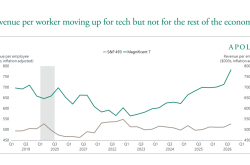
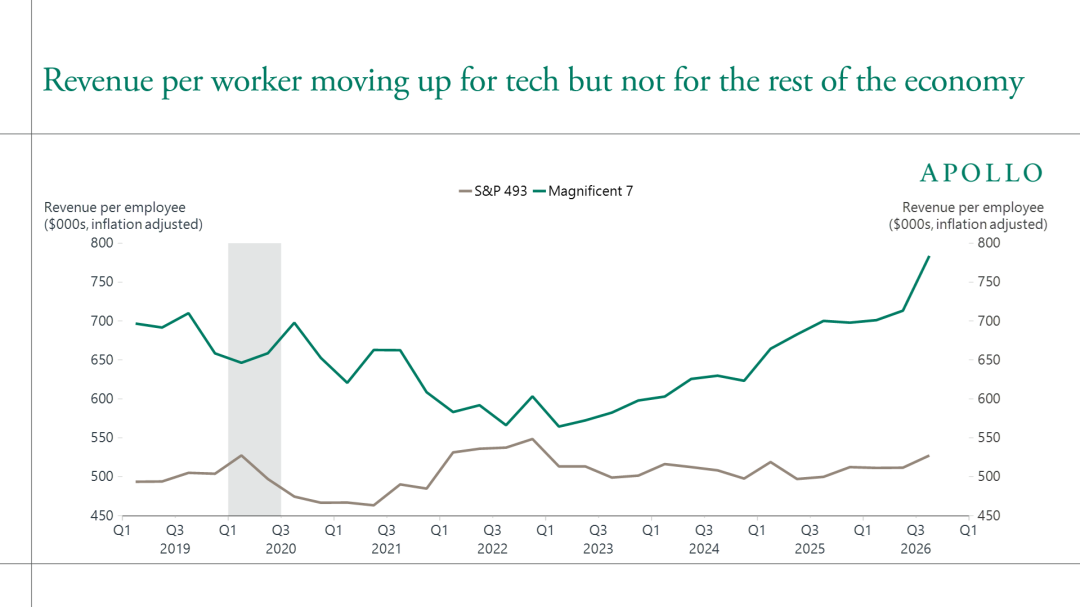
However, almost concurrently, Apollo's chief economist Torsten Slok unveiled a contrasting set of data: Excluding tech behemoths, AI's financial returns for U.S. companies are negligible. Across 493 non-tech S&P companies, revenue per capita, profit margins, and total factor productivity have all remained stagnant. The substantial investments made have yielded no discernible results.
On one hand, there's a hundred-billion-yuan arms race in computing power; on the other, a verdict of "zero economic returns from AI." These two contrasting scenarios coexist, marking the most paradoxical moment for capital and technology in 2026.
Hundreds of Billions: Who's Footing the Bill?
DeepSeek's current funding round surged from an initial target of 50 billion yuan to nearly 100 billion yuan, with a pre-money valuation hovering around 500 billion yuan. Over two rounds within a mere six months, it has absorbed over 150 billion yuan in capital.
Tencent has made significant investments in two consecutive rounds (10 billion yuan in the first round, with additional stakes in this round), aiming to secure priority access to ecological entry points. When WeChat, gaming, or cloud businesses require model integration, Tencent ensures it's at the forefront. CATL, on the other hand, has upped its investment to around 10 billion yuan, but with a different strategy in mind: leveraging data center electricity costs, energy storage arbitrage, and direct green power supply to integrate the largest cost component of computing power—electricity—into its business portfolio.
One entity manages digital traffic, the other manages electrical power. Their bets may not be on large models per se but on securing strategic positions within the "computing power infrastructure." SMIC Poly Capital (backed by SMIC), Shixi Capital (backed by GigaDevice), and Geely have also joined the fray, as chip manufacturing and the automotive industry's demand for computing power create a virtuous cycle.
The destination of this colossal investment is clear: DeepSeek plans to construct a data center in Ulanqab, Inner Mongolia, deploying at least 160,000 Huawei Ascend chips—marking the first use of domestic computing power for cutting-edge model pre-training. Liang Wenfeng himself dubs it "the biggest gamble."
The notion that "we've never lacked money" no longer holds true. Previously, the company's primary concern was the embargo on high-end chips; now, the financing logic has shifted. Since the most advanced chips are unavailable, massive capital is being used to construct a domestic computing power ecosystem. Money has become a weapon to counteract sanctions.
The Economy Has Yet to Reap the Benefits
Apollo's report presents a sobering assessment of this AI investment wave, with four charts each pointing to the same conclusion: AI has not delivered tangible output.
Revenue per capita for the S&P 493 (excluding the Mag 7) has long plateaued between 450-550, while the Mag 7 approaches 800. Profit margins have flattened for the former and risen for the latter. Productivity growth—whether measured by total factor productivity or output per hour—shows no signs of being propelled by AI.
Even more concerning is the distribution of spending. Model services and inference account for 99.5% of expenditures among the top 10% of enterprises. For OpenAI + Anthropic's clients, the top 10% account for 95.6%. Among companies in the top 1% of AI spending, 80.4% have venture capital backgrounds, while VC accounts for only 13.1% of median-spending clients.
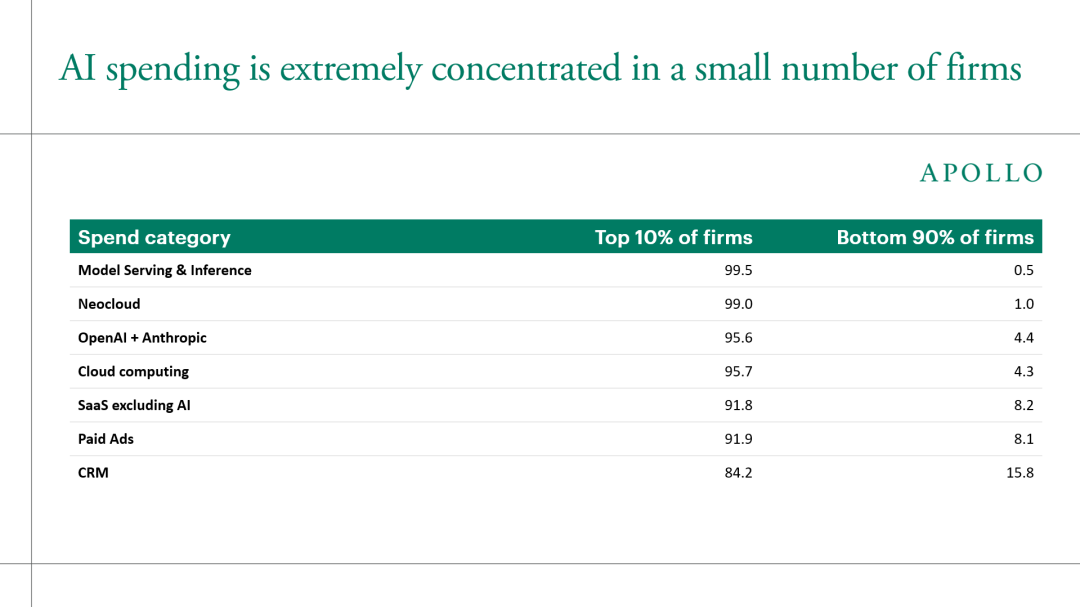
A significant portion of AI spending is VC money circulating within its own ecosystem—reminiscent of the subsidy-burning bike-sharing craze of yesteryear, vibrant in apps but devoid of real financial substance.
Torsten Slok succinctly summarizes the situation: Mainstream companies are redefining token spending from a "source of growth" to a "cost center eroding profits." They neither need the latest models nor are they willing to pay a premium for them.
The AI Graveyard Is Filling Up
Foreign media has already erected a metaphorical tombstone for this frenzy, dubbing it the AI Graveyard. According to S&P Global Market Intelligence, approximately 42% of corporate AI projects are ultimately abandoned by their parent companies due to insufficient financing, technical hurdles, competition, scalability issues, or weak demand.
Even the industry giants are scaling back. OpenAI scrapped its video platform Sora due to high operational costs and low user retention. The browser Atlas was merged back into ChatGPT within a year. Operator and DALL-E were similarly folded into the main app, while the "super app" redesign was rolled back due to user backlash.
Below them lies a long list of failed ventures: Relay, a Zapier alternative, was crushed by established platforms. Phind, a rebranded clone, shut down a month after funding. Tome, a PPT tool, boasts 20 million users but only $3 million in annual revenue. Hardware pioneer Humane AI Pin raised $230 million but was acquired by HP for $116 million. Yupp burned through $33 million, Figgs AI couldn't survive on free tiers, and top companion app Character.ai went bankrupt. The "graves" in the AI Graveyard continue to multiply.
Domestically, the cleanup is also underway: At least 25 Chinese AI apps halted operations, were delisted, or ceased updates in 2025 alone. Overseas, the AI Graveyard tracked 392 global AI tools that ceased services. Tencent Yuanqi, QClaw, Doubao, and Qianwen's self-built agents were shut down or taken offline. Unified Enterprise Services merged into an "office" agent.
When giants integrate capabilities into their own products, startups lack a competitive edge. This AI death list mirrors those of the bike-sharing and community group-buying sectors.
Self-Driving Technology: A Cautionary Tale
The list of self-driving exits from 2019-2026 serves as an effective autopsy report of AI's first full industry cycle. Drive.ai, Starsky Robotics, Uber ATG, Argo AI (Ford and Volkswagen withdrew funding, causing a cash crunch), lidar leader Velodyne (product redundancy), TuSimple (technical commercialization difficulties + geopolitical pressure + internal mismanagement, delisted), Luminar, Jingchi Technology (three failed IPOs), HoloMatic, QianGua Technology, QingTian Zhika... The causes of death are strikingly similar: financing ruptures, commercialization challenges, slow technical iteration, and tight capital chains.
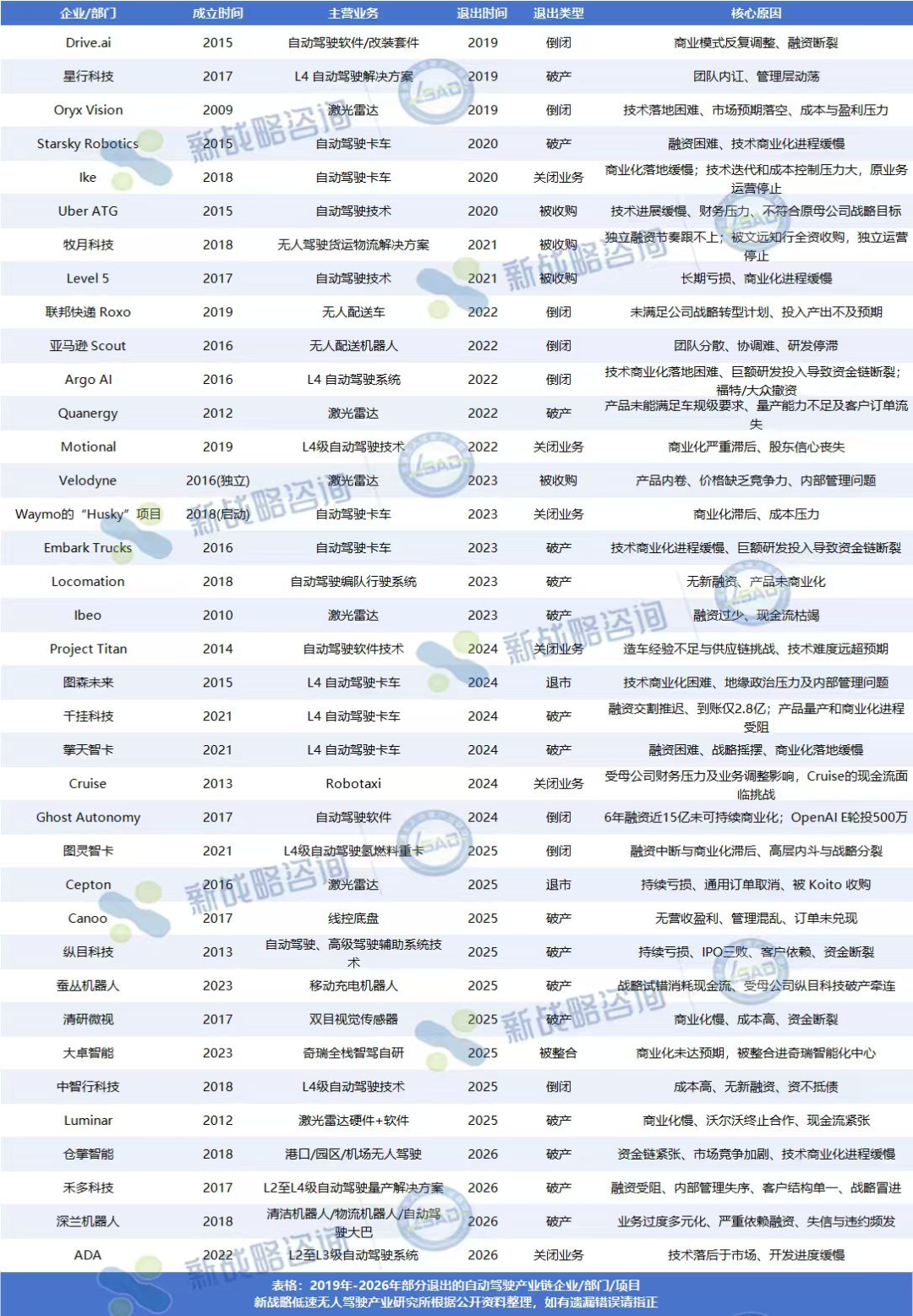
These weren't small-scale operations. Argo AI was backed by Ford and Volkswagen; Velodyne was once the industry leader; TuSimple was the "first self-driving truck stock." Yet, commercialization never materialized, and when capital markets tightened, they collapsed. Over eight years, self-driving technology proved with a list of over 40 exits that technical viability doesn't guarantee commercial success.
Today's general-purpose large models are reliving self-driving's 2019-2021 hype and 2022 retreat—just on a grander scale, burning money faster, and at a more alarming magnitude.
Embodied AI: The Next Bubble?
The same script is already being rushed onto the stage. In August, DeepSeek invested 141 million yuan in Unitree Robotics, and Liang Wenfeng is set to lead investment in humanoid robot company Winverse AI. Embodied AI stands where self-driving did: hot financing, premature valuations, and distant commercialization.
Robots burn money faster than self-driving vehicles—hardware, supply chains, mass production, and scenarios are all money pits, and no company has yet cracked a sustainable business model. Worse, they share the same lifeline as large models: capital. If this computing power arms race cools first, embodied AI will be the first to feel the chill of funding cuts. It doesn't even need to become the next self-driving bubble—just following the same path will suffice.
All in AI, or All in the 'Base'?
Returning to the initial question: Do Tencent and CATL's heavy investments signify that the mobile internet and new energy vehicles are fully committing to AI?
My verdict: No. Both sectors are at peak maturity—mobile internet growth has plateaued, and new energy vehicles face overcapacity. Both are searching for the next certainty of growth. AI, especially computing power, is currently the closest thing to "infrastructure" in capital's eyes. So, what they're fully committing to isn't AI applications but AI infrastructure: one wants traffic entry points, the other wants electricity—both are about securing strategic positions.
The truism that "risks and opportunities coexist" plays out concretely here: The opportunity lies in DeepSeek potentially using hundreds of billions to build a domestic computing power ecosystem, integrating chips, energy, models, and applications into an infrastructure revolution more fundamental than the mobile internet. The risk is that if this investment yields no results, like self-driving, the collapse of a hundred-billion-yuan bubble will dwarf the impact of self-driving's failures.
The AI story's ending isn't written in the Mag 7's earnings reports or funding news—it's written in the profit margins of the S&P 493. Only when the economy truly absorbs AI's money will it count. Until then, this hundred-billion all-in is more a gamble on the future—a win makes it infrastructure; a loss makes it a tombstone. The AI Graveyard's list keeps growing.
-
![]()
Annual Production Capacity in Phase I to Hit 50,000 Units! Weijing Optics Unveils Mudanjiang Production Base
-
![]()
Net Profit Loss Shrinks by 35.52% in First Three Quarters of 2026, Yet Costar’s Stability Remains Elusive
-
![]()
Massive Exchange Losses! Lens Technology’s Profits Plummet in First Three Quarters—Will the iPhone Duo Mark a New Turning Point?
-
![]()
2026 World Intelligent Connected Vehicles Conference: Transitioning from Spec Benchmarking to Safety Benchmarking, the Industry Steps into a New Era of Regulatory Oversight
-
![]()
Hundreds of Billions Fully Invested in AI, Yet No Returns in Sight
-
![]()
ByteDance's Automotive Ambitions Come to the Fore
-
![]()
$12.9 Billion: Nvidia Buys an 'Insurance Policy'
-
![]()
iPhone Duo: Is It a Thorn in Ternus's Side?