The 1-Cent Computing Power Era Arrives: When Li Jiaqi Starts Selling Tokens, AI Is Completely Transformed
 11/04 2026
 451

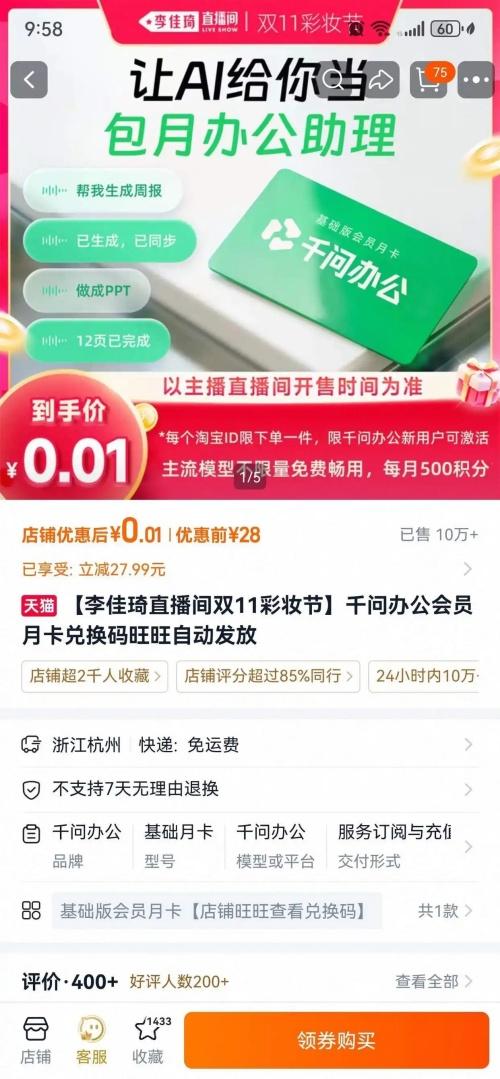
On the evening of November 2, Li Jiaqi's livestream welcomed a new Double 11 hit — Qwen Office Tokens. Within just half an hour of sales beginning, 100,000 Qwen Office personal membership monthly cards were sold, totaling about 2 trillion Tokens.
To be precise, what Li Jiaqi's livestream sold was the Qwen Office personal membership monthly card, originally priced at 28 yuan, offered in the livestream for only 1 cent, limited to one per person. Nearly 100,000 were sold in half an hour, corresponding to about 2 trillion Tokens' worth of call quota, with actual receipts of about 1,000 yuan. This is a 1-cent customer acquisition campaign — completely different from stockpiling tissues.
Li Jiaqi's livestream sold 2 trillion Tokens in half an hour. On the surface, it is eye-catching sales data, but in reality, it is a landmark move by Alibaba to push AI services from B-end technology procurement into C-end consumer mindset, accelerating the transformation of computing power services into everyday digital consumer goods similar to cloud storage memberships and video memberships.
A brief introduction to Tokens, also called word units, which are the unit of measurement for large models' work. When you chat with AI, write copy, make tables, or generate images, every question and every output consumes Token quota. Tokens are equivalent to traffic in the AI world, and 1 Token is approximately equal to 1.5 Chinese characters. When the quota is exhausted, AI cannot continue to provide the corresponding services, and new quota can only be used after recharging.
In summary, Li Jiaqi's livestream selling Tokens conveys three signals:
1. The commodification of AI services has entered deep waters
This Double 11, Tmall for the first time set Tokens as an independent category, with Zhipu, MiniMax, DeepSeek and other vendors collectively entering the AI space station, and JD.com also opened an AI software recharge hall. Li Jiaqi's livestream is the climax of this chain, translating the billing unit that only developers understood into "1 cent to use AI for a month," allowing ordinary consumers to stockpile computing power in the livestream for the first time.
2. Alibaba's ecosystem approach: models → applications → shelves → hardware fully connected
Upstream Qwen models, midstream Qwen App/Qwen Office, downstream Taobao Tmall livestream entrance, plus bundled sales of hardware such as AI computers and listening cards — Alibaba is using e-commerce traffic to pave a complete path for AI from technology to consumption. Qwen Office's user number exceeded 30 million in its first month online, and this livestream is a key step in pushing promotion from experience activities to paid conversion.
3. The real test is yet to come
The popularity of 1-cent customer acquisition does not mean that the C-end business model of buying Tokens by usage has already been proven. On the one hand, Tokens expire, vendors' standards are not unified, and whether users will stay after renewal returns to the original price are all unknowns. On the other hand, the trend of user stratification is gradually emerging: ordinary individual users continue to use free quota, heavy office users buy membership quota, and developers and enterprises go through API usage-based procurement.
In my view, Li Jiaqi selling Tokens has far greater market enlightenment significance than sales significance. It marks that AI is transforming from a geek toy into an off-the-shelf commodity, and it is a milestone-style communication for AI moving toward mass consumption. However, whether users are willing to continue paying and whether Tokens can become daily consumer goods like phone bills still need time and product strength to verify.
For the industry, this move is more like a collective trial. Alibaba, JD.com, and ByteDance are all competing for AI consumption entrances through different paths. Whoever can turn the first taste into a long-term habit will truly reap the dividends of the Token economy. What do you think?
-
![]()
Up Over 13%! Memory Giant Boosts Buyback to as Much as 5 Billion Yuan
-
![]()
The 1-Cent Computing Power Era Arrives: When Li Jiaqi Starts Selling Tokens, AI Is Completely Transformed
-
![]()
Yonyou Shifts to Enterprise AI: AI Revenue Soars 275% YoY — Can It Escape the Loss Trap?
-
![]()
Revenue Drops 40%, Gross Margin Holds at 22.55%: Seres' Mixed Q3 Report Card
-
![]()
Metal Film vs. Dielectric Film: The Selection Logic for AR Waveguide Reflective Coatings
-
![]()
Apple 'Wins Without Trying' Against NVIDIA
-
![]()
Nut Pandownload Ownership Change: The Logic of Large-Screen Projectors Replacing TVs Is Failing
-
Thanks to Chinese Support, Apple's China Revenue Surges 21%, with Revenue and Profit Hitting New Highs Again