"Unprofitable" Token Economy: 2 Trillion Sold in Half an Hour, Daily Average Consumption Grows 5,000-Fold
 11/10 2026
 458
New Game
Token prices have fallen yet again.
In its latest research report, Daiwa noted that since August of this year, the industry's Token price index has fallen by roughly 25% cumulatively. The decline among overseas leading large-model providers is especially striking, with OpenAI and Anthropic cutting their comprehensive list prices by 31% and 47%, respectively.
Meanwhile, Li Jiaqi's livestream added Token to the "little yellow cart," selling 2 trillion in just half an hour. Notably, what was actually sold in the livestream was not Token itself but a Qwen basic-tier membership monthly card bundled with a fixed amount of Token—originally priced at 28 yuan, offered in the livestream for just 0.01 yuan. In other words, the total price of those 2 trillion Token came to a mere 1,000 yuan.
Almost simultaneously, JD.com listed Token packages from more than ten large models—including JD Cloud, DeepSeek, Zhipu, and Volcano Engine—in its Double 11 livestream, giving away over 1 billion Token within the first hour of broadcasting, with sales growing 20-fold hour-over-hour within two hours.
From research report data to actual sales figures, both point to the same conclusion: Token prices keep falling. Counterintuitively, however, the Token price crash is being read as a positive signal, with the industry widely believing it will mark the starting point for the true explosion of the Token economy.
Lower Prices ≠ Cheaper to Use: Total Industry Consumption Is Soaring
To explain what Token is, Chen Yusen, Vice President of Alibaba Group and CEO of the Qwen Office, offered this analogy during Li Jiaqi's livestream: "Just as driving needs gas and household appliances need electricity, the fuel that powers AI is Token. With Token, AI can work for you."
This explains the importance of Token in the AI era—and why users need to pay for it.
It should be noted, however, that Token is not purely a product of the virtual internet realm. Its production involves real floating-point computation, GPU computing power, and electricity consumption—which are also the primary basis for current Token pricing. Stanford University crunched the numbers in its "2023 AI Index Report": a single GPT-3 training run consumes 1,287 megawatt-hours of electricity, equivalent to 3,000 Teslas each driving 200,000 miles.
Today's massive Token price crash has been achieved mainly by attacking these consumption costs, and the rise of domestic large-model vendors has contributed significantly. On the one hand, domestic companies such as DeepSeek and Moonshot AI have adopted mixture-of-experts architectures and mechanisms like caching repeated content hits, greatly reducing the parameters that need to be activated during model inference and compressing computing power consumption at the root. On the other hand, a large number of domestic models are released as open source, using nearly free yet adequately capable products to force global large-model vendors into collective price cuts.
The reason is that most domestic large-model vendors never intended to make money from Token in the first place. Not only do the main profits from selling Token flow to upstream physical supply segments such as GPUs, but behind the overall downward trend of Token prices, model capabilities are gradually converging and vendors' differentiated pricing power no longer exists.
Put simply, selling Token is no longer the most profitable segment. The almost "self-destructive" price cuts by domestic large-model vendors are aimed at trading margin for a larger market.
Because if Token prices don't come down, AI's use scenarios remain fairly limited, making it even harder to embed AI in real production processes—and task forms featuring "multi-round calls and massive consumption" would never appear. After the price crash, more people can afford and access AI, and AI actually gets involved in more scenarios. This is the classic "Jevons Paradox" in economics: efficiency improvement → unit price decline → lower usage threshold → new uses flood in → total consumption soars.
According to statistics from the China Academy of Information and Communications Technology, as of June 2026, domestic daily average Token consumption had reached 500 trillion, whereas at the beginning of 2024 this figure was still in the hundreds of billions—an overall increase of roughly 5,000-fold.
More importantly, the Token price crash only creates the psychological impression that using AI seems cheaper, but this is not actually the case—because the tasks AI can handle have simultaneously become more precise and complex, and the amount of Token required has risen significantly. Users' actual bills may even be higher due to more AI uses.
Productization Competition Accelerates: Vendors Regain Pricing Power
As mentioned above, Token price cuts have destroyed vendors' own pricing power.
Currently, domestic vendors selling Token mainly fall into several categories: model original manufacturers (water sources), public cloud giants (water plants + pipe networks), independent inference service providers (contract manufacturers), aggregated distribution platforms (wholesale and retail), telecom operators (selling packages to the general public), and traditional intelligent computing transformation vendors (converting idle data centers to sell Token).
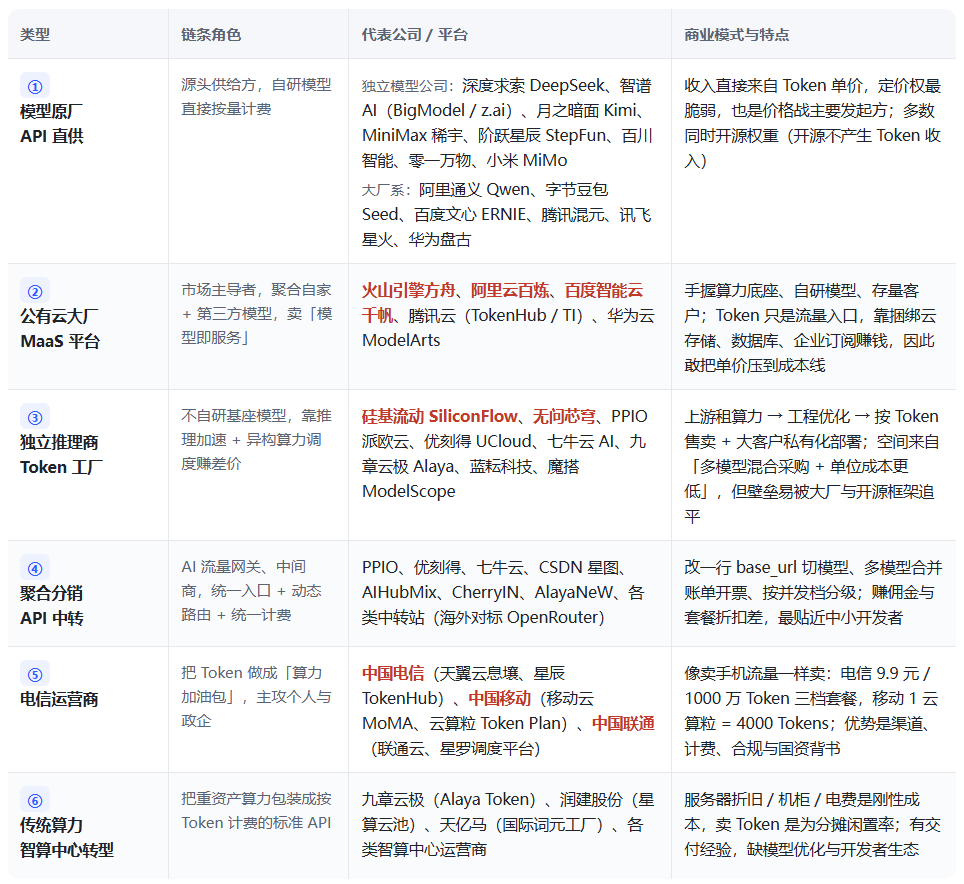 Generated by Workbuddy
Among them, the Token price crash has hit hardest the manufacturing end that processes computing power into Token—such as independent inference providers, Token factories, and traditional computing transformation enterprises—while for more upstream enterprises the loss lies in losing pricing power.
Yet new directions have emerged. Just like water and electricity, prices are fixed and there is no premium space—but products that need water and electricity can still be produced. This is the stage the Token economy is currently going through: productization.
In June this year, Chinese Online stated in an institutional exchange: "Among all domestic Token consumption shares, AI short dramas and video generation rank first, accounting for 55%; followed by e-commerce and marketing (such as livestream selling, advertising, etc.), accounting for 24%; software development accounts for 15%." This set of data intuitively presents several major directions of productization development. In addition, AI office, which has been hotly contested in the second half of this year, is also one of them.
Their commonality lies in the fact that Token is gradually pushed to the back—or even made "invisible"—in productization competition. Various products almost no longer directly present Token at the payment stage, but instead charge by membership monthly cards, annual cards, or finished products such as videos and work tasks. In other words, the strategic focus of the entire industry is shifting from "pricing by Token" to "pricing by results, scenarios, and deliverables," and this shift allows vendors to regain pricing power.
In this process, "dumping" Token has even become an important way for model vendors to acquire customers at low cost. For example, when Doubao Work officially launched, it offered free 30-day standard version subscription benefits; Workbuddy launched activities such as check-in to earn points and limited-time free access to some models at different times.
Similarly, Li Jiaqi's recent livestream selling Token is also a disguised way to drive traffic to Qwen Office. But at the same time, it is worth noting that this action also conveys two signals to the outside world through huge traffic: one is that Token has begun to enter the mass market like everyday consumer goods, accelerating the application and popularization of Token.
The other is that, in addition to purchasing Token within products that call large models, e-commerce platforms have also opened Token recharge entry points for multiple vendors. Through differentiated sales channels, they complete the cognitive anchoring of Token from a scarce item to a bulk commodity, making more people realize that Token is rapidly becoming the "water, electricity, and coal" of the AI era.

Token recharge entry points on Taobao and JD.com
Grabbing Entry Points, Distribution, and Settlement: A New Round of "Ecosystem Land Grab" Begins
In fact, in addition to explicit actions like selling Token via livestream, a new round of "ecosystem land grabs" around the Token economy by major vendors has already quietly unfolded.
Especially after the "Jevons Paradox" was triggered, total Token consumption is rising rapidly. A 1,000-fold increase in two years means that under exponential growth of the overall market, players who laid out earlier will reap more industry growth dividends. Currently, however, the directions major vendors are focusing on are not entirely the same: cloud vendors value computing power and settlement more, while internet giants and mainstream model vendors aim at entry points and workflows.
At the same time, the industry's judgment of vendors' growth potential is gradually shifting toward Token consumption growth rate and user binding depth. This is because Token itself is becoming less and less valuable, but where Token is consumed and whether it can be retained long-term are becoming more and more valuable.
This trend actually well explains why model giants are obsessed with seizing the next-generation internet interaction entry point, as well as the current fierce AI office battle—their essence is a new round of "ecosystem land grab."
The acceleration of productization competition also lies here. For example, in the AI office field, after office products, Agents, and digital employees are embedded into enterprise processes, Token can be consumed within the corresponding products. AI office itself is also an ecosystem competition around the office products of ByteDance, Tencent, and Alibaba. Users' deep habit formation continues from this, and the resulting consumer stickiness will further raise migration costs.
In addition to continued efforts on the enterprise side, the government has also gradually stepped in.
In March this year, the National Data Administration officially designated the Chinese translation of Token as "token." This unit of measurement has also been incorporated into the national-level data resource statistical survey framework and monitoring system as an important indicator for measuring the development vitality of the artificial intelligence industry. The Beijing Economic-Technological Development Area even released in August the first systematic support policy focused on the entire Token industry chain—"Token Ten Measures"—which explicitly mentions: support will be given to Token invocation "super entry points" with cross-model, cross-modal, and cross-computing-platform access capabilities, providing full-model aggregation and unified Token settlement services.
This actually further clarifies that the true explosion point of the Token economy is not on the production side, but on the distribution layer. Building a "super distribution entry point" that aggregates all models, schedules all tasks, and settles all Tokens is also about occupying a favorable position in advance during the process of Token transforming from a "production resource" to an "economic factor." This also foreshadows that when Token prices bottom out, the Token economy will usher in its true moment of explosion.
-
[Insight] 2026 Global and China LDI Inner-Layer Photosensitive Circuit Ink Market Status and Major Enterprise Analysis
-
Lei Jun Is Having a Really Tough Time: Xiaomi Phone Prices Rose by an Average of 410 Yuan in 2026, Yet Profits Fell by 1.7 Billion Yuan
-
![]()
Super Nodes Enter Large-Scale Delivery, Computing Power Arms Race Escalates
-
![]()
"Silver October" Falls Flat, Exports Hold the Line: 928,000 Chinese Vehicles Sold Overseas in October
-
![]()
From 3.06 Million to 158 Million Monthly Active Users: What Did Qwen Get Right in Its First Year After the Rebrand?
-
![]()
Overseas Sales Prop Up Half the Business—So Why Does Great Wall Motor Earn Less the More It Sells?
-
2027: The AI Office Battlefield Is About to Erupt
-
![]()
"Unprofitable" Token Economy: 2 Trillion Sold in Half an Hour, Daily Average Consumption Grows 5,000-Fold