From 3.06 Million to 158 Million Monthly Active Users: What Did Qwen Get Right in Its First Year After the Rebrand?
 11/10 2026
 473
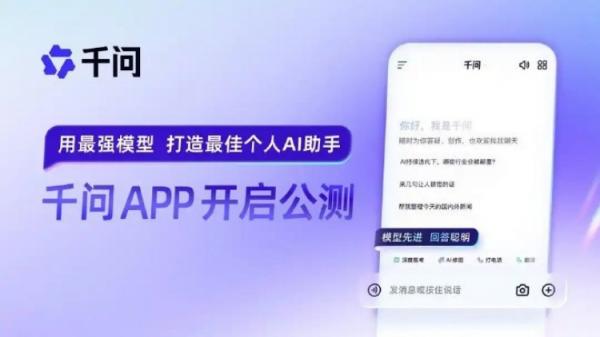
On November 14, 2025, the Tongyi App's version number leapt straight from 3.60.0 to 5.0.0 and was rebranded as "Qwen." Time flies—before we knew it, the Qwen App has been live for nearly a year. So the question is: how has it performed in the market over the past year?
A year ago, the Qwen App skipped version 4 and jumped straight to 5. That detail alone spoke volumes: this was not an iteration but a fresh start. Previously, Tongyi had gone through a three-year period of strategic ambiguity, with multiple brands running in parallel—Tongyi Qianwen, Tongyi Wanxiang, and Tongyi Tingwu. Users could not tell whether it was an AI assistant or a cloud service. As of Q3 2025, the Tongyi App had only 3.06 million monthly active users—a huge gap compared with the hundreds of millions boasted by Doubao and DeepSeek—and it had almost no presence on the consumer side.
In March this year, Alibaba went a step further and unified its general AI offerings under the core brand Qwen, officially renaming the Tongyi Qianwen large model the Qwen large model. This move eliminated the confusion caused by the coexistence of multiple names such as Qwen, Tongyi Qianwen, and Qwen.
After the relaunch, the Qwen App shifted into rapid-advance mode. Let me lay out the rough timeline: downloads exceeded 10 million in the first week of public beta, and monthly active users surpassed 30 million in 23 days; on January 15 this year, monthly active users broke 100 million, and on the same day the app fully integrated with Taobao, Alipay, Taobao Flash Sale, Fliggy, and Amap, launching more than 400 service capabilities; on February 6, the Spring Festival "treat plan" injected 3 billion yuan, orders on the first day exceeded 10 million, daily active users surged by 51 million in a single day, and the App Store ranking surpassed Doubao to take the top spot.
In September this year, Qwen's monthly active users reached 158 million—a stunning 5,077% year-on-year surge, ranking first in hundred-million-level growth. On the AI native app list, it was second only to Doubao's 419 million and ahead of DeepSeek's 123 million. It is not hard to see that Qwen has completed explosive growth on the consumer side and forged a route different from other AI assistants. Other consumer AIs prioritize tools; Qwen's consumer strategy prioritizes transactions and services.
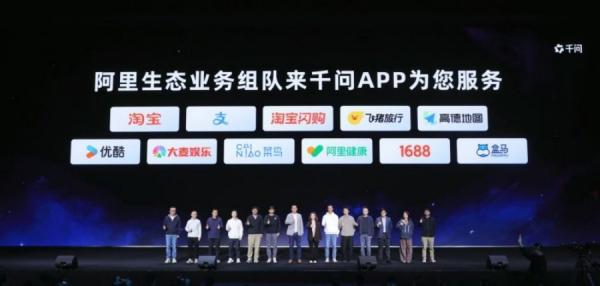
In my view, Qwen's most valuable move this year was pushing AI out of the digital closed loop inside the screen and into real transactions. A sentence like "Order me 40 cups of Chagee" directly calls Taobao Flash Sale to place the order and completes payment within the app using Alipay AI Pay—no redirects throughout the entire process. Only Alibaba could be the first to make this capability work.
By comparison, OpenAI has the strongest models but lacks fulfillment infrastructure; Amazon has logistics, but its models are still catching up; Google's and Microsoft's services are mostly confined to the digital world. Only Alibaba simultaneously possesses top open-source models and a nationwide physical service ecosystem, and its interfaces can be connected without external negotiation or authorization. This means that Qwen's true moat lies in getting things done, not in cold parameters.
Beyond the consumer side, the enterprise side is the real key to victory. Qwen's B-end commercialization is steadily advancing and forming synergies with Alibaba Cloud's business. Qwen's underlying API and the Bailian platform serve enterprise customers. In Q4 of fiscal year 2026, Alibaba Cloud's external commercialization revenue grew 40% year on year—the highest growth rate in nine quarters—and AI-related product revenue grew by triple digits for 11 consecutive quarters.
For government and enterprise clients, SaaS service providers, and developers, Qwen offers tiered solutions: lightweight API calls, private deployment, and industry fine-tuning, paired with T-Head's self-developed computing power to form a packaged "model-computing power-service" solution. Unlike many large models that are "heavy on the consumer side and light on revenue," Qwen's B-end commercialization entered a stable repayment cycle earlier, becoming an important increment for Alibaba Cloud's performance growth. In April this year, Alibaba formally proposed that it would fully advance the agent economy strategy represented by Qwen.
Overall, Qwen mainly got two things right this year: first, it used a rebrand to complete the organizational alignment from technology orientation to user orientation; second, it used ecosystem integration to create a product form that others cannot copy. But the shortcomings are also clear, including retention after subsidies fade, the scale gap with Doubao, and the fact that Agent task-handling capabilities are not yet fully mature. Put plainly, Qwen's consumer side has already proven the growth path, but it has not yet firmly established itself in users' minds.
Today, Qwen is no longer the technical showcase that Tongyi once was. It gives full play to Alibaba's ecosystem advantages rather than relying on the organic growth of an app itself, and has leapt to become a national-level AI assistant. In other words, over the past year, Qwen proved one thing: large models do not necessarily have to take the productivity tool path; by leaning on a mature transaction ecosystem, AI can become a consumer entry point.
-
[Insight] 2026 Global and China LDI Inner-Layer Photosensitive Circuit Ink Market Status and Major Enterprise Analysis
-
Lei Jun Is Having a Really Tough Time: Xiaomi Phone Prices Rose by an Average of 410 Yuan in 2026, Yet Profits Fell by 1.7 Billion Yuan
-
![]()
Super Nodes Enter Large-Scale Delivery, Computing Power Arms Race Escalates
-
![]()
"Silver October" Falls Flat, Exports Hold the Line: 928,000 Chinese Vehicles Sold Overseas in October
-
![]()
From 3.06 Million to 158 Million Monthly Active Users: What Did Qwen Get Right in Its First Year After the Rebrand?
-
![]()
Overseas Sales Prop Up Half the Business—So Why Does Great Wall Motor Earn Less the More It Sells?
-
2027: The AI Office Battlefield Is About to Erupt
-
![]()
"Unprofitable" Token Economy: 2 Trillion Sold in Half an Hour, Daily Average Consumption Grows 5,000-Fold