2026 iResearch · China AI Office Ranking
 11/11 2026
 418
In October, the competitive landscape of the AI office market began to take shape. Doubao Work, WorkBuddy, and Qwen Office claimed the top three spots in the comprehensive ranking, all surpassing 25 million MAU; every other listed product remained below 10 million MAU. Doubao Work led the pack with 55.12 million MAU, while WorkBuddy posted the highest user mention rate.
This marks iResearch's inaugural release of the "2026 iResearch · China AI Office Ranking." The ranking evaluates products across two dimensions: user MAU and user mention rate. Going forward, iResearch will update the ranking monthly to track shifts in user mindshare and the evolving market landscape.
I. Ranking
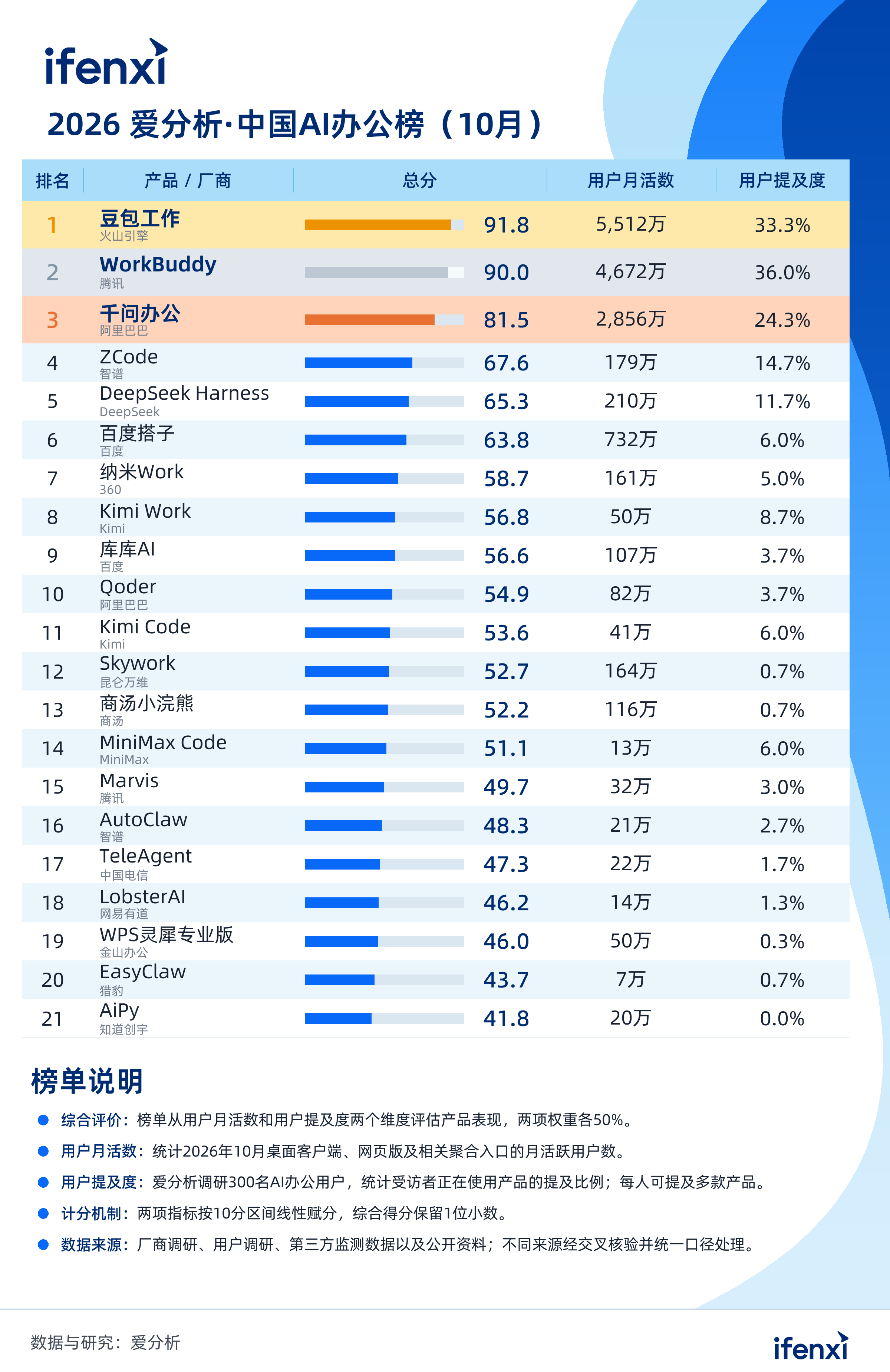
This edition of the "2026 iResearch · China AI Office Ranking" covers 21 products in total. By vendor background, the listed products fall roughly into four categories: internet giants, model vendors, traditional software companies, and telecom operators. Giant vendors' products dominate the top of the ranking, model vendors' products cluster in the middle, and other players are still searching for stable user entry points and differentiated scenarios.
Internet giants currently hold the strongest position in the AI office market. Their products include Doubao Work, WorkBuddy, Qwen Office, Baidu Dazi, Kuku AI, Qoder, Nami Work, Marvis, and LobsterAI. These vendors typically command mature user entry points and can rapidly expand AI office product coverage through their existing ecosystems.
Model vendors are extending model capabilities into specific office tasks. Their products include ZCode, DeepSeek Harness, Kimi Work, Kimi Code, SenseTime Xiaohuanxiong, MiniMax Code, and AutoClaw. These products rest on strong foundations in model, code, and agent capabilities, and some are expanding from coding scenarios into general office scenarios.
Traditional software companies and telecom operators are also entering the fray. Their products include WPS Lingxi Professional Edition, Skywork, TeleAgent, EasyClaw, and AiPy. They leverage office software, organizational customers, or professional tools respectively to enter AI office, but remain in a catch-up phase in terms of user scale and market awareness.
II. Ranking Interpretation
01. Doubao Work ranks first
Doubao Work tops the comprehensive ranking with 91.8 points, reaching 55.12 million MAU and a 33.3% user mention rate.
WorkBuddy ranks second with 90.0 points and a 36.0% user mention rate—the highest among all products. Of the 300 respondents, more than one-third are using WorkBuddy.
Qwen Office ranks third with 81.5 points, reaching 28.56 million MAU and a 24.3% user mention rate, placing third in both metrics.
All three top products score above 80 points, already opening a clear gap with the rest of the field and establishing a significant leading advantage.
02. Aggregated entry points have become key to expanding user scale
The MAU figures in this ranking count monthly data from desktop clients, web versions, and related aggregated entry points. Users can access products through AI assistants, IM, and other entry points without downloading standalone clients. Users contributed by aggregated entry points far exceed those from clients—a key reason the top three broke through 25 million users.
Doubao Work has relatively abundant entry points. Beyond independent entry points such as the PC client and web version, it also benefits from various aggregated entry points, including the PC Doubao client and some users accessing it through Feishu. Qwen Office laid out web, desktop, and DingTalk entry points simultaneously from the public beta stage. Both products expanded their reach through high-frequency entry points.
WorkBuddy clearly lags on the aggregation side and is working to accelerate its integration with the Tencent ecosystem. Buddy One, released on October 29, integrates products including Tencent Docs, Tencent Meeting, Tencent Drive, and ima. As the release came close to month-end, Buddy One's impact on this period's data is minimal, and its value is more likely to emerge in subsequent months.
However, Tencent's most important ecosystems are WeChat and WeCom, which WorkBuddy has not yet fully connected. WXG, the WeChat Business Group under Zhang Xiaolong, has always operated by its own rules. WeChat Search draws on the self-developed WeLM model, DeepSeek, and Hunyuan—with Hunyuan ranked last by priority. Whether WorkBuddy can crack WeChat will affect its user activity performance going forward.
03. Third-party model integration has become a must for AI office products
AI office products need to handle tasks spanning research, documents, spreadsheets, code, images, and video simultaneously. No office product in China can rely solely on a single self-developed model to cover all tasks and remain leading over the long term. Integrating third-party models allows products to select more suitable capabilities based on the task at hand and reduces the impact of underlying model fluctuations on user experience.
Doubao Work began integrating third-party models such as Kimi, Zhipu, and DeepSeek on October 29. This update occurred at month-end, with limited impact on October's ranking data, yet it sends a clear signal: even though ByteDance has its own model system, it still needs external models to supplement capabilities for different tasks. WorkBuddy, Qwen Office, and DeepSeek Harness have also provided varying degrees of multi-model or custom model support.
Most model vendors' products, however, remain confined to self-developed models. As office tasks grow increasingly complex, this closed approach will limit the upper bound of product capabilities.
04. Competition in industry-specific editions is intensifying
The top three have already shown their respective strong industries: Doubao Work is more likely to establish an advantage in content marketing and e-commerce creative fields, WorkBuddy is accelerating implementation in the financial industry, and Qwen Office has taken the lead in e-commerce. The industry directions of all three products are closely tied to the customer resources, data, and service capabilities their parent companies have accumulated over the long term.
Doubao Work is more likely to be the first to establish an advantage in content marketing and e-commerce creative fields. ByteDance has long been deeply engaged in content production and distribution, and Doubao Work puts the Seedream image model, Seedance video model, and Feishu collaboration capabilities into the same workflow chain. Enterprises can start from product materials and brand assets, continuously complete topic research, product images, marketing copy, video scripts, and final production, then bring the results back to Feishu for review and collaboration. QuadHAI under Bloomage Biotech has already used Doubao Work to connect product selling points, image materials, and video creation—a path highly consistent with ByteDance's years of accumulated content capabilities.
WorkBuddy has already formed a relatively clear leading advantage in the financial industry. Tencent disclosed at the end of October that WorkBuddy has entered more than 250 financial institutions, covering hundreds of business scenarios such as corporate credit due diligence, investment research and advisory, compliance review, and customer management. Institutions including CICC, CSC Financial, and China Taiping have participated in related practices. The key to WorkBuddy's rapid implementation in the financial industry lies in the customer base Tencent CSIG has formed through long-term service to financial institutions.
Qwen Office was the first to target the e-commerce industry, continuing Alibaba's traditional advantage. The Qwen Office e-commerce edition has connected systems including Business Advisor, Alimama, Taobao Live merchant backend, and Qianniu, and can complete store inspections, business analysis, order and inventory management, and advertising optimization. E-commerce users account for more than 20% of Qwen Office's paying users. The merchants, business data, and business tools Taobao and Tmall have accumulated over the years enable Qwen Office to quickly enter the actual business processes of e-commerce.
Competition in the industry market ultimately depends on whether products can enter enterprises' real business processes. Alibaba's e-commerce accumulation, Tencent's financial customer base, and ByteDance's content and multimodal capabilities are becoming the most realistic breakthroughs for the three products respectively. As industry applications continue to deepen, each company's traditional strengths will gradually translate into differentiated advantages for AI office products.
05. WPS has a huge office user base but has not yet translated it into AI office advantages
Among all listed vendors, Kingsoft Office has the most direct office software foundation. WPS Office covers high-frequency work scenarios such as word processing, spreadsheets, presentations, and PDF, with global monthly active devices reaching 678 million by the end of 2025. By the traditional competitive logic of office software, a huge user scale and a mature document ecosystem should have given WPS a favorable position in the AI office market.
The results in this ranking, however, show a clear contrast. WPS Lingxi Professional Edition ranks 19th, with 502,000 MAU and a user mention rate of only 0.3%. Compared with WPS Office's massive user base, Lingxi Professional Edition has yet to complete large-scale user conversion, nor has it formed market awareness matching the WPS brand's scale.
This outcome relates to Kingsoft Office's current AI product layout. WPS original products already offer WPS AI, while Lingxi Professional Edition enters the market as a standalone office agent. The two products differ in naming, entry points, and capability positioning, making it difficult for ordinary users to quickly grasp the relationship between them. Even if users have already used some AI functions in WPS, they may not go further to download, use, or proactively mention Lingxi Professional Edition.
06. AI office is still undergoing rapid reshuffling, and stagnating growth will soon be reflected in rankings
Rankings of AI office products change quickly. New products can rapidly gain users through large-scale promotion, but the lead brought by traffic is not stable. Once ad spending slows, MAU may quickly fall back.
This ranking shows that products such as Baidu Dazi and SkyWork, which entered the market earlier and received considerable attention at launch, have now fallen to the middle and lower reaches of the ranking. First-mover advantage, vendor brand, and short-term promotion cannot directly translate into a stable market position.
Low user switching costs are an important reason for the rapid reshuffling of the market. Currently, AI office products offer homogeneous functions, yet task completion results are not stable. When users find another product with stronger capabilities, lower prices, or more convenient entry points, they can quickly migrate.
Promotional resources can bring first-time use, but retaining users continuously still depends on real work value. Products need to enter users' daily work processes and form differentiation in model capabilities, industry knowledge, enterprise data, and business system connections. It is difficult to build long-term barriers through mere feature imitation and short-term ad spending.
The AI office market has not yet entered a stage of stable operation relying on existing users. Products need to continuously create new reasons for users to use them. Once growth stagnates, existing users and market attention may be quickly diverted by new products, and former star products may quickly fall behind.
07. DeepSeek Harness charges into the top five, challengers begin to emerge
On September 29, DeepSeek Harness launched a desktop preview version. After just one full month, its MAU reached 2.1 million and its user mention rate reached 11.7%, ranking fifth in this edition. DeepSeek Harness is currently the new product with the most potential to challenge the leaders.
DeepSeek Harness's rapid growth first comes from the brand awareness and model users DeepSeek has accumulated. DeepSeek already has a huge individual user and developer community, and after launching an AI office product, it can quickly translate existing users' recognition of the model into product attention. Compared with new products building brands from scratch, DeepSeek Harness starts from a higher point in the market.
The change in product form is equally important. The desktop version supports both Windows and macOS and comes preloaded with capabilities such as file processing, material organization, PPT creation, and code modification, extending the previously developer-oriented usage to daily office work. Users do not need to configure complex command-line environments and can use it directly after downloading the client, further expanding the potential user base from developers to ordinary office workers.
DeepSeek Harness adopts an open plugin architecture that can extend models, tools, and workflows. Users can configure different capabilities according to task needs, and developers can continue to add plugins. The open architecture is conducive to forming a product ecosystem, enabling DeepSeek Harness to cover new office tasks at a relatively fast pace.
There is still a clear gap between DeepSeek Harness and the top three. The product is currently in the preview stage and still needs further improvement in enterprise collaboration, organizational knowledge, business system connections, and aggregated entry points. But it simultaneously possesses model capabilities, brand foundation, developer ecosystem, and relatively fast growth, making it one of the few products in the current ranking with complete conditions to challenge.
Besides DeepSeek Harness, which has already entered the ranking, Manus is also an off-list variable worth watching. Manus has already established high market awareness in the general agent field, but has not yet formally conducted business in the Chinese market, so it did not enter this edition.
At this stage, DeepSeek Harness is a challenger that has already demonstrated growth, while Manus represents a potential competitive force that has not yet been fully unleashed. As more general-purpose agents shift toward office scenarios, the AI office market will welcome new competitors.
III. Ranking Notes
Research scope: The ranking focuses on AI office products that serve Chinese users and can handle work tasks such as documents, spreadsheets, presentations, research, code, and design. The statistical period for this edition is October 2026.
User MAU: The scope covers desktop clients, web versions, and related aggregated entry points, uniformly aggregated and calibrated according to product boundaries, with values in units of ten thousand. The full entry point scope is adopted to more accurately reflect each product's reach in real work scenarios, rather than observing only a single client or web page.
User mention rate: Based on iResearch's survey of 300 AI office users, this calculates the proportion of respondents who mention using a certain product. Each respondent can mention multiple products, so the sum of mention rates across products may exceed 100%.
Scoring mechanism: User MAU and user mention rate each account for 50% of the total score. The two metrics are linearly assigned scores in 10-point intervals, and the comprehensive score retains one decimal place.
Data sources: Vendor research, user research, third-party monitoring data, and public information. iResearch cross-verifies different sources and processes them according to unified product boundaries and statistical standards.
Release frequency: Updated monthly. The ranking reflects products' user scale and user mindshare in the current month.
-
Tesla Refutes 'Vehicle Recall and 2,800 Yuan Compensation' Rumor: It's a Scam, Do Not Click the Link
-
The Death of Digital Humans
-
![]()
In an Overlooked Corner of China's Auto Market, Japanese Cars Are Almost Rotting Away | Juchao
-
![]()
Smart Lighting Upgrade in Industrial Parks: Moving from Broad-Brush Control to Refined O&M
-
![]()
2026 iResearch · China AI Office Ranking
-
SAIC Audi's "Buy One, Get One Free" Promotion Under Investigation: After the Split, AUDI's Brand Awareness Challenge Remains Unresolved
-
NIO's Q4 Average Monthly Target of 40,000 Falls Short Out of the Gate, Ending 31-Month Growth Streak: Li Bin's Shortfall and the Test Ahead
-
![]()
Fujian's New Energy Heavy Truck Policy Takes Effect: Behind the 50.28% Penetration Rate, Hebei Chases Subsidies, Sichuan Chases Tolls, and Every Province Takes a Different Road