Fujian's New Energy Heavy Truck Policy Takes Effect: Behind the 50.28% Penetration Rate, Hebei Chases Subsidies, Sichuan Chases Tolls, and Every Province Takes a Different Road
 11/11 2026
 492
Multiple provinces have rolled out new energy heavy truck policies, yet the core difficulties in promoting them on trunk lines remain.
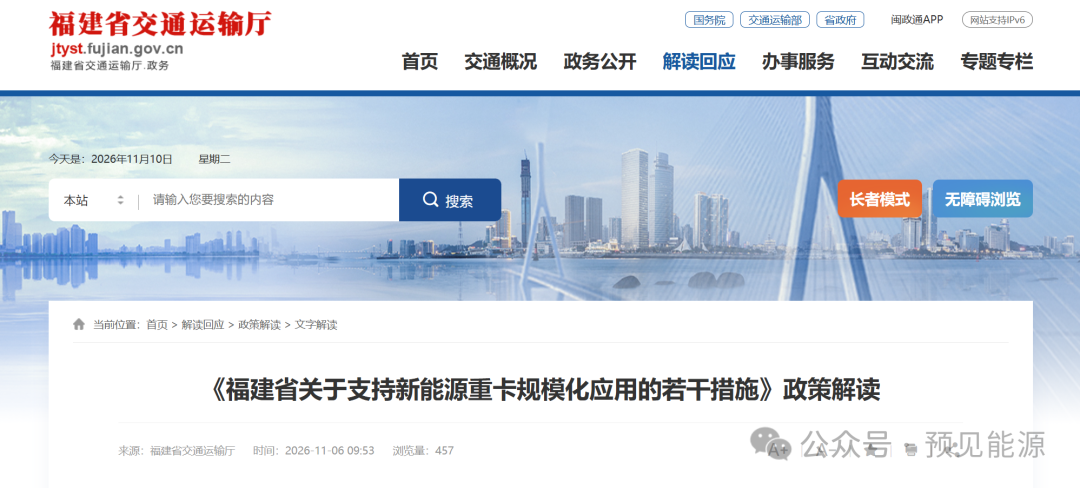
Foresee Energy has learned that the Fujian Provincial Department of Transport, together with ten other departments, recently issued Several Measures on Supporting the Large-Scale Application of New Energy Heavy Trucks. The window for special station construction subsidies runs from April 2026 to the end of 2028. Before 2030, centralized charging and battery swap facilities will be exempt from demand charges; ETC-equipped new energy heavy trucks will enjoy "convenience" on expressways; and on the insurance side, the document calls for "insurance to be provided wherever required."
This is another provincial-level document that responds with a full-chain framework covering "purchase, construction, operation, and insurance" after the Ministry of Transport and ten other departments issued the Implementation Plan for Promoting the Large-Scale Application of New Energy Heavy Trucks in May 2026. Yet the breadth of the document's coverage is no longer the most pressing issue for new energy heavy trucks.
In September, the monthly penetration rate of domestic new energy heavy trucks jumped to 50.28%, surpassing 70% in enclosed short-haul scenarios while stalling at 0.9% on interprovincial trunk lines. The places where policies are most densely implemented are precisely where the trunk line economics are hardest to work out.

Fujian's hidden strength is not in the document
but in its ports and steel mills
Only by placing this document back into Fujian's freight structure does its logic become clear.
In the first half of 2026, the penetration rate of new energy heavy trucks for short-haul transfers within the Xiamen Port area had already exceeded 30%, and the electrification rate of self-owned fleets at leading port transport enterprises exceeded 50%. Zhangzhou Sanbao Steel put its first electric heavy truck into operation in 2021, and by 2026 more than a thousand vehicles were on the road, with electric vehicles accounting for 86% of bulk cargo transport volume and all short-haul port transfers within 100 kilometers electrified.
These are not increments driven by policy, but an existing base that has been running for four years. Fujian's push for large-scale application is accelerating on a foundation that already has vehicles, stations, and dispatch experience—not building from scratch.
Sanbao's economics provide a key reference. A vehicle with a 400 kWh large-capacity battery sells for more than 600,000 yuan, which partner logistics companies cannot afford. Sanbao's approach is "vehicle-battery separation + battery leasing": logistics companies buy only the cab and chassis, while batteries are leased from Sanbao at a monthly rent of about 6,000 yuan. Taking comprehensive electricity, rent, and maintenance costs into account, the full life cycle cost is already close to or even slightly lower than that of diesel vehicles. The actual cost for logistics companies in Zhangzhou to purchase a new energy heavy truck has been reduced to around 100,000 yuan.
The special bonds, relending, battery leasing, and "insurance to be provided wherever required" in Fujian's policy are precisely aimed at the external costs that are missing when this model is replicated from a single enterprise to a province-wide network. In addition, CATL is located within the province, and eight Qiji battery swap stations have already been put into operation on the 420-kilometer Ningde-Xiamen trunk line. Part of the trial-and-error cost of the battery swap trunk line is shared by the local chain leader.
Therefore, Foresee Energy believes that Fujian's development of new energy heavy trucks is both the implementation of a central deployment and a self-initiated move that binds port logistics cost reduction with the depth of the local lithium battery industry. The two are not contradictory. The real question is whether this economics, which has been proven in short-haul scenarios, can still hold on trunk lines.

Battery swap stations can be built
but that does not mean trunk lines can keep running
The difficulty of trunk line electrification has long ceased to be a question of whether range is sufficient. Large-battery models have pushed pure electric range past 400 kilometers, charging heavy trucks have grown for consecutive months, and the vehicles themselves are rapidly converging to a usable state.
What is holding back trunk lines is everything other than the vehicle.
The first is the break-even utilization rate of battery swap stations. Industry estimates put it at about 15%, and 42% of sites need 3 to 5 years to recoup investment. Fujian's extension of station construction subsidies to the end of 2028 and exemption from demand charges until before 2030 is helping energy replenishment assets cross the earliest fixed-cost threshold.
But after a station is built, how many vehicles and how many round trips are needed to support it is something the document cannot answer more precisely than the market. Calculations for the Ningde-Xiamen trunk line show that an electric heavy truck saves about 120 yuan in freight per round trip, or 30,000 to 50,000 yuan per vehicle per year. This magnitude is enough to drive replacement in short-haul operations, but once applied to interprovincial trunk lines, the economics will distort once the gaps in insurance and tolls are added.
Insurance is the most direct example. An ordinary fuel heavy truck costs about 28,000 yuan per year in premiums, while a comparable electric heavy truck generally costs 40,000 yuan. In 2025, new energy vehicle insurance recorded an underwriting loss of 5.6 billion yuan for the year, and among 59 vehicle series of new energy trucks with scale, 37 had loss ratios exceeding 100%.
In response, Fujian's document states "insurance to be provided wherever required," but the decision to underwrite lies in insurers' actuarial models, not in a joint document from eleven departments. An electric heavy truck without commercial insurance cannot even get temporary plates.
Tolls are another issue. Fujian's wording is "toll convenience," without providing a unified provincial-level discount. By comparison, Sichuan offers a 20% discount on provincial expressways for ETC-equipped new energy trucks, exempts hydrogen trucks, and extends the policy to the end of 2027. Hebei offers a 15% ETC toll discount.
The weight of tolls in the TCO of trunk line heavy trucks does not need repeated argument. For a tractor running 200,000 kilometers a year, expressway tolls are the third-largest expense after fuel and labor.
Fujian leaves room for differentiated toll adjustment to "new national regulations," which is technically prudent, but when trunk lines most need the final push, prudence may not be the most effective.

Hebei, Shandong, and Sichuan each play their own cards
Enterprises cannot treat subsidies as profit
Beyond Fujian, several provinces have already implemented provincial-level documents in 2026, but their approaches are clearly differentiated.
Hebei focuses its efforts on the vehicle purchase side. For scrapping China III heavy trucks and replacing them with new electric heavy trucks, national and local subsidies cap at 138,000 yuan, and ETC tolls on provincial expressways are discounted by 15%. By the end of 2025, Hebei had 39,000 new energy heavy trucks in operation, the highest inventory in the country. In 2026, it is seeking 555 million yuan in central subsidy funds, with a year-end target of 45,000 vehicles.
Hebei's logic is to use subsidies to replace existing diesel vehicles as quickly as possible, prioritizing scale.
Shandong's focus is on the energy replenishment network and financial tools. It will build 155 high-power charging demonstration stations in two years, including 48 on expressways and 107 on ordinary national and provincial roads. Its 28 measures include zero down payment, ultra-long installments, and discounted electricity prices under direct supply of solar-storage green power.
Shandong's electric heavy truck inventory had already reached 20,000 by 2025, with 10,000 added that year, a growth rate of 190%. However, the province had only 443 charging stations, and there were previously no dedicated charging facilities on expressways. Shandong is filling the infrastructure gap left by the previous round of scale growth.
Sichuan has turned tolls into an explicit price signal. Provincial expressway tolls are discounted by 20%, one-year fiscal interest subsidies are provided for vehicle loans with a maximum of 400,000 yuan per loan, and subsidies for scrapping and updating old trucks reach up to 140,000 yuan. Sichuan's calculation is to use expressway discounts to directly lower trunk line operating costs and get cross-city transport running first.
The three provinces plus Fujian point to the same judgment: the replacement dividend in short-haul scenarios is approaching its upper limit, and the focus of provincial policies is shifting from "encouraging vehicle purchases" to "keeping vehicles running."
This is good for the industry, but it does not benefit all participants. For operators with stable short-haul cargo sources, their own scenarios, and the ability to build battery swap or charging facilities next to their fleets, policy is an accelerator. For enterprises hoping to rely on subsidies to directly enter trunk lines, subsidies cannot fill battery swap station utilization rates, nor can they fill insurers' actuarial tables.
For enterprises, what needs to be done is not complicated. First, fully capture existing replacement demand in short-haul scenarios, make full use of vehicle-battery separation and financial tools, and thicken the accounts that have already been proven. For those wanting to touch trunk lines, first calculate clearly the three things—battery swap network density, insurance solutions, and residual value outlets—before getting on board.
What policy can do is push vehicles onto the expressway. Whether vehicles can keep running on the expressway ultimately depends on the fleet's own accounts.
-
![]()
Fujian's New Energy Heavy Truck Policy Takes Effect: Behind the 50.28% Penetration Rate, Hebei Chases Subsidies, Sichuan Chases Tolls, and Every Province Takes a Different Road
-
AI Compute Provider's Stock Plummets Over 40% in a Month, Promises Profitability by 2028
-
![]()
Sea: Heavy Bets on Both E-commerce and AI—Is the "Little Tencent" Also Heading for Troubled Waters?
-
![]()
Musk Says the Cybercab Costs Two Dimes per Mile—Institutions Crunch the Numbers and Laugh: Not Even Enough to Cover Insurance
-
Anthropic's Valuation Shrinks, Putting Pressure on Chinese Large-Model Companies
-
Ecovacs' Single-Quarter Profit Plunges 70%: What Went Wrong?
-
![]()
Financial AI Agent Tenders Drop by One-Third in October, Winning Bid Amounts Hit Four-Month Low
-
![]()
Anthropic Sets Sights on $1 Trillion Market Cap — Is This a Double Eleven 50% Off Sale?