Where Does Ant Group's "Lingguang" Really Stand?
 11/11 2026
 468

Ant Group Deploys Two AIs to Keep Watch Over "the Same Plane Ticket"
Author | Dingshan
Editor | Xiaobai
Image | AI-generated
Produced by | Emphasis Next
At Ant Group's booth at the World Internet Conference in Wuzhen, a thought-provoking scene unfolded: "Lingguang," Ant Group's standalone app, and "Abao," Alipay's built-in AI assistant, demonstrated itinerary planning and follow-up capabilities side by side on the same stage.
This is a microcosm of Ant Group's "dual-track rivalry" in the general AI arena.
On one side of the scale is Alipay, with over 1 billion users and Abao deeply embedded in the commercial fulfillment ecosystem; on the other is the standalone app "Lingguang," nearing its first anniversary and attempting to break through single-handedly in the personal agent track.
Lingguang 2.0, released on October 27, has shifted its product focus entirely to "long-cycle affairs"—continuous flight ticket monitoring, organizing class group notifications, and tracking family to-dos. Yet when it engages in close combat with Alipay's built-in Abao in life service scenarios, the increasingly overlapping functional boundaries between the two raise a tough strategic question:
Given that Alipay's service capabilities are already robust enough and Abao is being comprehensively upgraded into an "AI wallet," why does Ant Group still need users to separately open Lingguang? Exactly which strategic high ground that Alipay cannot cover is Lingguang trying to seize?
From "Flash Apps" to "Long-Cycle Affairs": A Paradigm Shift Around Retention
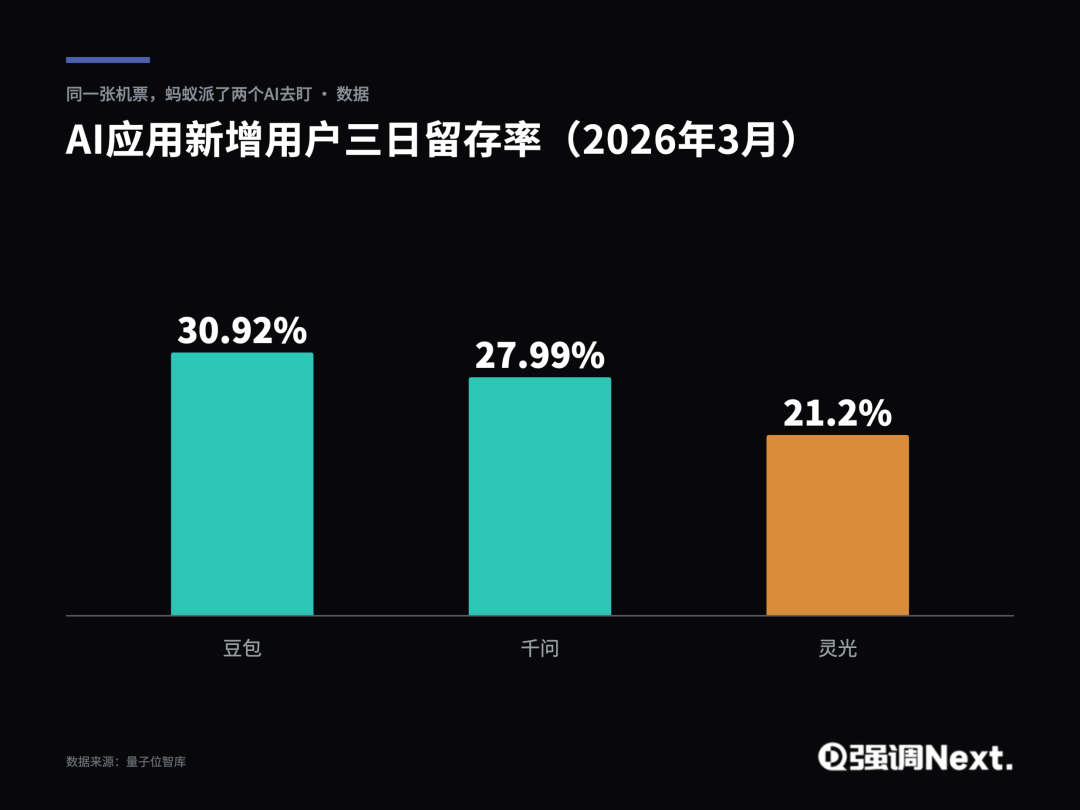
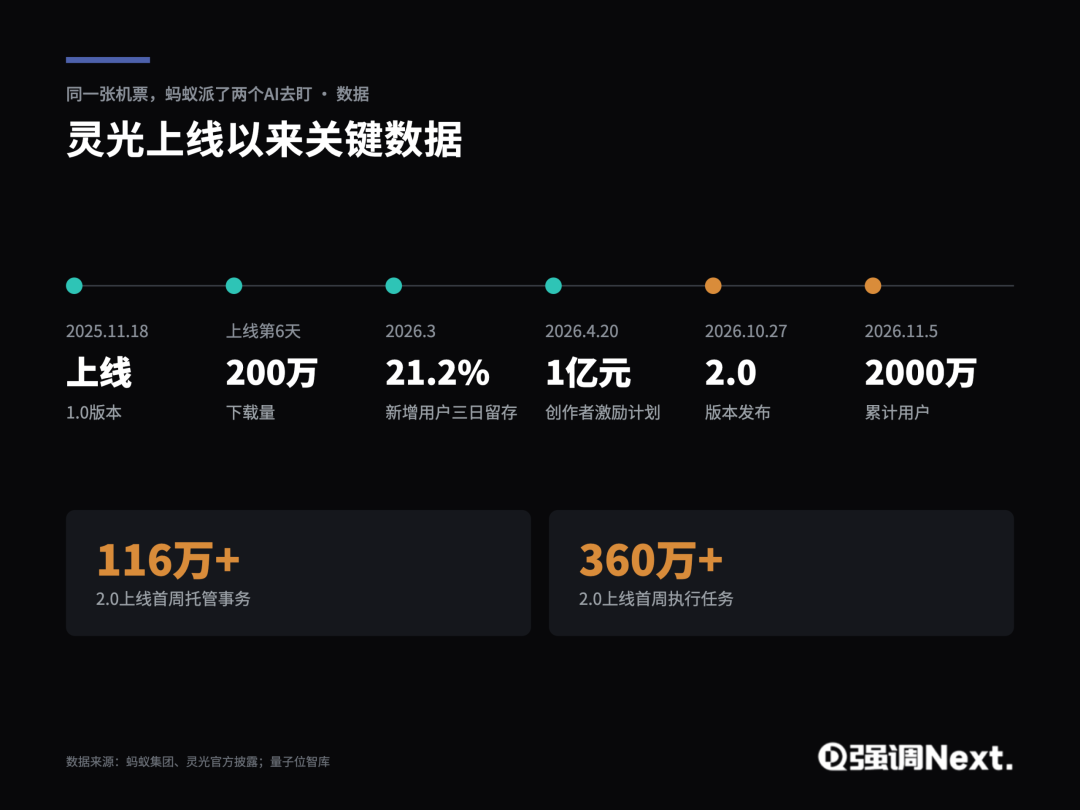
When it launched in November 2025, Lingguang's main selling point was "generating flash apps from natural language in 30 seconds." The minimalist no-code development experience brought strong virality; just six days after launch, downloads quickly exceeded 2 million. But tool generation with an extremely low threshold did not naturally translate into high-frequency, stable user habits. Third-party think tank data shows that in March 2026, Lingguang's three-day retention rate for new users dropped to 21.2%, lower than Doubao (30.92%) and Qianwen (27.99%). This exposed the inherent flaw of lightweight mini-tools: no matter how elegantly a one-off generation need is solved, it cannot create the strong dependence that makes users open the app every day.
Even the launch of a creator incentive program worth up to 100 million yuan in April could not stem the attrition of a tool-oriented ecosystem. The strategic adjustment of Lingguang 2.0 is essentially a self-reconstruction of the growth paradigm, shifting from "guiding users to try tools" to "taking on long-cycle affairs on users' behalf." As of November 8, Lingguang officially disclosed that cumulative users had exceeded 20 million, and one week after the launch of 2.0, it had hosted over 1.16 million affairs and executed over 3.6 million tasks. The data shows that some users have begun trying to delegate trivial matters to AI. But the decisive factor in moving from novelty-style "feature experience" to high-frequency "full delegation" is no longer how cool app generation is, but the success rate of task execution and the accuracy of long-term memory.
Fulfillment Barriers and Cross-Boundary Snags: APASS Cannot Automatically Tear Down Ecosystem Walls
From a technical architecture perspective, Lingguang 2.0 has built an independent cloud host sandbox, connected to Alipay bills as well as some office, email, and smart home services, and relies on the unified authorization infrastructure (APASS) for identity authentication. But recent hands-on tests by Huxiu and Geek Park show that Lingguang is still subject to interface and permission restrictions in some transfer, account inquiry, shopping cart reading, and message sending scenarios.
This awkward situation of "can advise, but hard to act on behalf" cannot simply be blamed on coordination resistance within Ant Group; it reflects three objective barriers that general personal agents are bound to hit at present. The first is the boundary of compliance and zero-trust risk control. Transfers and medical insurance involve financial-grade identity verification and sensitive data; before legal responsibilities and risk control mechanisms are thoroughly clarified, AI agency permissions will inevitably be tightly constrained.
The second is data sovereignty isolation across entities. Taobao, Alibaba Mail, and Alipay belong to different commercial entities; API openness is by no means a purely technical issue, but a commercial game. Finally, there is the "agent tariff" and anti-crawler barriers of external platforms. Cases such as Doubao Phone in China and Meta Muse overseas being banned by Amazon when placing orders on users' behalf have long proven that owning a general agent absolutely does not mean obtaining access rights to other commercial platforms.
By contrast, Ant Group's integration of the digital payment, Alipay, and Sesame Credit business units in September 2026, with Wu Minzhi leading the push for an AI wallet, enables Abao to naturally transform ordering, travel, and payment processes along Alipay's native merchant network. In short, what Abao solves is "minimal invocation of known services," while what Lingguang attempts to solve is "context linkage across scattered cross-platform affairs." The former's advantage lies in fulfillment; the latter's challenge lies in crossing boundaries.
The Final Battle: Alipay Guards "Fulfillment," Lingguang Competes for "Context"
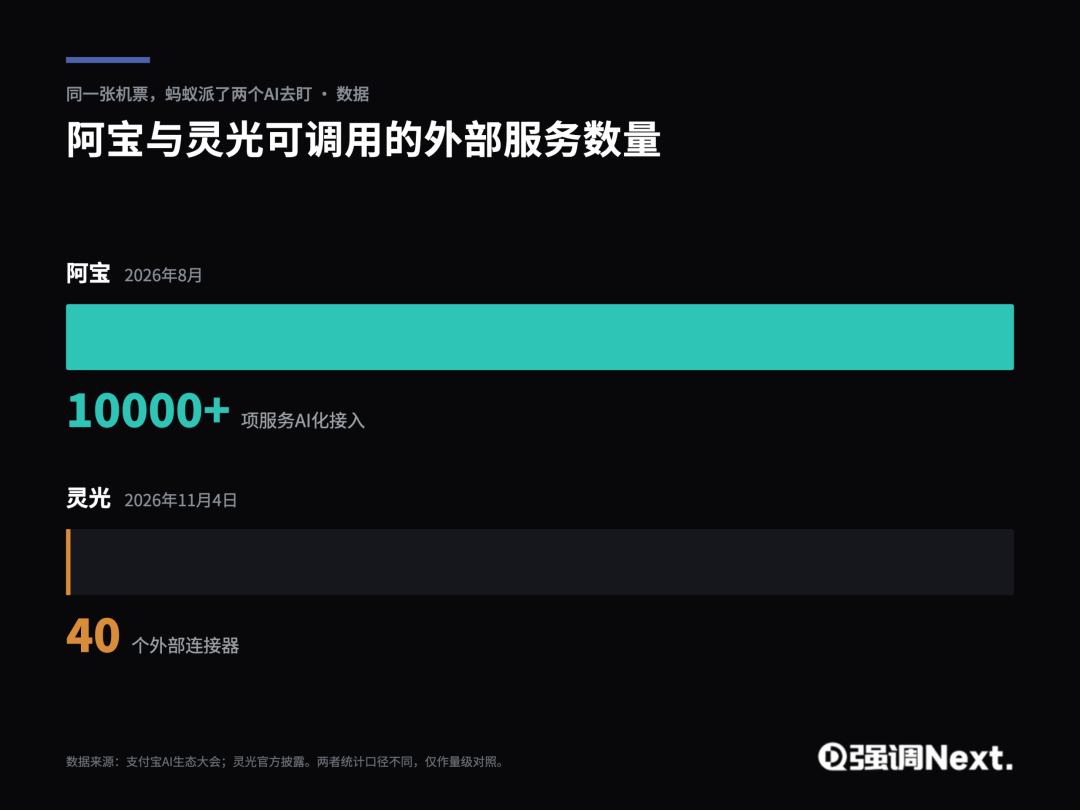
Ant Group management has explicitly positioned Lingguang as "general AI exploration," while vertical businesses such as Afu (health) are "hard battles that must be won." Understanding Lingguang as a "strategic insurance policy" for Ant Group in response to the paradigm shift in large models is certainly accurate, but one must see exactly what risk it is guarding against. In fact, Alipay itself has already been preventing marginalization in the AI era through "service expansion." As of August, Abao had completed AI-enabled integration of more than 10,000 services, covering 5 major phone brands and 16 automakers across devices. This means that even if the user's first instruction does not occur within the Alipay app, as long as the transaction is invoked by an agent on a hardware terminal, Alipay can still serve as the backend fulfillment and payment pipeline and stay securely at the table.
But behind this defensive posture looms Ant Group's historic weakness in the face of WeChat: Alipay has a powerful "transaction entry point," yet has always lacked the kind of "context entry point" that WeChat possesses.
In China's internet ecosystem, a large number of users' real daily intentions—whether class group notifications sent by school teachers, chat records of family discussions about trips, or travel arrangements synchronized by colleagues—naturally grow and settle within WeChat's social relationship chain, rather than in Alipay, which is used and then abandoned.
More critically, since June of this year, WeChat has accelerated gray-scale internal testing of its native AI assistant "Xiaowei," which can not only directly sort messages, generate to-dos, and create exclusive mini-tools via "Ask Xiaowei" in group chats, but has also simultaneously launched the WeChat Pay "AI exclusive card," connecting the transaction loop of leading mini-programs such as Meituan and Ctrip. Once WeChat leverages its natural social context to take over downstream mini-program fulfillment and payment, Alipay, relying solely on a "tool mindset," could easily fall into a passive position downstream of "waiting for rice to cook" or even being intercepted upstream.
This precisely answers Lingguang's irreplaceability: competing for control of the "upstream intent layer."
Under the traditional model or Abao's logic, users must first digest information themselves and form clear intentions before waking the assistant for single-point service invocation and payment completion; this is a short chain "from intent to transaction." But under the agent model envisioned by Lingguang, AI needs to first perceive the user's long-term context (such as group chat notifications, email exchanges, schedule changes, and price fluctuations), then plan multi-step affairs, and finally decide when and which service to invoke.
Booking a plane ticket only requires completing one transaction. But arranging a family trip requires coordinating work schedules, school notices, budget limits, and dynamic ticket price monitoring. Whoever masters this pre-existing long-term context can seize decision-making power at the earliest stage when demand sprouts. Alipay connects "specific services," while Lingguang attempts to connect "the user's complete personal life and work flow."
Precisely because Alipay cannot grow WeChat's social ecosystem within itself, Ant Group must dispatch "Lingguang," independent of the payment mindset. If its core value were merely to wrap Alipay's existing services in another layer of AI, then it would be doomed to lose its reason for existence in homogeneous internal competition with Abao.
On the contrary, using "personal affairs hosting" as the entry point to wrest scattered "long-cycle context" from the heartlands of social and office software is Lingguang's true strategic mission.
Alipay exports service interfaces externally, securing for Ant Group the "infrastructure" foundation of transaction fulfillment in the AI era. Lingguang, by exploring deep context, is seizing for Ant Group the "first decision entry point" at the very moment user demand is born, despite the inherent limitation of lacking a social entry point.
Note: The data in this article comes from public sources and does not constitute investment advice.
- END -
-
Apple, Huawei, and Xiaomi Sales Over the Past 8 Years: Who Really Took Away Huawei's Users?
-
![]()
Huawei Starlight Phone Faces Uncertainty Even Before Launch: Stores Say No Notice Yet, and It Won't Come Cheap
-
Why Is Anyone Waiting for AI Movies When Even "Niu Lai" Is Better?
-
![]()
Where Does Ant Group's "Lingguang" Really Stand?
-
![]()
Dong Mingzhu Blames Gree's Profit Decline on Copper Prices: A Fact, But Not the Whole Story
-
Tesla Refutes 'Vehicle Recall and 2,800 Yuan Compensation' Rumor: It's a Scam, Do Not Click the Link
-
The Death of Digital Humans
-
![]()
In an Overlooked Corner of China's Auto Market, Japanese Cars Are Almost Rotting Away | Juchao