Musk's High-Stakes Bet on Space Computing Power Amid Democratic Pushback—Will China Follow Suit?
 11/16 2026
 506
The Blue Camp Launches Its Counteroffensive Against the Trump Camp
On November 3, the Democratic Party won both the Senate and the House. Two days later, the Nasdaq fell more than 5%, the Dow dropped over 1,800 points, and the S&P shrank by more than 4%, erasing all of the post-election gains from the day after the vote—and then some.
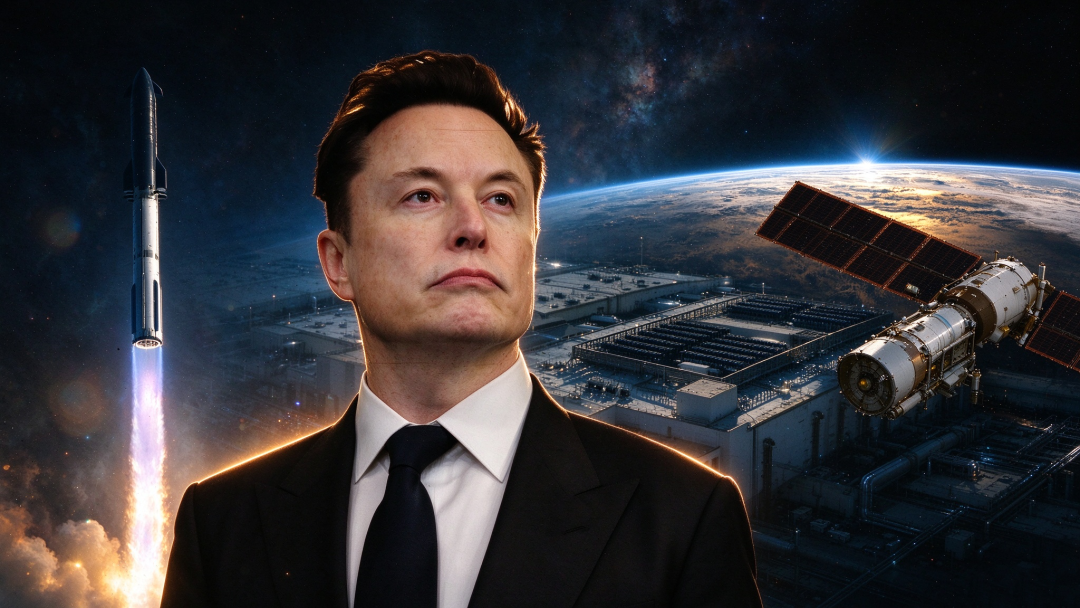
Musk was hit hardest. Tesla fell about 11% during the session, and SpaceX dropped about 9%. The reason is not hard to guess: with the Democratic Party back in control of Congress, investigations, hearings, and regulation targeting his companies will follow one after another. Jensen Huang was already forced to step down amid the "affair scandal." How will Musk avoid the Democratic Party's "reckoning"?
Image source: Internet
What the Democratic Party wants to do is actually already an open secret: a set of moves tightening in three areas at once.
First, energy and environment. Large tech companies are required to bear the construction costs of new power grids, disclose energy and water consumption, and not shift the bills for AI infrastructure onto residential electricity rates. Next are the models themselves, requiring mandatory safety testing, third-party audits, and reporting mechanisms for major incidents. In October, Cantwell, the Democratic leader of the Senate Commerce Committee, already put a national AI regulatory framework on the table. Finally, congressional oversight—subpoenas, hearings, investigations—all the way down to tax incentives for data centers and the sharing of electricity costs. Once the committee chair has the gavel, subpoena power comes with it.
Behind this set of moves is the sentiment reflected in the ballots. An Ipsos poll previously showed that 55% of Democratic voters support restricting data center construction, while only 37% of Republican voters do. More noteworthy is that in this round of "deep red states" turning blue—Texas, Kansas, South Carolina—the real driver was not ideology, but electricity prices and the cost of living. AI investment surged and asset prices rose, but ordinary voters did not share in the benefits; they only got the bills.
However, a special note is needed here. The Democratic Party won both chambers, but did not reach the two-thirds majority needed to override a presidential veto, and Senate legislation still needs 60 votes to end a filibuster. Major bills involving the core interests of both parties are unlikely to pass before the 2028 election. At the federal level, harsh measures such as "pausing AI data center construction before a safety framework is implemented" are basically unworkable.
The real variable lies in state and local governments. State-level power constraints and local environmental approval are the hands that raise costs and lengthen timelines.
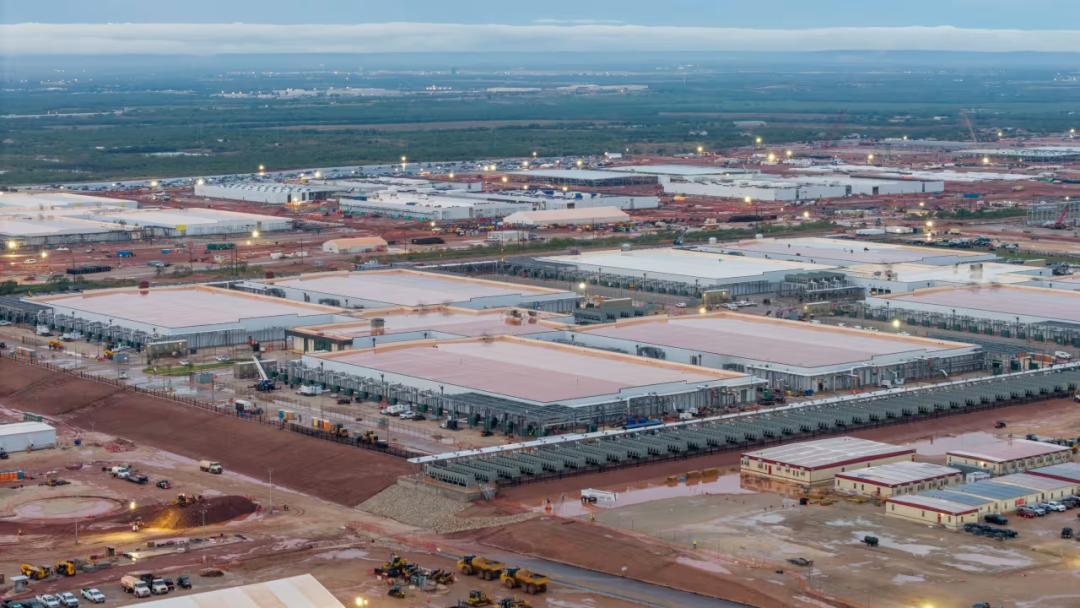
The "Stargate" AI data center under construction in Abilene, Texas, USA. Image source: Internet
So the limited incremental pressure on the ground is structural and chronic, not in the form of a paper ban. It will not stop data centers tomorrow, but it will push the IRR of every new project down by several points, drag the approval cycle from 18 months to 36 months, and turn "going online next year" into "take another look in two years."
For capital, chronic disease is harder to endure than acute disease. Acute disease kills; chronic disease makes people move.
So computing power has begun looking for a new address. Musk's move came earlier than the market reaction.
Too Troublesome on Earth? Go to Space
On January 30, 2026, SpaceX submitted an 8-page document to the FCC titled "SpaceX Orbital Data Center System," with the core demand in one sentence: send 1 million satellites into orbit.
The parameters are carefully chosen. Orbital altitude of 500 to 2,000 kilometers, a sun-synchronous orbit with an inclination of about 30 degrees, all packed into a narrow shell no more than 50 kilometers wide, ensuring coordination of its own system while leaving safe spacing for others' spacecraft. In the higher-orbit layer, sunlight accounts for more than 99% of the time, basically eliminating the need to carry large batteries; the lower-inclination layer uses global time zone differences for load balancing.
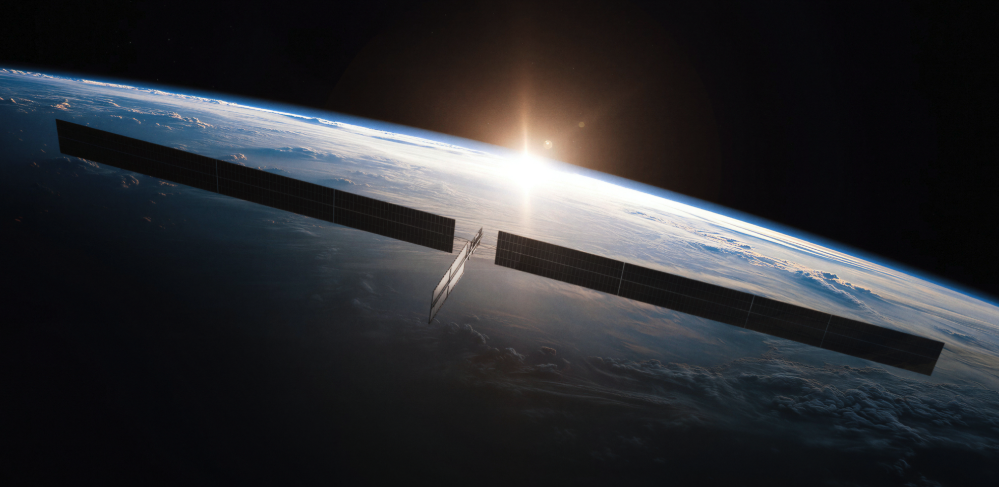
Image source: Internet
Then came organizational surgery. On February 2 this year, SpaceX announced the acquisition of xAI, with a combined valuation of $1.25 trillion—SpaceX at $1 trillion and xAI at $250 billion. Musk's stated goal is to build a "vertically integrated innovation engine" covering the complete technology chain from ground to space. An IPO is to be launched in June or July, and the use of proceeds is clearly stated: buy chips.
The execution-level numbers are also on the table. 6,000 dedicated racks have already been ordered, to be delivered in 2027; by 2028, 1 GW of on-orbit computing power is to be achieved; word from the supply chain is 1.5 million space computing power cards, corresponding to about 20,000 cabinets and 3.2 GW.
The economics supporting all this comes down to one thing: launch cost. It is currently about $500 per kilogram, and after Starship is fully operational it will be $10 to $150. Starcloud did the math: for a data center of the same scale, the ten-year core cost of the space solution is about $8.2 million, versus about $167 million on the ground—the space solution is only 5%.
So what Musk is betting on is not technology, but the slope of the cost curve.
The risks must also be made clear. The FCC is not a rubber stamp. Previously, for the second-generation Starlink, SpaceX applied for 22,488 satellites but was ultimately approved for only 7,500. A million-satellite constellation must pass three hurdles: spectrum coordination, space debris, and astronomical observation. If any one of them gets stuck, the pace will have to be rearranged.
Musk said that "within the next two to three years, space is expected to become the lowest-cost way to compute AI." Note the phrase "expected to." This is a vision, not a financial report.
The premise of the bet holding is that Starship does not fail.
As it happens, Starship has just completed its 15th test flight. After about 22.5 hours, SpaceX completed the recovery of the Starship spacecraft portion on November 14 (Saturday), achieving for the first time the use of the launch tower's mechanical arm to "catch" the returning Starship spacecraft. However, the originally planned "double capture" was not fully successful; the Super Heavy booster malfunctioned after separation and eventually splashed down in the Gulf of Mexico and caught fire.
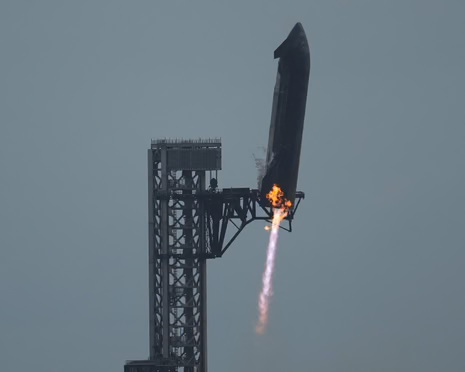
Image source: Internet
Although booster recovery suffered a setback, the successful capture of the spacecraft is a key milestone on Starship's reusable technology path. This test flight verified the feasibility of the spacecraft returning from orbit and being directly recovered by ground facilities, accumulating crucial data and experience for the subsequent goal of truly achieving "rapid reuse."
Why Computing Power Must Go to Space
Space computing power does not exist because of romance. It was forced out by three numbers.
TrendForce estimates that global data center power demand capacity in 2026 will be 161 GW, a year-on-year increase of about 31%, with AI servers accounting for one-third; by 2030 demand will reach 491 GW, while, on the premise that all other electricity demand is met, the grid can free up only 222.6 GW for data centers—a gap of 268 GW.
Gartner's forecast is even more direct: global data center electricity consumption will rise from 448 TWh in 2025 to 980 TWh in 2030, more than doubling, with AI-optimized servers rising from 93 TWh to 432 TWh, nearly five times, accounting for 44% of total electricity consumption by then. RAND believes that by 2030 a single training task could require 8 GW, exceeding the installed capacity of many of the largest power plants in the United States.
Behind these three numbers there is also a timing problem: the queue for grid interconnection in the United States is 3 to 7 years. For an 8 GW-scale cluster, it is almost impossible to find a plot of land that simultaneously satisfies land, water, grid, and community acceptance.
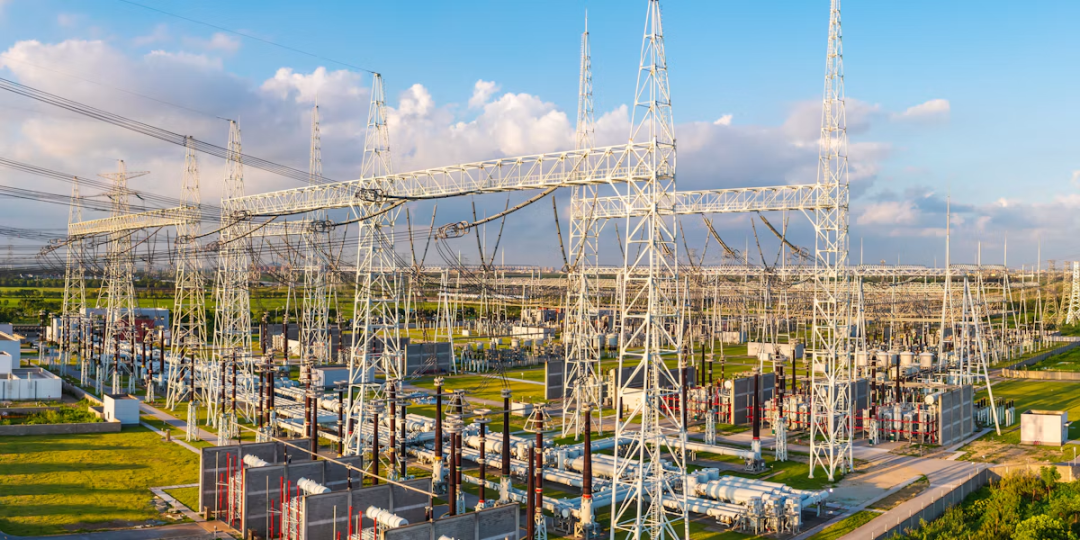
Image source: Internet
So overall, the ceiling for ground computing power is not chips, but electricity and land.
Only space happens to satisfy the above conditions.
Outside the atmosphere, solar irradiance is about 1,366 W/m², 30% to 40% higher than at sea level, with no atmospheric attenuation, no day-night cycle, and no weather. The average capacity factor of ground photovoltaic systems in the United States is about 24%, while in dawn-dusk orbit it can exceed 95%; for an array of the same area, annual power generation is more than five times that on the ground. Heat dissipation is even better: the vacuum background is close to minus 270°C, heat radiates away directly, cooling energy consumption can be reduced by more than 70%, and PUE approaches 1. Ground data centers spend 30% to 40% of their electricity on cooling; in orbit, that cost is almost entirely saved.
There is another, less visible but harder reason—latency and coverage. Low-orbit round-trip is only a dozen milliseconds, and "space sensing, space computing" can compress emergency response from hours to seconds. Oceans, deserts, forests, and polar regions—places ground networks cannot reach—only orbit can provide computing power. This is not a commercial option; it is a boundary of capability.
But to be complete: necessary does not mean cost-effective now. The design life of space computing power centers is usually only 5 to 8 years, while ground data centers last more than 15 years. Launch costs have not yet fallen below the threshold of $200 per kilogram, and single-satellite hardware is still expensive. So its role today is as a supplement with "high unit price and strong scenarios," not a replacement.
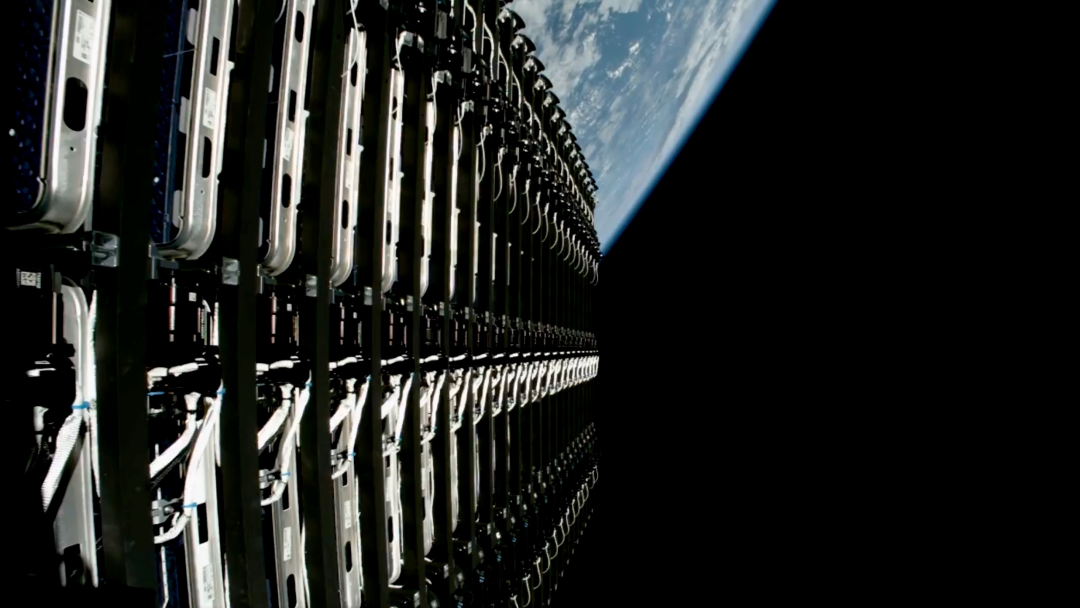
Image source: Internet
So will it become a trend? My judgment is that the question is not "whether," but "which segment comes first."
Taibo Think Tank divides space computing power into three forms, with inflection points around 2027, 2030, and 2035 respectively: single-satellite intelligence will have conditions for scalable replication around 2027; computing power constellations will cross the threshold of large-scale networking and metered charging around 2030; space data centers, constrained by launch costs, on-orbit lifespan, and on-orbit service capability, will not truly reach their inflection point until around 2035.
The slope of the market confirms this rhythm. The global space computing power market was $2.94 billion in 2025, forecast at $19 billion in 2030 and $171.93 billion in 2035, with a ten-year compound growth rate of about 50%; the Chinese market will go from 5 billion yuan to 45.2 billion yuan and then to 363.25 billion yuan, moving even faster.
The order of commercialization is also clear: inference first, training later; space data-space computing first, ground data-space computing later. Starmind, jointly advanced by Nvidia and Musk, has given a timetable: first launches within 2027, considerable volume by 2028, and large-scale deployment in 2029. Musk's reason is very simple: to sustain computing power growth of 200 GW per year, ground power supply cannot keep up, so computing power can only go to the sky.
Space computing power is not a spare tire for ground computing power; it is the only direction for incremental growth after ground computing power hits a wall. It is just that this wall has only just shown a crack for now.
In the short term, Musk's bet on space computing power is a response to interference from political opponents (the Democratic Party) and competition from commercial rivals (Blue Origin). In the long run, from the technology narrative itself, Musk's vision is to liberate AI computing power from the physical and regulatory constraints of Earth, and to try, in an area where the law is still blank, to establish for his AI businesses (such as xAI) a long-term infrastructure advantage unfettered by ground rules.
China Does Not Intend to Follow
China has not applied for a million satellites. This is not conservatism; it is a different path.
The national team line has already produced results.
In May 2025, the "Three-Body Computing Constellation" launched its first 12 satellites into orbit, led by Zhejiang Lab and developed by Guoxing Aerospace. The highest single-satellite computing power is 744 TOPS, the maximum inter-satellite laser rate is 100 Gbps, and after the 12 are interconnected they have 5 POPS of computing power and 30 TB of storage, and also carry an 8-billion-parameter space-based model. By the end of 2025, more than 50 satellites had been deployed in orbit, with total computing power reaching 1,000 PFLOPS. A more critical step occurred in November 2025, when Tongyi Qianwen Qwen3 was deployed into the "Star Computing" plan's Group 01 space computing center, completing the world's first on-orbit deployment of a general large model, with multiple end-to-end inference tasks taking less than 2 minutes in the full process. This is not a demonstration; it is a feasibility verification.
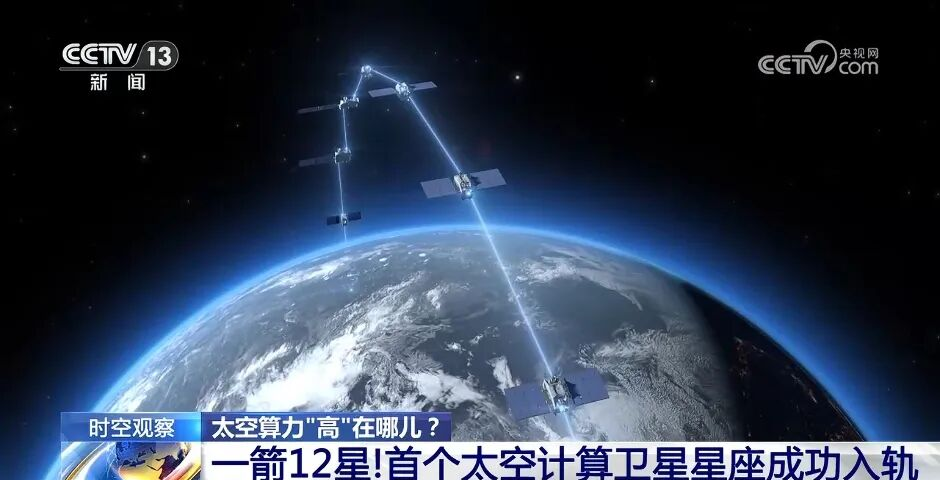
Image source: CCTV.com
The Beijing initiative is betting on scale. The plan calls for building a GW-level centralized space data center in a 700 to 800 kilometer dawn-dusk orbit, composed of three major subsystems: space computing power, relay transmission, and ground control. From 2025 to 2027, the first phase will be built, with total power of 200 KW and computing power of 1,000 POPS, enabling "space data, space computing"; from 2028 to 2030, the second phase will be built for "ground data, space computing"; from 2031 to 2035, large-scale networking will support "space-based primary computing." According to the Beijing Municipal Science and Technology Commission, completion of the first phase alone can directly drive more than several billion yuan in industrial chain output value, and in the long run is expected to exceed one trillion yuan.
There is also a commercialization track rolling forward on its own. The Star Computing plan has planned 2,800 computing satellites with total computing power of 100,000 P. In October 2025, the Group 02 constellation was released, and the "Libra-10" satellite, with single-satellite computing power exceeding 10 P, was unveiled—making the signal of a shift from technical verification to large-scale deployment already very clear.
Beyond these three tracks, what can truly capture orders is the industrial chain. Solar wings will move toward flexible structures and perovskites, with 5 GW of capacity corresponding to nearly 12 square kilometers of solar arrays; on radiation-hardened chips, the self-developed "Tiangang" processor has a single-event upset rate below 0.001%; the next generation of inter-satellite lasers needs to break through 10 Tb/s per channel; further down the chain are optical modules, TT&C, and ground stations.
There is another layer that is easily overlooked: standard-setting power. In January 2026, CAICT, together with more than ten institutions, released the "Computing Power Star Network" cooperation initiative, aiming to establish the rules before racing for frequencies and orbits at the ITU. Orbits and spectrum are first-come, first-served. Getting the rules there earlier than the satellites is the real skill.

Image source: Internet
Now that the opportunities are covered, it is time to lay out the accounts. Space computing power is not as simple as moving servers up there.
The hardest part is heat dissipation. In a vacuum there is no air convection, so heat can only leave by radiation. A 1-square-meter radiating panel at 20°C has a net radiated power of about 633 watts. This means a high-power GPU cluster must be equipped with a pair of "big wings"—deployable radiators. The industry consensus is that heat dissipation is the first constraint on structural design, not merely one of several.
Energy is likewise a hard constraint. GW-level power supply requires several square kilometers of solar wings, and the cost of solar wings is still 400,000 to 500,000 yuan per square meter. If cost reduction is not solved, scale is empty talk.
Radiation hardness is the third hurdle. Single-event upsets and total ionizing dose effects can degrade or even disable chip functions. The engineering compromise is "commercial chips as the primary copy, domestic chips for on-orbit verification": first ensure mission success rate, then gradually replace them.
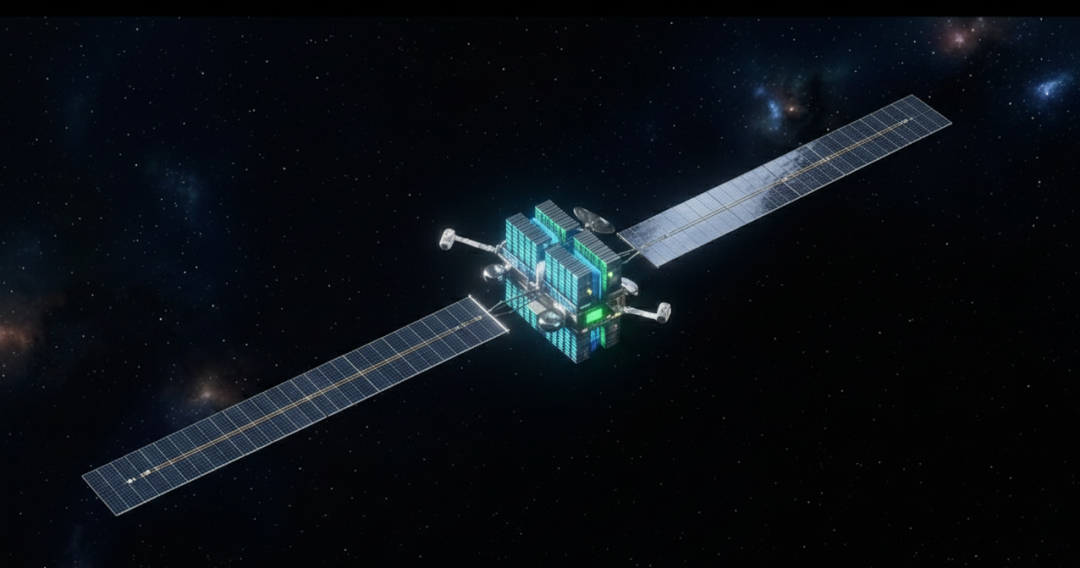
Image source: Internet
Finally, depreciation. Ground data centers can be used for 15 years or even longer, while space computing power centers usually last only 5 to 8 years. The asset model is completely different, and the IRR calculation must also be rewritten.
Beyond the physics problem, there is a business problem: who pays. The answer is not in "ground data, space computing" but in "space data, space computing." In scenarios such as remote sensing, low altitude, and national defense, data is originally generated in space, and on-orbit processing can save more than 90% of the backhaul bandwidth. This is a rigid demand, and willingness to pay is clear. As for moving ground training tasks into space, that is a matter for after 2030.
Written at the end
Putting the two paths side by side, the difference is clear at a glance. The United States has vertical integration by technology giants, diverse technical routes, and uses capital to buy time. SpaceX stuffs rockets, satellites, models, and chips all into one engine, betting that "I can run faster than regulators." China follows national strategic guidance, advancing all the way from experimental satellites to demonstration constellations to large-scale networking, using the system to buy certainty—not seeking to be the fastest, but seeking to be the most stable, most autonomous, and most replicable.
"The blue tide beats the shore" looks like bad news in the short term. But over a longer time axis, it is more like a forced lane change: the more expensive the ground, the more attractive the orbit.
Going forward, three indicators are enough. One is the pace of FCC rulings on million-satellite constellations: how many satellites are approved, in how many batches, and with what conditions attached directly determines Musk's timetable. Another is Starship's unit cost to orbit, whether it can truly fall below $150 per kilogram—this is the denominator of the entire space computing power economics. The third is domestic single-satellite computing power and the number of networked satellites: single-satellite computing power moving from 744 TOPS to 10P, and networking from 12 satellites to 50 and then to 2,800. The slope is industrial maturity.
Where computing power ultimately lands does not depend on who first shouts "to the sky," but on who first pushes the cost per PFLOPS of computing power down to a position others cannot reach.
References:
Who is entering the construction of the "space computing power network" Source: Yicai
Does Musk want to move the computing power "battlefield" to space? Source: Global Tiger Finance
Some materials collected by AI
- END -
-
![]()
Chopsticks Catch a Spacecraft! Musk Wins Another Bet—Whose Face Does This Slap Wake Up?
-
![]()
Five Years After the Huawei Spinoff: xFusion Seeks 8 Billion Yuan in IPO — Why Is the No. 2 Server Maker Turning to Energy? The Next Battle in Computing Power Is All About Power Supply
-
![]()
Double 11 Token Rush: Discounts Alone Can't Secure AI's Commercial Future
-
![]()
NIO Main Brand October: ES8 Sells Out, Accounting for Nearly Half
-
![]()
HUD Giant Foryou Group Posts Q3 Revenue of 4.273 Billion Yuan, Up 22.79%, as It Expands into Cabinet Cooling Components
-
![]()
Beyond the ZEEKR 9X and 7X: What Does It Take to Build a Hit Model?
-
![]()
SAIC Motor Sold 430,000 Vehicles in October, 220,000 Domestically: Which Businesses Are Growing and Which Are Still Contracting?
-
![]()
Musk's High-Stakes Bet on Space Computing Power Amid Democratic Pushback—Will China Follow Suit?