Five Years After the Huawei Spinoff: xFusion Seeks 8 Billion Yuan in IPO — Why Is the No. 2 Server Maker Turning to Energy? The Next Battle in Computing Power Is All About Power Supply
 11/16 2026
 429
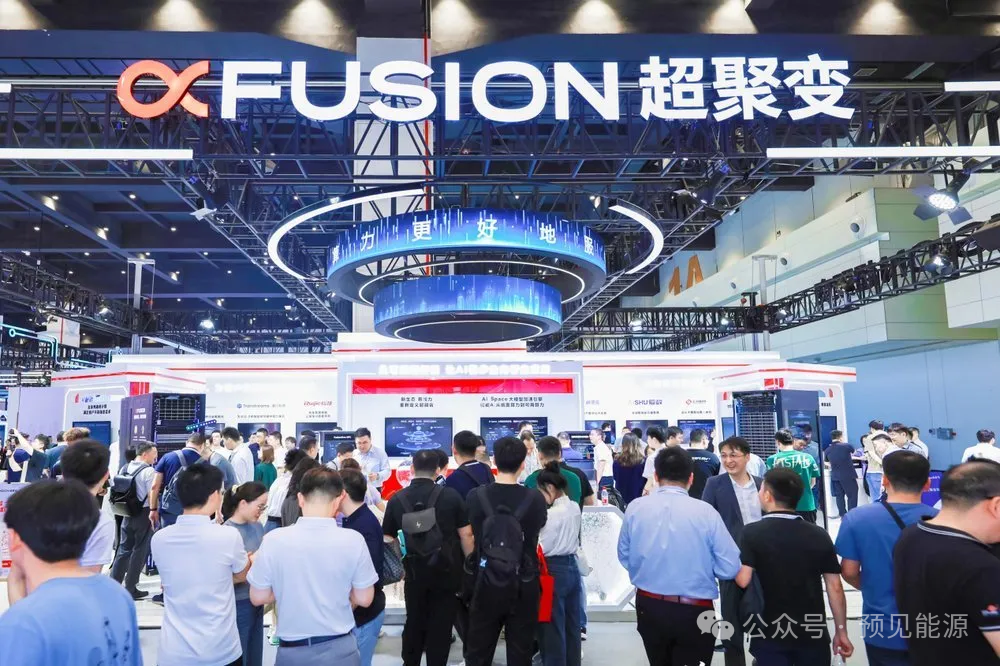
xFusion plans to raise 8 billion yuan and spin its power supply architecture into a new business line.
Foresee Energy has learned that on November 12, the Shenzhen Stock Exchange Listing Review Committee's 61st deliberation meeting of 2026 approved the IPO application of xFusion Digital Technologies Co., Ltd. The company plans to raise 8 billion yuan — the largest among ChiNext projects accepted this year.
Five years ago, the company did not exist. Its predecessor was Huawei's x86 server business, and what came over with the team during the spinoff were server product series such as FusionServer, KunLun and FusionPoD.
Of the 8 billion yuan, 890 million is earmarked for an R&D project whose full name lists power supply architecture alongside intelligent computing power and AI. In 2025, energy intelligence solutions generated revenue of 18.1116 million yuan, which together with the urban-enterprise digital intelligence business accounted for 0.28% of main business revenue.
Why would a company that has sold its way to the No. 2 spot in China's server market turn the electricity in the data center into a separate business? The first half of the answer is written in the spinoff list of five years ago; the second half is written in the action plan issued by four ministries in April this year.

From HUAWEI CONNECT to the Zhengzhou Production Line
On June 7, 2021, Huawei established Huawei Digital Power Technologies Co., Ltd. with a registered capital of 3 billion yuan. The data center energy corps and smart PV corps reported to the president of this company, and the data center energy business was summarized as "reconstructing architecture, reconstructing power supply, reconstructing temperature control, and reconstructing operations and maintenance."
Three months later, on September 13, Huawei wholly registered xFusion in the Zhengzhou area of the China (Henan) Pilot Free Trade Zone, transferring the x86 server business as a whole.
The two lines were originally adjacent within Huawei. What was transferred out was the complete machine product line and R&D team, while the incorporated entity for energy and data center power supply and distribution remained in Shenzhen.
At HUAWEI CONNECT on September 24, 2021, then Huawei Rotating Chairman Guo Ping acknowledged that the x86 business "had indeed encountered difficulties" and revealed that it was in contact with potential investors. The next day, then Huawei Vice President and President of the Computing Product Line Deng Taihua explained the reasons more specifically: the continuity of the x86 supply chain faced challenges, and Huawei retained a server route based on its self-developed Kunpeng and Ascend chips.
The shareholding platform established by the Henan State-owned Assets Supervision and Administration Commission to take over this business was completed earlier than the industrial and commercial change. In August 2021, Henan Chaoxuneng Technology Co., Ltd. was established, and Henan Province set up a special information industry computing power fund for this acquisition, receiving part of the equity in December of that year and subsequently becoming the controlling shareholder. On November 5, xFusion completed the industrial and commercial change, and Huawei exited all shareholding.
After the shareholder register changed, what first loosened was the upstream supply license. In early 2022, Intel took the lead in resuming supply, and other suppliers followed within half a year. The controlling shareholder provided a 3 billion yuan entrusted loan that year, exempted 2.25 billion yuan of it in February 2023, and received about 400 million yuan in government subsidies that year.
According to media reports, in the spring of 2022 Liu Hongyun led a team to launch the "Hundred Cities Tour," visiting customers one by one. After the launch of NVIDIA H800 in March 2023, it bet on this solution relatively early. From 2023 to 2025, revenue increased from 25.092 billion yuan to 58.246 billion yuan, with shipment volume ranking second domestically and sixth globally.
The part of the foundation truly related to electricity was all attached to complete machine delivery at the time. Among the 12 xLAB laboratories in the prospectus, a green power supply direction is specially established. On the power supply side, the high-voltage high-power bidirectional conversion system outputs 125 kilowatts with conversion efficiency exceeding 98%, and the dual-width super node is equipped with power supply side cabinets and cooling side cabinets, achieving 1 megawatt of power supply with 1 megawatt of cooling.
In 2022, the company took the lead in commercializing gallium nitride server power supplies. These capabilities all served complete machine delivery at the time; after single-cabinet power rose to hundreds of kilowatts, cooling and power supply began to determine whether a data center could be put into operation at the designed power.

Power Supply Architecture Enters the Procurement Catalog
Changes in power within the data center have pushed electricity to become a precondition for computing power delivery. NVIDIA GB200 NVL72 has a whole-rack power consumption of about 120 to 132 kilowatts, while the upper limit of traditional air cooling is usually 20 to 30 kilowatts per cabinet. According to industry estimates, the two configurations of the next-generation Vera Rubin NVL72 cabinets consume about 190 kilowatts and 230 kilowatts respectively. The International Energy Agency's "Energy and AI" report estimates that global data center electricity consumption will increase from 415 terawatt-hours in 2024 to about 945 terawatt-hours in 2030.
Policy has followed by writing computing power facilities as participants in the power system. In 2026, "computing-power-electricity coordination" was written into the government work report for the first time. The action plan issued by four ministries in April deployed 29 tasks, among which Article 2 encourages the deployment of grid-forming energy storage, Article 7 encourages computing power facilities with flexible adjustment capabilities to carry out green electricity direct connection, and Article 8 encourages computing power facilities to participate in grid operation as flexible and adjustable load-side resources.
Among them, Article 5 lists efficient cooling, high-performance servers and high-performance power supply architecture as technical R&D directions, whereby power supply architecture has changed from a technical link inside the complete machine into a technical direction separately listed in both policy texts and the names of fundraising projects.
According to Document No. 650 of 2025 issued by the National Development and Reform Commission and the National Energy Administration, green electricity direct connection refers to a model in which new energy such as wind power, photovoltaic and biomass power generation is not directly connected to the public grid but supplies green electricity to a single electricity user through dedicated lines, with electricity volume clearly and physically traceable, and the project is in principle led by the load side.
Most provisions of the plan take computing power facilities as the subject, and Article 27 also lists energy and artificial intelligence-related enterprises as implementation entities. Data center owners have changed from the party purchasing IT equipment to the load-side entity bearing responsibility for power supply stability and grid regulation, and procurement decisions for energy storage and direct-connection power supply fall on this side.
The reason for making electricity a separate business is also written in the accounts on the complete machine side. In 2025, raw materials accounted for about 98% of main business costs, and sales to the top five customers accounted for more than 50%. The gross margin of the main business fell from 14.27% in 2023 through 10.04% to 8.58% in 2025, and rebounded to 15.49% in the first half of 2026, mainly from inventory and pricing effects under component price increases. From 2024 to 2025, AI server revenue increased from 22.505 billion yuan to 29.629 billion yuan, while gross profit fell from 2.684 billion yuan to 1.942 billion yuan.
Scale has changed the shipment ranking, but has not yet changed the distribution position of complete machines between upstream and downstream. The Shenzhen Stock Exchange's three rounds of inquiries included business independence and historical evolution, pointing to the question of where capabilities belong.

Letting Computing Power Grow on Electricity
At the Explorer Conference in May 2026, Cheng Zhao, President of xFusion Energy Intelligence Solutions, released the Energy Intelligence Solution 2.0 strategy, clearly positioning the company as "a provider of energy intelligence solutions for AIDC and campuses." At the Shenzhen International Digital Energy Exhibition in September, the company presented digital energy storage systems, megawatt-level charging hosts, solid-state transformers and the FusionWatt solution, and demonstrated power electronics capabilities such as grid-forming PCS.
The prospectus divides the business into four blocks: "intelligence, computing, data and energy." The company says it enters the energy intelligence solutions field based on root technologies such as electricity, heat and AI — a path closer to separately pricing capabilities that originally served complete machines.
Of the 8 billion yuan, 4.08 billion yuan is invested in R&D and industrialization of next-generation computing power infrastructure, 2.03 billion yuan for smart manufacturing parks and R&D centers, 1 billion yuan to supplement working capital, and another 890 million yuan for "key technology R&D projects for intelligent computing power, AI and power supply architecture," with power supply architecture listed alongside intelligent computing power and AI as the three R&D directions.
Energy intelligence solutions already have several verifiable implementation records. In March 2026, FusionWatt smart charging piles were deployed in Uzbekistan, which the company calls the first Central Asian order for its energy intelligence solutions. In the same year, it joined forces with China Energy Investment Corporation's Henan company and Xuchang Intelligent to advance computing-power-electricity coordination and green electricity direct connection, and in October was rated an "Excellent Service Provider for Source-Grid-Load-Storage Solutions."
The revenue scale is still very small. In 2025, computing power business revenue was 58.038 billion yuan, accounting for 99.72% of main business revenue, while energy intelligence solutions revenue was 18.1116 million yuan, which together with the 144 million yuan urban-enterprise digital intelligence business accounted for 0.28% — still in the early stage of market expansion.
Huawei Digital Power, which remained in Shenzhen five years ago, has now become a competitor on xFusion's energy line. According to exhibition reports, Huawei Digital Power released an AIDC source-grid-load-storage integrated solution and a new-generation 1000V string grid-forming PCS at SNEC 2026.
On the overseas side, Eaton completed the acquisition of Baud's thermal management business, and its official press release described the combined capabilities as "from grid to chip." In March of the same year, Trane Technologies acquired LiquidStack. The grid-connected projects, grid customers and certification accumulation these companies hold are difficult to replace in the short term with complete machine delivery records.
What was completed over five years is an identity migration: equity, supply qualification, team and customers all changed ownership, and shipment volume reached No. 2 domestically.
The migration solved supply qualification, but pricing power did not shift with it. The electricity capability line originally grew inside the complete machine and was separately priced as power rose. The customer list can be reused, but the procurement catalog and responsible entities have changed.
Energy intelligence solutions revenue of 18.1116 million yuan and no systematically publicly disclosed grid-connection verification records mean whether it can form a revenue source beyond complete machines depends on entering power supply procurement where the load side is the responsible entity. Complete machine delivery capability does not constitute a substitute.
-
![]()
Volkswagen's Crash Course in Car Making
-
The Second Round of the AI Office Battle Begins
-
![]()
Why Does Correcting One Aberration Often Make Another Worse?
-
![]()
BYD Puts a 5-Million-Yuan Bounty on the Table — and Exposes a Hidden Industry Chain
-
![]()
Chopsticks Catch a Spacecraft! Musk Wins Another Bet—Whose Face Does This Slap Wake Up?
-
![]()
Five Years After the Huawei Spinoff: xFusion Seeks 8 Billion Yuan in IPO — Why Is the No. 2 Server Maker Turning to Energy? The Next Battle in Computing Power Is All About Power Supply
-
![]()
Double 11 Token Rush: Discounts Alone Can't Secure AI's Commercial Future
-
![]()
NIO Main Brand October: ES8 Sells Out, Accounting for Nearly Half