HUD Giant Foryou Group Posts Q3 Revenue of 4.273 Billion Yuan, Up 22.79%, as It Expands into Cabinet Cooling Components
 11/16 2026
 521
On August 21, controlling shareholder Huayue Investment signed a share transfer agreement with Sichuan Jiuzhou Group to transfer approximately 149 million shares for consideration of about 5.66 billion yuan.
Jiuzhou Investment Holding Group plans to acquire 28.30% of the shares, which would shift control of Foryou Group from the founder team to the Mianyang state-owned assets system.
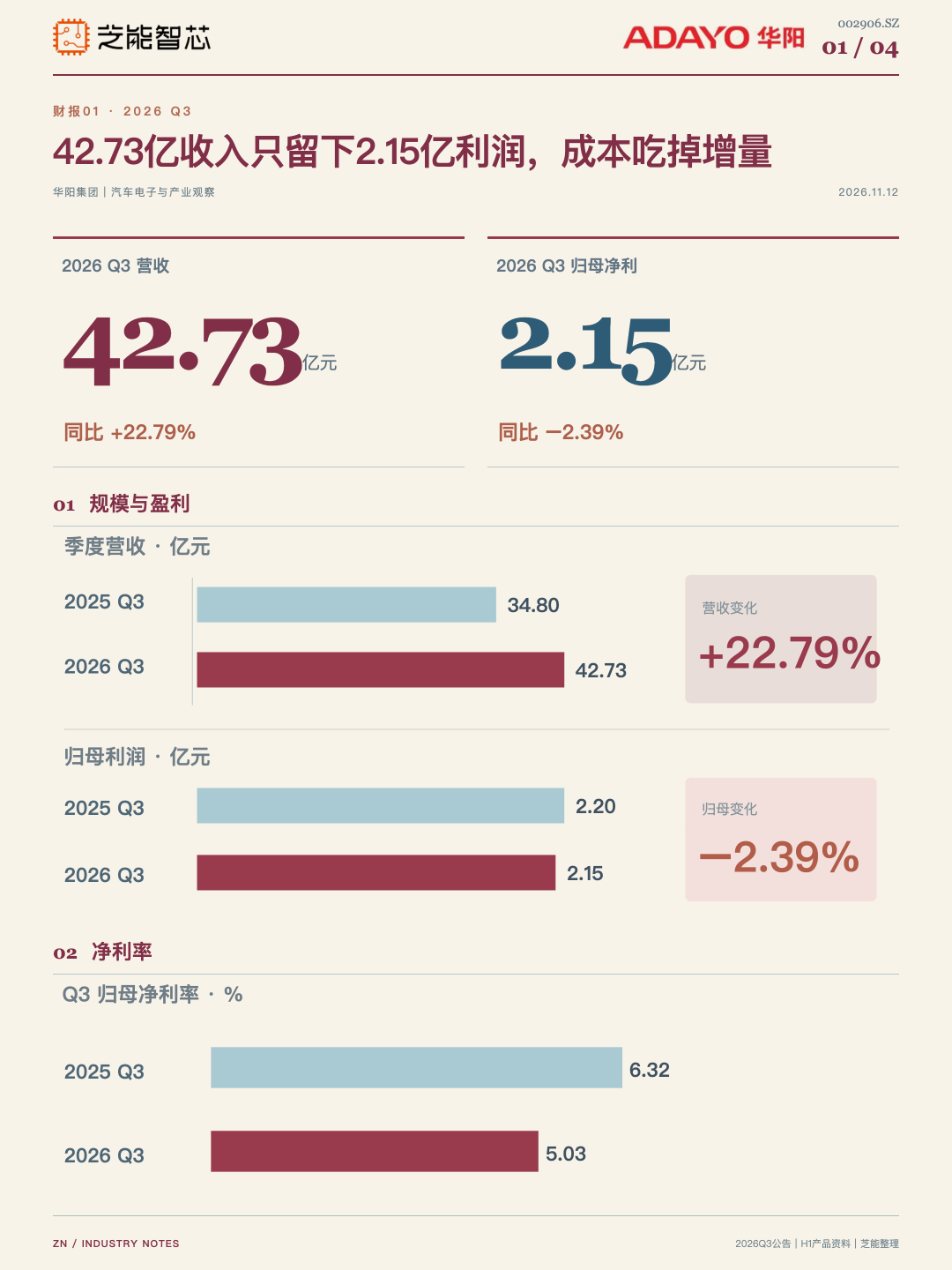
In the same quarter, the HUD and cockpit electronics supplier's revenue rose 22.79%, while net profit attributable to parent fell 2.39%, as material price increases and interest expenses consumed most of the incremental revenue.
On November 9, management outlined the progress of designations in its AI business—making cooling components for cabinets. Are better days ahead?
Part 1
Revenue Up 27.36%, Profit Growth Only 9.74%
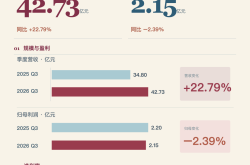
Single-quarter revenue was 4.273 billion yuan, net profit attributable to parent was 215 million yuan, and non-recurring net profit attributable to parent was 201 million yuan—up 22.79%, down 2.39%, and down 7.18% year-on-year, respectively.
For the first three quarters, revenue was 11.196 billion yuan, up 27.36%; net profit attributable to parent was 616 million yuan, up 9.74%; non-recurring net profit was 547 million yuan, up 1.35%; and net cash flow from operating activities was 358 million yuan, down 32.96%.
Single-quarter net margin attributable to parent was 5.03%, versus 6.32% in the same period last year; the proportion of new revenue converted into profit is declining.
The cost items listed at the October 29 investor exchange were rising prices of memory chips, PCBs, and aluminum alloys, along with increased interest expenses.
Automotive electronics' screen displays, HUD, wireless charging, cockpit domain controllers, and precision motion mechanisms continued to grow, and the die-casting business's magnesium alloys and zinc alloys also performed well.
DDR, PCB, and PMIC on cockpit domain controller boards rise at will during procurement, while component supply prices follow vehicle programs, annual price negotiations, and designated contracts—the difference first lands on the Tier 1 supplier's books.
Foryou is pushing VAVE cost reduction and negotiating price linkage with customers; swapping a component requires re-validation of quality, software adaptation, and manufacturability, and the replacement cycle for high safety-level products will span more than a quarter.
In the first half of 2026, automotive electronics revenue was 5.063 billion yuan, up 33.64% year-on-year, and precision die-casting revenue was 1.574 billion yuan, up 21.81%. HUD domestic market share was 29.8%.
Large-volume deliveries of HUD and screen displays underpinned revenue, with new order volume for HUD and cockpit domain controllers doubling; AIBOX won designation for a platform-type project, and PHUD and collision power modules also entered a batch of new customer projects.
The customer list covers Geely, Changan, Seres, Xiaomi, Li Auto, and Leapmotor, as well as the designation systems of multiple international automakers.
A company supplying both software-hardware systems and precision die-cast parts increases per-vehicle value, while platform complexity and multi-factory investment also press onto cost management.
Part 2
Jiuzhou's Optical Modules and Foryou's Die-Cast Structural Parts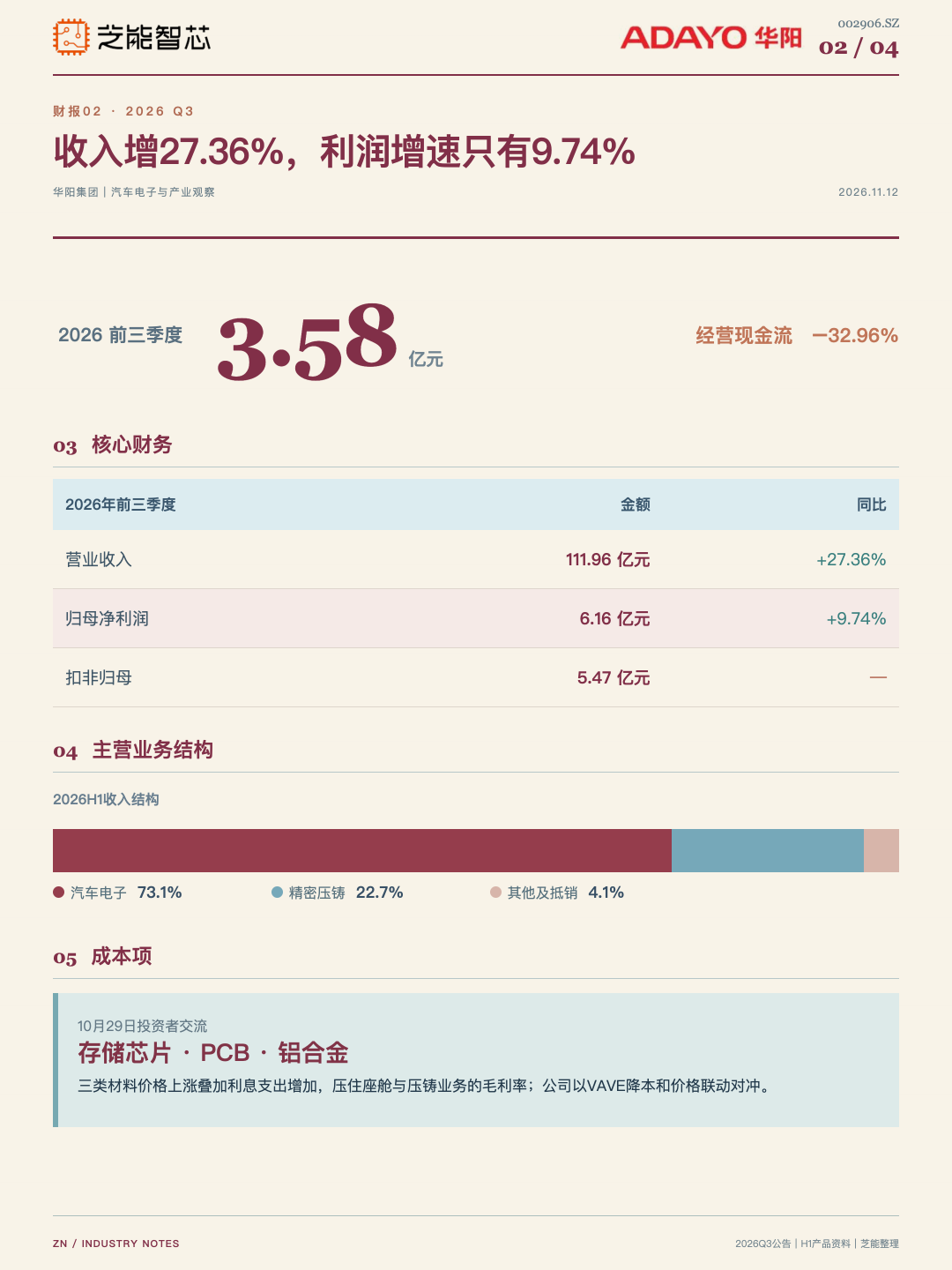
The agreement was signed on August 21, and on October 20 the company announced that the concentration of undertakings review had passed; as of the November 9 investor exchange, the company listed the subsequent steps as state-owned assets regulatory approval, exchange confirmation, and share transfer.
Jiuzhou Group has optical devices, optical modules, and embodied intelligence businesses; Foryou's precision die-casting makes optical module housings, server high-speed connector structural parts, liquid cooling components, and robot joint structural parts—the two sides can connect on products.
On November 9 the company disclosed that the full-lifecycle amount of designated AI business projects exceeds 3 billion yuan, corresponding to delivery cycles over the following years.
Die-casting, cold forging, and precision machining capabilities extend from automotive parts to cabinet parts: optical module housings must fit precisely and dissipate heat, cabinet aluminum alloy cooling parts depend on machining and thermal structure, and liquid cooling parts must withstand higher power density.
The company disclosed that the AI server cabinet aluminum alloy cooling project has entered mass production, copper alloy cooling products have obtained designation from international customers, and multiple optical module liquid cooling plates are still in customer advancement and development stages. Foryou supplies cabinet structural parts.
Automotive die-casting and HUD are engineering-mature but sit within automakers' long-cycle price-reduction procurement systems; AI server products depend on rapid iteration, cooling capability, and delivery speed—the customer structure has changed entirely.
The new AI business capacity planned at Huizhou Dongxing and Thailand is scheduled to gradually commence production in Q4 2026; the full-lifecycle amount of new automotive electronics mass-production projects grew year-on-year, with capacity demand from both lines stacking up in the same quarter.
New line yield and mass-production ramp-up will determine how these designated projects show up on the income statement.
Part 3
After Cockpit Architecture Rearrangement, How Much Value Can the Product Portfolio Retain?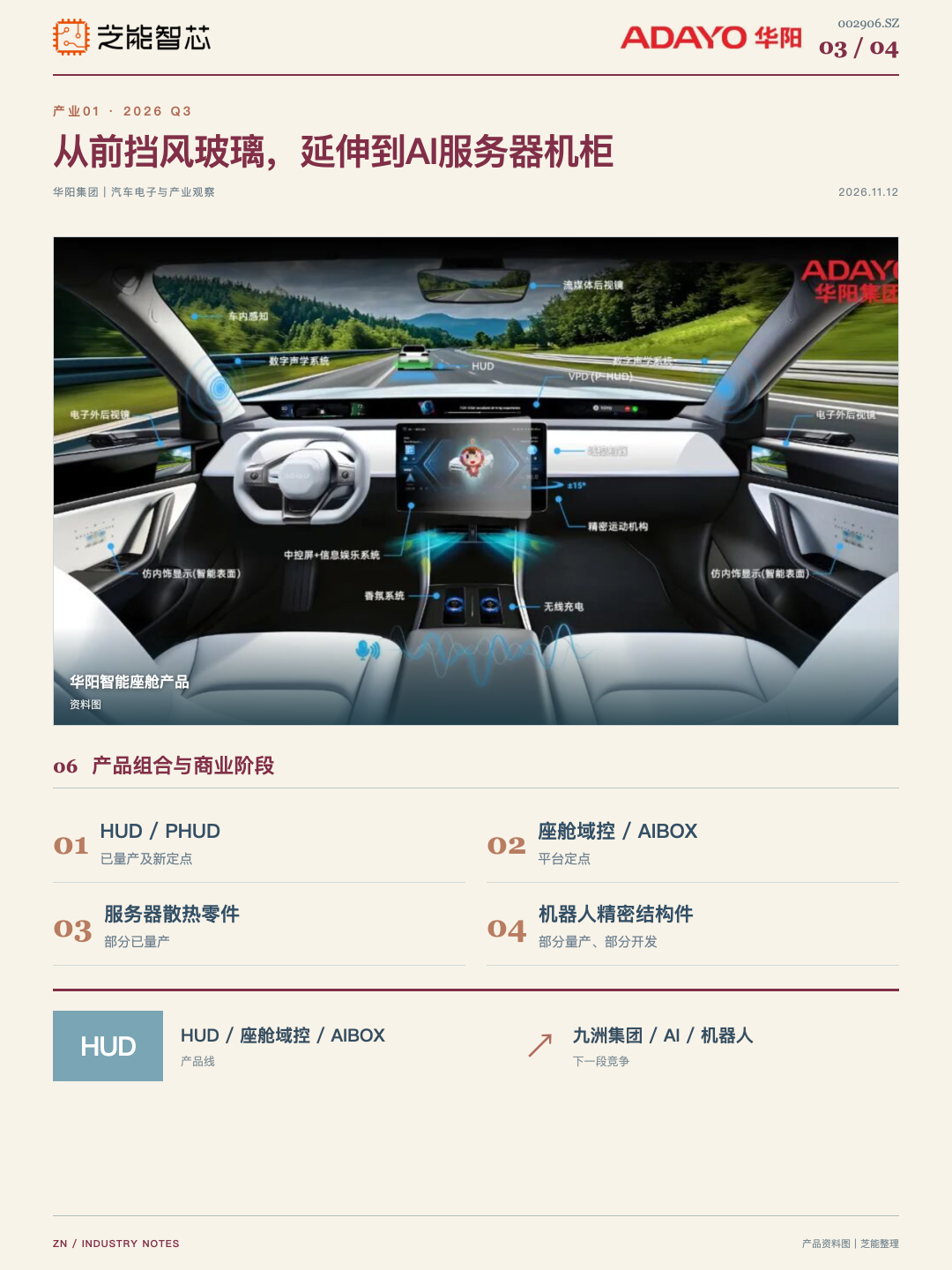
Smart cockpits are moving from stacking screens to system integration; HUD is expanding from single windshield projection to PHUD, angled projection, and depth-of-field displays; AIBOX brings on-device AI applications into cars. The company's cockpit domain controllers already adapt to multiple processor platforms and are accelerating overseas deliveries beyond domestic customers.
After automakers integrate similar functions into central computing platforms, the price of standalone cockpit domain controllers will be redefined, and Foryou's value in next-generation architectures will follow its product portfolio.
In the first half of 2026 the company also disclosed development of robot joint, head, and waist structural parts, as well as positioning, robot charging, and interaction hardware, with sales targets at the component and Tier 1 level.
The Jiuzhou system's optical devices, optical modules, and industry scenario resources leave concrete interfaces for R&D and procurement after the transaction.
Traditional automotive electronics projects follow model cycles with years of validation and continuous supply, while AI optical interconnect structural parts iterate specifications faster; the two rhythms must fit into the same process management, equipment commonality, procurement, and capital expenditure.
Capital expenditure during the AI new capacity ramp-up will be scheduled on the same cash plan as molds and equipment investment for automotive projects.
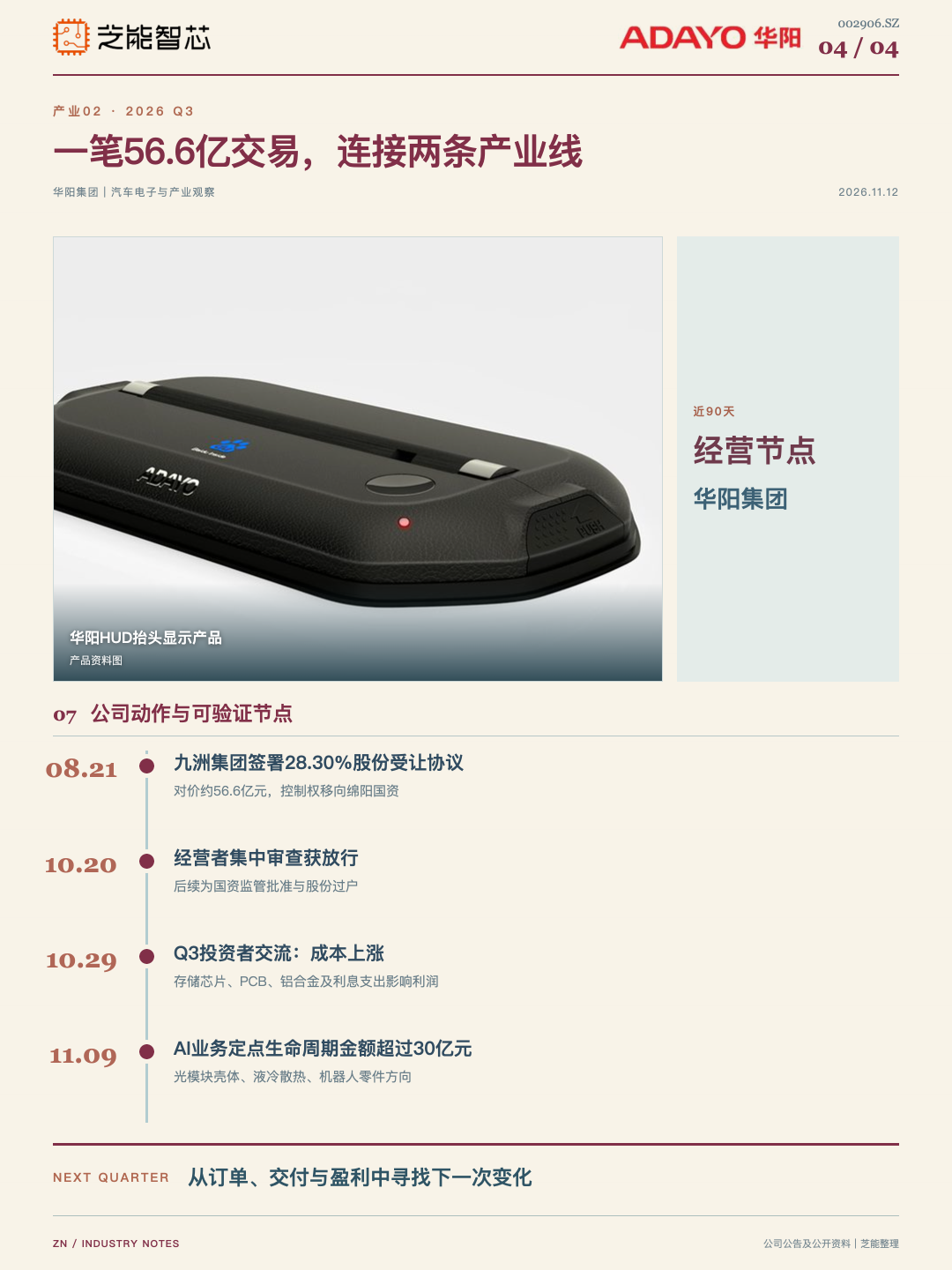
Summary
Revenue of 4.273 billion yuan, up 22.79%; profit down 2.39%; materials and interest consumed the increment. We watch Jiuzhou's share transfer and AI production line ramp-up—will better days come?
-
![]()
Chopsticks Catch a Spacecraft! Musk Wins Another Bet—Whose Face Does This Slap Wake Up?
-
![]()
Five Years After the Huawei Spinoff: xFusion Seeks 8 Billion Yuan in IPO — Why Is the No. 2 Server Maker Turning to Energy? The Next Battle in Computing Power Is All About Power Supply
-
![]()
Double 11 Token Rush: Discounts Alone Can't Secure AI's Commercial Future
-
![]()
NIO Main Brand October: ES8 Sells Out, Accounting for Nearly Half
-
![]()
HUD Giant Foryou Group Posts Q3 Revenue of 4.273 Billion Yuan, Up 22.79%, as It Expands into Cabinet Cooling Components
-
![]()
Beyond the ZEEKR 9X and 7X: What Does It Take to Build a Hit Model?
-
![]()
SAIC Motor Sold 430,000 Vehicles in October, 220,000 Domestically: Which Businesses Are Growing and Which Are Still Contracting?
-
![]()
Musk's High-Stakes Bet on Space Computing Power Amid Democratic Pushback—Will China Follow Suit?