Slashing Prices While Imposing Quotas: The AI Large-Model War Has Already Switched Tracks
 11/18 2026
 526

If you only look at the parameter tables presented at the launch events, you probably won't grasp what really happened on November 16.
On that day, Alibaba released its new-generation foundation model Qwen4-Max, Tencent unveiled Hunyuan Hy4-Flash, and Huawei Cloud open-sourced its embodied world model CloudRobo-WM1.2. All three companies put price cuts and open source on the table almost simultaneously. On the same day, DeepSeek quietly imposed quotas on its own app and web version: long conversations would be capped, daily usage would be limited, and the length of a single input would also be restricted. The reason given was blunt to the point of being unusual — insufficient computing power.
One side cuts prices, the other imposes limits — the directions look completely opposite. But put them together and you'll see that these are not two separate developments at all, but two sides of the same coin, driven by the same force. That force is cost.
01 The Price-Cut Wave: The Narrative Has Changed
First, consider just how aggressive the price cuts are.
This time, Alibaba's Qwen4-Max pushed the cache-hit price down to 0.5 yuan per million tokens, with the average cost of a single task dropping by about 58% compared with the previous generation. It supports million-level context and native visual capabilities, and the company also announced that small and medium-sized models will be open-sourced one after another. Tencent's Hunyuan Hy4-Flash was even more direct, billing itself right away as the "most cost-effective Hy model to date," supporting multimodality and 1M context, with API prices substantially lower than Hy4.
It is worth noting that while these vendors were racing on price, they did not give up racing on capability — parameter counts are still rising and context windows are still getting longer. But the real signal is hidden in one detail: in the past, large models competed for customers by saying "I am one point smarter than you"; now they compete by saying "I am half the price of yours and can also be open-sourced for your private deployment."
The power to define the terms has changed hands. Today, the yardstick for judging whether a model is good or bad is quietly sliding from the intelligence leaderboard to the cost-effectiveness leaderboard.
02 Quotas: The Most Honest Plain Truth
Amid the clamor of more capability at no extra cost, DeepSeek's quotas stand out sharply — and are therefore especially valuable.
When peers were all competing over "how cheap and how much volume I can offer," it did the least dignified but most honest thing — keep users from using too much. Long-conversation limits, daily quota limits, and single-input length limits — the reasons behind these three gates all point to the same phrase: insufficient computing power.
This is precisely the hard constraint that the entire AI industry is least willing to publicly admit right now. You can make the launch-event slides gorgeous, and you can cut the listed price of a single call to a few dimes, but as soon as inference demand rises, the GPUs, electricity, and data centers behind it have to burn money for real. DeepSeek's quotas are equivalent to lifting this constraint from under the table onto the table for the first time: cheapness is a promise, stability is the real cost, and cost has a ceiling.
Therefore, price cuts are the face, and quotas are the inner reality. Only by understanding the quotas can you understand the true underlying color of this round of competition.
03 The Sandwich Layer: Cheap Does Not Mean Capable
So here comes the question: since everyone is competing on cost-effectiveness, does lowering the price mean winning? On the contrary, the most uncomfortable position is exactly the middle ground — cheap but not yet at the very top.
On the efficiency end, the story is indeed easy to tell. Take Alibaba's Qwen as an example. In automotive manufacturing scenarios, it can compress the machining programming time for a single workpiece from 475 minutes to 24 minutes — a reduction of about 95%. This kind of visible cost saving is the most solid implementation of cost-effectiveness.
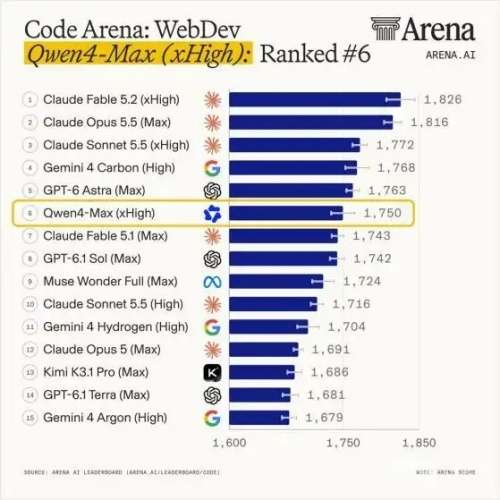
But the other end is equally real. In third-party independent evaluations, the scores of such models still lag behind top closed-source models, including those from Anthropic, Google, and OpenAI. As a result, an awkward sandwich layer appears: the cheap ones are not yet strong enough to fully replace the very best; the highly capable ones cannot withstand massive calls or offer affordable prices.
For customers, using them for routine tasks is very cost-effective, but once they need to tackle the hardest part, they may not dare to bet everything on them. This means that the gap between leading on cost-effectiveness and leading on capability is becoming the most crowded and hardest-to-hold position in the entire industry.
04 Track Change: Computing Power Is the Decisive Factor
Pull the camera back a bit, and November 16 actually had an even bigger footnote.
Almost at the same time, research institution SemiAnalysis cut its forecast for global AI accelerator capital expenditure in 2028 by 28%, and cut 2029 and 2030 by 41% and 40% respectively, with HBM and electricity demand also declining; in the bond market, yields on high-grade technology corporate bonds kept rising. In other words, the underlying cost constraint on being cheap and stable is getting harder, not looser.
Put this background back on top of the price cuts and quota limits from the beginning, and the conclusion becomes clear: the three companies' collective price cuts and one company's forced quotas are two expressions of the same pressure. The competition logic of this round of large models has officially switched tracks — from "I am smarter than you" to "I am cheaper than you, can carry more than you, and can afford to supply over the long term better than you."
The parameter table determines the applause at the moment of the launch event, while computing power and cost determine life and death after the launch event. Whether cheapness and stability can be supplied long-term and simultaneously is the real scoring standard for this question. As for who can laugh last — this marathon that has switched from an intelligence race to a cost race has just fired the starting gun. Let the bullets fly for a while!
-
![]()
Slashing Prices While Imposing Quotas: The AI Large-Model War Has Already Switched Tracks
-
![]()
XPeng Reports 870 Million Yuan Net Loss in Q3 — Who Ate the Profit?
-
Xiaomi 18 Pro Overseas Launch: 86% More Expensive Than Domestic, Breaking 10,000 Yuan!
-
![]()
Avatr's Shareholder Shift Ahead of Hong Kong IPO: CATL's Influence Set to Change
-
![]()
New M8 Secures Only 11,000 Firm Orders in Three Days—Has AITO's Report Card Lost Its Luster?
-
![]()
AI Computing Power Stocks Defy Market Downturn with Sharp Gains
-
![]()
OpenAI Unveils GPT-6.2 Astra and Sol, Outperforming Claude Fable 5.2 at Just 5% of the Cost
-
![]()
Baidu's Q3 Report: Advertising Stalls as AI Takes the Wheel