XPeng Reports 870 Million Yuan Net Loss in Q3 — Who Ate the Profit?
 11/18 2026
 557
On November 16, XPeng Group (9868.HK) released its third-quarter report for 2026. Revenue reached 24.28 billion yuan and deliveries totaled 118,390 units, both hitting record highs — yet net loss came in at 870 million yuan, 490 million yuan more than the 380 million yuan loss in the same period last year.
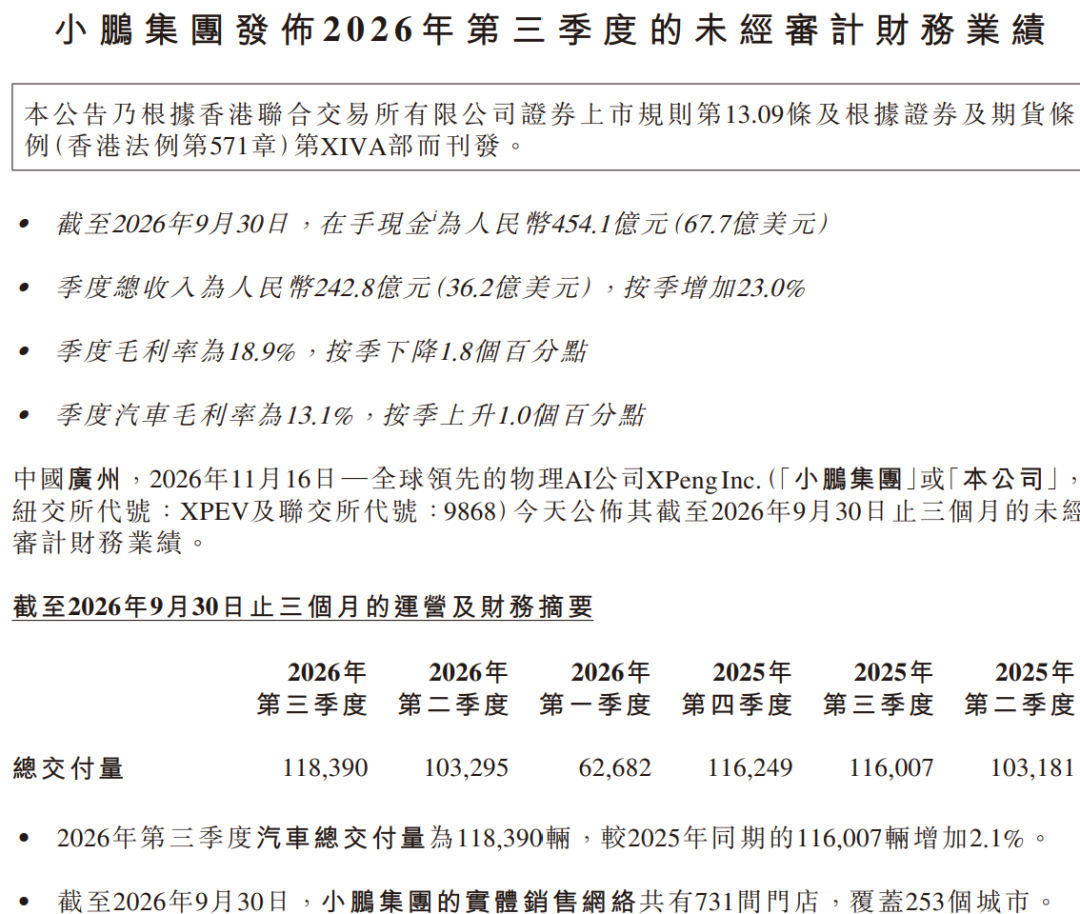
According to the third-quarter report for 2026, XPeng's operating loss was 750 million yuan, flat with the same period last year but down from 1.14 billion yuan in the second quarter of this year.
Notably, XPeng's third-quarter operating revenue of 24.28 billion yuan was 3.9 billion yuan more than the same period last year, while its operating loss did not decrease at all.
On the delivery side, XPeng delivered 118,390 units in the third quarter of this year, up only 2.1% year-on-year. Almost all of the increase came from overseas, with 27,882 units delivered abroad during the quarter, accounting for 23.6% of total deliveries.
The main domestic growth driver was the MONA model. In October, MONA L03 monthly deliveries exceeded 20,000 units, accounting for more than 40% of the company's total deliveries.
The MONA L05, launched at the end of October, started at a promotional price of 139,800 yuan, and 5,000 quasi-stock vehicles sold out in 3 minutes.
However, from January to October this year, XPeng delivered a total of 334,604 units, still down 5.8% year-on-year. The reason was that rush purchases before the phase-out of the purchase tax incentive at the end of 2025 front-loaded demand at the beginning of the year.
Deliveries increased only 2.1%, but revenue grew nearly 20%. The difference came from the average selling price.
In the third quarter of this year, XPeng's revenue per vehicle was 182,700 yuan, up 17.4% year-on-year. The reason behind this was that the new flagship GX and overseas markets pushed up the average price.
But as the unit price rose, costs also rose. In the third quarter of 2026, XPeng's cost of sales per vehicle was 158,800 yuan, 23,600 yuan more than the same period last year. In the third quarter of 2026, XPeng's vehicle gross margin was 13.1%, flat with the same period last year, while its overall gross margin was 18.9%, down 1.2% year-on-year.
In the third quarter, XPeng's revenue per vehicle sold did increase, but costs rose more.
In the third quarter, cost per vehicle rose to 158,800 yuan, 23,600 yuan more than last year's cost per vehicle. Although vehicle gross margin remained at 13.1% and did not decline, overall gross margin fell 1.2% from the same period last year.
In addition, in the third quarter of 2026, XPeng also earned 2.65 billion yuan from "carbon credit trading," a segment with a very high gross margin of 67.1%.
In the third quarter, XPeng's gross profit was 4.6 billion yuan, only 500 million yuan more than last year.
Compared with last year, XPeng's R&D expenses in the third quarter of this year increased by 17.5%, and selling and administrative expenses also rose by 11.4%. Together, the two items cost 710 million yuan more.
Add other income and book gains brought by acquisitions, and the company still posted an operating loss of 750 million yuan in the third quarter of this year. Excluding some non-cash items, the actual operating loss was 770 million yuan, while the actual operating loss in the same period last year was only 520 million yuan.
In terms of net loss, XPeng's net loss in the third quarter of this year was 870 million yuan, 120 million yuan more than its operating loss of 750 million yuan, while in the same period last year, the net loss was instead 370 million yuan less than the operating loss.
Compared with peers, what XPeng loses on is not gross margin, but expense ratio.
Take Leapmotor, for example. It relies on cost control. Leapmotor's revenue in the first half of 2026 was 38.11 billion yuan, and net profit was 208 million yuan, marking three consecutive profitable half-year periods. Its gross margin was only 11.7%, lower than XPeng's. But Leapmotor's R&D, selling, and administrative expenses combined accounted for only 14.0% of revenue in the first half of the year, far below XPeng's 23.2%.
NIO relies on brand premium, with a higher price per vehicle. NIO's vehicle gross margin in the second quarter of this year was 18.5%, and adjusted net profit was 26.1 million yuan, positive for three consecutive quarters. Higher vehicle prices mean higher gross profit.
Xiaomi Auto, meanwhile, is still in the investment phase. Xiaomi Auto's smart EV and AI innovative business segment gross margin in the second quarter of this year was 19.2%, with an operating loss of 2.6 billion yuan. In October, deliveries exceeded 50,000 units for the first time.
In terms of expense ratio, XPeng's expense ratio in the third quarter of this year was 23.2%, while Leapmotor's was 14.0%. For every 100 yuan of revenue, XPeng spends 9.2 yuan more on R&D, sales, and administration.
Moreover, compared with peers, XPeng is more eager to expand across sectors. On October 26, XPeng's Robotaxi obtained Guangzhou's L4-level demonstration operation qualification. The humanoid robot IRON will enter mass production at the end of the year and be launched to external customers in 2027. The robotics business raised more than US$900 million in August, with a post-investment valuation of more than US$6.3 billion.
XPeng has proven that it can create hit products, but it has not yet proven that hit products can make money.
Source/Jinguanshe
-END-
-
![]()
Slashing Prices While Imposing Quotas: The AI Large-Model War Has Already Switched Tracks
-
![]()
XPeng Reports 870 Million Yuan Net Loss in Q3 — Who Ate the Profit?
-
Xiaomi 18 Pro Overseas Launch: 86% More Expensive Than Domestic, Breaking 10,000 Yuan!
-
![]()
Avatr's Shareholder Shift Ahead of Hong Kong IPO: CATL's Influence Set to Change
-
![]()
New M8 Secures Only 11,000 Firm Orders in Three Days—Has AITO's Report Card Lost Its Luster?
-
![]()
AI Computing Power Stocks Defy Market Downturn with Sharp Gains
-
![]()
OpenAI Unveils GPT-6.2 Astra and Sol, Outperforming Claude Fable 5.2 at Just 5% of the Cost
-
![]()
Baidu's Q3 Report: Advertising Stalls as AI Takes the Wheel