Baidu's Q3 Report: Advertising Stalls as AI Takes the Wheel
 11/18 2026
 523
Baidu's AI business has finally seen the light of day.
AI Cloud booked 8.2 billion yuan in a single quarter—to my mind, the standout highlight of the Q3 report.
On November 16, Baidu released its Q3 2026 results: AI cloud infrastructure revenue hit 8.2 billion yuan for the quarter, up 94% year-over-year. Customer prepayments rose, contract terms lengthened, and years of investment began to translate into firmer orders.
Yet the income statement told a different story. Group revenue came in at 30.807 billion yuan, down about 1% year-over-year; gross margin for the quarter was 35.43%, down 5.82 percentage points from a year earlier—the third consecutive year of decline.
On one side, AI cloud is nearly doubling; on the other, group profitability is under mounting pressure.
Baidu has reached the point where the market's questions are pointed and specific: when will this new revenue start delivering profit? Image source: New Yellow River

AI Cloud Drives Growth
Baidu App, Search, and Maps connect users; Wenku and Netdisk provide content and storage. Intelligent Cloud sells computing power, models, and other services to enterprises; Apollo Go runs autonomous ride-hailing; iQIYI earns from memberships and advertising.
Each makes money differently. Search mainly collects advertising fees; cloud services bill by resources, usage, or contract; apps like Wenku and Netdisk charge for premium services; autonomous driving still carries the cost of vehicles and daily operations.
In the consolidated statements, Baidu's general business revenue for the quarter was 24.973 billion yuan, iQIYI contributed 6.007 billion yuan, and after deducting 173 million yuan in eliminations and adjustments, the group revenue was derived.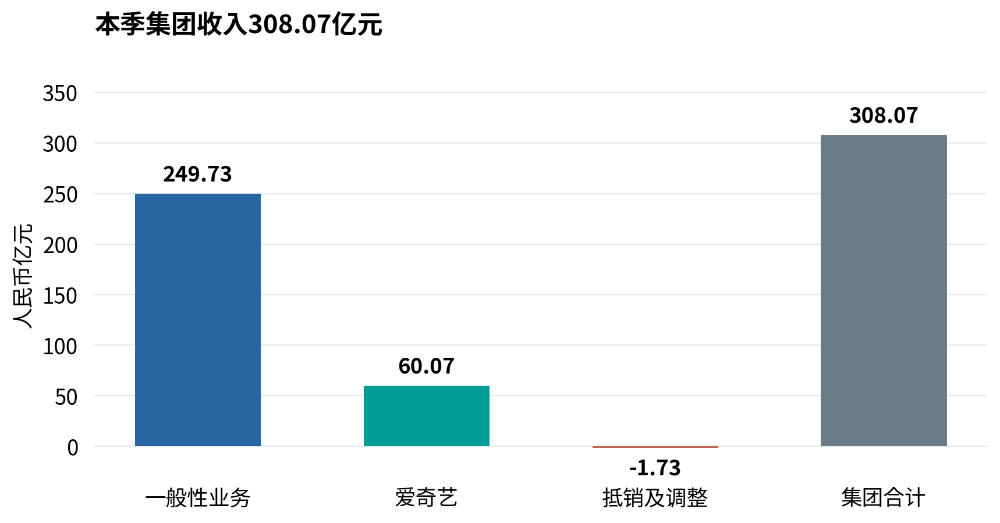 Figure 1: Group revenue composition for the quarter. Source: Baidu Q3 2026 Report.
To gauge the AI transformation, one must also look at a separate set of figures management discloses: core AI new business revenue of 13.2 billion yuan, up 37% year-over-year, accounting for 53% of general business. These figures come from unaudited internal management accounts.
Change the denominator and the story changes. "AI revenue exceeds half" refers to general business; measured against the entire group, that 13.2 billion yuan accounts for about 43%. To see how far the transformation has really gone, one must first read this account clearly.
Breaking down the 13.2 billion yuan further, growth is concentrated in cloud infrastructure.
AI application revenue was 2.6 billion yuan, roughly flat year-over-year; AI-native marketing revenue was 2.4 billion yuan, down 15% year-over-year.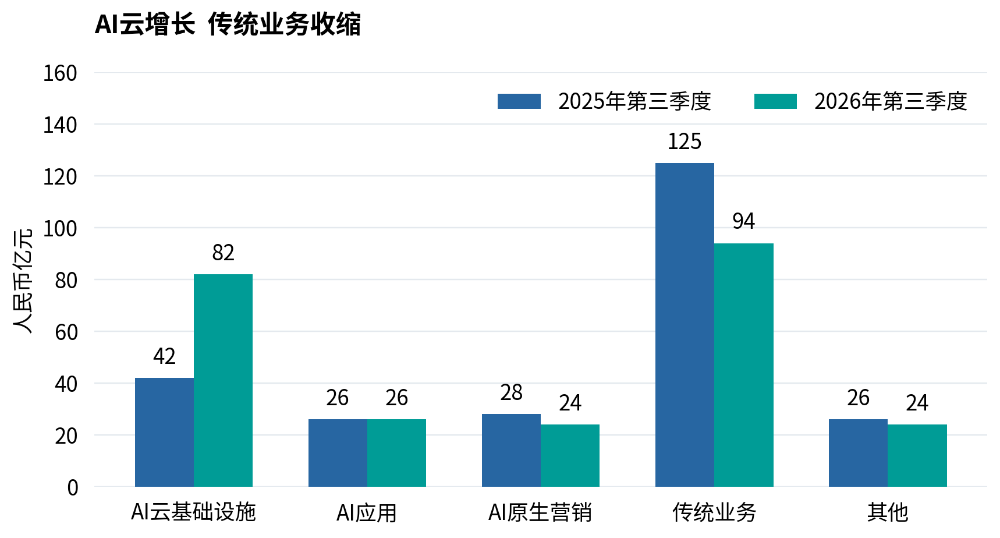 Figure 2: Revenue comparison by business segment. Internal management basis, unaudited; amounts rounded per announcement, growth rates as disclosed by the company. Total AI new business rose from 9.6 billion yuan to 13.2 billion yuan.
The cloud increment has indeed come quickly. GPU cloud revenue grew 191% year-over-year, and customers are willing to pay in advance and sign longer contracts. Demand is materializing; whether deliveries can be made on schedule and payments collected smoothly will determine the quality of this growth.
The pressure comes from the old businesses. Traditional business revenue fell 24% year-over-year, a decrease of about 3.1 billion yuan from the same period last year based on rounded announced amounts.
AI new business grew by about 3.6 billion yuan over the same period, offsetting most of the decline. General business revenue ultimately grew only 1%, iQIYI revenue fell about 10%, and group revenue continued to slide.
New businesses have emerged, yet Baidu's overall pie has not visibly grown.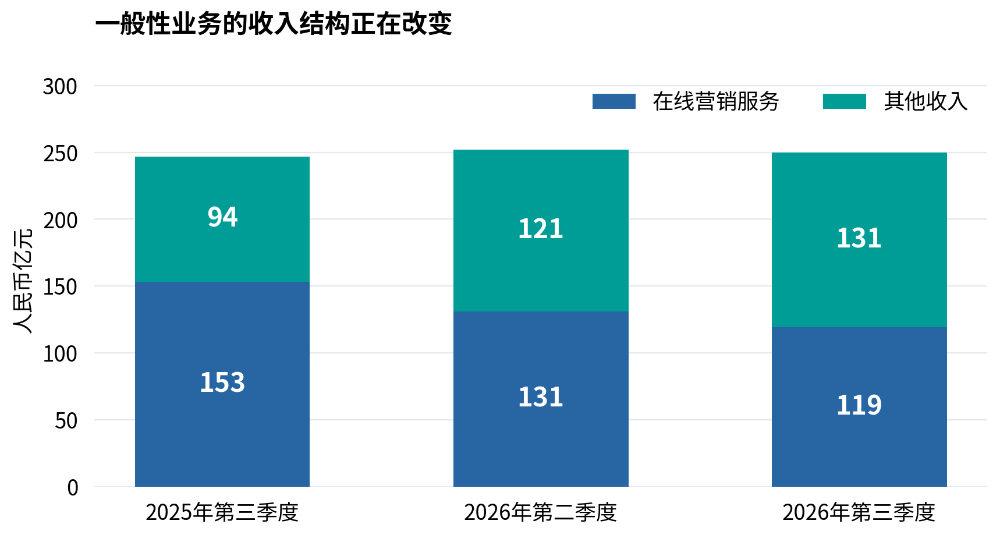 Figure 3: General business revenue structure. Source: Baidu Q3 Report; amounts rounded per announcement. "Other revenue" does not necessarily equal AI new business. Each bar represents the labeled quarter, not consecutive quarters.
Profit Remains Under Pressure
Revenue fell about 1%, yet cost of sales grew about 9%—the most direct reason for this quarter's profit pressure.
Behind the 19.892 billion yuan in cost of sales, the announcement cites two main increases: cloud business-related costs and traffic acquisition costs. Content costs declined, offsetting part of the pressure.
Calculated from the statements, gross profit fell from 12.859 billion yuan a year earlier to 10.915 billion yuan. Gross margin fell from 41.25% to 35.43%. For every 100 yuan of revenue, after deducting cost of sales, nearly 6 yuan less remained than a year ago.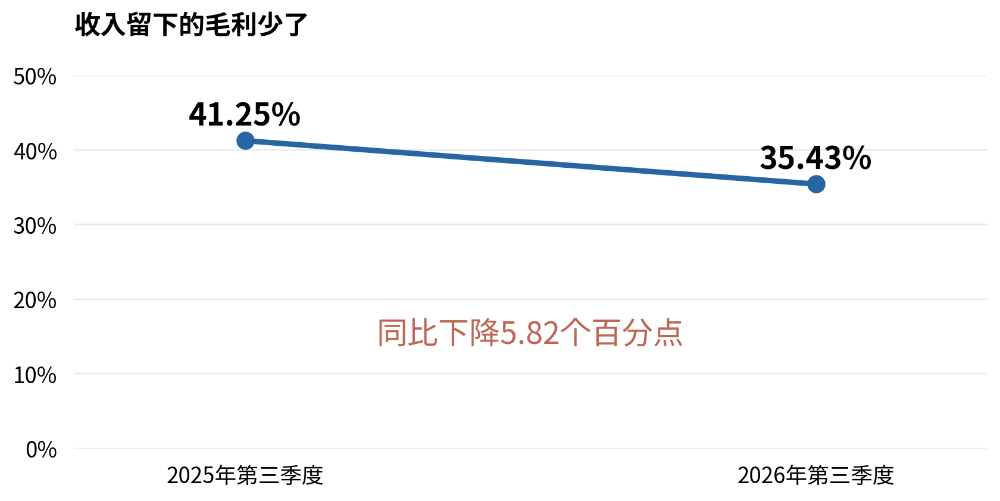
Figure 4: Group gross margin year-over-year change. Calculated as revenue minus cost of sales; the line connects only the two comparison periods and does not represent the path in between.
Moving from advertising to computing power changes the way money is made. Cloud services require equipment, data centers, and ongoing operations and maintenance. As the business grows, upfront investment often rises accordingly. Old businesses contracting and new ones expanding are intertwined, and the group's profit margin is bearing a dual test.
The company has not separately disclosed AI cloud gross margin, and group costs are affected by multiple factors. The judgment the available data supports is that AI cloud growth has not yet brought synchronized improvement in group gross margin; its own profitability level still requires more disclosure.
Net profit attributable to shareholders was 1.395 billion yuan, a year-over-year turnaround—seemingly good news. But last year's 16.190 billion yuan in long-lived asset impairment lowered the comparison base. The swing back to profit is not yet sufficient to show that the core business has recovered its vitality.
The group's operating profit for the quarter was 626 million yuan; on a non-GAAP basis, after excluding share-based compensation and related amortization, operating profit was 1.712 billion yuan, down about 22.4% year-over-year. This measure is still declining, indicating that pressure indeed exists.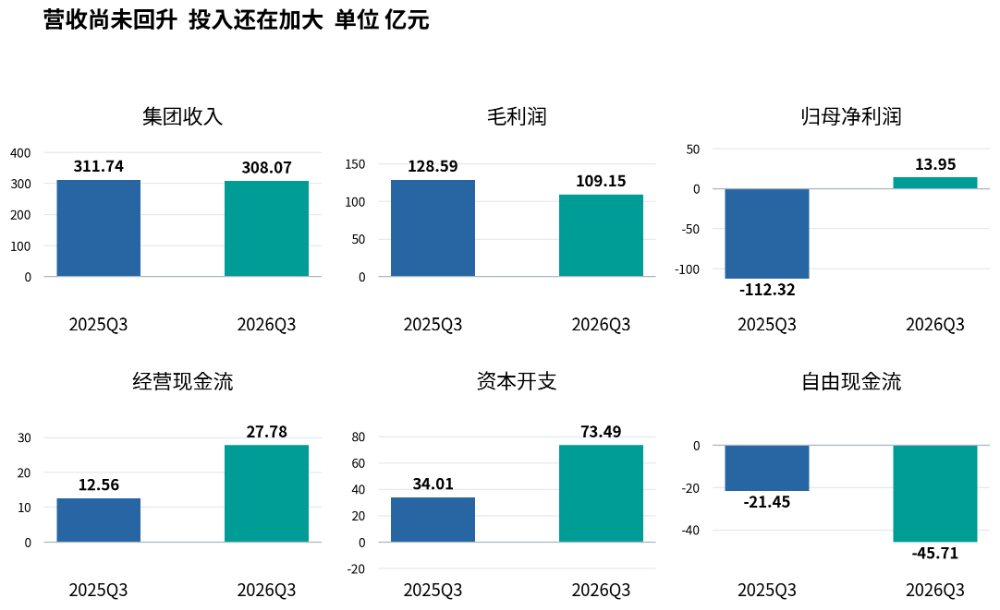 Figure 5: Year-over-year comparison of key group financial data. Unit: RMB billion. Free cash flow per company disclosure; prior-year net profit attributable to shareholders affected by large asset impairment.
Cash flow also reflects the weight of investment. The group's operating activities brought in 2.778 billion yuan in cash, while capital expenditure reached 7.349 billion yuan. Under the company's disclosed calculation method, free cash flow was a net outflow of 4.571 billion yuan.
It is not that Baidu lacks capital for patient investment.
As of the end of September, total cash and investments stood at 276.6 billion yuan, though this includes long-term investments and other assets that cannot all be regarded as readily available cash. The funding reserve buys the transformation time; whether customers will continue to pay determines whether that time is worthwhile.
The market's waiting also has a cost. Old businesses are retreating, new businesses still need investment, and application revenue has temporarily stalled. The slower profit recovers, the more discriminating investors become about the next round of investment.
The stock price has halved during the year. As of the November 16 U.S. market close, Baidu was at $73.94, down about 55.3% from its intra-year high of $165.30 on January 22. This is a drawdown from the high; the return from the beginning to the end of the past year needs separate calculation.
Operating changes and market sentiment jointly affect the stock price, and this decline cannot be attributed item by item.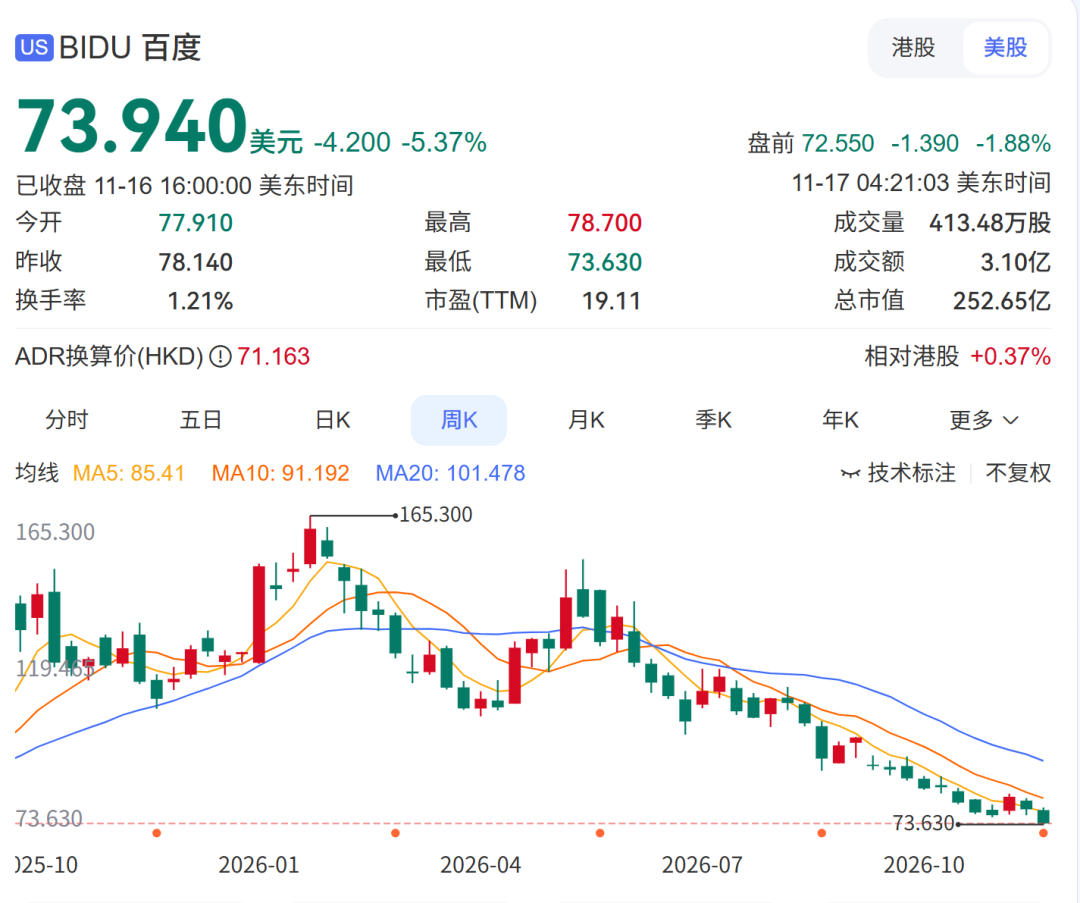
Big Tech Competition
In today's AI competition, whether customers are willing to stay and keep paying is increasingly critical.
Alibaba's AI cloud and computing power services revenue for the June 2026 quarter was 48.437 billion yuan, up 45% year-over-year; of which AI-related product revenue was 12.376 billion yuan, achieving triple-digit growth for 12 consecutive quarters.
The business scope and statistical periods here differ from Baidu's; directly dividing the two companies' revenues lacks comparability.
More noteworthy than revenue scale is Alibaba's customer relationships. Cloud is interconnected with office and e-commerce products, and existing workflows can become entry points for new products into enterprises.
Tencent's path offers another reference. Its 2026 interim report shows Q2 marketing services gross profit grew 21% year-over-year, with the company citing improved AI marketing capabilities as driving revenue growth. Applying AI to existing advertising businesses can directly test how technology helps earning efficiency, while Tencent also bears new depreciation and operating costs.
ByteDance reaches individual and enterprise customers through Doubao and Volcano Engine. Huawei combines Pangu models, Ascend, and cloud services, competing around enterprise applications.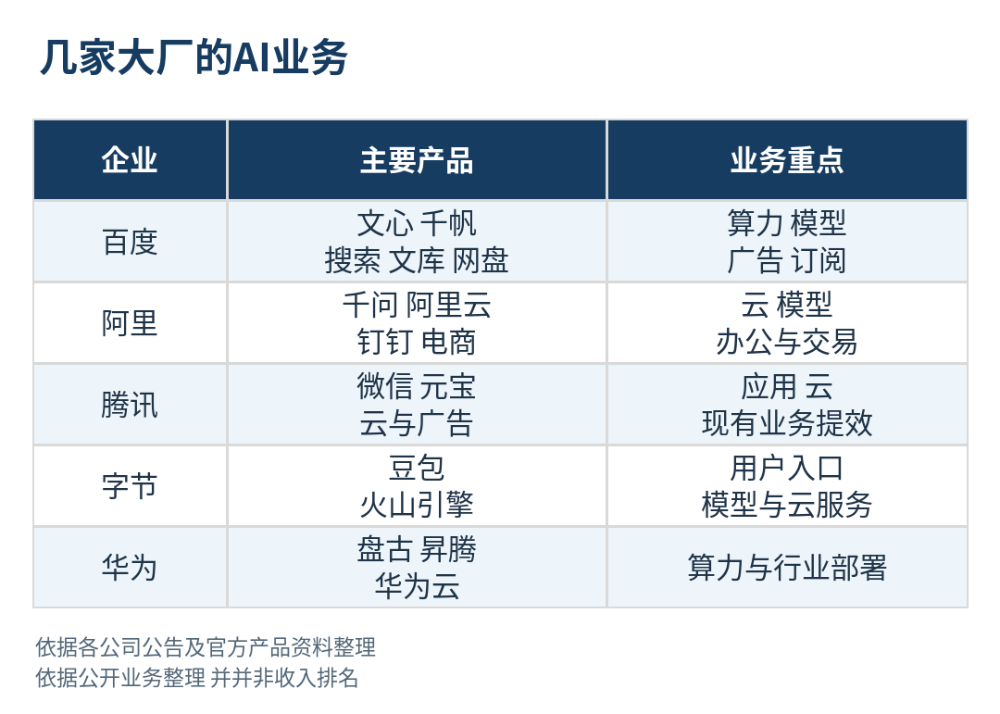 Figure 6: AI business layout of major big tech companies. Compiled from company announcements and official product materials; does not represent revenue ranking.
Shanghai Securities News, citing a Sullivan report, stated that in the first half of 2026, China's full-stack AI cloud services market was 58.13 billion yuan, up 123.8% year-over-year. Alibaba Cloud held 42% share, with Volcano Engine, Baidu AI Cloud, and Tencent Cloud ranking second through fourth. This is the market segment as defined by that report, and the ranking is based on it.
Baidu has already obtained a ticket to the enterprise market.
Whether it can expand share next depends on how much money it actually saves customers, what problems it solves, and whether services can remain stable over the long term.
Robin Li Also Points to Applications
"Woke up early, arrived late at the fair"—this lament is often invoked when discussing Baidu.
But 13.2 billion yuan in AI new business revenue shows that commercialization has already happened. The current gap is more about the fact that after technology took the lead, overall returns have not yet caught up.
Robin Li is responding to the challenge.
On November 16, in the Q3 report announcement, he stated that investment in full-stack AI is translating into scaled growth, the AI-first strategy has seen practical results, and the company will continue to invest firmly in the future.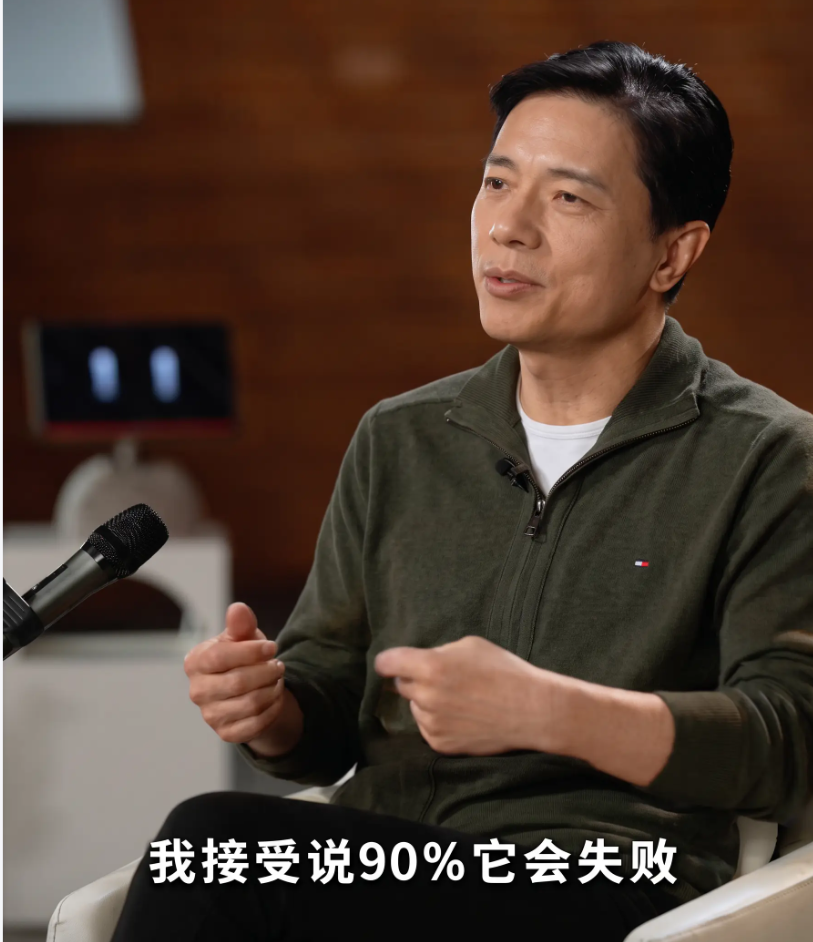
Over the years, what I most admire about my Peking University alumnus Robin Li is his candor and composure—whether being publicly humiliated and doused with water on stage, or now facing such sensitive questions, he can face them candidly.
A day later, at the APEC CEO Summit in Shenzhen, he focused on applications: competition in underlying models and infrastructure is fierce, yet adoption of upper-layer applications is below expectations; if most enterprises have adopted AI but revenue and profit still have not grown, one should be wary of a bubble.
Combined with the "intelligent organization" concept proposed at Baidu World on November 12, his thinking is clear: let agents enter business operations and adjust organizations and processes around AI to turn technological capability into productivity. For Baidu, these remarks also raise the bar for self-examination.
Cloud order growth is only the beginning; whether applications can generate payments and whether organizational adjustments can improve efficiency must ultimately be reflected in the financial statements. The market is waiting, and Baidu still needs to deliver operating results.
The difficulty of the transformation starts with search itself. In the past, users clicked links and Baidu sold advertising around search demand; now that AI directly provides answers, how ads are displayed and how customers see campaign results must all be rearranged.
AI-native marketing declined this quarter, and the company cited competitive changes, the external environment, and prioritizing user experience improvement at this stage as reasons. Baidu is transforming its products and also bearing short-term monetization pressure. The user value brought by the new experience ultimately needs to find a corresponding way to charge.
This also brings the resource allocation dilemma to the forefront. Chips, models, cloud, applications, autonomous driving—every line requires real money.
A full-stack layout helps optimize cost and performance, but the larger the footprint, the more management needs to answer: where should money be invested first, and why are customers willing to pay?
What is most worth observing in organizational management is how capabilities become a usable product. This quarter, Baidu's "Dazi" integrated the capabilities of internal office agents, Comate, and Miaoda. This integration shows that Baidu is attempting to let one product accomplish more tasks.
Will connecting capabilities together necessarily make products easier to use?
The answer must be found with users.
Whether tasks can be completed and whether customers are willing to renew are more persuasive than how many internal features have been added. Public information is still insufficient to reconstruct the details of internal collaboration, and directly attributing performance pressure to internal friction still lacks a basis.
Organizational adjustments must ultimately translate into business results. Once model performance improves, task completion rates, customer renewals, and service costs should improve accordingly. Otherwise, progress in technical metrics will be hard to convert into incremental gains in the next financial report.
Paid conversion is another hurdle. In September, the AI daily active user penetration rate of Wenku and Netdisk rose 60.7% year on year, while AI application revenue this quarter was basically flat. The two indicators cover different scopes, so the conversion rate cannot be directly inferred from them. But Baidu still needs to answer how usage momentum turns into revenue. Apollo Go file photo, source: 36Kr report in May 2025.
Apollo Go also has returns to calculate. As of October, its business footprint covered 30 cities, including stages such as operations and testing.
After the footprint expands, whether vehicle utilization, operating costs, and revenue can keep pace determines how far this expansion can go.
Looking at this third-quarter report, Baidu's AI transformation has made substantive progress, while profit repair is still underway. Cloud revenue growth and an increase in customer prepayments provide positive signals; falling gross margin, stagnant application revenue, and free cash flow outflow are another set of numbers that must be confronted head-on.
Next, Baidu needs to let new revenue retain more gross profit, turn people who use AI into continuously paying customers, and gradually turn investment into cash returns.
Having passed the stage of technological first-mover advantage, the next source of persuasiveness must be written in the income statement and cash flow statement.
Founders can accept 90% failure, but investors cannot; they do not have that patience. In short, the AI layout has finally shown promise, so in the end I will still give it a thumbs up.
What do you think of Baidu's latest third-quarter report and AI layout? We look forward to your civilized and rational comments in the message area.
Statement: This article is only an analysis of financial hot topics from a professional perspective. The data and materials cited are from public queries, company announcements, and Tonghuashun iFinD. The views are for reference only and do not constitute any investment or consumption advice.
#FinancialHotTopics #InDepthInterpretation #BusinessFinance #InvestmentBankingCircle #ListedCompanies #PrimaryMarket #IPO #AI
-
![]()
OpenAI Unveils GPT-6.2 Astra and Sol, Outperforming Claude Fable 5.2 at Just 5% of the Cost
-
![]()
Baidu's Q3 Report: Advertising Stalls as AI Takes the Wheel
-
![]()
JD.com: Retail Stops the Bleeding While Overseas Burns Cash — When Will the "Thrashing" End?
-
![]()
Great report! But without Jensen Huang, Nvidia just doesn't feel the same!
-
![]()
LCoS and the Screen Door Effect: Why Do Our Eyes "Catch" the Pixel Gaps?
-
![]()
Cybertruck Failed to Keep Musk, the Car Builder
-
![]()
Chips Are Scarce, Yet TSMC Has Started "Vetting Customers' Finances"?
-
After "Taking Down" Jensen Huang, the United States Officially Shows Its Hand: A Comprehensive Blockade on China's AI Computing Power