Huawei's Open-Source Pangu Quietly Ships a New Release—Just How Strong Is "National Chips Training National Models"?
 11/19 2026
 351
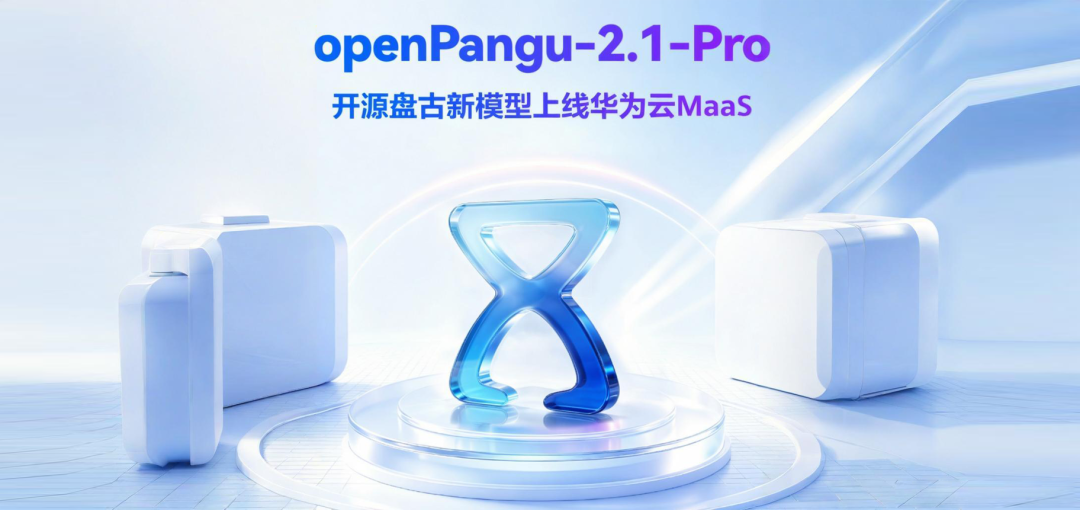
On November 15, Huawei Cloud's MaaS platform released the open-source Pangu model openPangu-2.1-Pro.
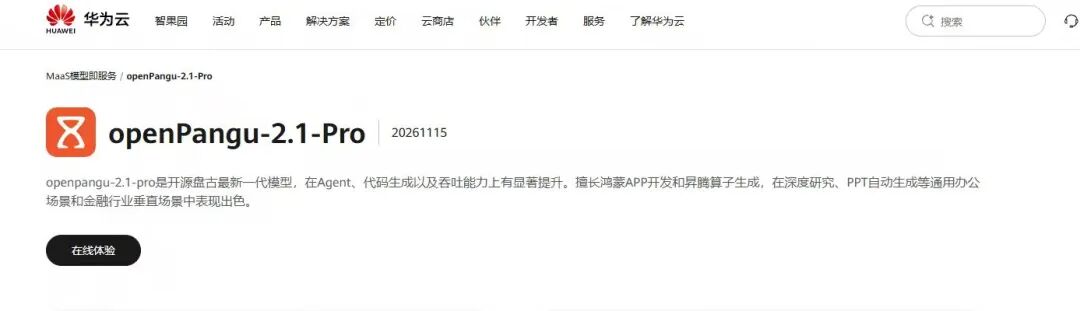 Image source: Huawei Cloud
No launch event, no teaser poster—the pricing went straight into the announcement: 0.8 yuan per million input tokens, 3.2 yuan per million output tokens, and 0.016 yuan for cache hits.
The DeepSeek V4-Pro of the same period quoted 6 yuan for output. Converted, this generation of Pangu comes in at only fifty to sixty percent of that. A few months ago, 2.0-Pro carried an output unit price of 14.5 yuan, roughly 2.4 times that of the other. From a pricier tier to a cheaper one—that is a very sharp turn.
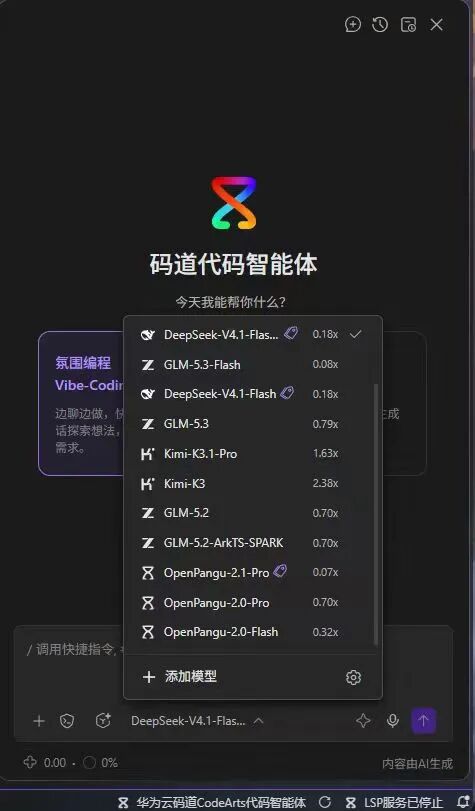 Image source: Huawei Cloud
The 0.016 tier is the easiest to misread. It only applies to cache hits and suits workloads where the same prompt and the same codebase are fed in repeatedly. For regular conversations and long code generation, the cost is still calculated at 3.2 yuan. Whether this cheap tier is usable depends on the business model.
Price only explains half the story. Over these years, Pangu started early but stumbled along the way, and now Yu Chengdong has carried it to the forefront, determined to strive for world number one.
The old exits, the new goes on the shelf
In 2021, when few people in China were even talking about large models, Huawei brought out Pangu.
Yu Chengdong mentioned at HDC 2026 that at the time, no one in all of China or the world knew what a large model was, and Huawei could be considered an absolute pioneer in this industry.
He took over before National Day 2025. The next year at HDC, openPangu 2.0 was released, with the line "in the dictionary of the rest of my life, there is no second, only first."
Previously, Huawei Cloud MaaS issued an announcement that two openPangu 2.0 models would be taken offline, but the old versions going offline does not mean Pangu models are discontinued.
What is easy to confuse is this: what is stopped is the hosted interface on the cloud, not the model. The weights and code have long been in the open-source community, and downloading, deployment, and fine-tuning are all unaffected. The industry Pangu large models for government and enterprise have also not been touched.
The old exits, the new goes on the shelf, with fifteen days in between. One retreat and one advance show that Huawei has changed its approach.
Confidence is not in words, but in hundreds of millions of devices
From National Day 2025 to the launch of 2.1-Pro, just over a year.
One year is not short in model iteration, and not long in ecosystem building.
What Huawei has hardest in hand is terminals. Phones, PCs, tablets, smart screens, and car machines—their installed base is in the hundreds of millions. For Pangu, this is both scenario and a daily exam paper—a voice command, a cross-app jump, a stretch of road conditions on the car side. Whether the model works does not need to wait for leaderboards; hundreds of millions of devices are testing it every day.
The second thing is data. HarmonyOS terminal interactions, HarmonyOS Smart Cockpit driving, and cloud documents and meetings—not many companies hold all of these at the same time. But whether they can be used is another matter; authorization, desensitization, and compliance are each a threshold; even if they can be obtained, they still need labeling and cleaning before they can become corpus, which is another cost.
The third thing is HarmonyOS developers. HarmonyOS went from lacking apps to where it is today by relying on the people who actually write code in it. CodeArts, officeAce, and AgentArts connecting to 2.1-Pro is equivalent to adding leverage for these people; the more people write, the thicker the ArkTS corpus, and the more accurate the model is on this line. This is a snowball; whoever gets it rolling first gains the advantage.
So Pangu's advantage is not on the parameter table. It stands among hundreds of millions of devices and a whole set of HarmonyOS development tools, an entry point that DeepSeek, Doubao, and Tongyi cannot get.
Entry does not equal capability. Whether devices are willing to hand over scenarios and whether developers are willing to feed in code are the prerequisites for whether confidence can be cashed in. This is also where the real test for Yu Chengdong this year lies.
This time it is not about leaderboards, but about ecosystems
The three lines officially given are Agent, AI coding, and inference link optimization.
2.0 was still comparing scores with general models, but 2.1-Pro no longer compares; it only does three things others cannot do: HarmonyOS system control, HarmonyOS ArkTS development, and Ascend operators.
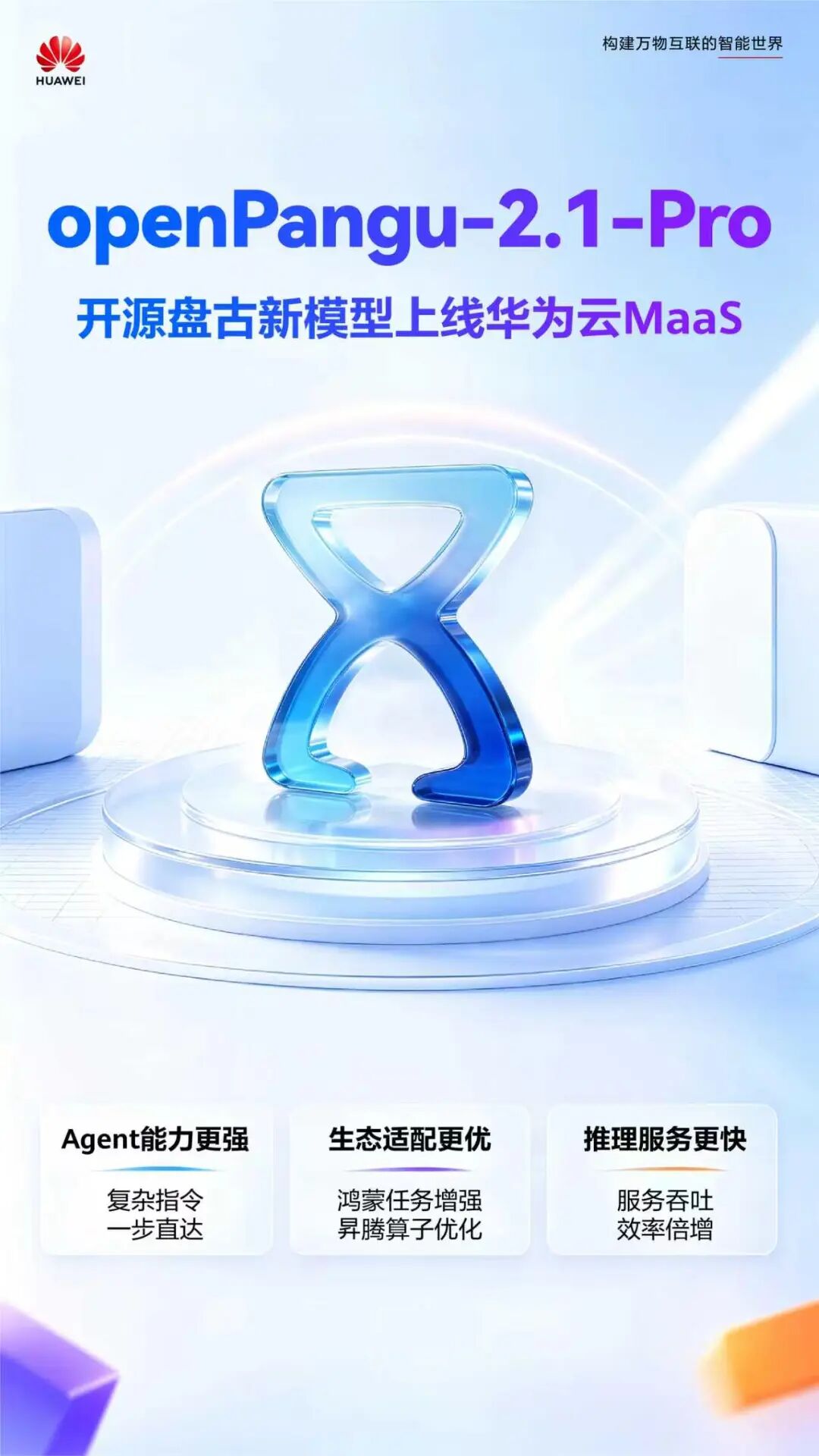
Image source: Huawei Cloud
In the Agent part, more than 100,000 pieces of specialized data train Skills triggering, tool selection, and parameter filling. It is not "can it chat," but "should it call, which one to call, and whether the parameters are filled in correctly." When agents break the chain, it is mostly at these three steps.
Two scenarios were named: deep research and HarmonyOS control. The latter can break a spoken sentence into multi-step system operations. Both types of work require the model to remember what it has called, which also explains why the cache tier is listed separately.
Code is the big part. General models' old problem with writing ArkTS is always the same: the syntax looks right, compilation is all errors, and the interaction logic does not connect. Pangu has adapted to ArkUI components, state management, and declarative UI, and the official statement says both accuracy and usability have improved. Translated into plain language: lightweight applications such as AI Phone, travel, and food can run with one sentence.
Ascend operators are even harder. Previously, for a set of operators—requirements, coding, testing, acceptance—it took two to three weeks. Pangu switches roles, with architecture, development, testing, and acceptance taking turns. In the official case, an RMSNorm was delivered in 14.5 hours, leaving 13 documents, 5 source codes, and 9 test files. What domestic computing power has always lacked is not cards, but these detailed tasks no one wants to do.
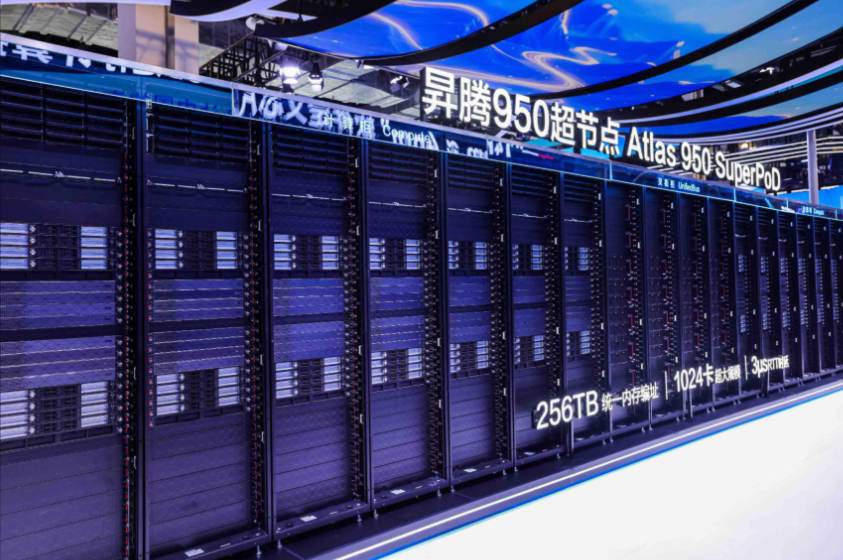 Image source: Huawei official website
On the inference side, operator and link optimization have also been done. Under typical deployment, throughput is higher than the previous generation, and the same batch of cards can handle more concurrency. On the MaaS side, APIs, rate limiting, usage statistics, and monitoring are all configured, so there is no need to build services yourself.
Three products connect to it: AgentArts connects enterprise agent development, optimizing tool calls and task planning; CodeArts connects AI coding, deeply adapting to the HarmonyOS ArkTS language and Ascend operators; OfficeAce connects enterprise office work, taking deep research and PPT capabilities further.
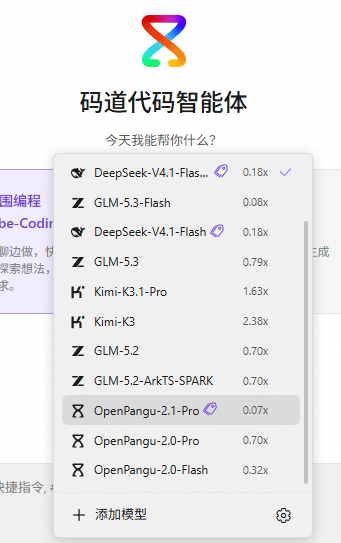 Image source: Huawei Cloud
Model capabilities must ultimately land in tools for developers and enterprises to use smoothly.
On open source, Huawei is more aggressive than most vendors. Earlier this year, it released all training code and training and inference operators, with the entire chain outside—from pretraining to reinforcement learning post-training to Ascend inference optimization. This supports "national chips training national models." Slogans aside, few in China are indeed willing to put their family assets on the table.
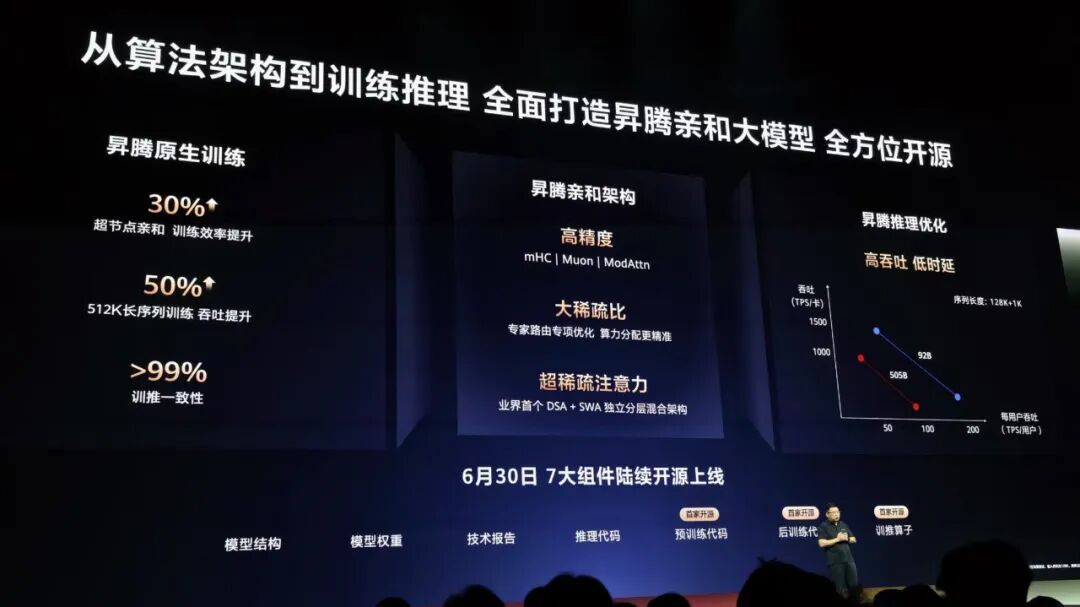
Image source: Huawei Developer Conference
Being cheap is not the answer
By the time the price war reached 2026, being cheap was long no longer a barrier. Whether one can stand firm depends on whether results can be reproduced, whether the ecosystem has depth, and whether developers dare to bet for the long term.
Pangu's bottom card is still that same set of things—Ascend, HarmonyOS, and the cloud toolchain. Others can write general code, but they cannot fully grasp the underlying rules of ArkTS and Ascend operators, nor can they connect into HarmonyOS terminals.
World number one—how far away?
The nearest visible step is to first take number one in China. This step relies on HarmonyOS and Ascend, and there is a real chance. The number one further out must wait for the ecosystem to go overseas; that is a project of another magnitude.
Mockers say it rose early but arrived late at the market. But from another angle, avoiding the frontal battlefield of general models and betting on HarmonyOS and Ascend—two directions only it can deeply cultivate—is one of its few paths in the gap between DeepSeek and Doubao.
Whether this path works does not depend on Yu Chengdong's bold words, nor on this price list. In the coming months, whether technical reports are supplemented, whether open-source weights are delivered, and whether developers vote with their feet are the answers. "How far away" likewise cannot be given as a number; what is certain is that the road has changed: no longer comparing leaderboards, but comparing who can stuff models into real devices and scenarios.
Whether there is a second in the dictionary is not important. Whether there is a place for it in developers' hearts is what matters.
Disclaimer: This article is only a big-tech financial commentary and does not constitute any investment advice. The enterprise data and regulatory events involved in the article all come from public information and are for reference only; the official release shall prevail. Images are from the internet; if there is copyright, please contact for deletion.
-
![]()
October Auto Sales Inventory: Four Carmakers Exceed 70% of Annual Targets
-
Li Shufu's "Relentless" Bet on the Methanol Market
-
Why Has AI Office Work Become the Competitive Focus for Industry Players?
-
![]()
Voyah Secures MIIT Batch 412 Production Access Qualification, Formally Bids Farewell to Operating Under Dongfeng's Umbrella
-
Tencent also cannot achieve the "impossible trinity": traditional business growth, AI business breakthroughs, and positive net cash flow
-
Anthropic Goes Public: A $1.4 Trillion Public Stress Test
-
![]()
Shenzhen: Letting the World Understand China
-
![]()
Survival Is Already Hard Enough—So Why Talk About "Brand Upward Mobility"?