The Biggest IPO Ever—and Buyers Are Swarming
 11/19 2026
 345

Absolutely insane. Unprecedented.
A $10 billion subscription order and you still have to wait in line for this IPO.
Bloomberg, citing people familiar with the matter, reported that Anthropic received multiple subscription orders of $10 billion or more. At $78 per share, $10 billion could buy about 128 million shares—roughly one-sixth of the shares planned for this public offering.
Reuters also reported that on the first day of the roadshow on November 10, orders were about twice the number of shares planned for sale, rising to about six times by the third day. By November 18, Bloomberg's latest figure was close to seven times.
Final allocation has yet to be announced, and how many shares big buyers will receive will have to wait on the underwriters.
Wall Street has seen plenty of hot new stocks in recent years. What's rare here is that, based on the upper end of the offering range, the public offering size already exceeds $64 billion—and orders can still pile up to this extent.
According to Reuters' comparison, institutions are snapping it up even more eagerly than during the early SpaceX roadshow.
The heat has also spread from the order book to brokerages.
Reuters reported that some investment banks are preparing to livestream the listing for clients, and some asset managers are readying trading products to track the stock. Before the stock even starts trading, those building businesses around it are already making moves.
The next hurdle in this scramble is $78 per share.
Bloomberg reported that the issue price could be higher than that number. Only when the price is truly set will the market know at what price the funds rushing to place orders are willing to take the shares. The header image is a generated illustration | Company logo from Wikimedia Commons

Nearly seven times oversubscribed—and the price is climbing too
In September last year, Anthropic secured a $13 billion Series F financing at a post-money valuation of $183 billion. In February this year, Series G pushed the valuation to $380 billion.
At the end of May, a $65 billion Series H closed, bringing the valuation to $965 billion. In just over eight months, the company's private-market valuation rose to 5.3 times its original level.
Four days after the Series H announcement, Anthropic confidentially submitted a draft registration statement for listing. It publicly filed on October 26 and launched the roadshow on November 10.
The revised prospectus on November 17 still listed $70 to $78 per share, and the next day Nasdaq issued a listing certification letter. According to the timetable disclosed by the company, pricing was set for the 18th local U.S. time, with trading expected to begin on the 19th under the ticker ANT.
By the time of pricing, price expectations had already moved higher.
Bloomberg reported that Anthropic conveyed to potential investors expectations that pricing could be above the offering range.
At $78 per share, Bloomberg estimates a fully diluted valuation of about $1.4 trillion. As of November 18 Beijing time, the final issue price was still pending announcement.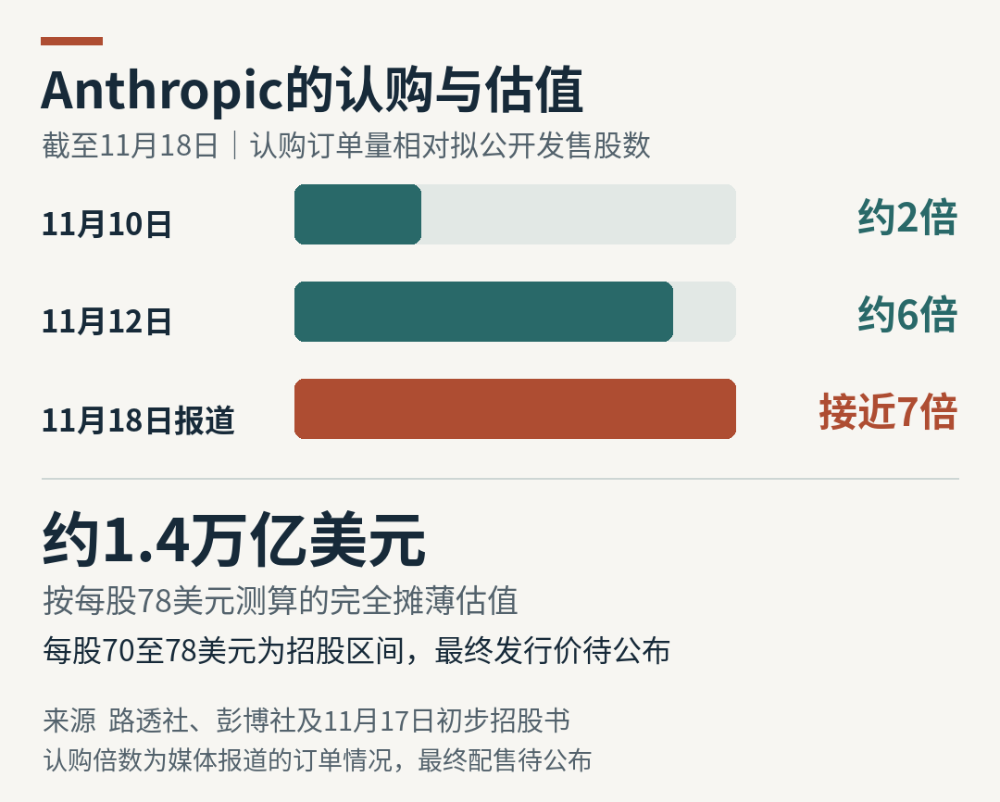
Fully diluted valuation also includes potential shares. The $965 billion in May came from private financing, while $1.4 trillion is the IPO valuation calculated based on the proposed issue price.
Putting the two numbers together shows where the market is willing to discuss the price—and how much it has risen still depends on the share capital basis.
The proceeds from the offering also come in three parts. Of the 825 million shares planned for public offering, about 801 million are newly issued by the company, and about 23.65 million are being sold by existing shareholders.
At $78 per share, the company's new share issuance corresponds to about $62.5 billion, with offering expenses deducted separately. The roughly $1.845 billion sold by existing shareholders goes to the sellers.
There is also a $26 billion concurrent private placement to subscribe for another class of common stock at the IPO issue price, with closing subject to conditions such as completion of the IPO.
Adding the public offering and private placement together, the transaction size is about $90.35 billion, not yet including the underwriters' over-allotment option. Of the more than $90 billion, to calculate what the company receives, the amount belonging to existing shareholders must first be deducted.
Why are institutions so frenzied?
Cloud vendors' stocks contain cloud services, advertising, or office software. By subscribing to Anthropic, institutions can bet more directly on a foundation model company.
What they need to judge is also more specific. How much of enterprise budgets can Claude capture? After deducting computing power and R&D, how much profit is left in this business?
Growth among large customers gives institutions a reason. By the end of September 2026, customers contributing at least $100,000 in revenue over the past 12 months exceeded 11,900, compared with more than 950 a year earlier.
Only when a company is willing to push Claude from small-team trials to multiple departments will budgets truly increase. That bill says more about the business than download numbers.
The stock itself is also in demand. Based on the share capital assumption at the midpoint price of $74 per share, the publicly offered shares account for about 6.3% of Class A and Class N shares after issuance.
The number of shares tradable on the first day will also depend on the over-allotment and the release of employee shares. Buyers receive Class A shares, while founder entities control 50.1% of voting power on ordinary shareholder matters through Class F shares.
Entities affiliated with Google, Nvidia, AMD, Broadcom, Micron, Microsoft, and TSMC have all signed up to participate in the concurrent private placement. For these industrial shareholders, there is business beyond equity.
The more tasks Claude runs, the more computing power it consumes. Whoever can win cloud service and equipment orders, and who must spend first to expand capacity, depends on the contracts each holds.
This also explains why industrial shareholders and financial investors can have different judgments about the same price. The former also look at how much more computing power they can sell years later, while the returns the latter can obtain ultimately depend on Anthropic's own business.
What kind of revenue is needed to support a $1.4 trillion valuation?
Reuters reported that some sell-side institutions expect revenue of about $52 billion to $53 billion in 2026, and possibly $270 billion to $280 billion in 2028.
Based on this valuation, a rough calculation implies about 26 to 27 times forecast 2026 revenue and about 5 times 2028 revenue.
At the same price, a different set of forecasts tells a different story. Bloomberg Intelligence estimates 2028 revenue at about $200 billion, corresponding to about 7 times.
Forecasts differ by tens of billions of dollars, and the disagreement lands in the same place.
How much are enterprises willing to pay for Claude, and for how long?
If renewals slow down, or if price cuts run ahead of usage growth, revenue will have to be recalculated.
Claude takes orders, and computing power needs more orders too
Claude first introduced many people to chatbots, while Claude Code brought it into engineers' daily work. Reading code, modifying files, and running tests can all be done through subscriptions or pay-per-use.
Claude Cowork brings similar task-processing capabilities into the office, handling documents, organizing materials, and connecting multiple steps.
Another group of customers is software developers. They embed Claude's interfaces into their own products, and Anthropic charges based on usage, also selling model services through channels such as AWS and Google Cloud.
Subscriptions depend on how long customers are willing to renew, while usage depends on how many times the product runs each day. If customers truly integrate it into their business, bills on both sides can grow.
Third-quarter revenue had already grown to $16.956 billion, about 12.3 times the same period last year and up about 47% quarter over quarter.
The previous quarter grew about 144% quarter over quarter; the growth rate has come down, but the third quarter still did $5.401 billion more business than the second quarter. As the base gets larger, growth slows by a notch, yet incremental revenue remains considerable.
The company also disclosed that annualized run-rate revenue at the end of October was about $81 billion. This annualizes the past 28 days of usage charges and one month of subscription fees to show the operating pace at that time.
Turning to the income statement, actual recognized revenue for the first three quarters of this year totaled about $33.242 billion.
The third-quarter net loss narrowed from $66.309 billion in the previous quarter to $23.291 billion, including a $21.936 billion book loss from fair value changes in financial instruments such as convertible bonds.
Looking further up at operating results, the second quarter earned $974 million, while the third quarter lost $567 million.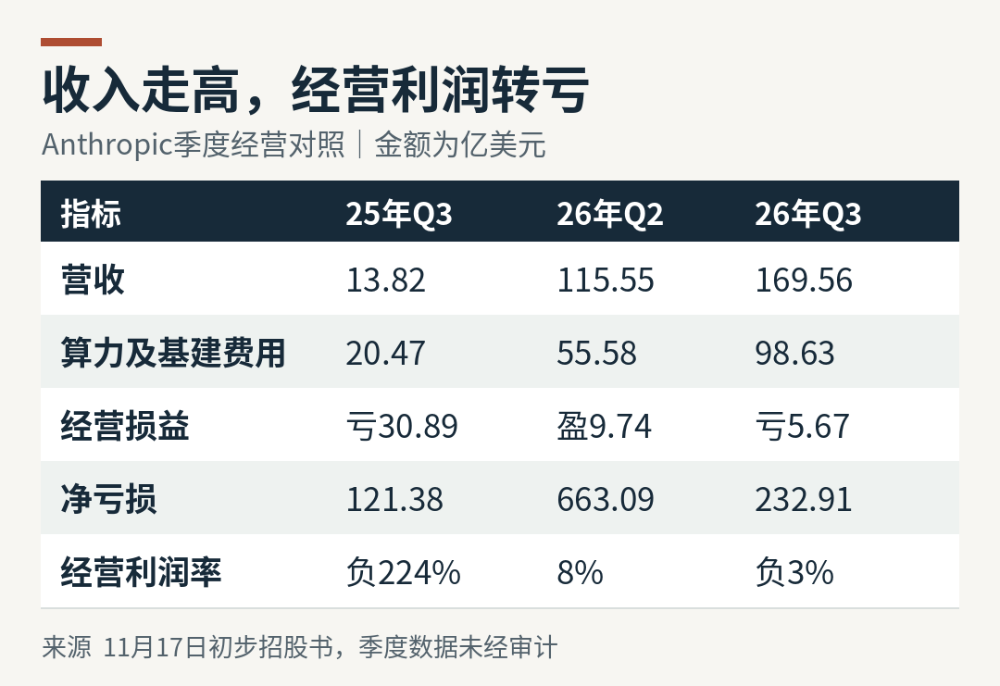
What weighed on third-quarter operating profit included about $5 billion in short-term computing power spending. The company generally locks in computing power 12 to 18 months in advance, and temporary procurement is much more expensive than comparable computing power under multi-year contracts.
Booking too early brings idle costs, while booking too late means having to restock at high prices. For a model company of this size, it still must be confident in arranging supply for the next one to two years.
Cash flow also needs a new page. Net cash inflow from operating activities in the first nine months was about $6.6 billion, compared with a net outflow of about $2 billion in the same period last year.
While cash flow turned positive, the prospectus disclosed contractual obligations of about $900.9 billion, almost all related to computing power and infrastructure. Some payments depend on conditions such as partner financing and project delivery.
These commitments are paid over many years. The prospectus estimates that about $70.7 billion in contractual payments will be made in the 12 months starting from the end of September 2026.
Data centers must be built, power must be connected, chips must arrive, and customer usage must keep up. If any step slows down, cash collection and payments may fall out of sync.
For Anthropic, ample funds allow it to lock in more years of computing power and give it room to handle temporary price increases. But the locked-in capacity still needs users.
Only when customers move Claude from pilot projects into businesses that run every day will revenue cover the money that still has to be paid even when this equipment sits idle.
After listing, the whole market changes
Nearly seven times oversubscription is support for first-day trading, but if the issue price is raised higher, those willing to take over after the open will also have to recalculate.
If the price has already absorbed most optimistic expectations, no matter how hot trading is, the final answer will still have to wait for the next quarterly report on enterprise renewals, computing power costs, and operating profit.
Upstream looks at demand first. Gartner predicted on November 12 that global AI spending will rise from $2.746 trillion in 2026 to $4.050 trillion in 2027.
In 2027 alone, AI infrastructure is expected to account for $2.397 trillion, or 59%.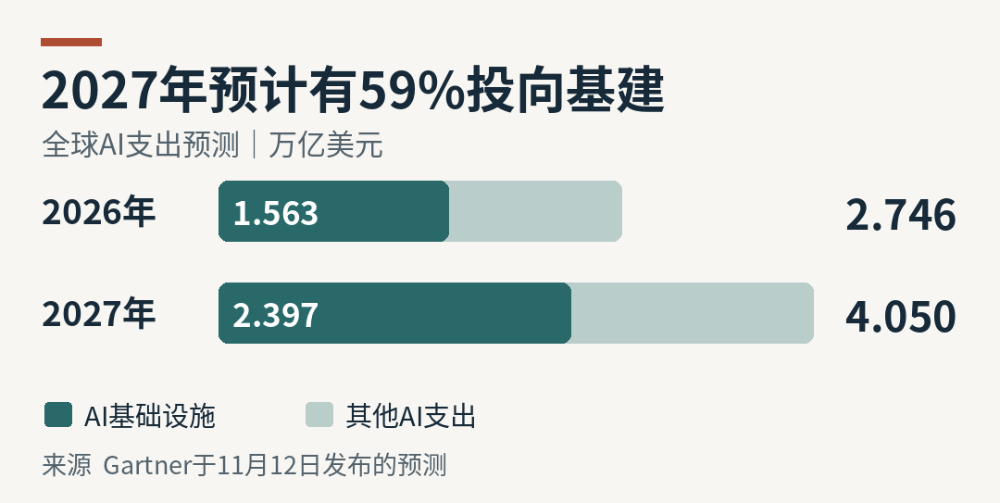
This money flows down through servers, storage, networking, and data center power. Chip shipments can generate revenue first, while the payback period for data center leases and power investment is longer.
Cloud vendors also need to calculate rental revenue together with upfront investment; only if customer usage grows quickly can they absorb the cost of new data centers.
The accounts of application companies are changing as well. Model price cuts can save API call costs, while Claude's expansion into office and development workflows may pack certain standalone features into subscriptions.
Those building applications must provide reasons customers are willing to renew. Some rely on industry data, some on familiarity with customers' workflows, completing a labor-intensive job.
Anthropic's listing is a milestone because the market can finally use continuous public financial reports to price a leading foundation model company.
From now on, peers have another yardstick.
How fast revenue runs, how much profit keeps up, and how computing power contracts worth hundreds of billions of dollars can recover costs can all be compared quarterly.
Approaching the bell, orders have already piled up to nearly seven times. The next test lies in the data centers and customer bills.
Wait until the next wave of data centers goes live and the next cohort of customers renews—then we'll see how many cents of every extra dollar Claude earns can actually be retained.
By then, the market's pricing will offer a clearer signal of just how large a bet it is willing to place on the AI industry as a whole.
What are your thoughts on the frenzy surrounding the largest IPO in history? We welcome your civil and reasoned comments in the message section below.
Disclaimer: This article offers a professional analysis of financial hot topics only. The data and materials cited are drawn from public queries, company announcements, and Tonghuashun iFinD. The views expressed are for reference only and do not constitute any investment or consumption advice.
#FinancialHotTopics #InDepthInterpretation #BusinessFinance #InvestmentBankingCircle #ListedCompanies #PrimaryMarket #IPO #AI
-
![]()
October Auto Sales Inventory: Four Carmakers Exceed 70% of Annual Targets
-
Li Shufu's "Relentless" Bet on the Methanol Market
-
Why Has AI Office Work Become the Competitive Focus for Industry Players?
-
![]()
Voyah Secures MIIT Batch 412 Production Access Qualification, Formally Bids Farewell to Operating Under Dongfeng's Umbrella
-
Tencent also cannot achieve the "impossible trinity": traditional business growth, AI business breakthroughs, and positive net cash flow
-
Anthropic Goes Public: A $1.4 Trillion Public Stress Test
-
![]()
Shenzhen: Letting the World Understand China
-
![]()
Survival Is Already Hard Enough—So Why Talk About "Brand Upward Mobility"?