Tencent First, ByteDance Second
 11/19 2026
 493
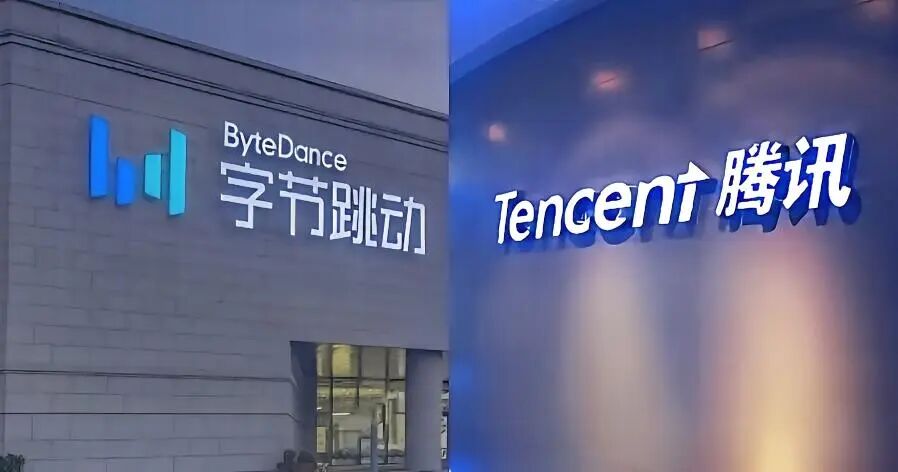

Just one social app apart—yet two eras.
Image source: Internet (please contact us for removal if infringing). Partially AI-generated.
On November 11, Tencent turned 28. As usual, the company held its LinkTime all-hands meeting, where Pony Ma and core executives reviewed the year's gains and losses with all employees. In past years, the keywords were mostly "cost reduction and efficiency improvement" and "focus," but this year was different.
"The wave is already crashing down. Some core businesses look firmly positioned, but AI is advancing rapidly, and the distant wave is already swallowing one hill after another. You can't just sit there and admire it," he said. This is not an ordinary business adjustment—"this is a life-or-death issue."
Pony Ma rarely uses such words. During the 2010 3Q battle and the 2018 viral spread of "Tencent Has No Dreams," he never used "life-or-death."
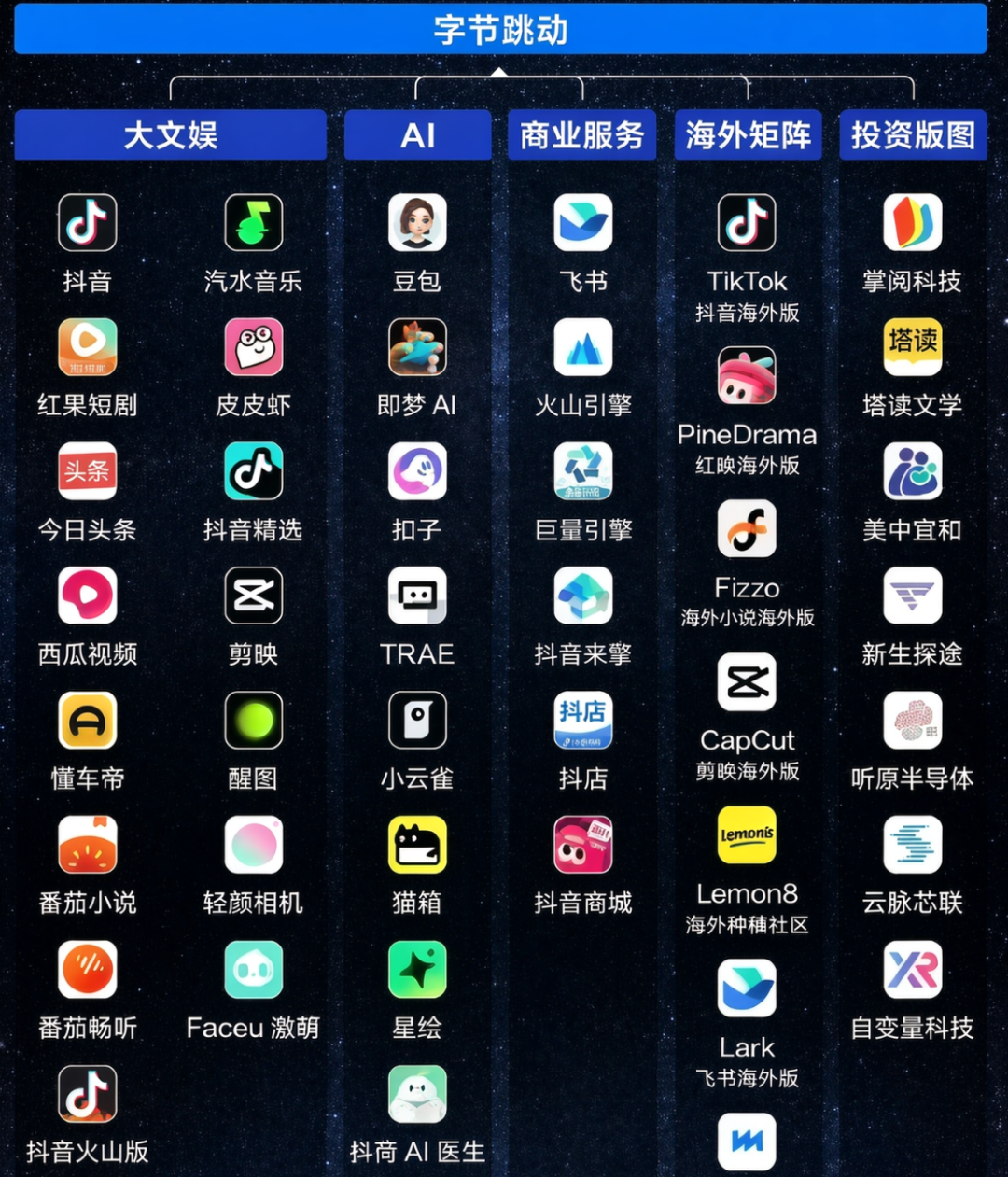
Almost at the same time, another image circulated: ByteDance products arranged in a matrix—Douyin, Hongguo Short Drama, Fanqie Novel, Qishui Music, Doubao, Feishu, TikTok, CapCut, and others. From scrolling short videos on the commute to using Feishu for meetings at work and Doubao to write weekly reports, one image arranges an ordinary person's entire day.
So the internet hotly debated: ByteDance is only one chat app away from dominance.
On one side, a 28-year-old giant cries life-or-death; on the other, a 14-year-old latecomer is said to be only one last piece of the puzzle away.

Spending the Money Proactively
The Q3 2026 financial report shows Tencent's revenue was 207.3 billion yuan, up 8% year on year; operating profit was 59.1 billion yuan, down 7% year on year; net profit was 63.6 billion yuan, almost flat. Looking at the numbers alone, it is a report card "slightly below expectations."
But there is a more critical line in the report: excluding investment in new AI products, Tencent's operating profit was 83.3 billion yuan, up 8% year on year, with an operating margin stable at 40%.
In other words, Tencent is not incapable of making money; it is proactively spending the money.
Where did it go? Capital expenditure in one quarter was 81.4 billion yuan; the total for the first three quarters was 166.1 billion yuan, up 179% year on year. R&D investment was 32.3 billion yuan, up 42% year on year. Free cash flow was negative 69.1 billion yuan, and net debt shifted from net cash of 58.2 billion yuan in the previous quarter to 13.7 billion yuan.
A company that has long kept hundreds of billions in cash on its books has started borrowing.
The biggest takeaway is not "Tencent is failing," but "Tencent is finally willing to spend money." For more than two decades, its style has been "steady": not burning money lightly, not expanding lightly, spreading its investment map widely, but always keeping a sufficient safety cushion in its main business.
Now it is willing to tolerate negative free cash flow and let its income statement look ugly, which shows it has done the math: compared with "being left behind by the times," this bit of profit is nothing.
The revenue structure explains more. Value-added services were 98.3 billion yuan, up only 3%; advertising was 43 billion yuan, up 19%; fintech and business services were 63.6 billion yuan, up 9%, among which cloud services grew 35%.
Gaming remains a cash cow, advertising still has resilience, and cloud is re-accelerating driven by AI, but social network revenue was 31.8 billion yuan, down 1% year on year, and is no longer really growing.
Revenue is not growing much, but users have not decreased. Combined monthly active users of WeChat and Weixin were 1.449 billion, and time spent on Video Accounts grew more than 20% year on year. The people are still there, the time is still there, but "social" itself is increasingly difficult to directly turn into money.
This is exactly where Tencent is most comfortable and also most dangerous.
At the same time, ByteDance is doing the same thing: pouring profits into AI and putting growth ahead of profit. In 2026, ByteDance's AI capital expenditure plan may reach as high as 70 billion US dollars, twice that of 2025.
The two companies—one listed in Hong Kong, China, one still unlisted; one relying on gaming and social, one relying on content and e-commerce.
Yet their situations are strikingly similar: both are using today's profits to buy tomorrow's position. The only difference is who can less afford to lose.

What Pony Ma Is Really Worried About Is the Organization
On November 11, 1998, at Shenzhen SEG Science and Technology Park, 27-year-old Pony Ma and four friends registered Tencent. Twenty-eight years later, Tencent has more than 100,000 employees, WeChat covers 1.4 billion people, and its gaming business is the world's number one. Also after 28 years, 55-year-old Pony Ma, on his birthday, told all employees "life-or-death."
In this speech, several phrases stand out.
One is "reset the mindset to zero." He said this is different from the previous cost reduction and efficiency improvement: "Last time was passive cost reduction; this time is proactive efficiency improvement." All core businesses must start anew for the AI era.
Another is "land war becomes sea war." "Land war becomes sea war, the army becomes the navy; everyone must move supplies, transform skills, and quickly board the ships to fight."
Another is aimed at the organization: "Do not let middlemen who pass messages and cadres who do not want to move but occupy territory become obstacles. Mountain-stronghold mentality and territorial awareness must be completely broken." He even preemptively cautioned: in the future, there may not necessarily be so many management positions.
This sentence may be preparing for future layoffs.
Tencent's organization grew out of "product lines + business groups." The horse-racing mechanism was once its handiest weapon: QQ raced with WeChat, and several game studios raced against one another; internal competition forced out many good things.
In 2011, WeChat was able to emerge in Guangzhou largely because Zhang Xiaolong's team was not at the Shenzhen headquarters and was far enough from the center of power to dare to build a product that would "revolutionize QQ."
But after racing horses for a long time, mountain strongholds also emerge. Each BG has its own territory, budget, and KPIs. For something like AI that requires cross-department integration of data, scenarios, and computing power, it is easiest to get stuck in the middle layer.
What Pony Ma is really worried about may not be technology, but the organization. The organization has been too successful—so successful that everyone guards their own plot of land, so successful that any change requires three meetings first.
This is the paradox of big companies: what made you win will ultimately trap you.
He said many frontline colleagues are highly motivated to use AI to apply their intelligence, "but are constrained by many old architectures and organizations." On the surface this was said to employees, but it was actually said to management.
Tencent's problem is not at the front line, but in the middle. Young people at the front line want to fight, people in the middle are defending the city, and the top is anxious.
However, AI transformation is never a technical problem; it is more a problem of interests. If you do not tear down the old territories, new things cannot grow.
Tencent's posture in doing AI has always been a bit awkward.
The earliest approach was Yuanbao: build an independent AI app, use WeChat for traffic, and use red packets to acquire users. During the 2026 Spring Festival, Yuanbao spent 1 billion yuan in cash red packets, and daily active users surged to 50 million, with monthly active users at 114 million.
After the red packets stopped, daily active users fell back to 18 million, and monthly active users returned to just over 40 million. In the same period, Doubao's monthly active users were already ten times that of Yuanbao.
This proved a fact: traffic can buy users, but cannot buy habits. Yuanbao has no scenario in which it must be used. It is more like "a better search box" than "an assistant you cannot live without."
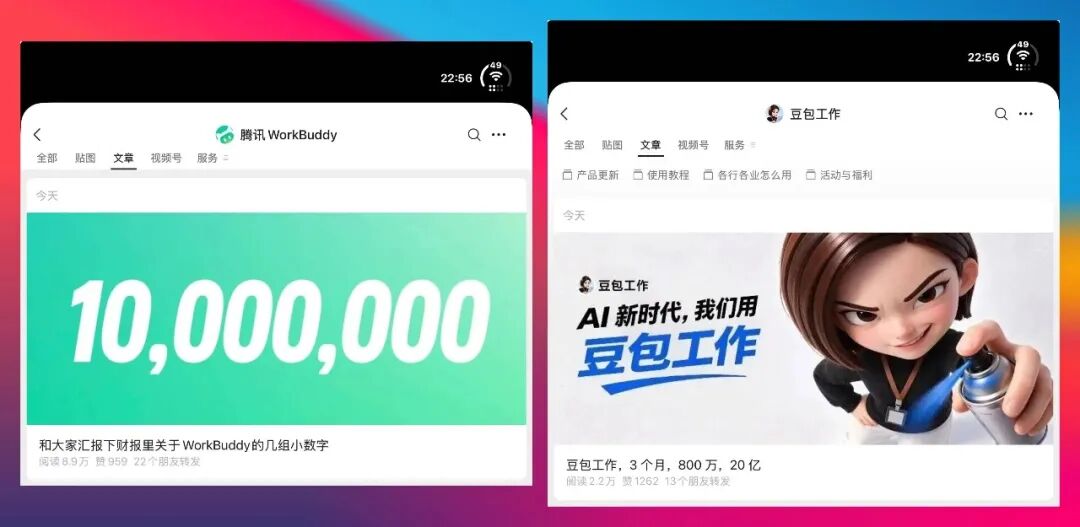
The AI product with which Tencent truly achieved scale is instead the ToB one. WorkBuddy launched in March this year, with daily active users exceeding 10 million; QuestMobile counts 32.35 million monthly active users, ranking first among domestic office intelligent agents.
The enterprise edition has landed in more than 50 industries and covers half of the China 500. It succeeded because office scenarios have clear tasks, paying parties, and effect standards.
Writing weekly reports, making spreadsheets, looking up information, generating PPTs—what used to take two hours now takes ten minutes. Enterprises are willing to pay for "saved human efficiency."
But WorkBuddy is not Tencent's vital gate. It is a business, not an entry point.
The real card is Xiaowei.
In June this year, WeChat began small-scale gray testing of "Xiaowei." Its biggest difference from Yuanbao is: Yuanbao is an app "you go to," while Xiaowei is an assistant "right inside WeChat."
You can ask it to send messages, set reminders, view Moments, summarize official account articles, invoke mini-programs to order, register at a hospital, and book hotels. It is not a chat window; it is a hand grown out of the WeChat operating system.
By November, Xiaowei's daily active users had reached 30 million. It uses the WeLM-80B model, with 80 billion total parameters and only 3 billion activated parameters, resulting in extremely low inference cost. Liu Chiping said that after Xiaowei is fully launched, its quarterly cost will be lower than Yuanbao's quarterly cost earlier this year.
Tencent has figured it out: an AI assistant does not have to be a super app; it can be made into a WeChat feature. Use lower cost, cover more users, and invoke more comprehensive services.
This is a play Tencent is good at: not building a new entry point from scratch, but stuffing new capabilities into the old entry point.
WeChat is replacing the entry point originally directed to Yuanbao with Xiaowei. In some test versions, the "Yuanbao Summary" in the upper right corner of official account articles has become "Ask AI," and clicking it leads to "Xiaowei." Zhang Xiaolong's team is answering with action: the AI in WeChat bears the surname "WeChat."
But this play also has a cost. WeChat's product philosophy is "restraint": use and leave, do not disturb, do not abuse the relationship chain.
The nature of an AI assistant is "proactive": it needs to know where you are, what you are doing, and what you need in order to get things done for you. The two philosophies are naturally in tension.
Xiaowei moves slowly not because the technology is slow, but because it must find a balance between "capability" and "boundary."
If it finds it well, WeChat will be the most stable entry point in the AI era; if not, WeChat may become an address book that "AI bypasses."

ByteDance: A Machine Meshed Too Tightly
Many people's impression of ByteDance still stays "Douyin is very popular." But this year, that impression is outdated.
According to The Information, ByteDance's revenue in 2025 was about 200 billion US dollars, up 29% year on year, nearly twice that of Tencent, and its revenue scale is already on the same order as Meta; in the first half of 2026 it was 120 billion US dollars, up 30% year on year.
This growth rate is rare against the backdrop of global tech giants collectively slowing down.
More important is the structure. On the content side, Douyin is the base; on the transaction side, Douyin e-commerce GMV has long stood at 3.5 trillion, local life payment GMV exceeds 850 billion, and Douyin Pay's usage rate reaches 36.82%, ranking third in China; on the enterprise side, Feishu and Volcano Engine; on the AI side, Doubao has 419 million monthly active users; on the overseas side, TikTok has more than 1 billion monthly active users, TikTok Shop's GMV growth is close to 70%, and overseas revenue accounts for more than 30% of ByteDance's total revenue.
These businesses mesh with one another, and not one link can be missing. Meshing too tightly also means that if one gear jams, the whole machine will shake with it.
Recommendation algorithms lower the marginal cost of content, content lowers customer acquisition cost, e-commerce and local life monetize attention, Volcano Engine sells computing power and models externally, and Doubao feeds user data back into the model. Each layer supplies blood to the next.
So ByteDance's expansion looks like "doing everything," but the logic is actually very simple: in any industry that can be transformed by "recommendation" and "transaction," it wants a piece of the action.
Short videos, short dramas, novels, music, e-commerce, local life, office, cloud, and AI are all nodes on this main line.
The most terrifying part of this play is that it can be replicated continuously. ByteDance has turned "algorithm + organization + capital" into platform capability, and then replicated it industry by industry.
In August this year, ByteDance made an organizational adjustment: Feishu's product team was merged into Doubao, and the marketing and sales team was merged into Volcano Engine.
On the surface, "Feishu no longer has an independent business unit"; in reality, it is recombining ToB "products" and "commercialization." Liang Rubo's keyword for 2026 is "bravely climb the peak": no longer satisfied with "fast," but aiming to strike "deep."
Zhang Yiming's return is another signal.
In 2021, 38-year-old Zhang Yiming stepped down as CEO, saying he wanted to "do early-stage things." But starting in the second half of 2025, he has faithfully attended a monthly Seed large-model review meeting, and his office has moved from Singapore back to Beijing.
According to a report by The Paper, at an all-hands meeting for the AI team, he said ByteDance is capable of competing with OpenAI and Anthropic, but to truly catch up with frontier technology, "the earliest it will be is 2029 or 2030." He also said ByteDance's pre-training dataset scale is still insufficient, and this is the most urgent problem to solve right now.
Foreign media reported that the Seed team is pre-training a model with a parameter scale as high as 10 trillion. One principle Zhang Yiming set for the team is "reject distillation"—do not use others' outputs in exchange for a temporary leaderboard ranking.
A founder who had already "retired" sits back down in the large-model weekly meeting; a company known for "speed" begins to talk about "long-termism" and "delayed gratification." These changes explain ByteDance's ambition better than any launch event.
Put Ma Huateng and Zhang Yiming together, and one sees two completely different methodologies. Ma Huateng came from product management and believes in "user experience" and "internal horse racing"; Zhang Yiming came from algorithm engineering and believes in "data" and "Context, not control."
The two methodologies have grown two companies with completely different temperaments. Tencent is like a city: it has everything, but every plot of land has its own owner; ByteDance is like a machine: it has many parts, but they all mesh on the same drive shaft.
There is another number that would make Tencent silent if it saw it.
In August 2026, among the top 50 apps by usage time, ByteDance products accounted for 41.8%, and Tencent products for 28.6%. A year ago, the gap between the two sides was not this ugly. Even more striking: in July, Douyin alone had a 19.4% share of time, surpassing WeChat's 18.8% for the first time.
In the matter of "occupying users' time," ByteDance surpassed Tencent for the first time.
Note, it is time, not relationships.
Time can be taken away by algorithms; relationships cannot.
This is also why, despite doing so much, some people still say ByteDance is "only missing a social network."
It is not that ByteDance has not tried social networking. In 2019, ByteDance launched Feiliao and Duoshan at the same time. Feiliao targeted WeChat, while Duoshan entered through Douyin's youth social networking. Resources were given, traffic was poured in—and the result?
Feiliao stopped service in 2022, and Duoshan gradually became a feature within the Douyin ecosystem.
The problem lies deeper: social networking and content are two completely different businesses.
Content is a "hot medium." When you swipe to a good video, you do not need to know the publisher; the algorithm just pushes the content in front of you. Social networking is a "cold medium"; its value lies not in the content itself, but in the relationships themselves.
Your mother is on WeChat, your boss is on WeChat, and your elementary school group chat from ten years ago is still on WeChat. These things cannot be pushed out by recommendations, nor can they be moved away by subsidies.
A relationship chain is a "slow asset." It requires time to accumulate, shared experiences, and repeated "are you there?" and "received." ByteDance is good at "fast": fast experimentation, fast iteration, fast scaling. But social networking precisely cannot be fast.
So ByteDance took another path.
Since it cannot fill in social networking, it will make social networking less necessary.
In October this year, the Doubao mobile assistant released a set of "SAEP declaration protocol + MCP standard interfaces," attempting to use screen reading and simulated clicks to complete tasks across apps on behalf of users.
You do not need to open Taobao, JD.com, or Meituan. Just say, "Help me order the cheapest set meal," and the assistant compares prices, places the order, and pays by itself.
This move touches the cheese of all super apps.
As a result, in less than a day, 153 mainstream applications publicly refused to integrate, including 65 from Tencent and 23 from Alibaba. A "battle to defend the entrance" had begun just like that.
ByteDance's calculation is clear: simply bypass chat software and build an assistant that "does things for users." If users become accustomed to using AI to get things done, then WeChat will no longer be the necessary path, but just a "contact list + payment tool."
By then, ByteDance would not need to own the relationship chain to dilute its value.
This is much smarter than "building another WeChat," and much harder.
The difficulty is that it must simultaneously challenge phone manufacturers, super apps, regulators, and user habits. Screen reading and simulated clicks naturally tread on the red lines of privacy and security; super apps have ample reason to block it; and users cannot possibly hand their payment passwords to a third-party assistant.
But the direction is right. In the battle for the entrance in the AI era, it may not be about whose app is bigger, but about whose agent is more trusted.
So the statement "ByteDance is only missing a social network" is half right.
The right half is: social networking is indeed the high ground ByteDance has the hardest time conquering, and it is Tencent's last and hardest moat.
The wrong half is: ByteDance may not necessarily need to conquer it. It can choose not to attack this city, but to build another road outside the city. If the road is completed, the city remains a city, but it is no longer the only way through.

How can a moat be defended?
How deep is Tencent's moat, really?
First, look at a few open cards. WeChat has 1.449 billion monthly active users, covering almost all Chinese internet users. WeChat Pay's usage rate is 67.85%, while Douyin Pay's is 36.82%; the gap is still large.
There are millions of mini programs, and official accounts and Video Accounts form one of China's largest content ecosystems. Gaming is in the global first tier, and the cash cow is still there. Add to that the investment map including Meituan, JD.com, and Pinduoduo, and Tencent's "asset thickness" remains in a class of its own in China's internet industry.
How many have these moats stopped? They stopped 360, stopped Alibaba's Laiwang, stopped ByteDance's Feiliao and Duoshan, and stopped countless "next WeChats." The logic is simple: you can build a better chat tool, but you cannot move my relationship chain.
But a moat has one precondition: the enemy must come from the front.
AI Agents do not come from the front. They come from underground.
They do not compete with you for "chatting"; they compete for "getting things done."
What users want is not "open WeChat and send a message," but "get this done." If an assistant can handle things directly, WeChat shifts from an "entrance" to a "channel," from a "destination" to "somewhere you pass by."
Some will think this is alarmist. With 1.4 billion people on WeChat, how could it be bypassed just like that?
The problem is that the migration of entrances never happens overnight. It happens slowly, so slowly that you have no time to react. Users are still there, habits are still there, but the "first stop" has changed.
You still message your family every day, but before that, you have already started asking AI first.
This is what "land warfare becoming sea warfare" means. In the past, the fight was over products; now it is over entrances. In the past, you defended a city; now you defend a shipping route.
Tencent's response is to pull Agents into its own moat.
Xiaowei is that defense line. It grows inside WeChat and uses the relationship chain, payments, mini programs, and official account content as its "hands and feet." You want to get something done? Sure, but do it inside WeChat. You want to find a relationship? Sure, but the relationship is still inside WeChat.
This is a very "Tencent" move: do not fight head-on; turn what you want into a feature within my ecosystem.
But whether this move succeeds depends on two variables.
First, can Xiaowei really "get things done"? Not chatting, not summarizing, but booking tickets, registering for appointments, refunding, reimbursing, finding people, and organizing gatherings. These tasks require calling a large number of services, connecting with millions of mini program merchants, and ensuring no mistakes. This is much harder than building a chatbot.
Second, can WeChat bear the cost of "AI-ification"? AI needs data; WeChat has data, but WeChat's data is the most sensitive. AI needs to be proactive; WeChat's philosophy is restraint. AI needs trial and error; WeChat cannot make mistakes. The balance between these is harder than the technology.
If both things succeed, Tencent's moat will not only avoid being bypassed, but will deepen by another layer: when others build Agents, they can only call public services; when WeChat builds an Agent, it can call relationships and services. This is a dimensionality-reduction strike.
If they do not succeed, the moat remains, but the water in it will gradually become shallower.
Some will say, has Tencent not been through plenty of crises? The 2000 internet bubble, the 2010 3Q War, the rise of Douyin in 2018, and antitrust and tightened game approvals in 2021.
These were certainly all crises. But they share one thing: Tencent's "entrance" was not shaken. Each time, Tencent could fall back on "I still have WeChat."
This time, however, what is being questioned is precisely "whether WeChat can still serve as the fallback."
WeChat will not collapse. But it may no longer be the "first stop." If the entrance is no longer an app, but an assistant, a pair of glasses, or a car, are 1.4 billion monthly active users still a moat?
It is still a relationship chain, a payment network, and a mini program ecosystem, except that the user's first sentence may be spoken to an AI, not to WeChat.
Tencent's real fear is that more and more people are beginning to believe: chat software is no longer the only entrance.
Ma Huateng's "life-and-death survival" is not alarmism. What he sees is that when the PC internet migrated to the mobile internet, those once-invincible names—Yahoo, Nokia, Renren—were none of them defeated by rivals of the same era. What defeated them was the entrance of the next era.
Tencent does not want to become the next one.
So before the wave hits, it wants to get on the boat first.
-
![]()
Consumers Have Fallen Out of Love with Tesla—So Why Are Automakers Still Copying Its Homework?
-
![]()
Auto Braking Leader's Performance Keeps Rising, Spends Over 1.1 Billion Yuan on M&A
-
Two-Wheel Drive Plus LiDAR: GAC Trumpchi Yue 7 Smart Driving Edition Lowers the Bar Again—How Many Extra Sales Can It Deliver?
-
Li Yanhong and Baidu May Finally Be About to Catch the "Last Train" of AI
-
![]()
Tencent First, ByteDance Second
-
![]()
Tencent and ByteDance's B2B Battle
-
ZTE's bond issuance to "supplement working capital" behind the scenes: total liabilities hit a record high of 168.5 billion yuan
-
WorkBuddy Tops 10 Million DAU: Office Agents Are No Longer Priced by the Seat