IREN: Power Without Customers, Land Without Capital—What's Holding Back the Mining-Farm-to-Cloud Pivot?
 11/27 2026
 351
In this latest wave of AI compute fever, IREN is a textbook "latecomer": a former Bitcoin miner that has spent the past two years converting its mining farms into data centers and muscling into the AI compute leasing business. What sets it apart from other neoclouds is that it holds over 5GW of power backed by signed grid connection agreements, plus self-owned land.
Power is plentiful, and contracts are being signed at a brisk clip—yet IREN's stock has fallen harder than its peers. On the one hand, after a year of transformation, its signed ARR has topped $4 billion, which looks impressive. On the other, the stock is down more than 80% from its previous high—a steeper decline than peers CoreWeave (hereafter CRWV) and Nebius (hereafter NBIS), which are down roughly 60% and 30% respectively. At first glance, IREN looks even worse off than the other neoclouds mired in trouble.
Dolphin has already laid out the general logic of the neocloud business in two in-depth pieces on CRWV—"CoreWeave: Can NVIDIA's 'Godson' Really Rise on Its Father's Status?" and "CoreWeave: Neocloud Noble or Hard-Luck 'Worker'?"—and in an in-depth piece on NBIS, "Nebius: The Neocloud 'Magic Pill'—Real Gold or Bubble?"—so we won't rehash that here. This article focuses on IREN and answers three questions:
1. What makes IREN different from CRWV and NBIS?
2. Do those differences make it better or worse than the other neoclouds?
3. What scenario does the current share price imply?
The following is a detailed analysis.
I. After a Year of Transformation, How Does IREN Differ from the Two Neoclouds?
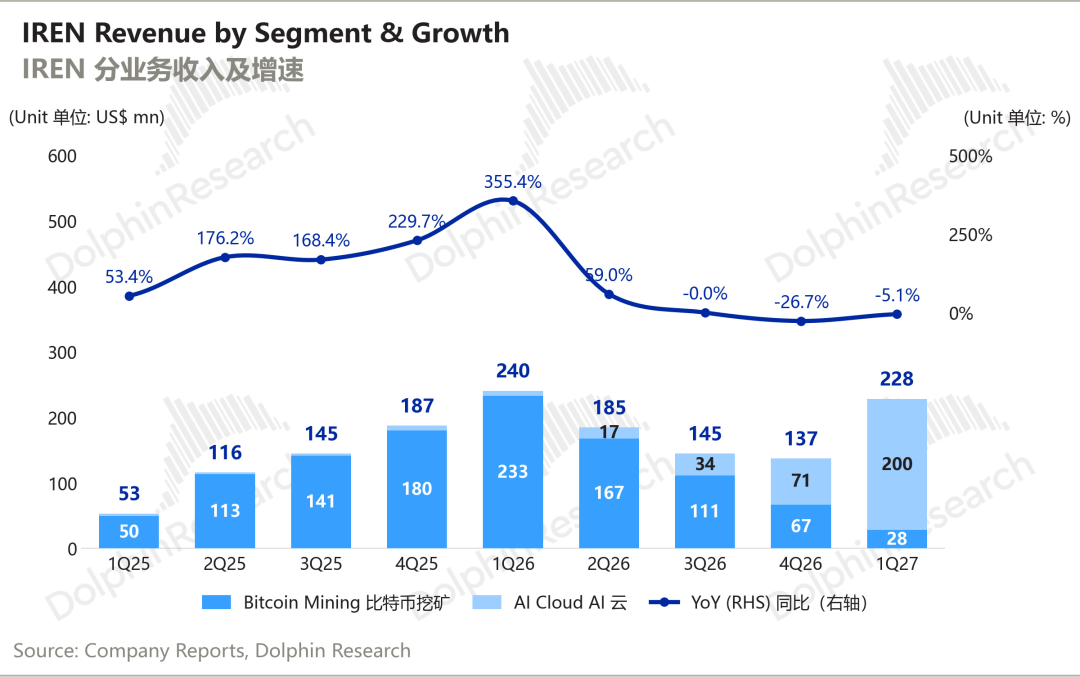
Judging by revenue mix, IREN took one year to shift its core business from mining to AI cloud. A year ago, in FY1Q26 (July–September 2025), AI cloud quarterly revenue was just $7.3 million, about 3% of total revenue. By FY1Q27 it had reached $200 million, nearly 90% of total revenue; management plans to essentially complete the transformation by the end of December 2026.
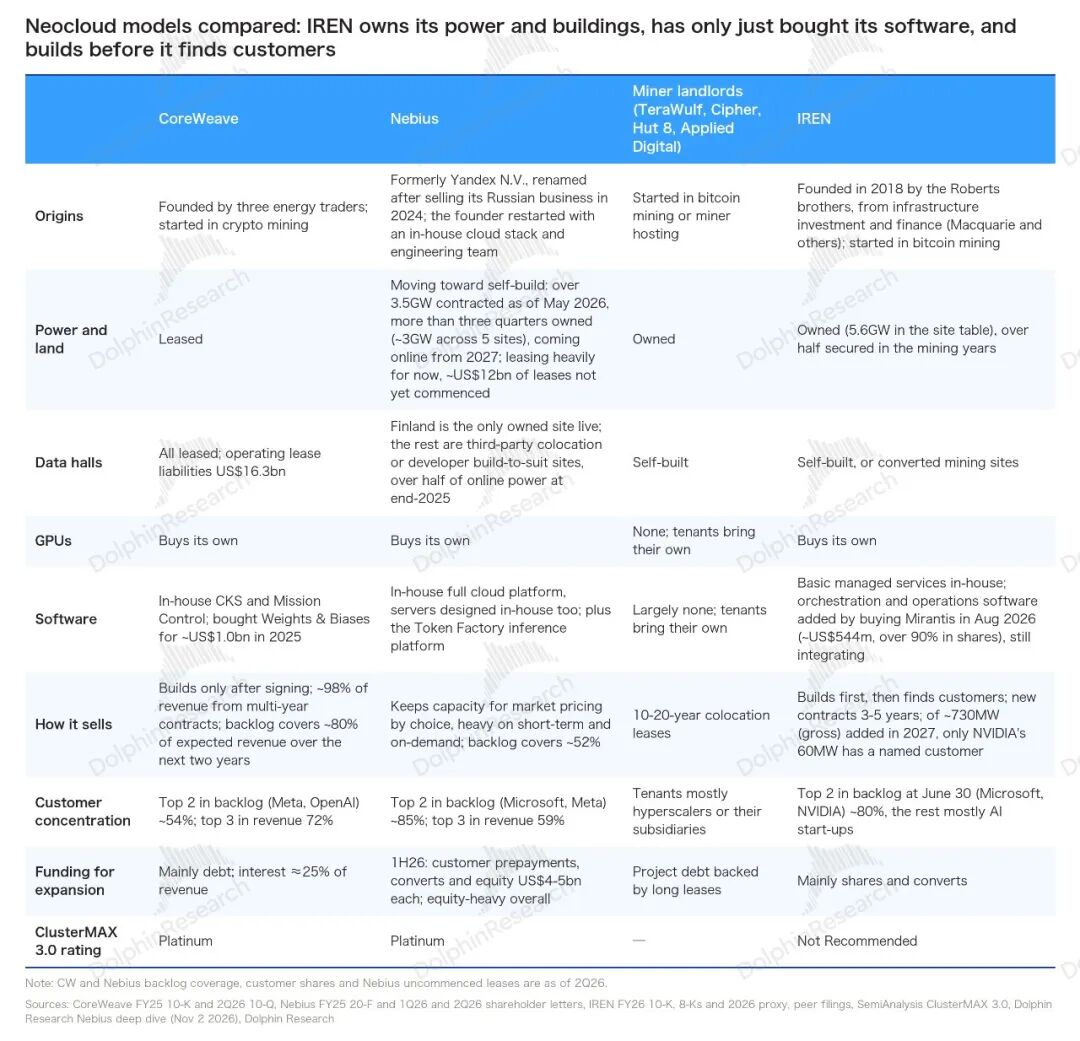
In terms of operating model, IREN combines NBIS's balance-sheet structure with CRWV's long-term contract model. IREN funds expansion mainly through equity financing and builds most of its data halls in-house; like CRWV, it signs mostly 3-to-5-year long-term contracts—unlike NBIS, which deliberately holds back part of its capacity to sell at market prices.
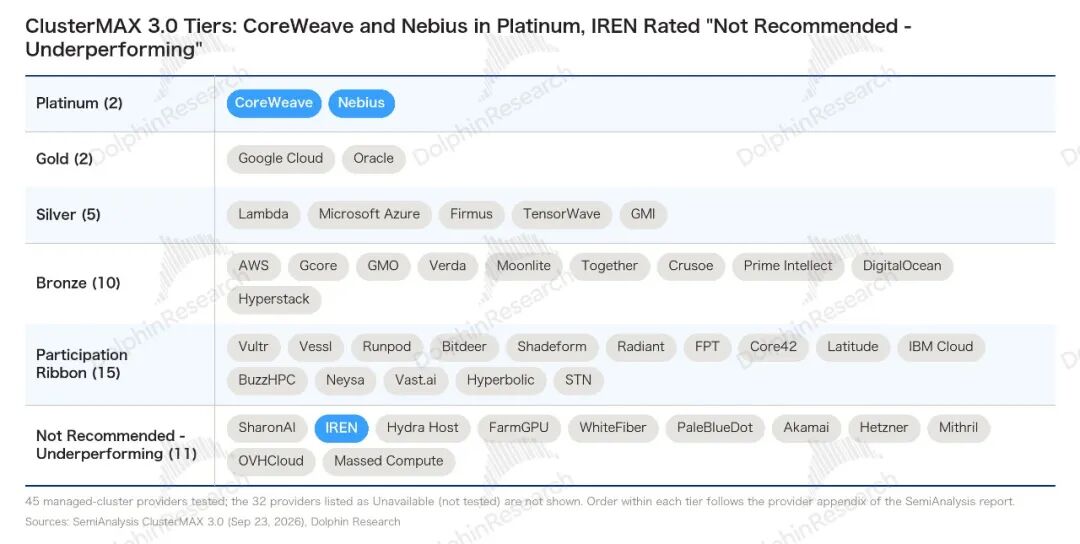
IREN differs from the other two in two main respects: it builds capacity first and finds customers later, and its software and operational capabilities are weaker. CRWV signs orders before investing in construction, whereas most of IREN's new 2027 capacity has yet to lock in orders. On the software side, IREN only bolstered itself by acquiring cloud management software company Mirantis in August 2026, and SemiAnalysis's GPU cloud rating lists it as "not recommended."
II. Compute Power Plans: Capacity but No Customers?
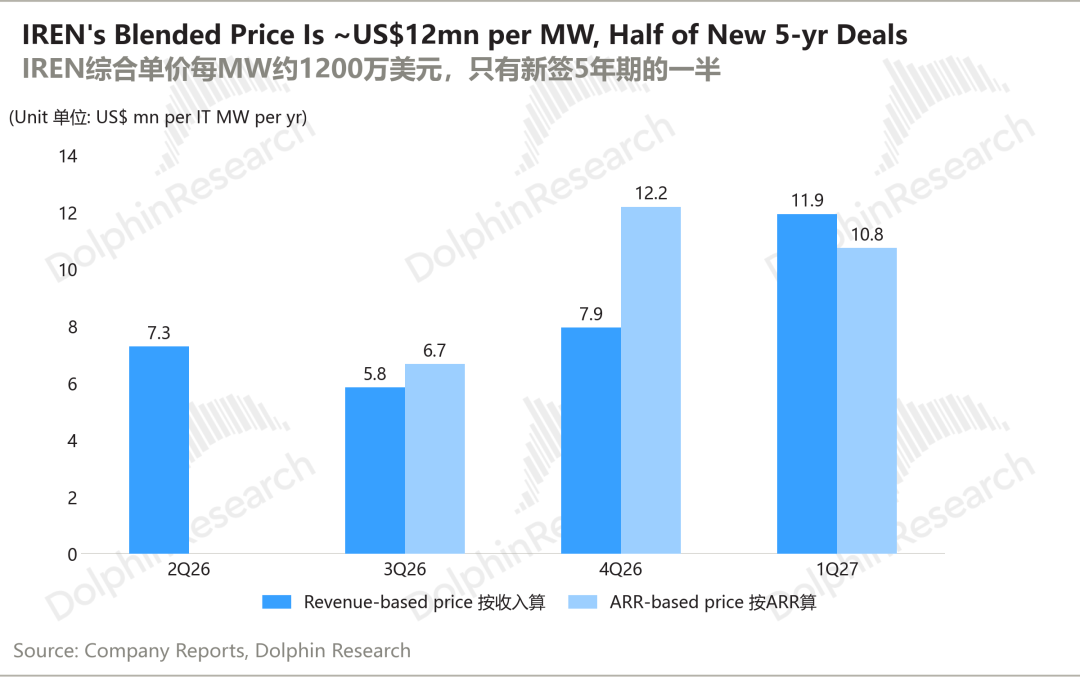
IREN's operating capacity will expand significantly in 2027, but blended unit pricing (annual revenue per MW calculated on operating IT capacity) will only creep up, peaking in 2028.
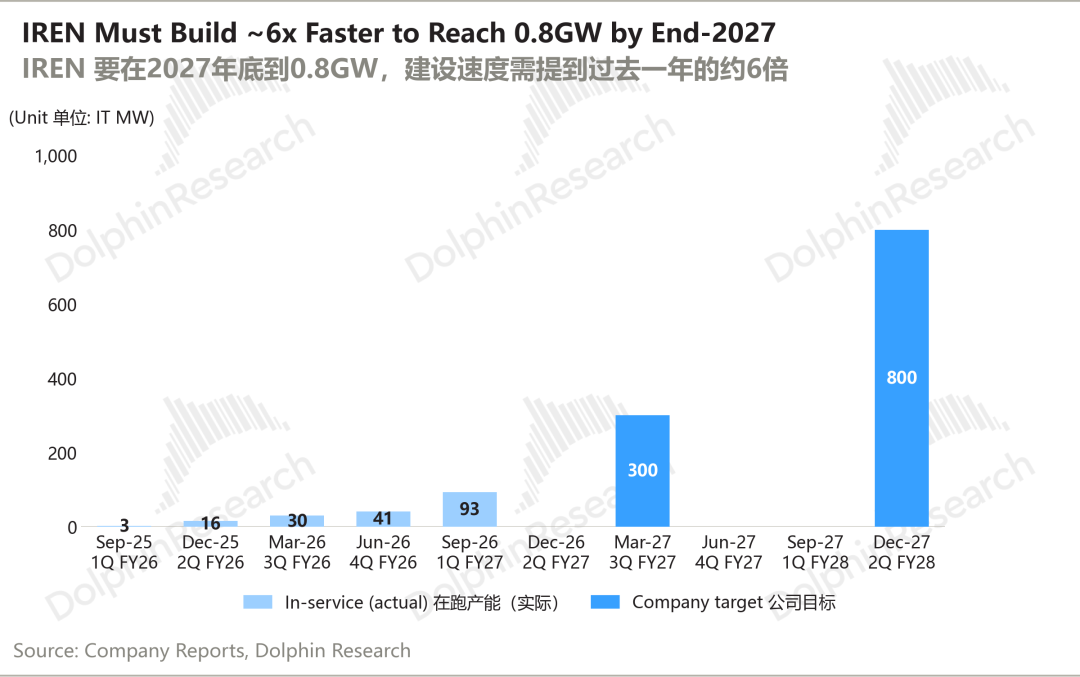
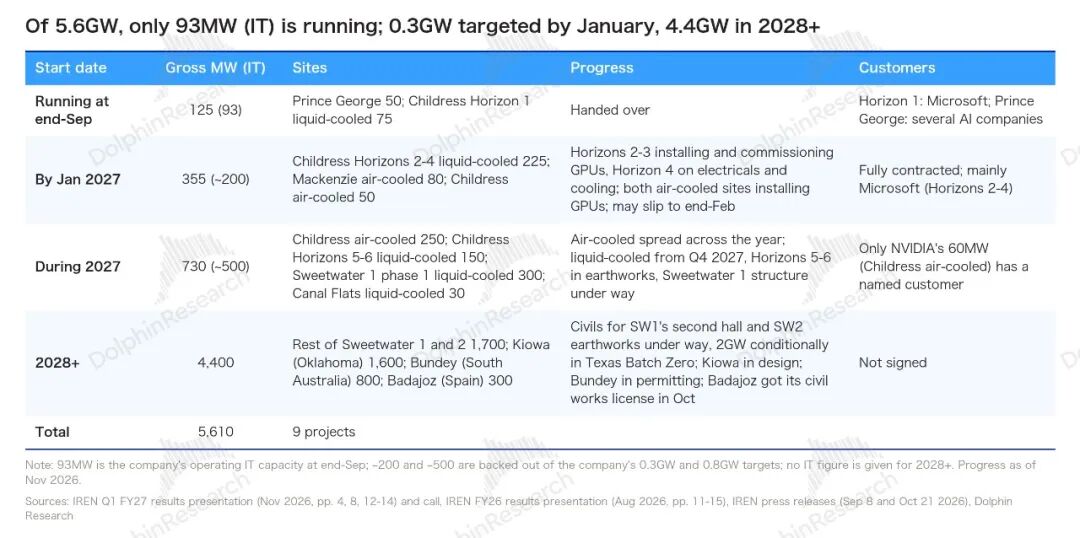
Under the company's plan, operating IT capacity will double from 93MW at the end of September 2026 to 0.8GW by the end of calendar 2027. Beyond that lies roughly 3GW of potential capacity, but it remains pie in the sky—the grid has agreed to supply power, but most won't be energized until after 2028, and customer orders aren't in place yet.
The biggest problem: of the planned 0.8+3 GW of new capacity, only about 0.3GW has secured orders—the bulk of the remainder has yet to find tenants.
2.1 The 0.3GW Coming Online in January: Fastest Volume Growth, but Locked at Old Prices
This 0.3GW is expected to be fully commissioned in January, lifting ARR from about $1 billion currently to over $4 billion. The company says this capacity is fully contracted and the data halls are essentially built, with only equipment delivery, card installation, and debugging remaining. But on-time delivery remains a risk—there has already been one delivery delay.
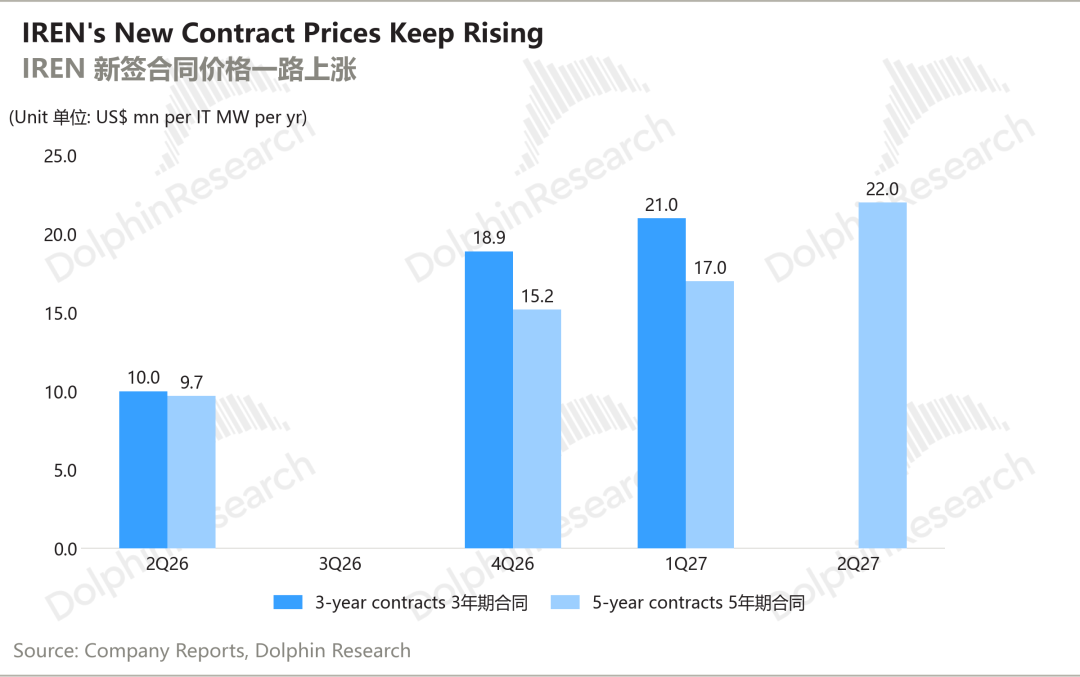
The largest single order in this batch of new capacity is the contract with Microsoft. IREN's current backlog is about $20.3 billion, of which Microsoft alone accounts for about 47%—but at roughly $9.7 million per MW per year, only about half of today's newly signed prices.
2.2 The New 0.5GW Added in 2027: Prices Still Rising, Volume Hinges on Financing
Industry demand is holding up, and signing prices keep climbing. According to disclosures on the November earnings call, annual revenue per MW on newly signed contracts is more than 10% higher than the prior quarter. Contracts signed after the quarter are running about $22 million per MW, with customers prepaying about 90% of the GPU investment; meanwhile, pricing for older cards is also rising—a batch of H100s was just re-signed at twice the original contract price.
But IREN may not get its cards on time. The chips for the liquid-cooled capacity within this 0.5GW are Vera Rubin, and management said on the earnings call that supply of this GPU generation is extremely tight. Currently only 0.3GW of the 0.5GW has cards ordered; the cards needed for the remaining 0.2GW have yet to be locked in.
What's more, IREN's ties to NVIDIA are shallower than those of CRWV and NBIS, and new cards reach it last. NVIDIA has invested about $2 billion in each of the other two neoclouds, but in IREN's case it only took a warrant at $70 per share, which has not yet been exercised. For the Vera Rubin generation, CRWV opened it to customers by the end of September, NBIS received its first batch in August, and IREN will have to wait until later in 2027.
Even when the cards arrive, construction must be fast enough—and IREN's past construction timelines have mostly run later than planned. One IREN project (Horizon 1) was about 8 months late, and the 0.3GW originally slated for commissioning by the end of 2026 has also slipped to January next year. To reach 0.8GW by the end of 2027, average monthly capacity coming online needs to be 6 times the 2026 pace—making on-time completion quite difficult.
Financing is also rough. FY27 still has about $6 billion of capital expenditure unfunded: debt requires contracts as collateral, but most of the planned new 0.5GW hasn't been signed yet, so mortgage loans can't be obtained; and issuing shares is a big problem too, with the stock down more than 80% from its high. How to finance remains a major question.
Given the financing difficulties, the company has also proactively slowed investment, cutting FY2027 capital expenditure from the $25–30 billion mentioned in August to about $20 billion.
2.3 Nearly 3GW Beyond the 0.8GW: No Contracts, Mostly Still Waiting for Power
Beyond 0.8GW lies nearly 3GW of potential capacity—more than three times the size of the first two batches—but none of it will be commissioned until after 2028. It is spread across four parks: Oklahoma Kiowa, South Australia Bundey, and Spain Badajoz, in addition to the first phase of Sweetwater in Texas—and not a single contract exists yet.
Most of the power isn't in place either. Apart from the Sweetwater project, which has been energized and has begun construction, the other three parks are still in design or approval, or have only just obtained civil construction permits.
By the time this capacity is signed, market supply will be much greater, and prices will be hard to predict. SemiAnalysis expects about 50GW of new data center capacity in 2027; Musk also said in October that SpaceX will add 10GW of compute in 2027, competing with IREN for the same pool of frontier lab customers. By then, the ready power and buildings in IREN's hands may no longer fetch high prices.
III. Profit Margin: Self-Owned Power and Buildings Save Rent, but After Depreciation the Gross Margin Advantage Nearly Vanishes
Fully self-owned power and buildings are the most fundamental difference between IREN and most neoclouds. That saves rent, but the help to gross margin is very limited.
3.1 How Much Self-Ownership Costs and Saves: Data Halls Account for About One-Third of New Investment; What Is Saved Is Rent
Data center investment breaks into three layers: land and buildings; non-IT equipment such as power supply and cooling; and IT equipment. IREN funds and builds all three layers itself. For the liquid-cooled data hall built for Microsoft, the first two layers cost about $15 million per MW, roughly one-third of total investment; for converting old mining farms to air cooling, the power, land, and buildings were all paid for during the mining years, so the new investment is almost entirely GPUs.
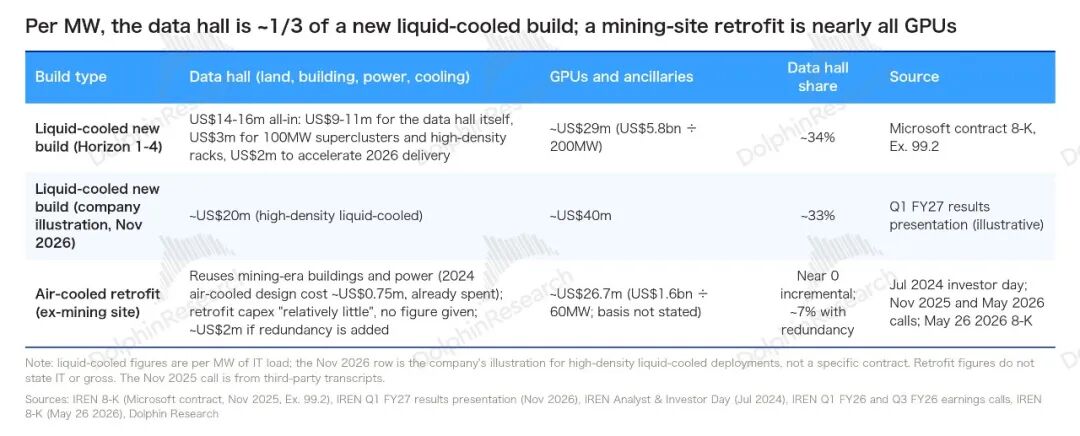
The liquid-cooled data hall built for Microsoft costs about $15 million per MW, roughly $3 million above the U.S. average construction cost, with the premium attributable to specifications and rush work. Of that $15 million, the data hall itself is about $10 million—below the U.S. average of $12.1 million per Turner & Townsend data; another $3 million goes to super-large clusters and high-density racks, and $2 million is rush fees paid to catch the 2026 delivery.
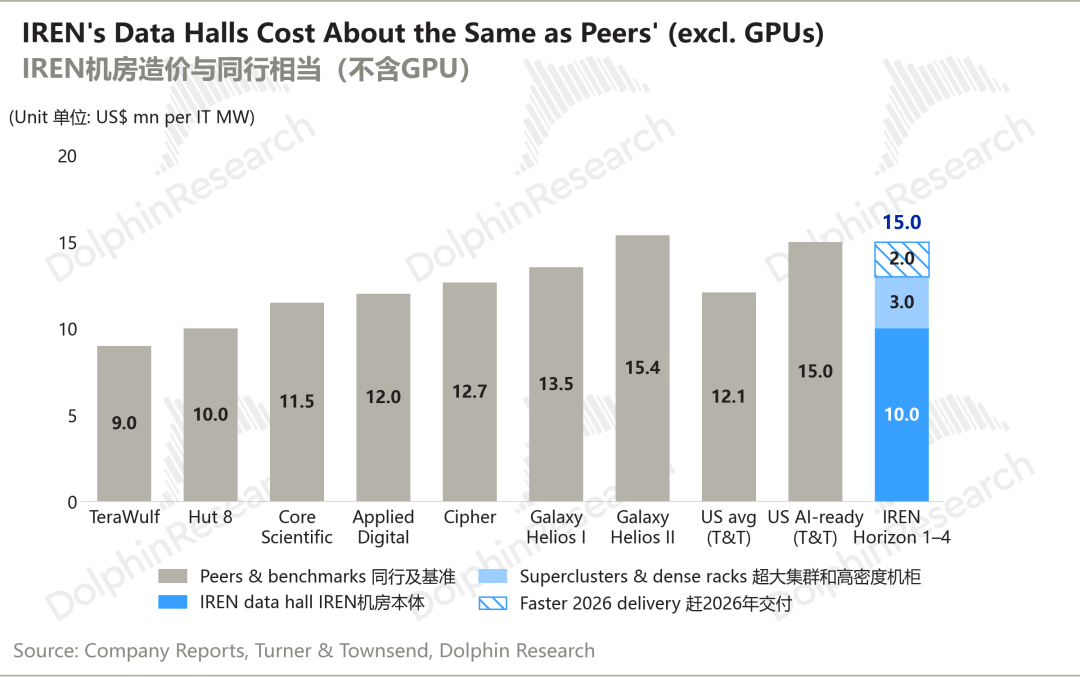
IREN doesn't pay data hall rent, so data hall costs as a share of revenue are lower than at NBIS, which also mostly builds in-house. Because IREN builds its own data halls, its data hall cost is only depreciation. Liquid-cooled data halls cost $15–20 million per MW, depreciated over 20 years at about $750,000 to $1 million per year—which even at the old lease price of $9.7 million per MW accounts for only 8%–10% of revenue, and an even smaller share under new contracts.
By comparison, NBIS's site rent in the first three quarters of 2026 accounted for about 10% of revenue.
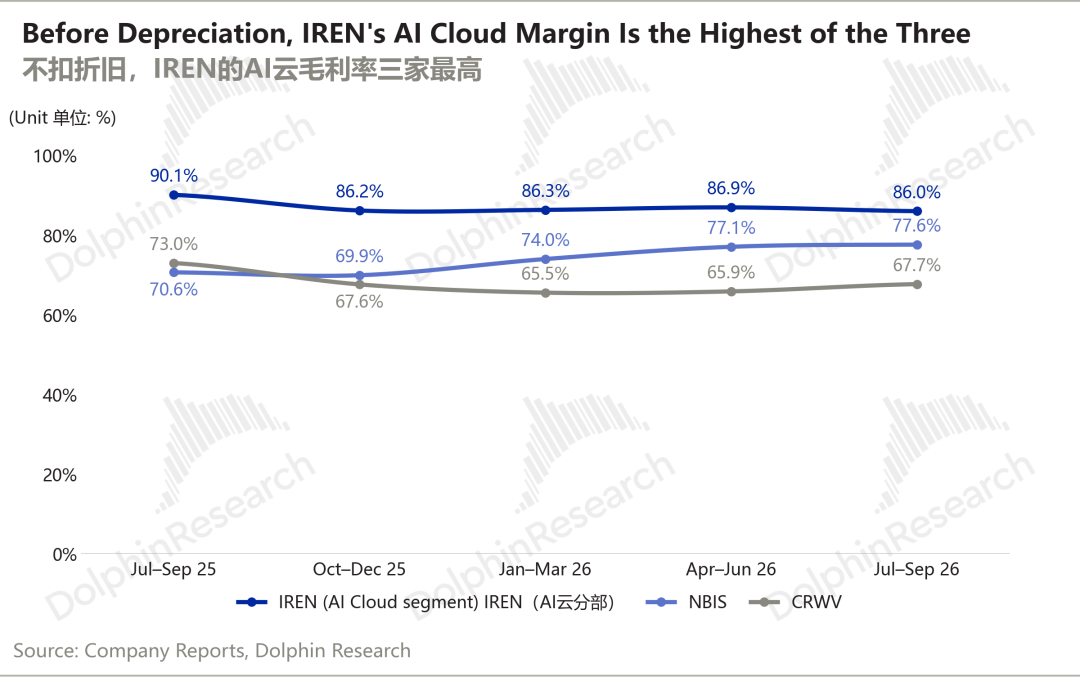
3.2 After Depreciation, the Gross Margin Advantage Disappears; GPU Depreciation Is the Biggest Cost
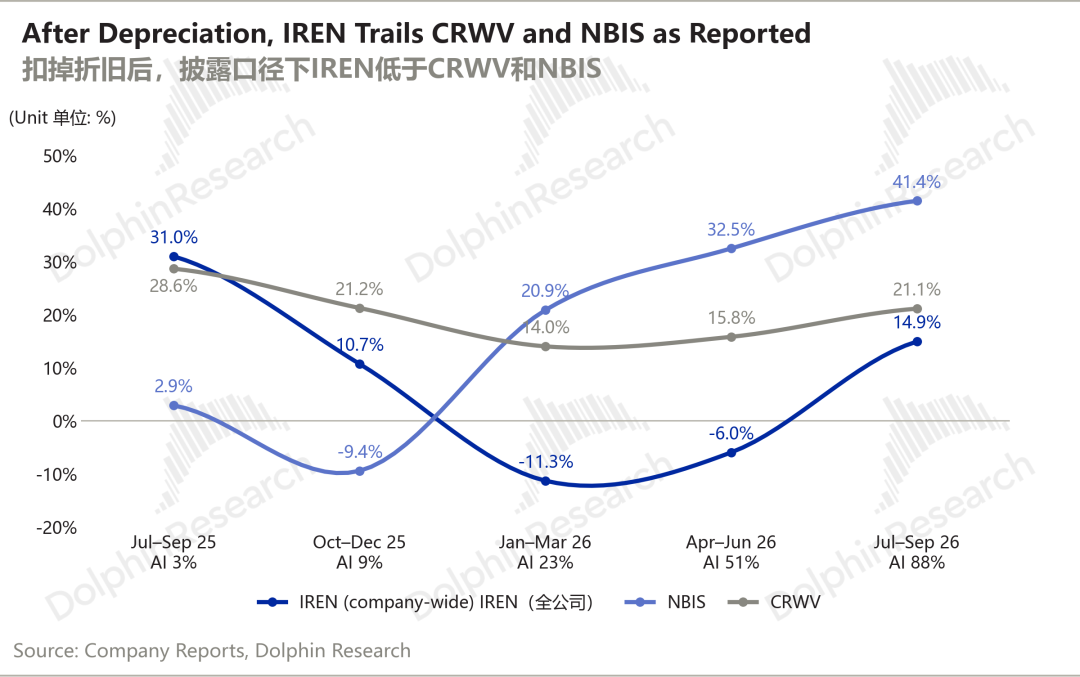
But beyond depreciation, IREN's advantage is nearly gone. From July to September, IREN's company-wide gross margin after depreciation was about 15%—on a disclosed basis, even lower than CRWV's roughly 21% and NBIS's roughly 41%.
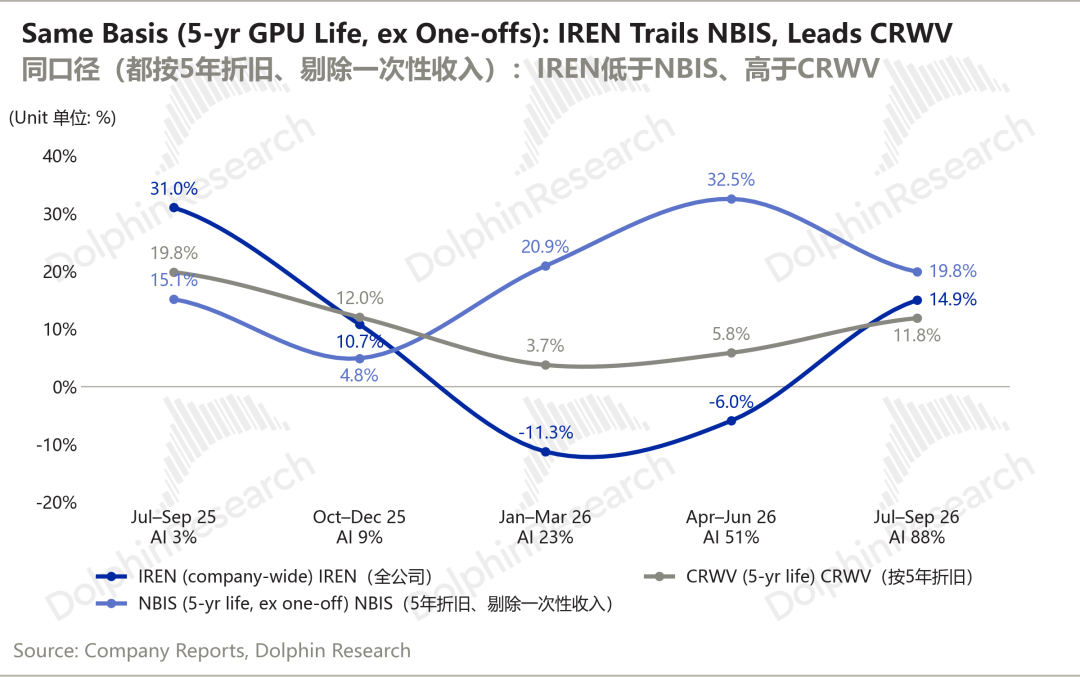
Because depreciation periods differ, we normalized all three to 5-year depreciation and excluded one-time revenue; on that basis CRWV and NBIS both land around 12%, with IREN only two or three points higher.
On the disclosed basis IREN comes out lower, mainly because its depreciation period is shorter: IREN depreciates GPUs over 5 years, CRWV over 6. If both used 5 years, CRWV's gross margin would fall from about 21% to about 12%.
On a like-for-like basis, the gap among the three is within 5 points. IREN is about 3 points above CRWV, thanks to rent saved by self-owned data halls—but still about 5 points below NBIS. The advantage evaporates because the biggest cost, GPU depreciation, is the same for all three.
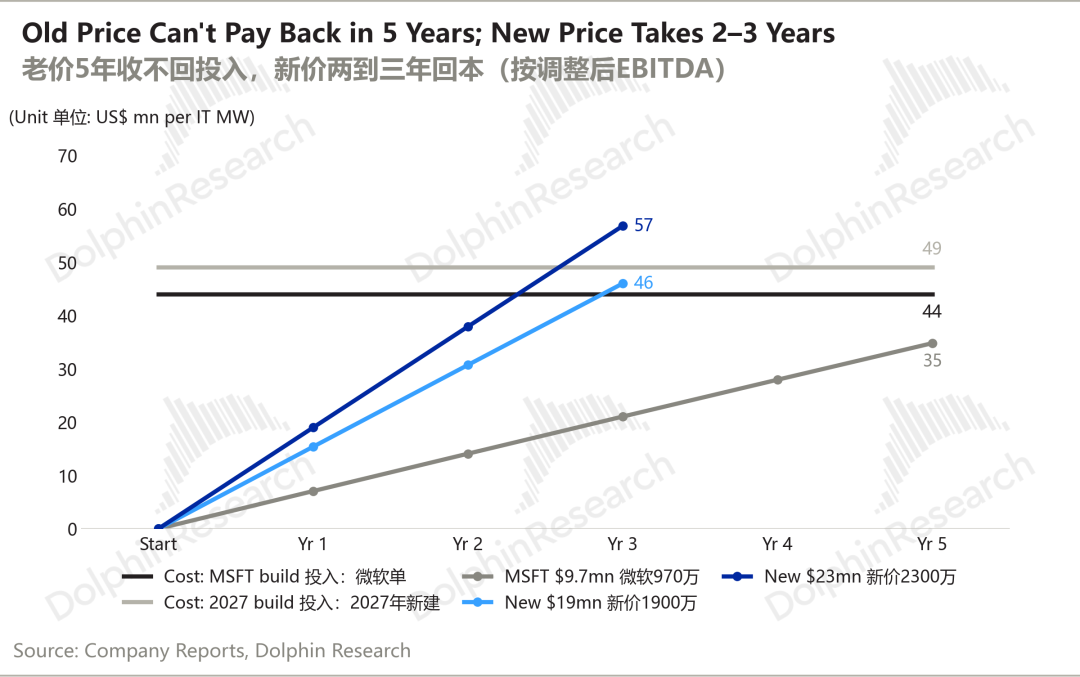
3.3 Payback: Old Prices Can't Recover the Investment; New Prices Pay Back in Two to Three Years
The Microsoft order signed at old prices cannot recover the investment within the contract term. After deducting direct operating costs and SG&A (excluding SBC), adjusted EBITDA per MW over 5 years is about $35 million—only about 80% of the roughly $44 million investment; the return depends on the buildings and cards after expiry.
Capacity signed at new prices can basically recover the investment within the contract term. The 3-year contracts newly signed this quarter at about $19–23 million per MW per year, based on the investment in Microsoft's batch of cards and data halls, pay back in just over two to three years; switching to the roughly $49 million per MW investment in new liquid-cooled construction in 2027, it takes two and a half to just over three years.
So the ultimate return on the compute tied to Microsoft's batch of contracts hinges on how high renewal pricing can go after the Microsoft contract expires.
IV. Delivery: Power Is Not the Problem; the Difficulty Is Installing Cards on Time
IREN has enough power; the bottleneck is getting the cards installed. When large customers choose a neocloud provider, the first thing they look at is whether the delivery record shows compute can be delivered on time—and this is a major disadvantage for IREN.
4.1 Repeated Delivery Delays Push Revenue Back
IREN powers up quickly but installs cards slowly. The 910MW of legacy mining sites left over from the mining era come with ready power and buildings, skipping the steps of land acquisition, grid connection, and substation construction—this is what has driven IREN's rapid expansion over the past two years. But card installation, commissioning, and acceptance testing can't be skipped.
Past projects have largely stayed on schedule during power-up, though card installation and commissioning have lagged. Sweetwater 1's substation was energized essentially on the company's stated timeline; Horizon 1's building was constructed in a park that already had power, yet it still took about nine months to go live, held up by NVIDIA equipment supply.
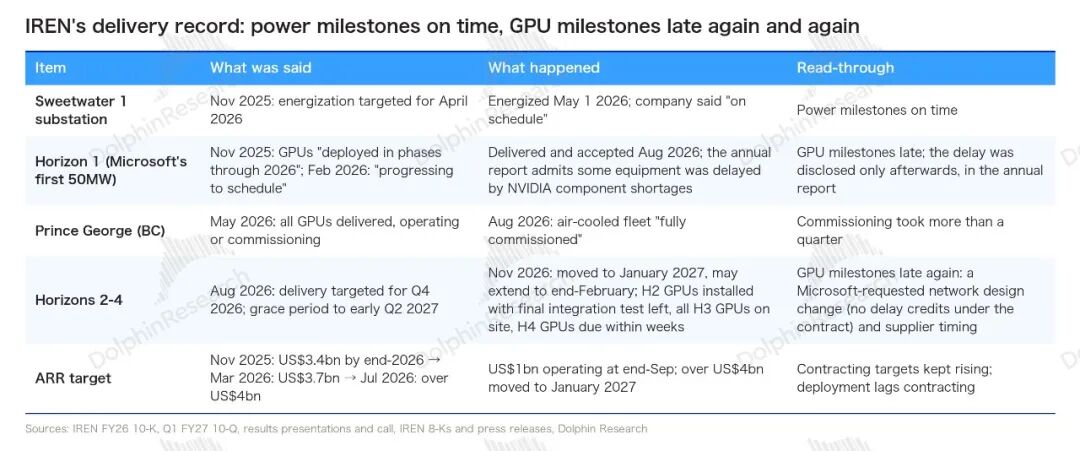
The Microsoft project was also delivered late. The company signed Horizon phases 1–4 with Microsoft in total, of which phases 2–4 were originally scheduled for delivery in Q4 2026, now pushed to January 2027 and possibly slipping to the end of February. There are two reasons: after the phase 1 delivery, Microsoft required a network upgrade, and under the contract this part does not incur delay penalties; supplier deliveries were also late.
However, this delay still falls within the contract's allowed range: the grace period runs to early Q2 2027; after that point, not only must IREN pay compensation, but Microsoft can also reduce capacity or terminate the contract.
The cost of late delivery is that revenue is pushed back while costs continue. For every month the January batch is delayed, about $250 million of revenue is pushed back; the 0.5GW added in 2027 at new contract prices is about $10 billion a year, so a one-quarter delay means about $2.5 billion of revenue. Meanwhile depreciation starts once cards are commissioned, so revenue is delayed but costs must still be paid.
4.2 External assessment: problems concentrated in reused legacy mining sites
There is also outside skepticism about its operational capability. SemiAnalysis's September GPU cloud rating ClusterMAX 3.0 tested 45 providers, listing IREN as "not recommended", while CRWV and NBIS were the only two to receive the highest rating.
The problems are concentrated in two legacy mining sites in British Columbia, Canada. Both Prince George and Mackenzie have had multi-day outages, and storage and networking have failed multiple times; Prince George also has no redundancy for power, cooling or networking. SemiAnalysis, citing users, called it "the #1 worst site in the industry".
Dolphin Research believes this is the price of reusing legacy mining sites. Legacy mining sites let IREN secure power quickly and invest less, but these sites were built to mining standards. A few days of outage at a mining site just means a few days less mining; an outage in a training cluster is an incident. The new buildings in Texas are built to data center standards, and SemiAnalysis also says they look much better, but they have not yet been tested.
5. Where the money comes from: reliance on share issuance and convertible bonds, still about $6 billion short this year
IREN's expansion money has mainly come from share issuance and convertible bonds in the past. It is still about $6 billion short this year; how much pure debt can be borrowed is uncertain, and most of the rest will likely still have to come from share issuance.
5.1 How much is missing: still about $6 billion short this year
FY27 capex is still about $6 billion short. As of the end of September, FY27 still requires about $15 billion of spending: about $5.8 billion in cash on hand, about $3.2 billion in negotiated GPU financing and customer prepayments, leaving about $6 billion unaccounted for. The company describes this $6 billion as "subject to market conditions"; if it cannot raise the money, it will slow expansion.
5.2 What fills the gap: historically share issuance and convertible bonds; pure debt is unavailable
Over the past three years, IREN's money has mainly come from shareholders. In FY26 alone it raised about $12.1 billion externally, with share issuance accounting for 39%, convertible bonds 35%, customer prepayments 15%, and GPU-collateralized borrowings only 8%. So IREN's leverage is very light: at the end of FY26 net debt was only about 0.45x shareholders' equity, while CRWV has consistently been at 2x to 4x.
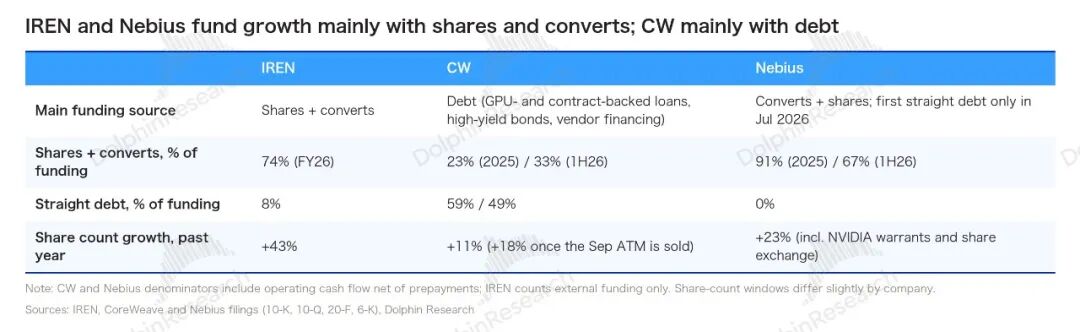
The reason lies in contracts. Pure debt requires contracts as collateral; CRWV's customers are mainly Microsoft, OpenAI and Meta, and banks are willing to lend against the contracts; IREN's buildings, substations and capacity that has not yet signed customers have no contracts to pledge. It was not until May 2026 that IREN obtained its first collateralized loan for the Microsoft batch of cards; by the end of September, all three borrowings were secured by cards and contracts, while the buildings to date have been funded with cash and remain unpledged.
Moreover, even though both rely on equity, NBIS is in a looser position than IREN. NBIS holds large orders from Meta and Microsoft, with more prepayments. In the first half of 2026, customer prepayments accounted for about one-third of its financing, versus only 15% for IREN in FY26. As a result, IREN's equity dilution is faster: Dolphin Research estimates NBIS's share count at the end of 2030 will be about 80% higher than mid-2026, while IREN's rose about 50% in the past year alone.
How much of this year's $6 billion can be borrowed is still unknown. The company says it can still raise $12 billion to $15 billion under target conditions, but the building-collateralized debt it has long touted has still not been signed at all, and the interest rates on these financings have not been mentioned.
5.3 How much equity dilution: if this year's gap is filled entirely with share issuance, the share count would more than double again
Over the past year, the share count has already risen by 50%, and each issuance has been cheaper than the last. Shares outstanding rose from 283 million at the end of October 2025 to 424 million at the end of October 2026, with new shares mainly from at-the-market (ATM) offerings and private placements.
If the remaining $6 billion this year is raised entirely through share issuance, the share count would more than double again. At the current price of $12.85, $6 billion would require about 470 million shares, equivalent to 1.1x the current share count; the lower the stock price, the more shares must be issued.
6. Valuation: at current prices, 0.8GW alone looks expensive; full commissioning offers greater upside
Dolphin Research follows the same approach used for CRWV and NBIS, valuing the company on forward after-tax adjusted operating profit. Counting only 0.8GW, the valuation multiple at the current price is higher than peers; if all 5.6GW is commissioned, the valuation has considerable upside.
6.1 Base case: the valuation multiple at the current price is higher than peers
At the current share price, IREN's enterprise value to FY29 after-tax adjusted operating profit multiple is higher than the valuation multiples Dolphin Research assigned to CRWV and NBIS; IREN's financing resembles NBIS, mainly share issuance, while its contracts resemble CRWV, mainly long-term agreements. Under the base case, the current price is expensive.
The base case rests on five main assumptions:
a. Volume. Count only the 0.8GW scheduled by the end of 2027, about 840MW (IT), fully leased for all of FY29.
b. Price. FY29 revenue per MW per year at $13 million, consistent with Dolphin Research's base-case assumption for NBIS in 2029. Signed contracts use contract prices; unsigned capacity is inferred on this basis, about $13.7 million.
c. Cost. Direct operating cost of $1.65 million per MW, $3 million for Sweetwater, rising 3% per year; sales and administrative expenses at 10% of revenue plus 2% of quarterly capex. GPUs depreciated over 5 years, buildings over 20 years.
d. Renewal. The 4-year contract is renewed at the original price in year 5, which does not affect FY29.
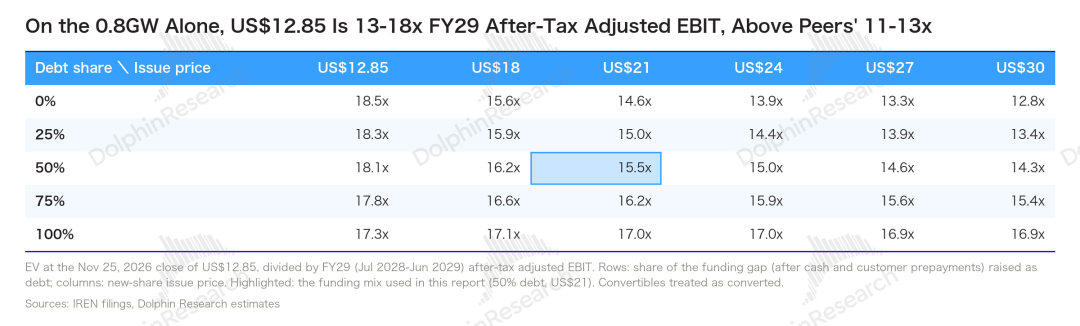
e. Financing. Half the gap funded by debt, half by share issuance at $21.
FY29 adjusted operating profit is about $1.74 billion, a margin of about 16%, below the 23% to 28% of the two peers. The drag comes mainly from the 200MW Microsoft leases priced at $9.7 million and the legacy assets as of the end of September.
Financing is the hardest item to pin down and has a large impact on the multiple. How much is borrowed and at what price shares are issued determines how many shares are issued and how much debt is carried. Dolphin Research ran a sensitivity analysis: with the debt share ranging from 0% to 100% and the issuance price from $12.85 to $30, across 30 combinations the valuation at the current price ranges from about 13x to 19x.
6.2 Bull case: all 5.6GW commissioned
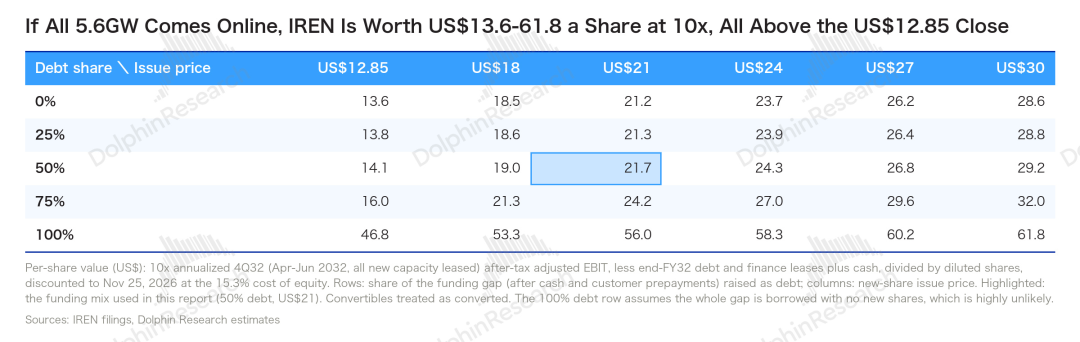
The bull case also counts about 2,900MW (IT) beyond the 0.8GW, for a total of about 3.8GW, corresponding to 5.6GW of total site power across the campuses, with the rest being cooling and distribution losses. From 2028 to 2031, 750MW is delivered each year, with new contract prices rising in batches from $17 million to $20 million.
Full commissioning corresponds to steady-state profit in 2032, after which there is no new capacity, so the multiple should be lower than the two peers. Under the same financing combinations, the valuation upside is considerable.
6.3 Valuation conclusion: at current prices, expensive under the base case
Counting only 0.8GW, the current price is not cheap; if the potential 3GW of capacity can all be commissioned, there is still a glimmer of opportunity. Given the increasingly difficult financing environment facing new clouds and the increasingly unclear outlook for compute supply and demand in 2027 and beyond, overall uncertainty in the new cloud industry remains high. The next thing to watch is whether signing and financing can be delivered.
Next, focus on three types of signals: a. Contract prices and signing rates. Of the 0.8GW, how much of the roughly 460MW unsigned capacity gets signed and at what price, and whether new contract prices can hold at $17 million. b. Financing. How the remaining roughly $6 billion this year is filled, how much is borrowed, and at what price shares are issued. c. Delivery. Whether Horizon 2–4 can be accepted before the early Q2 2027 grace period, and whether Sweetwater 1's first phase can be delivered in Q4 2027.
7. Conclusion: its features have not turned into profit, while its shortcomings are many
Compared with CRWV and NBIS, IREN's biggest feature is owning its own power and buildings, but this does not show a clear advantage in gross margin. Owning power and buildings means it does not pay rent, but buildings account for only about one-third of new-build investment, with the bulk being GPUs, and GPU depreciation is the same for all three.
The shortcomings, however, are very real, and on almost every item it is worse than the two peers:
a. The shallowest binding with NVIDIA: even the Vera Rubin generation of new cards arrives about a year later than peers;
b. Weak execution on bringing compute online: as a mining transition, it lacks engineering and technical capability, and delivery delays occur repeatedly;
c. Compute without orders: of the planned 0.8GW of compute supply, more than half has yet to secure orders, so revenue certainty is low;
d. On financing, it lacks a large proportion of customer prepayments, has few contracts to borrow against, and expansion relies heavily on share issuance.
With the new cloud industry under overall pressure, IREN has no fundamental advantage. The upside from full commissioning looks considerable, but it depends on signing and building nearly 3GW beyond the 0.8GW, and IREN is weak in signing, securing cards and financing, making execution difficult. Among new clouds, it is inferior to CRWV and NBIS.
- END -
// Reprint permission
This article is original content by Dolphin Research. Authorization is required for reprinting.
// Disclaimer and general disclosure notice
This report is intended only for general comprehensive data use, aimed at general reading and data reference by users of Dolphin Research and its affiliates, and does not take into account the specific investment objectives, investment product preferences, risk tolerance, financial situation or special needs of any person who receives this report. Investors who make investment decisions based on this report must consult an independent professional adviser. Anyone who makes investment decisions by using or referring to the content or information mentioned in this report bears the risk themselves. Dolphin Research shall not be liable for any liability or loss that may be directly or indirectly caused by the use of the data contained in this report. The information and data contained in this report are based on publicly available materials and are for reference only. Dolphin Research strives for but does not guarantee the reliability, accuracy and completeness of the relevant information and data.
The information mentioned or views expressed in this report shall not, in any jurisdiction, be treated or regarded as an offer to sell securities or an invitation to buy or sell securities, nor constitute advice, inquiry or recommendation with respect to the relevant securities or related financial instruments. The information, tools and materials contained in this report are not intended or intended for distribution to, publication to, provision to or use by citizens or residents of any jurisdiction where such distribution, publication, provision or use would conflict with applicable laws or regulations or would cause Dolphin Research and/or its subsidiaries or affiliates to be subject to any registration or licensing requirements in that jurisdiction.
This report reflects only the personal views, opinions and analytical methods of the relevant creators and does not represent the position of Dolphin Research and/or its affiliates.
This report is produced by Dolphin Research, and the copyright is owned solely by Dolphin Research. Without the prior written consent of Dolphin Research, no institution or individual may (i) produce, copy, reproduce, reprint, forward or otherwise make any copies or reproductions in any form, and/or (ii) directly or indirectly redistribute or transfer them to other unauthorized persons. Dolphin Research reserves all related rights.
-
![]()
Why Is There No "Pinduoduo Narrative" in the AI Era?
-
![]()
Wall Street's "Big Short" Investor Suddenly Boosts Chinese Holdings -
![]()
Memory Price Hikes, Spec Cuts, and Incremental Upgrades: The Smartphone Spec War Hits a Memory Wall
-
AI Is Rewriting the Pricing Logic of Office Software — Kingsoft Software's Bid for the Enterprise Productivity Entry Point
-
![]()
Priced from Over 300,000 Yuan with L3 Architecture: Is the Xiangjie V8 Gunning for the Tengshi D9's Lunch?
-
![]()
How Will Automakers Fight the Final Battle in a Tough 2026?
-
![]()
Automakers Burdened by Collective Debt Double Down on AI Investment
-
![]()
Li Auto to Launch Only 1–2 New Models in 2027