Why Is There No "Pinduoduo Narrative" in the AI Era?
 11/27 2026
 518

It is just quietly doing AI
Image source: Internet (please contact us for deletion if infringement). Partially AI-generated.
Across all four earnings calls in 2025, Pinduoduo's management barely mentioned AI—not once.
No launch event for a self-developed large model. No consumer-facing AI assistant. R&D spending as a share of revenue held steady at 3–4% year after year.
Over the same period, Tencent's R&D share exceeded 10%, and Alibaba's topped 6%. Alibaba announced a three-year 380 billion yuan investment in cloud and AI infrastructure; ByteDance's 2026 capital expenditure ceiling was pushed as high as 70 billion US dollars; Tencent's single-quarter capex once approached 52.8 billion yuan.
Pinduoduo's capital expenditure has long stayed at just over one billion.
Put these numbers side by side, and the picture does look somewhat incongruous.
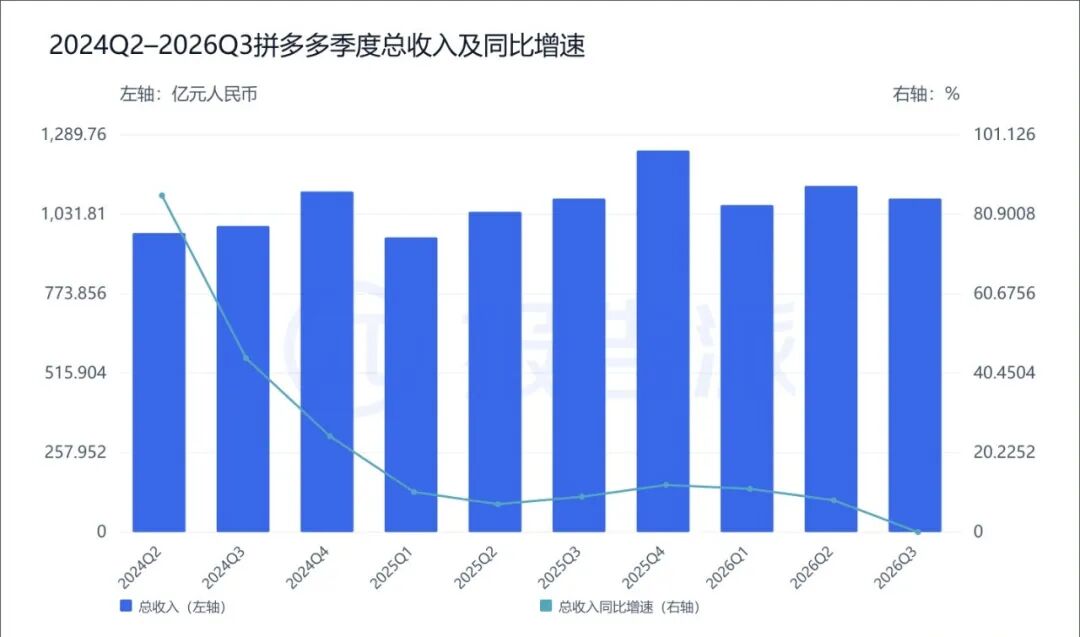
A company with 431.8 billion yuan in annual revenue and more than 420 billion yuan in cash and short-term investments chose near-total public silence during the most coordinated technological pivot the entire internet industry has ever seen.
But to conclude from this that "Pinduoduo is clear-headed while everyone else is panicking" would be too hasty.
Silence is not an answer in itself; it merely pushes the question elsewhere: when a company refuses to join a race in which everyone is placing bets, is it avoiding risk—or accumulating a different kind of risk?

Behind restrained investment, what is saved is not just money
Pinduoduo's restraint in AI is most easily read as "pragmatism."
It has no cloud business to feed, no general-purpose large model that needs commercialization. AI is broken into pieces and slotted into the price-comparison system, recommendation algorithms, intelligent customer service, and Temu's pricing engine—used and then discarded, never bearing the weight of "strategy."
The efficiency of this approach is beyond doubt. The problem is that the opposite of efficiency has never been waste—it is choice.
Much of the money big tech companies throw at AI is indeed burned where returns cannot be seen in the short term: stockpiling computing power, training foundation models, and trial and error on entry products.
But these investments are buying something at the same time: when the technology route shifts, having cards of one's own to play.
Alibaba does full-stack, ByteDance does traffic entries, Tencent does ecosystem connections. The paths differ, but what they share is that they are all at the table—and all have the ability to adjust the direction of their bets when the rules of the game change.
Pinduoduo chose not to buy a ticket to this table, saving money—and also depriving itself of room to switch posture when the rules suddenly change.
What is more worth asking is whether this restraint is really as simple as "treating AI as a tool."
In the second half of 2025, Pinduoduo's official website listed dozens of large-model-related positions in quick succession, covering inference optimization, GPU development, multimodal algorithms, and large-model infrastructure architecture. Recruitment descriptions explicitly stated "AI interactive conversational search, intelligent shopping guide, large-model Agent development."
It is hiring. It is laying out. It is building technical reserves.
Yet at the same time, it chose not to say a single word in earnings reports, not to offer a single explanation on earnings calls.
This is not "not doing AI." This is "doing AI but not letting AI become an object of scrutiny."
A company sufficiently certain of its own strategy does not need to maintain such a deliberate temperature gap between investment and expression.
That gap itself reveals a certain uncertainty: it knows it needs AI capabilities, but is not sure where to place them, nor what kind of expectations and follow-up questions will be drawn once it publicly acknowledges AI's strategic weight.

Silence happens elsewhere
If AI on the domestic main site is "not mentioned," then Temu's AI is "not mentioned—but deeply embedded."
In product selection, pricing, ad delivery, qualification review, and dispute adjudication, a large number of links are highly automated. AI plays a far heavier role in cross-border scenarios than on the domestic main site.
This looks like the strongest evidence of Pinduoduo's AI capabilities: look, it is clearly using it.
But it is precisely Temu that exposes the blind spot of treating AI purely as an efficiency tool.
Data from third-party testing agencies shows that from 2022 to 2025, the share of AI-generated reviews on Temu soared from 0.75% to 10.90%—nearly one in every ten reviews written by a machine.
AI-synthesized celebrity recommendation videos, fake product demonstrations, and buyers and sellers using AI to fabricate evidence for refunds or smear each other with negative reviews have already formed a gray automated chain.
South Africa's consumer regulator has launched an investigation into Temu's use of algorithms, with concerns including how automated systems decide what consumers see, what they interact with, and what they ultimately buy—as well as how user data is used inside the algorithmic black box.
Hungary's regulator, meanwhile, issued Temu a fine equivalent to about 30 million yuan, finding multiple misleading business practices.
These are not problems of "missing AI strategy." On the contrary, they are problems of AI applications running too smoothly while governance frameworks have not kept pace.
When a company defines AI as a purely efficiency tool, it naturally tends to rank governance, transparency, algorithmic explainability, and other dimensions that "do not generate direct efficiency" lower on the priority list.
Efficiency tools do not need to be accountable to "the people acted upon by the tool"—only to the people using it.
This posture manifests as silence on the domestic main site, and as a more concrete risk on Temu.
The deeper AI goes into the transaction chain, the more the platform needs a clear judgment on the boundary of "what can be automated and what cannot"—and that judgment cannot be driven by conversion rates and dispute-handling costs alone.


The tension beneath the silence
The most honest footnote to Pinduoduo's avoidance of the AI narrative appeared at the end of 2025.
Doubao released its first-generation AI phone, whose built-in shopping assistant can automatically open multiple e-commerce apps on the user's behalf, complete same-item searching, price comparison, and coupon collection, and finally stop on the order page awaiting confirmation.
On the second day after the phone went on sale, it encountered a collective blockade by WeChat, Taobao, Pinduoduo, and several banking apps. The reason Pinduoduo gave was "security risk control."
A platform that in its public narrative does not care at all about AI entries had, as its first reaction to an AI shopping assistant, cut off access.
The contrast here explains the problem better than any earnings data.
Pinduoduo's advertising revenue in Q2 2025 still accounted for 53.6% of total revenue. Its traffic distribution mechanism—anchored on price and tilting exposure toward products with the greatest price advantage—is essentially a machine that converts user attention into advertising and commission revenue.
A truly neutral AI price-comparison assistant should in theory become an "external calling interface" for this machine: users find the cheapest products on Pinduoduo through the Agent, orders flow to Pinduoduo, and the platform still earns commissions.
If Pinduoduo were sufficiently confident in its "low-price gravity," it should welcome any rational price-comparison entry.
But it chose to block it.
The reason may lie in the fact that what AI Agents bring is not just orders, but also a potential bypass of traffic distribution power.
When users outsource "finding the cheapest same item" to an Agent, Pinduoduo's carefully built recommendation feeds, price-comparison interfaces, limited-time countdowns, and add-on purchase prompts are all compressed into a single data call in the Agent's backend.
Users no longer "browse" Pinduoduo; they merely "use" Pinduoduo's inventory.
For a platform that relies on recommendation feeds and interface guidance to extend user dwell time, cross-sell, and amplify advertising inventory, this prospect of "being instrumentalized" is more fundamental than order loss.
Some analyses point out directly that Agents mean users skip the recommendation feed and go straight to products with clear intent—and the impact on Pinduoduo may be greater than on any other e-commerce platform.
So Pinduoduo's silence is not because it has no anxiety, but because the object of its anxiety is not on the same dimension as that of Alibaba and ByteDance.
The latter are anxious about "whether AI entries will replace my entry." Pinduoduo is anxious about "whether AI entries will turn me into an inventory interface inside someone else's entry."
The former anxiety can be hedged with investment and narrative. The latter cannot be solved by narrative—because the louder the narrative, the more it confirms the positioning of "you are just a supply base."
Silence, in this context, is a defensive posture—not a form of composure.

Huang Zheng's AI skepticism
What provides the deepest defense for Pinduoduo's silence is the founder's early philosophical judgment on AI.
In 2016, he cited Gödel's incompleteness theorems to question the fundamental limitations of machine intelligence based on deterministic logic, and therefore tended to position the platform as a "distributed intelligent agent network" rather than relying on a centralized super AI brain.
This line of thinking, viewed today, does have foresight: Pinduoduo did not chase the arms race of general large models, but distributed AI across various nodes of the transaction chain, letting each node use the most appropriate technical solution to solve the most specific problem.
But a philosophy can explain "why not build large models." It cannot explain "why even AI search is done so quietly."
At the end of May 2025, Pinduoduo launched natural language AI search, with the function embedded in the shopping chain—without a launch event, without executives appearing on stage, and without even a paragraph in the earnings report.
This has already gone beyond the scope of "instrumentalized AI" and entered the exploration of product form. Yet it chose not to let this exploration enter public view.
Philosophy can provide the aesthetics of restraint, but it cannot replace the judgment of "to what extent restraint is enough and at what point recalibration is necessary."
The more practical problem is that Huang Zheng's skepticism was formed in the previous technology cycle.
At that time, the capability boundaries of AI were clearly visible, and large models had far from demonstrated the ability to rewrite interaction methods and decision paths.
Today the situation is different. In the second half of 2025, AI Agents for the first time made "shopping on people's behalf" move from concept to a perceptible reality—and the collective blockade of the Doubao phone itself proves that the impact at the entry level is no longer a hypothesis.
A technical judgment formed more than a decade ago can explain why a company did not burn money on general large models. But it cannot automatically answer: when Agents really begin to reshape the shopping path, can the AI capabilities scattered across the business quickly aggregate into a defensible form?
The advantages of distributed AI are flexibility, low cost, and close fit to scenarios.
The disadvantage is that when platform-level competition shifts from "whose efficiency is higher" to "who controls the interaction interface," tools scattered everywhere are hard to piece together into a complete hand in a short time.

Silence only postpones the problem
Pinduoduo is a company that has engraved "do your own thing in your own position" into its culture. This culture has helped it avoid many traps over the past decade and has also given it a rare financial restraint in this round of technological turn.
With revenue growth of 10%, net profit close to 100 billion, and cash reserves of more than 400 billion, it does not need an AI story to prop up its stock price or reassure investors.
But financial composure does not equal strategic safety.
A considerable proportion of the money big tech companies throw at AI will indeed be lost—will become sunk costs, and will look impulsive or even absurd when reviewed years later.
But the pricing of technological revolutions never depends only on "who wastes less." It also depends on "who is still on the field when the rules change."
Pinduoduo chose not to participate in this rule game at the public level. It placed its chips on a more plain judgment: no matter how entries change, consumers ultimately want cheaper prices and faster fulfillment—and it does these two things better than anyone else.
This judgment is very likely correct today. But "very likely" is not "inevitable."
If AI agents truly transform shopping decisions from "opening an app" into "saying one sentence to an agent," and if a substantial share of consumer behavior no longer originates from any e-commerce interface, then "the lowest price across the entire network" remains a valuable asset—but the nature of its value will shift: from "a destination users actively seek out" to "a layer of supply summoned when an agent compares prices."
A supply base certainly has its place, but a base has no interface, no user relationships, and no pricing power over its own fate.
By then, whether the money Pinduoduo saved today and the silence it deliberately maintained were foresight or a bill whose payment has been deferred will only be known once the tide goes out.
In an era when everyone is rushing to tell AI stories, refusing to tell one is itself a stance.
But a stance cannot substitute for preparation.
Pinduoduo's real test is not whether it has an AI narrative today, but whether—when silence is no longer a choice but a passive fact—the AI capabilities scattered across Temu's pricing engine, recommendation algorithms, and supply chain nodes can be reorganized in a sufficiently short time into a mode of existence worthy of its scale.
This is something that the silent answers on the earnings call cannot address, nor can Huang Zheng's philosophy from more than a decade ago.
-
![]()
Why Is There No "Pinduoduo Narrative" in the AI Era?
-
![]()
Wall Street's "Big Short" Investor Suddenly Boosts Chinese Holdings -
![]()
Memory Price Hikes, Spec Cuts, and Incremental Upgrades: The Smartphone Spec War Hits a Memory Wall
-
AI Is Rewriting the Pricing Logic of Office Software — Kingsoft Software's Bid for the Enterprise Productivity Entry Point
-
![]()
Priced from Over 300,000 Yuan with L3 Architecture: Is the Xiangjie V8 Gunning for the Tengshi D9's Lunch?
-
![]()
How Will Automakers Fight the Final Battle in a Tough 2026?
-
![]()
Automakers Burdened by Collective Debt Double Down on AI Investment
-
![]()
Li Auto to Launch Only 1–2 New Models in 2027