Xiaodou Hands-On: A 72-Hour Test Drive
 11/29 2026
 396
Layout design: Ryan

Today, little wifi made a big decision—to let a personal Agent monitor the market on her behalf.
The stock market these days? Well, you know how it is. Checking it too often risks destabilizing your "dao heart," but ignoring it means you might miss the moves. At times like this, having a "Xiaodou" on your phone that can keep an eye on the market makes everything much simpler: set up a monitoring task, enter the stock code, and when the price hits your target, Xiaodou will ping you on whether to sell or buy.

Sounds simple, right? And it's just as easy to get started with.
The interface is divided into four sections: Chat, Guess What You Want, Follow Up for You, and About You. Put simply, these roughly correspond to instant tasks, proactive tasks, scheduled tasks, and personalized settings.
This personal Agent, which just entered public beta, comes from ByteDance. These days the industry has all but reached a consensus: no matter the product, when ByteDance makes its move, you can tell whether they've nailed it.

So what exactly makes this "quietly observant" Xiaodou special? After putting it through its paces, little wifi and her teammates all agreed: at this stage, limited by the public beta, the number of integrated apps isn't that large yet, and performance is occasionally rough around the edges—but the flaws don't overshadow the merits. If you want a personal Agent, Xiaodou is worth a try.
1 Already Have Doubao—Why Would You Need Xiaodou?
You must be wondering: I already have Doubao on my phone—do I really need Xiaodou?
Little wifi thinks: yes.

Simply put—Doubao "only answers when you ask," while Xiaodou "comes to you proactively when it thinks you should know."
The core difference between the two isn't conversational ability—it's proactiveness. Doubao requires you to actively initiate commands before it responds; Xiaodou, relying on background tasks and long-term memory, can continuously follow up on things without you saying a word, proactively pushing reminders or handling things for you when the time comes.

For example, if you ask it to monitor a stock, it will come to you when the target price is hit; if you ask it to keep an eye on the remaining cat litter, it will proactively ask whether to restock when it estimates it's running low.
Xiaodou can also help you hunt for the lowest price according to your settings, and once the target price is reached, it can even place an order first to lock in the price, then remind you to pay. However, constrained by the integrated apps, price comparison can currently only be done within the Douyin Mall, not across the entire web.

Another key point is the inheritance of memory.
You can log into Xiaodou directly with your Doubao account, and the preferences you've accumulated and topics you've chatted about in Doubao are "naturally" understood by Xiaodou from the start—no need to build rapport from scratch. In other words, Doubao is responsible for chatting with you and helping you look things up, while Xiaodou is responsible for keeping an eye on things for you and nudging you to get things done. That stock-monitoring scenario earlier is exactly where the division of labor between the two is clearest.
The official definition of Xiaodou is: a Doubao that understands you and can proactively help you get things done.

Pretty accurate.
2 What Can Xiaodou Do for You?
Now you already know Xiaodou can help you watch stocks and manage cat litter—so what else in daily life can you hand over to it?
Little wifi tested some scenarios we might encounter in daily life.
For example, finding restaurants and booking tables.

Xiaodou recommends suitable restaurants based on different scenarios, and can even read needs you haven't voiced: for a family gathering, it will consider accommodating different tastes and look for restaurants with round tables or private rooms.
It's worth mentioning that it can even call the restaurant itself according to your requirements.

The AI personal assistant truly becomes tangible at this moment.
It's fair to say that the value of a personal Agent lies in saving you time and energy.
Besides booking restaurants, Xiaodou can also help hail rides—like shopping, it currently only supports Amap and Caocao Mobility.
However, if you actually use it, you'll find that aside from placing the order yourself, setting the fare, choosing the car type, and flexibly adjusting based on real-time discounts are less convenient in the chat box than operating directly in the app.

Turning up the difficulty, little wifi asked Xiaodou to plan a New Year's trip to Harbin.
Xiaodou performed well, recommending suitable activities based on whether there were elderly people or children in the group, recommending accommodation and transportation based on budget, and giving practical and feasible suggestions. This ability to comprehensively plan across multiple conditions is relatively rare among current Personal Agents.

If you use Feishu for work, after binding, Xiaodou can help you send messages to colleagues or department groups, automatically book and coordinate schedule meetings, generate documents, spreadsheets, and PPTs, and proactively query the Feishu enterprise knowledge base. In other words, it can remind you when it's time for a meeting, tell you what the most urgent problem to solve recently is, and even help you write your weekly report.

A truly reliable private secretary is probably about like this.
However, it should be noted that Xiaodou's Feishu inspection relies on the timeliness of documents. In testing, there was a case where it proactively sent a reminder based on an old document that hadn't been updated in time, while the project had actually been completed long ago. So in actual use, everyone should still pay attention themselves.
In addition, you can also use Xiaodou to help organize photos on Baidu Netdisk.

And when it comes to solving things like checking whether membership auto-renewals were forgotten to be turned off, insurance expiration, driver's license/passport/residence permit about to expire, rent and utilities—Xiaodou sometimes needs app permissions, and sometimes needs you to input information first.
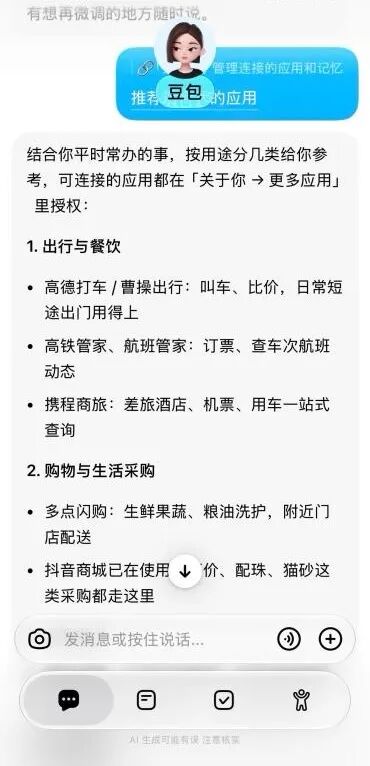
Overall, at this stage, Xiaodou, within its capabilities, can help you solve many needs in life and work. Compared with Doubao, it's indeed much more useful.
3 A Personal Agent That Really Knows How to Be Proactive
"It really loves to stick its nose into everything!" This was the exclamation from little wifi's teammate after trying it out.
She just watched a few more Jackson Wang videos, and Xiaodou proactively asked if it should help her follow information about Jackson Wang concerts. It even eagerly wanted to help her monitor ticket release times. "If it could really help me snag tickets, I'd sing Xiaodou's praises to the skies!" the teammate said with emotion.

Not being able to now doesn't mean not being able to later! ByteDance, we're rooting for you!
That "quietly observant" icon is really true to life.
Some needs, perhaps even you haven't noticed, and Xiaodou has already proactively solved them for you.

It told little wifi what to pay attention to when raising cats during seasonal changes, and what the rhythm is for raising flowers in winter.
It organized the travel route and best timing for the Ningguo water redwood forest that little wifi was interested in, as well as the weekend market at nearby Tianmuli.
It even listed a DIY checklist for the Bauhaus-style tea stove that little wifi liked, and sorted the saved baking recipes by difficulty.
It also noticed little wifi's order on Douyin, not only estimating the delivery time but also giving a pickup reminder.
When it comes to subjective initiative, Xiaodou is absolutely solid.
The "Guess What You Want" module is indeed much more interesting than many straightforward products.

The Personal Agent track is a bit delicate at the moment.
Meta's Muse has made a name for itself overseas, and major domestic companies are following suit, but most products that have actually launched are still in public or gray testing, with tightly constrained functional boundaries.
On the day Xiaodou launched, invitation codes were once hyped to hundreds of yuan, but users generally feedback that it "has an eye for work, but still needs to have its numbers straight."
Xiaodou's advantage isn't in intelligence, but in the cards ByteDance holds.
Doubao's conversation memory is directly inherited, and Feishu's work context and Douyin's life preferences, once authorized, can be strung into a relatively complete personal thread. The most impressive part in testing is this kind of cross-data-source linkage: digging out unfinished projects from old documents and proactively reminding, judging what you're interested in from browsing history and then coming to you on its own. This "without you saying a word" proactiveness, plus the natural interconnection of ByteDance's products, is currently the most tangible differentiation.

But the shortcomings are equally obvious.
The public beta has limited integrated apps, and capabilities diminish once you step outside the ByteDance ecosystem—WeChat is inaccessible, and shopping can only be done in Douyin Mall. In testing, there were also various small bugs. Xiaodou's proactiveness is built on data accuracy and comprehensive rules, and at this stage it can't control either.
Back to that "quietly observant" icon—it's indeed true to life: Xiaodou can already keep an eye on some things for you in the background, occasionally giving unexpected reminders. But it's still several layers of effort away from being a reliable private assistant—data accuracy, comprehensive rules, and finding a reassuring balance between your authorization and its autonomy.
Worth a try at this stage, but don't expect it to handle everything for you.

ByteDance's cards aren't bad; the question is how much patience it's willing to bet on polishing them, rather than rushing to push the cards onto the table.
-
![]()
Xiaodou Hands-On: A 72-Hour Test Drive
-
Decoding the Power Shift in the Auto Supply Chain at the 2026 Guangzhou Auto Show
-
![]()
226 Trillion Tokens: Why Is DeepSeek Leading?
-
![]()
Can the Jones Matrix Not Handle Polarized Light? How Does the Mueller Matrix Handle It?
-
100,000 Units Is Just the Pass Mark — for Leapmotor to Truly Succeed, It Still Has One Weakness to Fix
-
From "Saying Nice Things" to "Getting Things Done": Big Tech's Personal AI Agents Have Arrived
-
![]()
Tencent Releases Next-Gen 3D Large Model Hunyuan Hy3D 3.6, With API as Primary Entry Point
-
Why Are Big Tech Profits Tightening Even as AI Revenue Rises?