July’s Online Speaker Market: Harman Kardon Adjusts Strategy, Philips Breaks Through, and Outdoor and Home KTV Trends Reshape the Landscape
 09/10 2026
 524
524
Industry Overview: Market Consolidation and Post-618 Adjustment
According to AVC Retail Online Monitoring Data for speakers, in July 2026, the retail sales value of the speaker industry reached 700 million yuan, reflecting a month-on-month decline of 38.9%. Retail volume stood at 1.811 million units, also experiencing a month-on-month decrease of 20.8%. These figures suggest a significant adjustment period following major promotional events.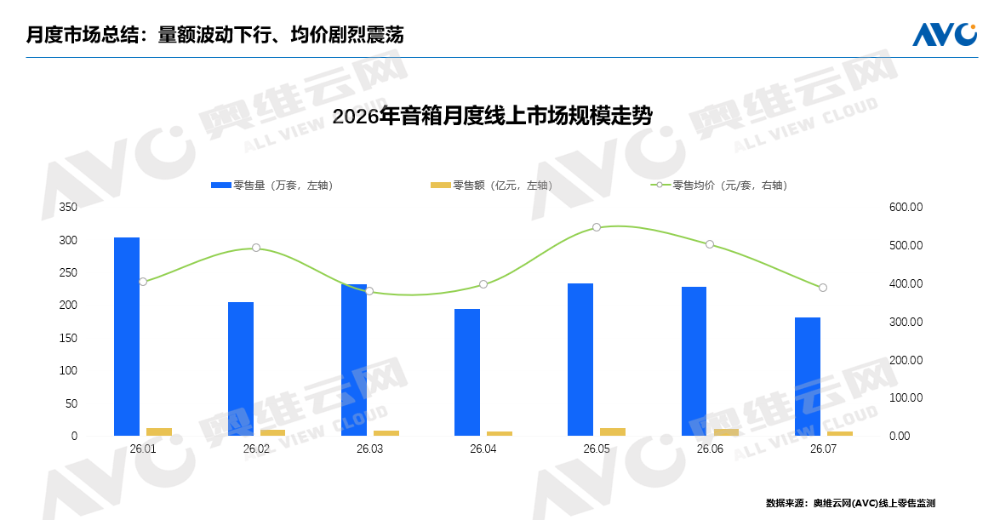
Brand Performance: Philips Seizes KTV Market Opportunity, Marshall Faces Innovation and Market Challenges
AVC’s data for the speaker market reveals that in July, Harman Kardon’s retail sales reached 68.155 million yuan, capturing 9.7% of the market share—a decrease of 2.5 percentage points from June. As a leading brand, Harman Kardon saw a notable overall decline in July, particularly on platform e-commerce sites. However, its pricing also rebounded during this period, and there was no significant downward shift in its product lineup. The transition from the heightened sales activity of June’s promotions to July’s more stable period highlights Harman Kardon’s heavy reliance on promotional cycles to sustain its premium market positioning. The brand still needs to improve its ability to maintain sales momentum (or "sales continuity") during periods of lower daily sales activity.
Philips achieved retail sales of 38.2 million yuan in July, accounting for 5.4% of the market share—a 3.8 percentage point increase from June. This makes Philips the only brand among the top three to experience positive growth. According to AVC’s monitoring data, Philips effectively sustained demand after major promotions, primarily by leveraging high-end KTV sets to drive growth. By strategically entering the blue ocean market of home KTV through authorized operators, Philips capitalized on this opportunity. Offering a bundled package of “speaker + karaoke machine + microphone,” Philips lowered the barrier to consumer decision-making. Coupled with the demand for summer KTV gatherings and the benefits of its initial product launch, Philips maintained strong market performance in July.
In contrast to Philips’ aggressive growth, Marshall’s retail sales reached 36.411 million yuan in July, representing 5.2% of the market share—a significant decline of 4.6 percentage points from June, the largest drop among the top three brands. All sales channels experienced substantial decreases, with professional e-commerce sales dropping by 55.4% month-on-month, platform e-commerce by 74.6%, and Douyin (TikTok) by 61.2%.
AVC’s research indicates that Marshall’s slowdown can be attributed to several factors: the 2026 limited-edition collaborative models failed to generate sufficient demand during periods of lower sales activity, the core product line did not receive significant updates, and the slowed pace of innovation resulted in a lack of sustained popular products following major promotions. At the same time, Marshall’s mid-to-high price range faced competitive pressure from both Harman Kardon and emerging brands, suggesting that the overall market requires further refinement.
Product Trends: Accelerated Scenario Differentiation, Driven by AI and LE Audio
Among July’s top-selling products, Philips’ SD289P Home KTV Speaker Set and SD299MAX Home KTV Speaker Set both achieved notable growth. Unlike the fierce competition in traditional outdoor portable speakers, these products specifically targeted the home KTV singing scenario—a relatively untapped blue ocean market with both social and practical appeal. By bundling speakers, karaoke machines, microphones, and even touchscreens into a single package, consumers no longer needed to purchase components separately, significantly reducing decision-making costs. AVC’s Retail Online Monitoring Data for speakers indicates that outdoor and KTV functionalities were the two areas with the highest penetration growth that month, suggesting that scenario-based segmentation is reshaping the product landscape.
The surge in outdoor speaker penetration was driven by increased demand for summer camping and cycling activities, with brands like JBL and Xiaomi expanding their outdoor product offerings. The rise in KTV speaker penetration was fueled by the introduction of Philips’ KTV sets and Edifier’s K300/K200 models, combined with the influence of live-streamed karaoke content that educated consumers about this scenario.
In terms of technology, Bluetooth LE Audio and Auracast broadcast audio technology continue to advance, offering lower power consumption, reduced latency, and multi-point broadcast sharing capabilities that are expected to drive a new wave of product upgrades. Meanwhile, with AI technology becoming increasingly prevalent across all product categories, on-device large models and AI chips are empowering speaker enhancements. The core voice interaction method is evolving from “passive response” to “proactive service + cross-scenario collaboration,” making the deep integration of AI in smart speakers a key focus for the second half of the year.
Original article by AVC. Unauthorized use or scraping of this content by any organization or individual for training AI large models or other purposes is strictly prohibited.
-
![]()
July’s Online Speaker Market: Harman Kardon Adjusts Strategy, Philips Breaks Through, and Outdoor and Home KTV Trends Reshape the Landscape
-
The Awkwardness of AI Long Series: Cost Reduction is Easy, but Profitability is Hard
-
What is the Real Issue with Foldable Screens? iPhone Duo Didn't Provide a Complete Answer
-
What if Jobs Were to Depart One Day: The Future of Apple?
-
Benchmarked Against Anker, Roborock, and Ecovacs: Has the Overhang from Lock-up Expiry Been Fully Released? Is Insta360 Still Overvalued?
-
![]()
Zhipu’s Dual-Track Strategy: Balancing Growth and Profitability
-
![]()
Financial Report Riddled with Bizarre Errors Again: Changzhou’s Wealthiest Woman Faces Ongoing Troubles
-
![]()
A Critical Year for Autonomous Driving: Will 'Systematic Capabilities' Determine the Final Outcome?