"Space AI's First Stock" Debuts Today, but Investors Aren't Exactly Rushing In
 11/13 2026
 437
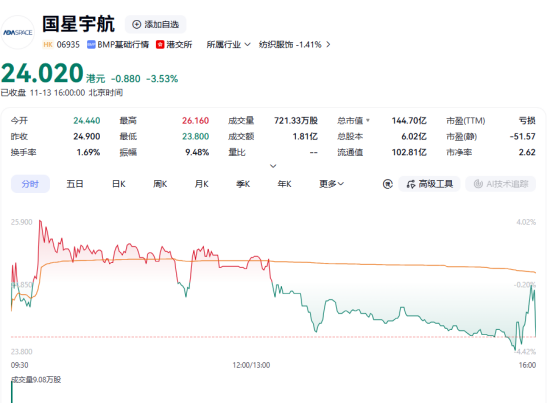
Today, Chengdu Guoxing Aerospace Technology Co., Ltd. (06935.HK, ADASPACE) officially began trading on the Main Board of the Hong Kong Stock Exchange, earning the moniker "first space AI stock." By today's close, shares stood at HK$24.02, down 3.53%.
The global offering comprised just 30.121 million H shares—only 5% of the total share capital after issuance—raising gross proceeds of HK$750 million and net proceeds of HK$652 million. Only two cornerstone investors participated: Jinxin Orient and JinkoSolar, together subscribing HK$60 million with a six-month lock-up. The Hong Kong public offering was 3.43 times oversubscribed, while the international offering drew 1.79 times subscription.
Hong Kong IPOs historically break issue price about 50% of the time, and a 3.43-times subscription suggests institutions weren't exactly clamoring to get in.
Founded in Chengdu in May 2018, Guoxing Aerospace primarily processes remote sensing data captured by satellites into 3D digital models, selling them for urban governance and digital twin projects—what the prospectus calls "satellite-based solutions." Its other line of business covers satellite design, assembly, launch coordination, and in-orbit operations management, referred to as "satellites and related services." The company is advancing its "Star Computing Plan" to build a space-based computing network and ranks among China's earlier players to conduct in-orbit verification of large AI models on satellites.
In 2023, satellite-based solutions accounted for 90.7% of revenue, while the satellite business generated a mere RMB 3.221 million, or 0.6%. By the first half of 2026, satellites and related services had climbed to 57.7%, with AI intelligent computing satellites alone contributing 55.1%.
The first business line has an existing comparable on the A-share market: Aerospace Huitou. With a total market value of RMB 1.632 billion, its shares have tumbled 83% this year. Revenue fell 66% in 2025, it posted a loss of RMB 1.860 billion, and year-end net assets stood at negative RMB 1.036 billion. The auditor issued a disclaimer of opinion, and in August the company came under CSRC investigation. Back in March, a brokerage still assigned it a target price of RMB 32.65 based on the price-to-sales ratio.
Aerospace Huitou does much the same thing—selling AI and remote sensing data to governments and special customers. Guoxing Aerospace's satellite-based solutions overlap in both customer base and delivery format. In 2025, revenue and gross profit for this segment both declined: RMB 703 million in revenue yielded RMB 143 million in gross profit, down 30% year-on-year, and the nascent satellite business failed to fill the gap.
The second business line is AI intelligent computing satellites. According to the prospectus, these satellites can perform data identification, screening, and processing in orbit, transmitting only the results back to Earth and conserving downlink bandwidth that would otherwise carry raw data. In September 2024, the company launched China's first AI large-model intelligent computing satellite. On May 14, 2025, twelve satellites formed a network with 5P of cluster computing power—claimed to be the world's first AI intelligent computing satellite constellation. On October 14 this year, a second batch of eight satellites entered orbit, bringing total in-orbit computing power to 50P.
As of October 20, the company held orders for 114 AI satellites awaiting delivery, with a total contract value of RMB 3.475 billion—nearly five times its full-year 2025 revenue. This is the most significant section of the prospectus.
That said, converting orders into revenue takes time. In the first half of 2026, accounts receivable turnover stood at 610.8 days, compared with 233.8 days in 2023—meaning it takes nearly two years on average for recognized revenue to turn into cash. On the customer side, the top five customers accounted for 91.1% of revenue, mainly governments and state-owned enterprises. Such customers aren't going anywhere, but their payment cycles are long.
In the first half of this year, impairment items on financial assets and contract assets included a net reversal of RMB 87.52 million. Operating cash flow saw a temporary net inflow, and the adjusted loss narrowed 54.7% to RMB 65.3 million. The base was simply too weak—but the direction is right.
On gross margin: overall gross margin fluctuated between 14% and 39% from 2022 to 2025, recovering to 39.3% in the first half of 2026, with satellites and related services at 53.3% and AI intelligent computing satellites alone at 55.4%. Revenue is recognized batch by batch as deliveries are made, so gross margin steps up, then falls back when the pace slows.
Put plainly, this is a business that settles accounts one batch at a time.
What underpins the HK$15.2 billion valuation is a different picture altogether. The Star Computing Plan was unveiled in Wuzhen in 2024, aiming to deploy 2,800 computing satellites in space and link them with more than 100 ground-based computing centers to provide in-orbit computing power for silicon-based intelligent agents—autonomous driving, drones, robots, and the like. The first 100 satellites are slated for launch before 2028, with 26 currently in orbit.
Going from 26 to 100 means clearing the launch hurdle. In January 2026, a rocket carrying two experimental satellites failed to launch due to technical problems. The maiden rocket could not be insured, leaving the company to absorb the RMB 10.8 million loss itself.
With IPO proceeds in hand, the next order of business is to build the 114 satellites on schedule, get them into orbit, and collect payment upon acceptance.
-
![]()
"Space AI's First Stock" Debuts Today, but Investors Aren't Exactly Rushing In
-
Apple Doesn't Want to Keep "Winning by Doing Nothing"
-
![]()
Token Overseas Revenue Can No Longer Keep Up with Soaring Storage Costs
-
![]()
Suzuki: From Retreat in China to Japan's Third Largest | Cover Story: Japanese Automakers at the Crossroads of Transformation (Part 5)
-
Nearly Half of Q3 Complaints to 12365auto.com Came from Cars Less Than Three Years Old, Putting Validation Under Pressure
-
![]()
1113 Domestic Computing Power Expert Exchange Minutes
-
AI Film & TV: Top 10 Companies with the Fastest Growth and Strongest Profitability
-
![]()
Long Time No See, "Little" Smart | Why Build a Car That Doesn't Make Money?