Seven Years After Foldable Phones Emerged, Why Has Apple Just Launched the iPhone Duo?
 09/10 2026
 502
502
Author | Anonymous. Seven years on from the advent of foldable-screen smartphones, Apple has finally embraced this evolving "trend."
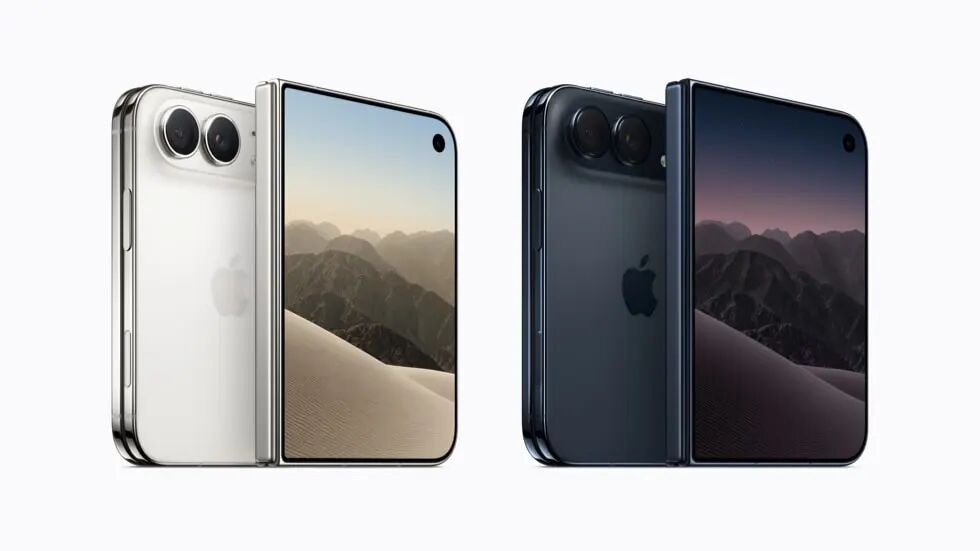
Image Source: Apple
On the morning of September 10, 2026, Apple held its autumn new product launch event, unveiling its first foldable-screen smartphone, the iPhone Duo. Featuring a horizontally inward-folding design, it boasts a 5.4-inch outer screen and a 7.6-inch inner screen, both with a 1.4:1 aspect ratio, and is priced between 15,999 and 26,499 yuan.
In terms of specifications, the iPhone Duo is powered by the 2nm A20 Pro processor and equipped with Apple's self-developed C2 baseband. It comes in two colors: Night Sky and Starlight White. The rear features a 48-megapixel dual-camera system and supports the Apple Pencil.
In response, Apple's new CEO, John Ternus, stated, "The iPhone Duo introduces a fresh design while preserving everything you love and expect from an iPhone. It boasts the largest screen in iPhone history yet fits easily into your pocket. Despite its complex engineering, it remains effortless to use, opening up new possibilities."
Since 2019, following Samsung's lead, smartphone manufacturers such as Huawei, Xiaomi, and OPPO have all developed foldable-screen phones, which have now shed their novel and futuristic image. Why has Apple chosen to introduce the iPhone Duo seven years after the birth of foldable-screen phones? What sets the iPhone Duo apart from its competitors in the market?
01
Waiting for Foldable-Screen Technology to Mature, Apple Aims to "Lead from Behind"
Although Apple is only now launching a foldable-screen phone, according to Bloomberg technology reporter Mark Gurman, Apple began exploring technologies related to foldable-screen phones as early as February 2019, when the Samsung Galaxy Fold was introduced.
Apple refrained from immediately entering the foldable-screen phone race largely because such products were highly engineering-intensive and had not yet resolved practicality issues.
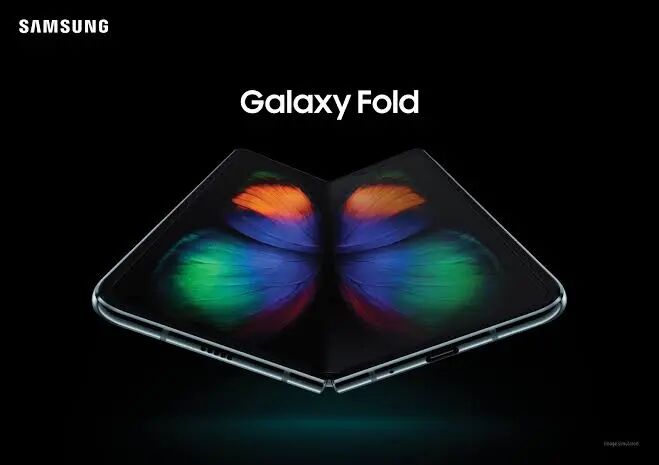
Image Source: Samsung
Take the Samsung Galaxy Fold as an example. Upon its initial release, it encountered setbacks. Originally scheduled for an April 2019 launch, the product was delayed by four months due to issues such as flickering, broken, and black screens on media test units.
In fact, even without considering quality issues, previous foldable-screen phones struggled to deliver an outstanding user experience. Due to the large space occupied by components such as hinges, middle frames, and inner screens, foldable-screen phones were generally too thick and heavy, and their configurations were weak.
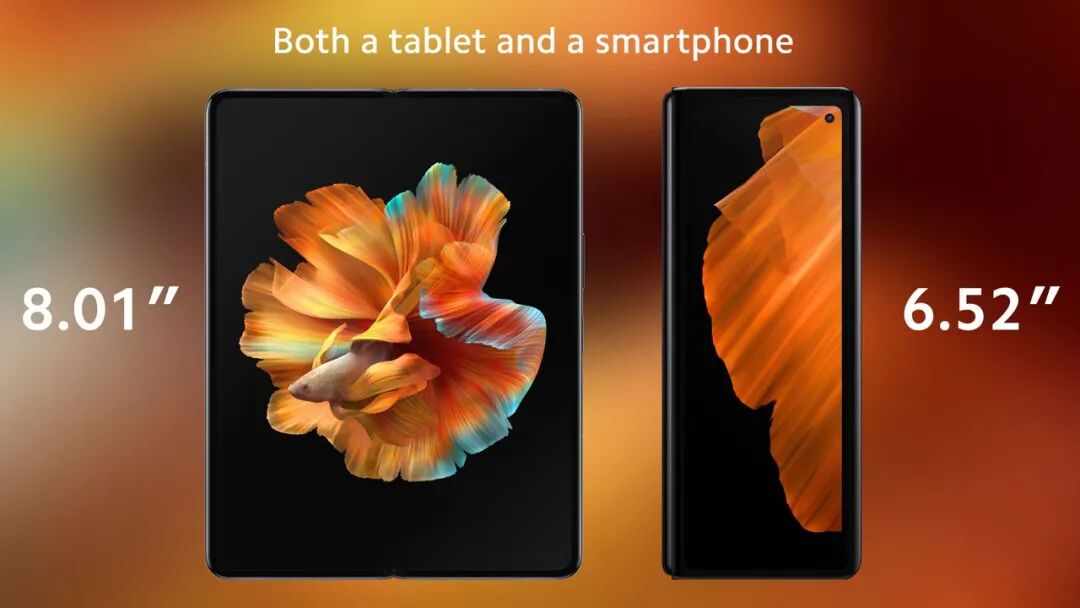
Image Source: Xiaomi
For example, the Xiaomi MIX FOLD, released in March 2021, had an outer screen aspect ratio of 27:9, a folded thickness of 17.2mm, and weighed 317g. It was equipped with a Snapdragon 888 processor and a 5020mAh battery. Not only was it derisively called a "remote control" due to its awkwardness in one-handed use, but its overall configuration also fell short of that of a flagship straight-screen phone.
After years of exploration, the hardware experience of foldable-screen phones now rivals that of straight-screen phones. Take the Honor Magic V6, released in February 2026, as an example. In its folded state, it has a minimum thickness of 8.75mm, weighs as little as 219g, and is powered by the fifth-generation Snapdragon 8 Supreme processor, making it indistinguishable from traditional straight-screen phones.
As Duan Yongping, founder of BBK and investor, said, "All masters dare to be last in the race, but they just do it better than others." Apple is precisely an example of "daring to be last."
In its fifty-year journey in the tech industry, although Apple has introduced revolutionary products like the iPod, iPhone, and iPad, it was not the pioneer in these categories. Before the iPod, MP3 products were abundant; in the mobile phone market, Nokia, Motorola, and Palm had already started exploring touchscreen phones; before the iPad's release in 2010, various tablet products were already common.
Former Apple CEO Tim Cook once said that Apple's core strategic goal has "never been to be first, but to make the best products. We only want to make the best products." Compared to previous products, the iPod, iPhone, and iPad can deliver an ultimate user experience, allowing them to "lead from behind."
Now, in the foldable-screen race, Apple is once again "daring to be last" because, with the gradual maturity of underlying technologies, it can create products with differentiated competitiveness.
At the hardware level, the iPhone Duo has a folded thickness of 11.3mm and weighs 254g, on par with the iPhone 18 Pro Max. In terms of software, thanks to deep iOS optimization, the iPhone Duo's inner screen can also be fully utilized.
02
In the Era of Rising Memory Prices, Apple Needs New Growth Drivers
Apple's decision to launch the iPhone Duo at this time is partly due to the maturity of folding technology and partly due to the increasingly challenging mobile phone market environment.
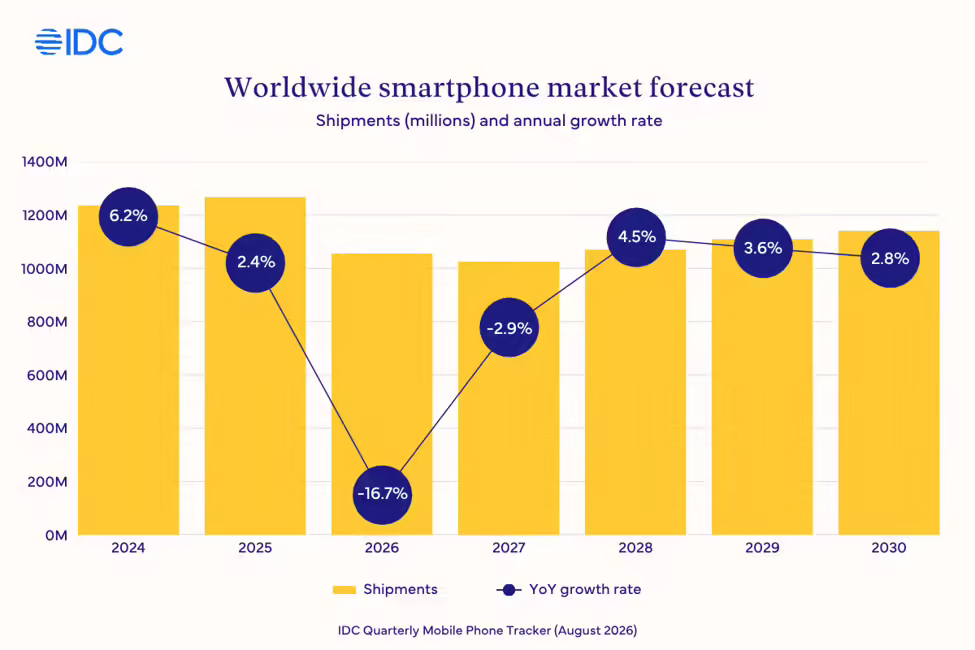
Image Source: IDC
It is well known that in recent years, the smartphone industry has faced significant downward pressure due to soaring memory prices. IDC pointed out in a research report that global smartphone shipments are expected to reach around 1 billion units in 2026, a year-on-year decrease of 16.7%, representing the largest annual decline in history.
Against the backdrop of rising phone prices, due to its strong bargaining power, Apple chose to absorb upstream cost increases internally, significantly expanding its market influence. Data disclosed by IDC shows that in the Chinese smartphone market in Q1-Q2 2026, Apple's smartphone shipments increased by 33.3% and 24.4% year-on-year, respectively, both ranking second.
However, this also came at the cost of damaged profits for Apple. In the third fiscal quarter of FY2026 (ending June 27, 2026), Apple's gross margin for hardware products was 40.1%. After excluding the impact of tariff rebates of about 2.5%, it was approximately 37.6%, a decrease of 1.1 percentage points sequentially.
In the long run, as memory prices continue to rise, if Apple continues to resist the pressure of rising memory prices, its profit margins may further narrow. In response, Tim Cook said, "The current state of memory prices is like a 'once-in-a-century flood,' showing exponential growth. We have to adjust prices accordingly."
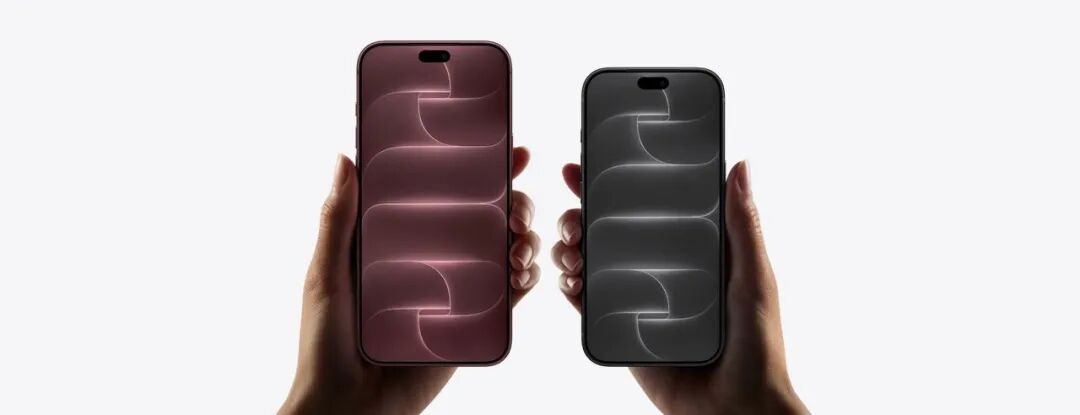
Image Source: Apple
Following price increases for Mac, iPad, and other products, Apple also raised iPhone prices at its autumn new product launch event. The starting price of the iPhone 18 Pro series increased by 1,000 yuan; the starting prices of the iPhone 17, iPhone Air, and iPhone 17e increased by 800 yuan.
Referring to the precedent of price increases for domestic flagship phones suppressing consumer demand, after the price increase of straight-screen iPhones, their shipments may also decline. Therefore, Apple urgently needs to create new products with growth potential to balance the downward pressure faced by straight-screen iPhones.
Apple's decision to bet on foldable-screen phones is mainly because this category has maintained relatively rapid growth in the past few years. Data disclosed by IDC shows that from 2020 to 2025, Chinese foldable-screen phone shipments increased from 470,000 units to 10.01 million units, with a compound annual growth rate as high as 84.36%.
In addition to having more growth potential, foldable-screen phones also have a higher price ceiling. Due to greater engineering challenges, foldable-screen phones are significantly more expensive than flagship straight-screen phones. Take Xiaomi as an example. Although known for its cost-effectiveness, the recently launched Xiaomi 18 Fold has a starting price exceeding 10,000 yuan, reaching 10,999 yuan, with the ceramic version priced as high as 15,999 yuan.
Against this backdrop, by doubling down on foldable-screen phones, Apple can raise the price ceiling of its phone lineup, establish new price anchors, and to some extent, mitigate market resistance triggered by the price increase of straight-screen iPhones.
03
With Limited Foldable-Screen Market Share, Can the iPhone Duo Reach the Mass Market?
Although foldable-screen phones have been developing for seven years, this category has not yet broken into the mass market. IDC data shows that in 2025, foldable-screen phones accounted for only 3.52% of the Chinese smartphone market, barely registering.
The reason is that foldable-screen phones have not yet found the right balance between cost and benefit. At present, the starting prices of most foldable-screen phones are around 10,000 yuan. Although they can provide a larger screen when unfolded, due to the severe fragmentation of the Android ecosystem, they struggle to deliver an ultimate user experience to consumers.
In response, during an interview at the 2026 IFA show in Germany, Lu Weibing, Partner and President of Xiaomi Group, President of the Mobile Phone Division, and General Manager of the Xiaomi Brand, said with exasperation, "In the end, large foldable phones just turn the outer screen into a straight-screen phone. In 80% to 90% of scenarios, users only use the outer screen."
In contrast, because Apple has absolute control over its app ecosystem, the iPhone Duo is expected to improve the adaptation experience of foldable-screen apps and differentiate itself from Android foldable-screen phones.

Image Source: Apple
The iPhone Duo's human-machine interface specifications show that to fully unleash the potential of the inner screen, Apple has restructured the iOS UI, moving the system menu bar from the bottom to the right. Additionally, Apple has guided developers to fully utilize the wide inner screen to display more content rather than simply enlarging the outer screen UI.
It should be noted that the biggest shortcoming of current Android foldable-screen phones is that most apps have not been adapted for the inner screen and merely enlarge the UI, resulting in a user experience inferior to that of the outer screen. The iPhone Duo may avoid repeating the mistake of inner screens being underutilized.
However, having a comparative advantage at the software level does not mean the iPhone Duo can instantly become a mass-market product on par with straight-screen phones.
Due to higher manufacturing difficulty, the production capacity of the iPhone Duo is very limited. Nikkei Asia, citing sources familiar with the matter, reported that due to Apple's extremely strict quality control requirements, the daily production volume of the iPhone Duo was only a few hundred units as of the end of August.
Even if the iPhone Duo's production capacity were sufficient, its high price would also keep most consumers at bay. The product offers four storage versions: 256GB, 512GB, 1TB, and 2TB, priced at 15,999 yuan, 17,999 yuan, 21,499 yuan, and 26,499 yuan, respectively.
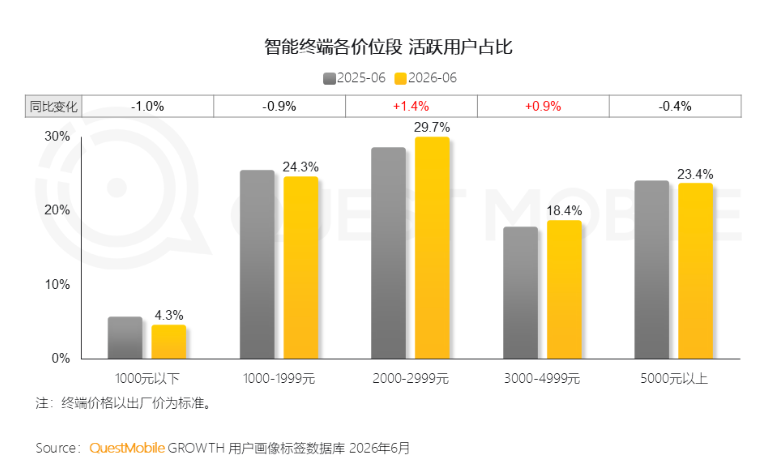
Image Source: QuestMobile
Although phone prices have been rising amid the memory price hike, overall, due to their high prices, flagship products have a very narrow audience. QuestMobile data shows that as of June 2026, active users of phones priced above 5,000 yuan in China accounted for only 23.4%. If only active users of phones priced above 10,000 yuan are counted, the proportion may even "halve."
However, this does not negate the significance of the iPhone Duo's birth. The foldable-screen phone industry has been developing for seven years. Although hardware configurations have continuously improved, software experiences have stagnated, primarily due to the lack of unified design specifications in the Android ecosystem.
Although the iOS and Android ecosystems are independent of each other, the demonstration effect of the iPhone Duo may spill over to Android devices. The iPhone Duo provides a relatively clear set of screen ratios, interaction logic, and app adaptation paradigms for large foldable screens. Once this form factor is validated by the market, Android manufacturers will have an incentive to follow suit, and developers will also be more willing to optimize apps for large foldable-screen ratios.
Ultimately, whether large foldable screens can reach the mass market depends not only on the innovation of individual manufacturers but also on whether a positive cycle can be formed among devices, ecosystems, and users. The iPhone Duo may not immediately rewrite the market, but it provides a relatively clearer path for foldable-screen phones to evolve into mainstream flagships.
Interactive Topic
What do you think of the iPhone Duo? Are you considering buying it?
This article is original content from Shijiao Farsight and is prohibited from being reprinted without authorization.
-
When Genuine Elderly-Friendly Home Appliances Meet Pseudo-Smart Features: Bridging the Intergenerational Gap in Appliance Consumption
-
![]()
When the iPhone Finally 'Folds,' Who Will Seize the Right to Define the Next Generation of Smartphones?
-
![]()
Seven Years After Foldable Phones Emerged, Why Has Apple Just Launched the iPhone Duo?
-
![]()
July’s Online Speaker Market: Harman Kardon Adjusts Strategy, Philips Breaks Through, and Outdoor and Home KTV Trends Reshape the Landscape
-
The Awkwardness of AI Long Series: Cost Reduction is Easy, but Profitability is Hard
-
What is the Real Issue with Foldable Screens? iPhone Duo Didn't Provide a Complete Answer
-
What if Jobs Were to Depart One Day: The Future of Apple?
-
Benchmarked Against Anker, Roborock, and Ecovacs: Has the Overhang from Lock-up Expiry Been Fully Released? Is Insta360 Still Overvalued?